
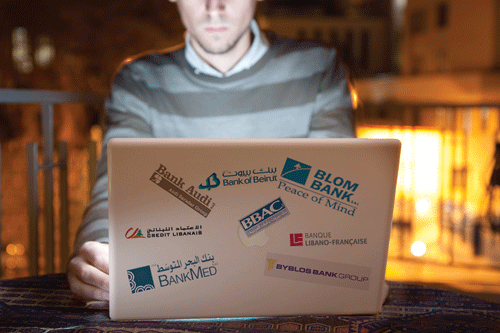
For many clients of international banks, a trip to a branch has become a thing of the past, as an increasing variety of services have become available online. Some institutions, such as Dutch lender ING Direct, have gone so far as to do away with branches completely. ING’s United States director, Arkadi Kulhmann, has said that the inspiration for the branch-less banking system came from enterprises in other industries such as Swiss furniture giant IKEA and the US’s Southwest airlines, both of whom choose product selection and low cost over aesthetics and frills.
Lebanon, however, has no discount airline, no IKEA, and face-to-face interaction with a bank teller is seen as a non-negotiable necessity, especially to the older generation. The result has been that, until recently, the country’s banks have kept their online service offerings to a minimum; most banks first offered online services five years ago, but these were limited to simply displaying accounts and balances, with some opportunities to transfer within the same bank.
But according to directors of online banking services, this tide is changing. Younger Lebanese, fully equipped with net books and wireless internet at every café and mall, demand more online banking access. Some banks have been eager to oblige, as a palpable move to online services would notably decrease operational costs. “Other than the infrastructure implementation, the only cost is how many bits they are taking from our system…this is peanuts,” said Ronald Zirka, head of marketing at Banque Libano-Francaise.
Antoine Lawandos, assistant general manager and chief information officer at BLOM Bank, agreed, and alluded to the day when banking services would be completely online.
“Within our strategy we consider internet banking as being a delivery channel, not a service,” said Lawandos. “We would like to compare it to [our branches].”
No safety net
Due to the antiquated laws governing banking transactions — which have not been updated and adapted to the internet age — developers of online banking services are treading in legally nebulous waters. A draft bill to officialize online signatures has been waiting for parliamentary approval for the last five years, like many other bills not deemed a priority for the backlogged parliament. Without this, banks that choose to expand their online services take a financial risk, since transactions that do not carry a physical signature are not legally binding in Lebanon.

