
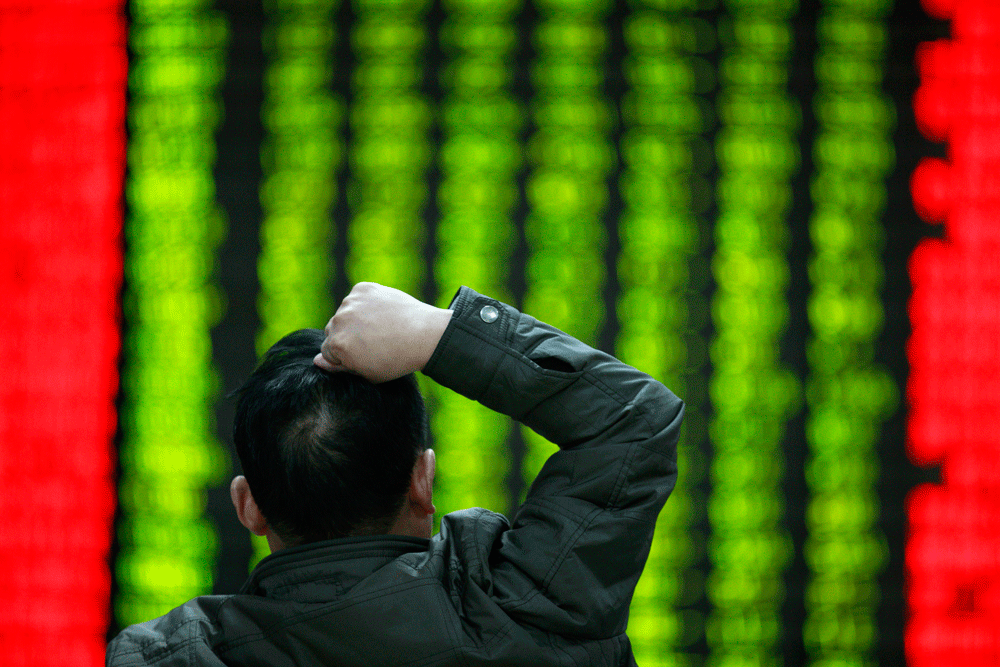
It was a choppy year for markets in 2012, with headlines dominated by the European sovereign debt crisis and ongoing austerity plans in the peripheral countries causing social unrest. The United States presidential elections also kept investors jumpy, assessing how each candidate would affect performance of the stock markets and how they would deal with the upcoming fiscal cliff. Ongoing unrest in the Arab world, a change in leadership in China and Hurricane Sandy on the US east coast were among several other issues that added to market volatility. For investment recommendations for the upcoming year, Executive spoke to 10 of the region’s top investment professionals.
.gif)
Georges Abboud – Head of private banking at Blom Bank
Overall view: Favors US over European markets but could see both markets becoming cheaper in 2013 due to rising unemployment and quasi-nil growth expectations. As for emerging markets, he favors Russia for being cheap.
MENA: Favors exposure to Saudi Arabia and would diversify across sectors.
Lebanon: Recommends Blom Bank (though it should be noted that this is the bank he works for) and Solidere for their upside potential.
By assets: Recommends investing in large cap companies with strong growth potential, limited debt and high dividend yields. Also favors building exposure to US residential real estate as he expects a pickup in prices in the next few years, increasing exposure to gold on dips around $1,550 or lower and selling the yen against the dollar. He is also keeping an eye out for high-yielding fixed income securities, such as Venezuelan government bonds, which are still returning more than 10 percent.
Top picks for 2013: For large-cap companies, he recommends Google, Total, General Motors and Nissan. For smaller companies, he favors LinkedIn in the US and Groupe Eurotunnel in Europe. In emerging markets, he recommends Russian energy company Gazprom.

Nadim Kabbara – Head of research at FFA Private Bank
Overall view: Believes that the US and major central banks’ quantitative easing measures limited the downside of the markets. Favors investment in the US over Europe as it is still challenging for now, and would not generally invest in Europe unless there are selective opportunities.
MENA: Sees good investment opportunities in the region. He would avoid countries that are oil importers, or that have high political risk, such as Kuwait, Lebanon, Syria, Bahrain and Egypt. He favors Saudi Arabia, which is looking to use its revenues to boost non-oil sectors. He also recommends investing in Qatar, Oman and the United Arab Emirates.
Lebanon: Expects the Lebanese equity markets to continue reflecting the performance of companies within the banking and real estate sectors, which are operating in more difficult conditions against a backdrop of greater economic and political uncertainty and weakened investor appetite.
By assets: Favors playing an increase in spending from the US consumer and would invest in discretionary sectors, such as apparel manufacturers, automobile and component makers, retailers and food and beverage. He is also opportunistically waiting to invest in more cyclical companies, with a preference for industrial companies and technology companies. He also likes the US healthcare sector as “the baby boomers are now turning 60 and many will be exiting the workforce and are going to need more medication.”
Top picks for 2013: Spirit Airlines, a US-based regional ultra-discount airline company, and Etihad Etisalat, a Saudi Arabia-based telecommunication company.

Elie Khoury – Chairman of Berytus Capital
Overall view: Conservatively bullish on US markets, with expectations for a modest 4 to 6 percent return given the lackluster unemployment picture and despite his bullishness on the US housing market. He is slightly bearish on Europe as austerity plans are one of his chief concerns.
MENA: Not too keen due to the political unrest in the region.
Lebanon: No interest in the Lebanese markets.
By assets: Favors equities, which he expects to continue their upward trend due to the continuous support from central banks globally. If the US unemployment and housing picture improves, he will be buying equities more aggressively. His top sectors to invest in are technology and consumer.
Top picks for 2013: Khoury likes Pfizer in the pharmaceutical sector, Kraft in the consumer non-cyclical sector and Microsoft, Intel and Qualcomm in the technology sector. Given his bullishness on the US housing market, he would acquire equity and mortgage real estate investment trusts as well as service and home improvement stocks, such as Home Depot, Costco and homebuilders exchange-traded funds but warns that investments exposed to this sector should not account for more than 10 to 15 percent of a portfolio.

Elias Feghali – Head of private banking at Middle East Capital Group, a subsidiary of First National Bank
Overall view: Prefers the US over Europe but not bullish on equity going into 2013, as quantitative easing policies are postponing a deeper problem — the continuous growth in sovereign debt.
MENA: Not much appetite for investments in the region due to the Arab revolutions. Top picks in the region would be First Gulf Bank and National Bank of Kuwait.
Lebanon: Would invest in Lebanese securities as some stocks are very cheap, but he would be cautious with the banking sector for now, due to its exposure to Arab countries in turmoil. He would invest in Solidere at a stock price below $14.
By assets: Favors high yielding stocks such as US tobacco companies Philipp Morris and Altria. He also has a preference for defensive sectors like consumer staples. He highlights Coca Cola, WalMart and McDonald’s, as even in times of economic crisis they perform well.
Top picks for 2013: Would buy gold and silver, and the stocks of McDonald’s and Altria. Also highly recommends owning a security that plays the market on the downside for hedging purposes, such as VIX Short Term Futures.

Nour Eldeen al-Hammoury – Chief market strategist at Amana Capital
Overall view: Expects economic growth to stall as long as debt continues to rise across the board and urges governments to stop spending money they don’t have; he would not be surprised if another economic shock occurs in 2013 or 2014.
MENA: No interest in the region but he does highlight that the abundant cash reserves in MENA government coffers provide support in these turbulent times and sustained high oil prices will continue stimulating reserve cash for the governments.
By assets: Recommends gold and silver with a preference for silver for its undervaluation. Within equities, prefers defensive stocks in 2013 such as telecommunications, consumer and utilities.
Top picks for 2013: Would acquire the S&P 500 index which he sees going to 1,500. Would also invest in Apple stock, which he expects to reach $800 in 2013, as well as Facebook, which he sees going to between $25 and $30.

Hatem Rafii – Head of asset management at Royal Forex Trading
Overall view: Very bullish on major world equity markets such as Germany, the UK, France and the US.
MENA: Expects the continued geopolitical risk to remain high and attract investors looking to buy cheap stocks, as opposed to greedy ones that buy stocks even if they are expensive in order to generate more returns. He likes the GCC markets, which he expects to continue to move higher, albeit very slowly. Favors markets in the UAE, Saudi Arabia, Kuwait and Qatar.
Assets: Very bearish on gold over the next 18 months as Rafii expects the continued economic recovery in the US and Europe to undermine gold prices. Even though the Japanese Nikkei index has been underperforming, he believes it has the most attractive risk-reward ratio, with a potential upside of 12,000 during the next 18 months but a downside of 8,250, as warranted by four-year lows.
Top picks for 2013: Invest in the Dubai Financial Market stock as it is a “great stock to accumulate once volumes come back to the exchange,” he says. He also likes the banking sector in Saudi Arabia. He would also buy two indices: Japan’s Nikkei 225 and the S&P 500.

Henri Chaoul – Chief investment strategist at Alkhabeer Capital
Overall view: Expects a slow recovery in the US, which is heading towards “an ugly fiscal cliff” at the end of 2012 and a contraction of growth in Europe. Expects most emerging markets, particularly India, Brazil and China, to struggle because of weaker exports to developed economies. Despite all the quantitative easing seen all around the world and especially in the US and Europe, believes inflation will remain broadly under control.
MENA: Amid a slowdown across the world’s major economic regions, he expects Gulf countries to witness continuous growth led by the $65-plus billion in construction contracts awarded in the GCC in 2012, the growing demand for hotel space in the region — particularly in the UAE — and the passing of the long-awaited mortgage law in Saudi Arabia (passed in July 2012).
Assets: Does not recommend investing in the US sovereign fixed-income market due to low yields; prefers European sovereign market due to the European Central Bank’s recent interventionist policies. Cautious on corporate bonds due to the excess liquidity impacting the yields. Remains neutral on European equities. Expects a 10 percent appreciation in US equities in the event of pro-growth fiscal policies as well as an unchanged capital income taxation policy.
Top picks for 2013: Favors cyclical sectors in Europe that may be more undervalued than others and which would benefit from a positive turn in events in Europe, such as chemicals, oil and gas and industrial goods. Recommends gold, which he expects could breach the $2,000 psychological barrier.

Walid Abousleiman – Chairman of Aksys Capital
Overall view: Believes 2013’s main theme for investment will be Asia, except Japan. Expects the resolutions regarding Greece and Spain to continue overhanging the embattled European markets, but “this time around, investors have been reluctant to deviate from risky assets due to profound commitment by the European central bank governor Mario Draghi to maintain a unified irreversible.” Hopes for a brighter economic outlook in the medium term in China following the once-in-a-decade government reshuffling. Sees the American economy leading economic growth globally, as justified by improving macro indicators, especially a rising uptrend in the housing sector combined with moderate third-quarter corporate results.
MENA: Expects volatility to remain as continuous geopolitical threats surround the region and oil prices pick up, leading investors to gradually pull out of equity markets and accumulate positions in the sovereign debt of solid economies, namely Saudi Arabia, the UAE and Qatar.
Lebanon: For long-term investors, recommends Bank Audi, Blom Bank and Solidere.
By assets: Recommends holding a third of the portfolio in cash or cash equivalents, a third in gold and a third in US large-cap equities. As for fixed income, he would stick to quality corporate names in developed markets with short-term maturities.
Top picks for 2013: Recommends the technology, consumer staples and financial sectors once the US fiscal cliff overhang is dealt with.

Khaled Zeidan – General manager of MedSecurities, a BankMed subsidiary
Overall view: Remains focused on US markets, in particular sectors that will benefit from the ongoing monetary easing, such as banking and consumer retail. As for emerging markets, expects China to remain the main driver, along with commodity-producing nations Brazil, Canada and Australia.
MENA: Still focused on Turkish and Saudi Arabian markets, no longer market wide but rather sector specific. In the case of the Saudi market, focuses on banking, insurance and cement. In Turkey, would look at the banking sector, particularly after Turkey’s credit upgrade to investment grade (in November 2012).
Lebanon: Expects the local market to bottom out in 2013, providing long-term investors with an opportunity to pick banking stocks as well as Solidere at great long-term value.
By assets: Recommends maintaining exposure to both equities and fixed income with a stronger bias to equities.
Top picks for 2013: US-centric banking stocks are an interesting trade as the Federal Reserve’s accommodative policy will result in prices drifting back to book value, which is 30 to 40 percent higher than current prices (as of November 2012).

Sami Akhrass – Chairman of Arab Finance Corporation
Overall view: Bearish on US and European markets due to the “money printing spree” of most central banks in developed countries, which he expects to contribute to creating asset bubbles. As for emerging markets, expects them to be negatively impacted by the performance of global developed markets.
MENA: He would wait for all the political changes and for the upheaval to play out before deploying capital into the region.
Lebanon: He would stay clear of Lebanon’s sovereign bonds. As for equities, while the valuation and the dividend yields of banks are attractive, he is concerned about the lack of liquidity and visibility.
By assets: Favors corporate and sovereign bonds in Europe as well as corporate bonds in the US.
Top picks for 2013: In the US, recommends corporate bonds of Bank of America, Goldman Sachs and Morgan Stanley as well as the US Treasury bond maturing in February 2022. In Europe, recommends corporate bonds of Telefonica, HeidelCement, Fiat and Credit Agricole, as well as the Spanish government bond maturing in April 2021 and the Italian government bond maturing in March 2022.
