
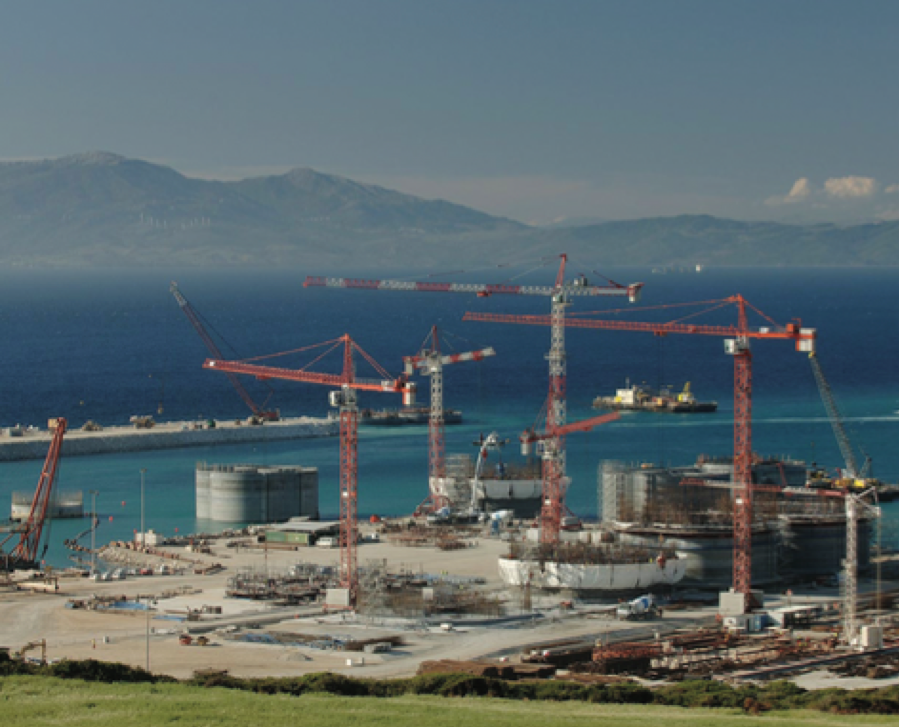
On a swath of coastal land 40 km east of Tangier, a project is underway that bills itself as a revolution for the Moroccan economy and a solution to the problem of rural neglect. Comprising a brand-new mega-capacity port that opens onto the Mediterranean and Atlantic, road and railway infrastructural renovations, and special zones of logistics, industrial, and trade activity, the TangierMed project is set to become a nexus of international trade, investment, and manufacturing.
The project’s 2002 launch with a $5.57 billion investment was Moroccan King Mohammed VI’s “strategic decision to transform the region into an investment hub” through a “major restructuring project consisting of a commercial and industrial port on the banks of the straits, east of Tangier.” The King mandated the TangierMed Special Agency (TMSA) to administer the project’s free zones, Port Authority, and regional development
From its ideal geographical situation at the crossroads of Africa and Europe, Tangier has long attracted investors and traders. Even during Morocco’s colonization between European powers, the French, Spanish, and English signed a treaty declaring Tangiers an international zone of neutrality. The Tangier Free Zone continues to draw investors seeking a place to conduct their business without tariffs, taxes, and duties. TangierMed is a facelift to the region by maintaining the usual fiscal incentives in the free zone while adding high-capacity port facilities and incentives offered to designated industries like electronics, aeronautics and automotives. The project will include a deep-water port for containers and passengers, a 98 hectare free zone for storage and quality control, export-oriented industrial free zones throughout the region, and road and rail works as added transport infrastructure. The main container terminal was opened in 2007, but the project is expected to be fully operational by 2015.
In an interview with Executive, TMSA Chairman Said Elhadi explained the project as a “global concept” focusing on competitiveness and logistics. For him, the distinct advantage is “the geographical location, where you have a high concentration of maritime traffic.” Wedged between two continents, the location makes the project “very interesting for the optimization of flows.” He explained that a platform allows connections to Europe, Asia, Africa, the US, and South America with more effective operations and lower costs, as well as suitable transit times.
Rapid construction and the success of early operations are proving that business affairs in Morocco need not be marred by corruption and sluggishness. Experts attribute the remarkable efficiency of the TMSA to its special status as a business corporation with public power perrogatives. Another TMSA official explained “this kind of port would not be possible without a public-private partnership.” The private-public partnership gives TangierMed the best of both sectors, while eliminating the obstacles of corruption and lack of transparency that mark many business dealings in this country.
A marriage in political economy
The government supports the project with a large financial endowment and tax-free incentives that make it extremely competitive. But the private sector handles management of day-to-day operations and outsources contracts to proven experts in the shipping field. Shipping, as a monopolistic industry, is simply not the business of government. Shipping companies have the expertise and the ability to cut costs.
Taking its cues from this project, the government has been discreetly privatizing aspects of the state-run Casablanca port, which is reputed to be the most expensive and least efficient in the Mediterranean, as well as others. It inaugurated a port reform in 2006 that replaced the state monopoly Ports Exploitation Office (ODEP) with a new Ports Exploitation Company that the Minister of Transport and Public Works hints will be privatized later on. Elhadi explained the near parity of investment between the public’s share, at $2.4 billion, and the private investment, at $2 billion. He believed that “to make the terminals work, you have to have a global reach. Otherwise it doesn’t work. You need to have operators that are global, which have the capacity to bring in global traffic to markets in Africa and Asia. You cannot do it with government or local means so you need to target the real partners. And it’s also an issue in the way to make sure that once you have these private partners there, you interface between the private partners and the public players but ensure that both parties will serve the project’s real purposes”.
Can shipping be that sexy?
Sheer magnitude and good taste are adding to high expectations for TangierMed. The port will feature four container terminals and special zones for industrial, logistics, and trade activity. So far, it is making international waves and has gained a reputation as a strikingly modern, glamorous and well-executed project. A TangierMed II is even underway to dramatically expand shipping capacity in response to growing demand. When TangierMed II is completed, the port will have a capacity of 8.5 million TEU, making it the largest port in the Mediterranean. Estimations put the overall cost of the complex, before the TangierMed II extension, at $1 billion, and major financing has come from a $200 million investment from the Hassan II Fund and a loan of $300 million from the Abu Dhabi Investment Fund.
As far as industry is concerned, insiders are saying there is a political will to court automotives. The automotive alliance Renault Nissan signed an agreement with the government in September 2007 for a joint manufacturing investment that CEO Carlos Ghosn predicts will be more cost-effective and competitive than existing plants in Turkey, Romania, and China. The complex will produce Renault’s Logan series and a new generation of low-cost Nissan vehicles, mostly for export. The operation will be the biggest in the country, and among the biggest in the Mediterranean, with a manufacturing capacity of 400,000 vehicles a year. Local press reports that planned investments will reach somewhere between $950 million and $1.6 billion.
Additionally, a US manufacturer of electric and electronic systems for the automotive industry will build a $36 million plant in the free trade zone, according to an agreement reported in March by local press. The main clients for the new 60-hectare Delphi Group plant will be Fiat, PSA, Renault and Opel. The firm cited low-cost labor and proximity to Europe as its principal incentives for moving into the region. Free trade agreements with the United States, Arab countries and Europe are sure to incite more investors to follow suit.
Importing development
Infrastructure improvements are also redefining the Northern landscape, in the interest of the King’s stated purpose to achieve an integrated regional development. Poor infrastructure has long proven a barrier to transportation of goods and people, but now government officials are prioritizing the transport sector. According to Karim Ghellab, Minister of Transport, the rate of road building has doubled over the past decade. In addition to bigger and better infrastructure, TangierMed will help job creation to the tune of 145,000 positions over the next 15 years as well as social development.
For employment, the TMSA has already implemented training and education programs in the region as the project will staunch the high urban unemployment, hitting 33% in some estimates”. However, according to one TMSA official, the target region is limited to 500 km, which can limit the impact of education and development of rural populations.
Elhadi believes that others might come from elsewhere in Morocco to take the up slack in a burgeoning job market, but “with the education and training programs in the region, within five to seven years it should be ok.” The project’s TangierMed Foundation is an initiative to devote 1% of all investments to social development in the region. The $16 million already secured will be going to the region’s primary schools to train the next wave of workers for 2020.
