
Tunisia has it
During Ramadan, overall investment in advertising in the Islamic world peaks as consumer consumption reaches the highest levels of the year. But apart from the holy month, Tunisia’s advertising sector has been booming the last few years. The rapid expansion can be attributed to the liberalization of the sector since the mid-1980s, which has bolstered corporate access to media outlets. The expansion has also been spurred by the greater variety of available products and services, and the arrival of competition.
The latest figures on advertising investment produced by media agency Med Media, based on findings by Mediascan Tunisie, indicate that overall investment in advertising increased in 2005 by 13.25% over 2004, reaching TD61.5 million ($46.2 million), up from TD54.3 million ($40.8 million) in 2004. In addition, figures for the first eight months of 2006 show that overall investment is expected to reach record levels this year, as sector-wide spending on advertising has already totalled TD54 million ($40.6 million).
A breakdown of spending among the various media reveals an overall increase in radio advertising by 86.25%, television by 17.08% and print media by 34.73%.
Who spent what and where?
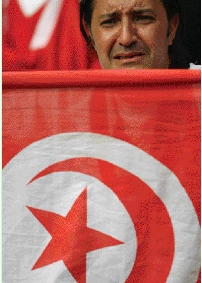
Besides Ramadan, advertising spending was also much higher during major events such as the handball championships held in Tunis in 2005 or the African Nations Football Cup in 2006.
In terms of sectors, the heaviest advertisers in 2005 came from Information and Communication Technology (ICT), whose overall investment increased by 108.98% over 2004. The second largest advertiser was the private mobile operator Tunisiana, one of the key advertisers since its launch in 2002, whose investment grew by 4.57%. The launch of new promotions in the telecommunications sector, where Tunisiana and Tunisie Telecom are fiercely competing, contributed to this growth. Finally, Stial Delice Danone, a dairy products manufacturer, came in third, with investment growing by 9.27%.
Meanwhile, in the first six months of 2006, internet service providers and mobile operators were the heaviest advertisers, spending some TD5.9 million ($4.4 millioin) and representing 11.8% of overall investment, followed by dairy products manufacturers, cosmetics companies and food manufacturers.
Television continues to get the lion’s share of advertising revenues, with total expenditure reaching TD36.7 million ($27.6 million) in 2005. And no wonder. Television penetration reached 75.9% on average. It reached 83.9% during the first week of Ramadan 2006, especially during popular game shows such as Dlilek Mlak. Another specific aspect of TV advertising is brand sponsoring of TV shows, which nearly tripled and represented 46.67% of overall advertising in the first six months of 2006.
Kamel Khattech, the media research director at Med Media said that television is still undergoing a number of changes, particularly in terms of liberalization. Indeed, television advertising wasn’t allowed until the mid-1980s. Until recently, the ANPA (Agence Nationale de Promotion de l’Audiovisuel) charged foreign companies an extra 300% on fees for airtime for an advertisement. At the same time, another production company, Cactus Production, did not impose this fee structure. Since June 2005, most advertisements are not charged an extra fee.
Moreover, the launch of the privately owned channel Hannibal TV in February 2005, at first only available on cable, before becoming available on terrestrial TV in October 2005, also boosted TV advertising.
Print comes second
Meanwhile, print media remains second with some TD27.2 million ($20.4 million) in advertising revenues. Dailies Al-Shuruq and La Presse dominate the market both in terms of readership and advertising revenue. Internet service providers and mobile phone operators remain the heaviest advertisers. Indeed, the ICT sector mainly advertises in the print media, which is also the main channel for strong publicity campaigns, such as new promotions in the telecoms sector.
Also, radio advertising is booming, albeit with rather low advertising revenue compared to television or print, with revenue amounting to TD6.5m ($4.8m) in 2005. The low rates for advertising slots primarily account for the lower revenue. The launch of the first private radio, Mosaique FM (MFM) in 2003 boosted growth. More recently, the online broadcasting of MFM plus the launch of a regional private radio, Jawhara FM were among the reasons that attracted more radio listeners, thus leading to more advertising.
