
Lebanese banks face tough choices
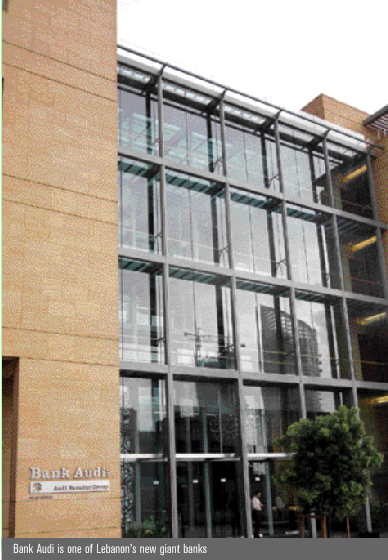
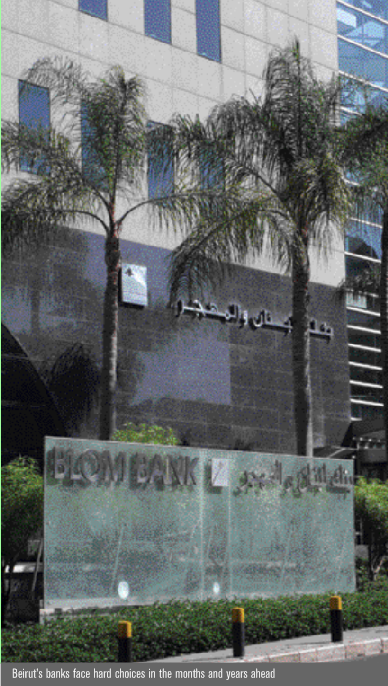
The Lebanese banking sector has gone through significant changes since the 1960s and the collapse of Intra in 1966. Banks that used to dominate the domestic market and were considered examples of sophistication in an ocean of state-owned Arab banks and inefficient European, South American and Asian banks have since disappeared and been replaced by new domestic giants, such as BLOM, Audi-Saradar, Byblos et al. Gone too are the days of a fragmented and diversified banking system, known for its ability to manage petrodollars and to play an active role in a once-prosperous local equity market and gone are names such as Banque Sabbagh, the old Banque de Syrie et du Liban (a onetime issuer of government T-bills), Banque du Crédit Populaire, Banque Trad-Crédit Lyonnais, Banque Libanaise des Emigrés, Crédit Commercial de France (Moyen Orient), and even the old Banque Libanaise pour le Commerce, now known as BLC Bank and owned by the Qatar Central Bank. Forty years ago, the Qataris would never have dared imagine that one day they would own one of the fifteen largest banks in Lebanon. But as Lebanese banks struggle to increase in equity to cope with the growth in deposits and assets, diversify earnings and activities, improve management quality and, most importantly, adapt to Basel II capital regulations, selling to foreigners might become the rule rather than the exception.
The surviving banks of the late 1970s and early 1980s—along with those born during the period from 1977 to 1978, when the central bank briefly allowed new entrants to obtain fresh banking licenses—had to go through two major phases in the last 25 years. The first, which spanned the 1980s, primarily involved surviving the civil war and the devaluation of the Lebanese pound, as well as the consequences on loan quality, bank equity, liquidity and performance.
A new phase of development
After 1991, the remaining banks entered a new phase in their development—helping successive post-war governments finance both infrastructure and economic reconstruction. This “bank aid” chiefly entailed subscribing to the numerous government debt issues in both Lebanese pounds and US dollars. The process accelerated significantly over the following 15 years, as the banks succeeded in developing a recurrent, solid customer deposit base to finance the purchase of Treasury bills and other government debt securities issues. In exchange, the high yielding government securities allowed the banks to produce a consistent profitability that was used to increase equity organically. This rise in equity was essential to the growth of the balance sheet at a time when capital-raising through external means was very difficult, given Lebanon’s reputation as a high-risk country. All this benefited the government, which needed time to complete the reconstruction project. Recourse to issuing debt and other types of borrowing endorsed by the local commercial banks was the sole way to finance it.
Lebanese banks were and still are profitable and highly capitalized; they have resisted numerous political and systemic shocks, while the central banking regulatory authorities have proven ingenious in times of difficulty and put their money where their mouth is when it came to supporting embattled banks. Moreover, banking regulations are quite sophisticated by global standards and the Central Bank Governor Riad Salameh was recently named “Best Central Bank Governor in the World for 2006.”
All these factors have made a positive impact on Lebanese depositors at home and abroad, who believe that service at Lebanese banks is friendlier and more geared towards small depositors. The rise in deposits has made them the primary source of government funding, which is used to finance the economy and the state through the purchase of T-bills. This state of affairs has also contributed towards a recurrent, albeit un-diversified, source of earnings for banks.
However—yes, there is always a however—Lebanese banks have faced hurdles they are still struggling to overcome: in no particular order, they include the need to increase equity to match fast growth in deposits and assets and the need to diversify earnings and activities, improve management quality and face the implications of the Basel II capital regulations that reared their ugly heads in 2000.
The larger banks have been more successful than the smaller ones in increasing the equity base as they had a better story to tell international investors and held more value. The higher values allowed for larger, more liquid share issues to be carried out, and for less dilution for the existing owners. But for most banks, raising capital is still linked principally to the ability to generate profits that are re-injected into the equity base. Although the larger ones remain profitable and are working hard to diversify earnings and products, the smaller banks are gradually running out of breath.
Difficult tasks lie ahead
Profit diversification and recurrence is proving to be a very difficult task for some Lebanese banks. With net interest income still accounting for around 70% of total operating income for the consolidated banking sector, the progress towards earning diversification—at a time when interest margins are getting narrower and the government is becoming increasingly reluctant to issue high-yielding debt securities—has been weak for the last five years.
Some of the larger banks, which benefit from external investor support and greater resources, have been able to tackle geographical expansion by going into what they believe are captive markets in the Middle East and North Africa. They have also been able to diversify their banking product base more significantly than their smaller peers and are involved in more active retail lending. But even the larger banks still principally make their profits out of margins between deposits and government debt securities, and to a lesser extent commercial loans and advances to the private sector.
The issue of management is a qualitative problem. Lebanon’s best managers have gone to greener pastures in recent years, and many banks in the country are under-managed, in the sense that they lack quality managers in sufficient numbers to take their institutions into a position of competitive parity with regional and international peers. Moreover, quality managers are often undermined and under-utilized by their seniors, most of whom are linked to shareholders and have immunity. The lack of corporate governance—in the sense that decision-making is still little diluted and some shareholders hold simultaneous non-executive and executive roles (for instance, many majority owners of banks give themselves the title of chairman and general manager, and grant few powers to executive members of management)—is still a major problem that, despite titanic efforts by the central bank and the Banking Control Commission (BCC), will not be resolved overnight. A majority of managers also lack sufficient training, which is seldom budgeted for by many banks. An alarming number of responsible executives are unaware of the latest banking techniques and lack the necessary corporate discipline and diligence. The central bank’s strict limitations on the expansion of banking activities (such as going into derivatives, proprietary trading and even lending beyond borders)—born from a fear of affecting the sector’s liquidity—also impede the sophistication of Lebanese banking management.
Uncertain future
The fear of insufficient liquidity, given an extremely volatile political environment and the recurrence of major external shocks (most recently the July-August Israel-Hizbullah war), has forced the central bank to be too conservative, hampering the development and competitiveness of the banking sector with negative effects on the rest of the economy. The forthcoming implementation of the Basel II capital regulations, which are based on the ability of a bank to accurately assess credit, market and operational risk, and develop a database of statistical indicators over a certain number of years, is also making the central banking authorities nervous, given that not all Lebanese banks have fully understood the implications of Basel II on their capital. Assessing credit the Western way, benefiting from transparent information from clients, and understanding the effects undisciplined market activities and inefficient operational infrastructure can have on capital are crucial aspects of modern banking.
One wonders whether the central bank wants to see Lebanese banks take on a more global dimension. It must be growing tired of those banks that still do not respect the basic rules of corporate governance, or who are light years from converting into risk-focused institutions and being able to implement Basel II—regulations that could direct many banks to concentrate on a niche market they know well, in order to put less strain on their capital. The trouble is that not enough Lebanese banks have the vision to become a niche player.
Time is running out
What is beyond doubt is that time is running out for a lot of Lebanese banks. Even those banks that are aware of the situation and trying to reform could face time constraints or find themselves unable to achieve their objectives, due to a lack of financial and human resources. The bottom line is that many banks could see their franchise values dwindle, and values for shareholders diminish.
The key question they could then face is this: Would it not be easier for these banks to capitalize on their current franchise and think about selling, preferably to large multinational foreign banks or financial institutions? For the moment, Lebanese bank values have risen significantly from 15 years ago and an outright sale would fetch interesting intrinsic values. Selling to Arab banks would be the most obvious route, given the keen interest Arab banking institutions have shown in Lebanon in the last few years.
Arab investor interest in Lebanon does not need to be proven, given the investments and financial support shown by Arab governments, investors and banks, especially in times of crisis. For them, Lebanon and its banks are interesting vehicles to develop tourism projects, and offer quality staff for activities such as back office, settlement, retail and wealth management and private banking. By buying Lebanese banks, Arab investors (or banks for that matter) would plug in the necessary resources to sort out all the current endemic problems described above. The arrival in force of foreign investors into the local banking sector would transform local banks into more universal institutions with a world-wide presence and the ability to boost the local economy exponentially. Other financial sectors such as the capital markets would be boosted—and new markets even created—while the job market could find relief from its current stagnation. Current bank owners would be able to retire or keep a presence in the “new” banks, but more important, they would be able to put their newfound wealth into derivative or completely different sectors.
The forthcoming implementation of the Basel II capital regulations is making central banking
authorities nervous
Entering the third phase
The entry of foreign investors buying into local banks could create a situation whereby the BDL would be forced to restructure the banking sector along the same lines as Hong Kong. A “categorization” of the Lebanese banking sector could mean classifying banks into international banks (those which had been bought by foreign investors and boosted), savings/retail banks (those banks which specialized in taking deposits and allocating them almost exclusively into government T-bills, housing loans and some other types of retail loans), and merchant/specialized banks (those involved in project finance, capital markets, investment banking, etc.). Were this to happen, Lebanon’s banking sector could then be considered to have truly entered the third phase of its development and embraced a more sophisticated and efficient way of supporting the economy.
