
Imagine being a poor student- not too difficult for those of us
who were once there. Your boots are falling apart and winter
is on its way, some of your clothes are so tattered they should
really be chucked out and replaced, while bare necessities like toilet
paper and food have to be stretched out to last, especially at the
end of each month. Then imagine you are the recipient of healthy
sums of money – student loans and cash from the parents, both
offered at pretty favorable terms. But you can’t get your act
together enough to actually spend it, so mom, dad and the government
have to keep encouraging you, pushing you to make use
of the money. Ludicrous, right?
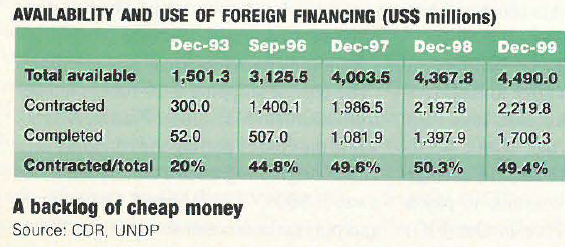
Absurd as it may sound, Lebanon is that student. Of the $4.5 billion
in foreign funds that were available at the end 1999, almost half had
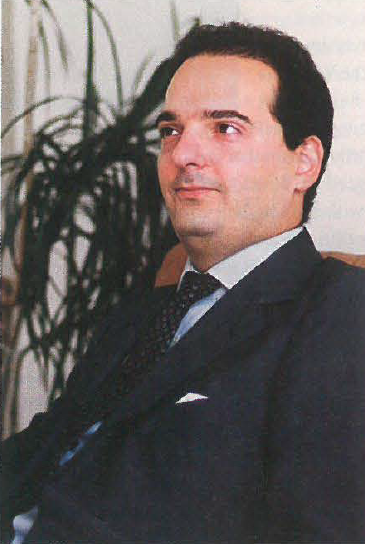
still not been contracted. “Sometimes you feel that you have to push
them to use it,” says Paolo Dionisi, economic and commercial attaché
at the Italian embassy. “It’s the opposite of how it should be.”
Last year was in keeping with Lebanon’s poor track record of the
previous three years, while there has been no significant improvement
in 2000 despite an effort by the council for development and
reconstruction (CDR) to speed up the process of project preparation.
”There is a stockpile of financing available, that’s not being committed,”
says Christian DeClercq, senior advisor to the UN’s resident
coordinator in Lebanon. Even once committed to specific projects,
the level of expenditures is sometimes still low. The slow rate at which
Lebanon uses foreign financing could put it at risk of losing some of
the funds and of attracting new money in the future.
Since the early 1990s, Lebanon has been a recipient of large
amounts of aid largely from the EU and the Arab world, while non aid
financing has come primarily from the World Bank and the
European Investment Bank. For a cash-strapped, indebted country that
is still in the process of post-war reconstruction, foreign funds represent
a vital source of financing. “It’s very important if you have hundreds
of millions of dollars pulled back because the government’s not spending,”
says a financial analyst, “especially when the country needs to
spend in order to bring itself up from Banana Republic grade three to
Banana Republic grade four.”
Even more important is that much of the unused stash is in the
form of grants and soft loans. More than two-thirds of the stockpile
carries extremely attractive financing conditions, according to
a report by the United Nations Development Program (UNDP).
“Soft loans and grants are more difficult to come by,” says
DeClercq. “Lebanon has really benefited from an important amount of goodwill on the part of donors and every effort should
be made to translate that into action so that more resources can be
made available in support of reconstruction.”
Not surprisingly, many point to the weak Lebanese administration
as the prime culprit for the backlog. “It goes back to the administrative
inefficiencies of this country,” says the analyst, “to the ill equipped
administration, the uneducated administration and totally
corrupt bureaucracy.” While the vast majority of funds are channeled
through the CDR, there is often a problem of coordination with
other ministries as a single project can involve numerous government
institutions. And within the government institutions themselves,
there is a limited capacity, often due to an insufficient number of qualified
staff. The political decision-making process can also create
major bottlenecks, according to donors, because even the simplest
decision may require the signature of the minister responsible, the
approval of the council of ministers or passage through parliament.
On top of all that, due to the government’s austerity policy, there are
often not enough counterpart funds. Investment to GDP stood at 20%
last year, compared to 33% in 1995.
But not all the blame can be lumped onto the lap of the Lebanese
government. “Also the donors have to do their part,” says
DeClercq, “because many of the delays have involved donors.”
That is due to complicated review and approval processes or
unrealistic expectations because donors were ill advised of the situation.
In addition, some aid comes with conditions of structural
reform. There is also the issue of tied aid – when contracts can only
be awarded to companies from the donor country in question, which
may not guarantee the best prices on tenders. According to
Bassam Othman, resident representative for the Kuwait Fund for
Arab Economic Development (KFAED), donors shouldn’t be
unbending. “You have to be flexible, you have to understand how
things get done in Lebanon,” he says. ‘Tm sure they’re genuine
about helping Lebanon and implementing these projects, but
maybe they have to go out of their way sometimes.”
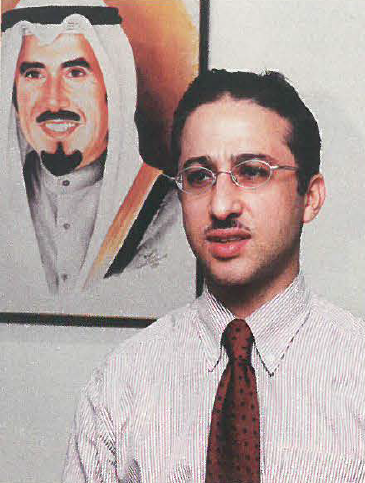
Kuwait has been one of Lebanon’s largest sources of cash, with
about$416 million in soft loans and grants since the end of the war.
Projects it has helped finance include the Beirut airport, the north
and south entrances into Beirut and the construction of health care
centers. Kuwait is one of the few donors not reporting delays. “Most
of our projects are on time. They’ re disbursed according to schedule
and we don’t have any substantial delays,” says Othman.
“When you compare the implementation of these projects with other
countries, Lebanon isn’t behind.” Others say that the relative ease
for the Kuwait and other Arab funds comes from the fact that they
finance comparatively easier projects – basic infrastructure that
doesn’t involve capacity building in administration or projects that
are self-contained like roads or hospitals.
Many others aren’t having an easy time convincing Lebanon to
spend their money. Some like France have given time limits, which
forced the Lebanese government to work hard to meet the deadline
in order to have the protocols signed into commitments. A$ I 00 million
soft loan from Spain, that was originally made available in 1998,
was renewed last summer for another two years. At the World Bank,
Lebanon’s loan portfolio totaled $750.44 million at the end of the
fiscal year on June 30, but just $289.91 million had been disbursed.
The two loans signed this year are not yet effective, but half
of the remaining ten are considered unsatisfactory.
While closing dates can be extended, that is an unlikely event for.non-performing
loans, according to John Wetter, the bank’s country economist.
Japan has had a soft loan agreement worth $120 million on the books
since March 1997. The agreement’s deadline is 2003, but Yukinobu
Miyakoda, the economy attaché at the Japanese embassy, was expecting
the funds to be disbursed by last year. A delegation from the Japanese
Bank for International Cooperation was sent to Lebanon several
times to push for the money to be used. In February and June of this
year the two lenders were finally completed, but the money still hasn’t
been used. Until that happens, more funds will not be forthcoming.
It’s a similar story with the Italians, who will not agree to more
funds until there has been clear progress made in Lebanon’s
efforts to spend the $145.25 million in soft loans and grants available
through agreements signed in 1997 and 1998. The loans
carry an interest rate of 0.5%, a 35-year repayment period and grace
periods of 14 and 24 years, respectively. With such attractive
terms, one would expect the Lebanese government to scramble for
these funds. But it took 18 months just to get the first agreement
passed through parliament, and 10 months for the second. So far
only about 30% of the money has been used. “Now things are
beginning to move, but if they had done everything in due time they
could have negotiated another loan,” says Dionisi.
Clearly, there must be a more efficient use of foreign funds. The
Italians recently established a working committee with the CDR in
order to push things through. Efforts have also been made to streamline
bureaucracy at the EU; of the 184 million euros in grants made
available through MEDA I (1996-1999) just 40% has been used,
while 33 million euros of that amount is still awaiting signatures. “In
Brussels we have done our homework to simplify the procedures,
because this was also a problem,” says Dmitris Kourkoulas, head of
the EU delegation in Lebanon. Now the donors want to see a concerted
effort on the part of the Lebanese government to reform the
administration and reactivate investments. And unless that happens,
it will be difficult to convince the international community that throwing
new money this way will be of any use.
