

Traffic in Beirut is grinding to a halt. The daily commute for the city’s workers is getting longer and more frustrating. As long ago as 1994 the government set up a comprehensive Greater Beirut Area Transportation Plan (GBATP) that was meant to address the most serious urban transportation issues through to the year 2015. The GBATP identified four main categories that needed immediate attention: (1) the lack of institutional capacity for urban transport planning and traffic management in the Greater Beirut Area (GBA), (2) the lack of capacity in the existing road network, (3) the lack of parking management and the shortage of parking spaces and (4) the unregulated public transport system.
As of early 2008, none of these four issues have been solved. In 2002, however, the World Bank Urban Traffic Development Project did give a big push towards helping Beirut solve its chronic traffic problems, with a $65 million loan to help with the implementation of the Urban Transport Development Project (UTDP). A progress report released by the World Bank gives an understanding as to why Beirut’s traffic problems continue. Despite the fact that the grant helped pay for two intersections, which have been completed, from the amount earmarked for street parking and traffic lights only $21 million of the $65 million granted has been dispersed. Added to this is the continued delaying of various road works projects around Beirut, especially the larger capacity building projects. As these various large scale road work projects drag on and newer roadwork projects begin, the whole road network is becoming increasingly jammed.
Complicating matters
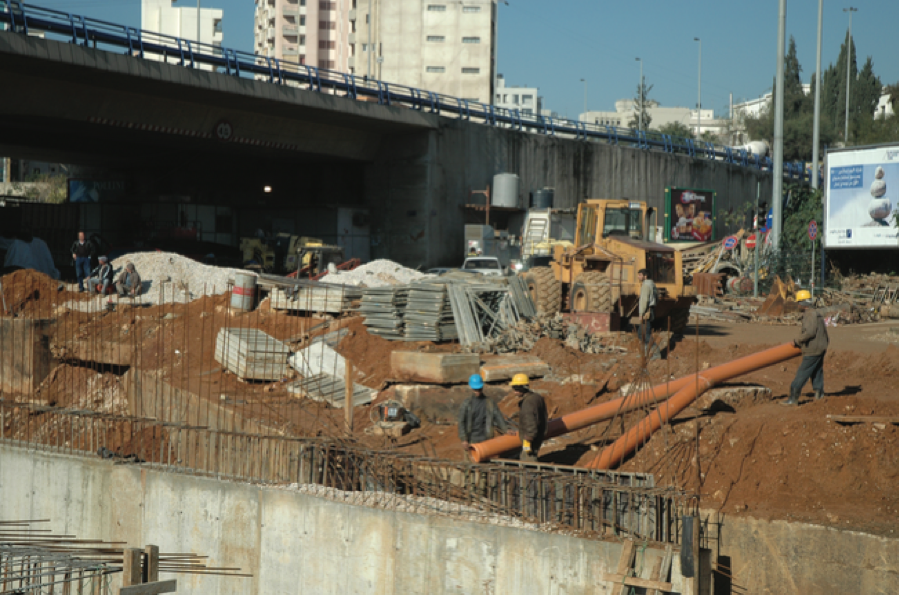
Willam Debs, of Elie Selwan contractors, who is the project manager for the Museum and Adlieh underpass, told Executive that “the July War of 2006, of course, created major delays to the projects as well as the introduction of various infrastructure elements, which were not part of the original contract.” The Adlieh project is now taking in all sorts of infrastructure works: telephone ducts, lighting systems, traffic control systems, sewer collector systems and security camera installations have all been incorporated into the underpass project. Subsequently, coordination with government councils has been a challenge, despite periodic meetings, according to Debs. Electricité du Liban (EDL) has caused particular problems for the Adlieh underpass. Due to the fact that EDL is planning long term and this therefore introduced lots more unforeseen work into the project. “The EDL, because of the political situation at the moment, cannot make straightforward decisions in how they set up their electrical systems and this is also causing coordination problems.” The current political crisis has also delayed construction of road work projects as it affected the labor pool. “Whenever the political tension rises the daily workers do not turn up,” Debs explained.
Meanwhile, as the delays of the various road work projects continue around Beirut, businesses next to major roadwork projects continue to suffer. Georges Aad, operations manager at Auto Mall right beside the Adlieh roundabout, location of one of the underpass construction sites, vented his frustration at the damage the road works are doing to his business. “For every client it takes half an hour to get here and as a result it is becoming increasingly difficult to run the business. We have to make more and more special offers to our customers.” However, Aad said that the contractor, Elie Selwan, had made sure they maintained good communications with local businesses. And although Aad is skeptical over the official date for the completion of the Adlieh underpass, summer of 2008, he is pleased with the plans for the final development and is looking forward to the project’s completion as he expects it to greatly improve his business.
As for the government actors, in particular the Council for Development and Reconstruction (CDR), who are responsible for “planning of road works and the progress of construction activities,” Aad was unsure what sort of oversight they were doing, if any. They have made absolutely no efforts to contact him in terms of consulting about the project or provide any sort of update. Any information about the project had been given by the contractor Elie Selwan. This, however, clearly contradicts the stipulations of the World Bank Urban Traffic Development Project report, in 2002, which cites as one of the main aims for the government need to create a process of “public consultation and public information programs.” After numerous phone calls and emails Executive was only given a list of the current road works being undertaken in Beirut. Obtaining any substantive information proved difficult as its officials would not give out any information and the CDR’s president, Nabil Jisr, was unavailable for comment.
It was also not possible for Executive to interview many of the consultants hired by the CDR to provide “supervision services during project implementation” or contractors due to the fact that they — the CDR — obligated them to sign agreements stipulating that they are not allowed to talk to the press, or anyone else, unless given official notice and permission by the CDR itself, as the consultancy Spectrum and contractor Hourie told Executive when contacted for information.
Public information blackout
The CDR thus has ensured that it has strict control over the information given out regarding Beirut’s road works. Willam Debs said that, according to the tender, the contractor’s only responsibility is to ensure access to all shops, business and residents to be open at all times. Public consolation and information programs are the CDR’s responsibility.
It is clear that the CDR needs to implement a public information program sooner rather than later (or never). The council itself has repeatedly stressed, as far back as 1994, the importance of the dissemination of information on road works into the public realm, as has the World Bank. Despite that, in the tender documents and in the implantation of the road work projects the CDR has completely ignored the end users and ultimately their (tax-paying) clients. Why is the CDR so reluctant to release public information into the public domain?
