
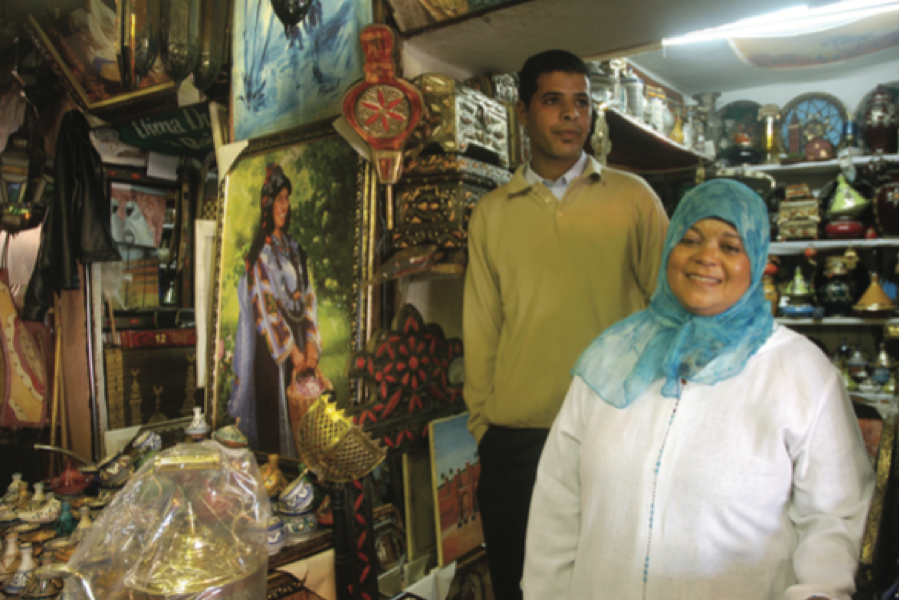
In three years, Khadija Boutarbash’s life has been transformed. Once an economically vulnerable ambulant seller of handicrafts, she is now a proud entrepreneur who has expanded her family-run small enterprise into four retail outlets in Casablanca, having rented her first storefront with a microcredit loan of MAD25,000 ($3,000) in 2005. The lending agency provided training to help her diversify her offer and better identify and adapt to seasonal consumption patterns. Today she travels to rural areas near Marrakech, Taroudant, and Fes to restock her supply of paintings, teapots and knickknacks, relying on verbal agreements with mostly illiterate sellers, achieving daily sales of up to MAD1,000 ($120) per day.
In Morocco, microfinance has quietly flourished in recent years, becoming something of a benchmark for the development of microfinance services throughout the MENA region. The country’s 13 microfinance institutions (MFIs) have so far loaned to over 1.7 million clients, at a 97% rate of repayment. Forbes Magazine’s 2008 ranking of the top 50 MFIs in the world listed no fewer than four Moroccan MFIs, with three of these making it into the top twelve (FONDEP at five, Al Amana at eight, and the Banque Populaire Foundation for Microcredit at 12). The IFC calls Morocco the MENA region’s leading market for microcredit institutions, with the country’s MFIs awarding half of all regional microloans.
It is unclear why microfinance, which spread rapidly through developing countries in Asia and South America during the past decade, has grown so slowly in the MENA, with Nobel laureate and microfinance pioneer Mohammed Yunus identifying it as the region with the lowest penetration rate. Over time, microcredit’s positive social impact and nearly perfect rate of repayment, in Morocco and other developing countries, have silenced early skeptics, who had warned that loans to the poor carried too high a risk. Now, as countries like Syria and Lebanon take the first steps towards creating microfinance institutions, industry insiders are using the Moroccan example to study the challenges and advantages of introducing MFIs to the region.
The Moroccan means
To guarantee repayment and results, MFIs actively supervise and guide the development of small enterprises, also offering leadership training and technical assistance. “With microcredit institutions, lending is not impersonalized in the way it is at a bank, where you create a credit file and the client has a relationship with the institution, not with this person or that person. But when a client comes to us, he is taken into our care from the beginning to the end by a single agent who knows him well, who he knows well,” said Mustapha Bidouj, secretary general of the Banque Populaire Foundation for Microcredit.
This carefully nurtured intimacy between Moroccan MFIs and their clients has proven remarkably effective in guaranteeing repayment and stimulating small business growth. However, the extra effort drives up operational costs for the institutions. “In order to arrive at the same volume of clients as a bank, we must have four times the personnel, because it’s not the same relationship, or the same practice at all,” Bidouj said.
High operational costs have generated concerns for the financing of Moroccan MFIs, which must raise interest rates to absorb these costs. “Interest rates for microloans are quite high compared to bank loans. The trips, the politics of building bridges between the organization and the client, these cost money. And it’s the interest rates that cover these costs,” said Mohamed Asri, director and founder of the International Agency for Economic and Social Development. Competition among the thirteen MFIs does put some downward pressure on interest rates, however.
Access to some form of credit, even at elevated interest rates, represents a significant step forward in incorporating Morocco’s population into a formal economy. The IMF reported in October that only 10% of Moroccans currently have access to bank credit and just 37% of the population has a bank account. Microcredit has brought about the fast growth of well-adapted financial services among the ‘pre-bankable’ majority of Moroccans. Access to credit has given Khadija Boutarbash and others like her a new lease on life. Microcredit shows that even among the least educated and marginalized communities there exists industriousness, resourcefulness and a sharp eye for business, if given the opportunity.
The sector’s evolution
Microfinance was introduced in Morocco by local NGOs in the mid-1990s, as part of a joint government-civil society effort to develop the country’s vast informal economy. The 1999 Microfinance Act provided the sector with a legal and regulatory framework, bringing it under the authority of the minister of finance. The ministry was also charged with determining interest rates, though it has yet to act on this point. It did, however, put a ceiling of MAD50,000 ($6,000) on all loans; it also restricted the scope of microfinance services by only authorizing microcredit loans destined to income-generating activities.
These early measures effectively encouraged the development of the sector, which grew out of large-scale donations by private individuals, banks, and the government. Moroccan MFIs praise the government’s support in the early stages of the sector’s development. “We are lucky to have a central bank and minister of finance who understood very well the needs of the microcredit sector. They have accompanied us and also urged us to proceed slowly, as if to say, ‘We will not get in your way, but let’s move forward step by step.’ That is what has allowed us to have this controlled development,” said Bidouj.
Now, as Moroccan MFIs grow up and encounter the limits of their own capacities, they are reflecting on new ways to develop. Upcoming sector reforms will probably include the introduction of various microfinance services, such as micro-savings and deposit programs, micro-insurance, and microcredit loans earmarked for cars or housing. Adding these financial services to the current offering of microcredit loans to develop small enterprises will enable Moroccan MFIs to tap into a large potential demand, as well as to diversify their product.
This diversification is crucial for Morocco to extend microfinance services to those most in need. According to one estimate, in Morocco as few as 20% of potential demand for microfinance is being met. In urban areas, agencies have benefited from word-of-mouth and high population concentration to build a strong clientele base. In rural areas, however, where poverty rates are higher and access to potential clients may be complicated by geographical isolation and lack of infrastructure, Moroccan MFIs have expanded slowly.
Asri piloted a recent study to advise Moroccan MFIs on diversifying their offer, to more effectively penetrate rural areas. “The rural world can only generate the resources to pay back the debt after a certain delay,” he remarked. “If we take a woman in the mountains who makes carpets, she wants a microcredit to buy wool to make carpets, and then it (the weaving) will take 15 days. Then, she will either sell the carpet to a reseller, at a loss, or take it to the souk herself. This could take another two weeks — that makes one month. Today, the associations impose repayment by day, week or month, but the activity in the rural world needs a particular service with more attention and services that are better adapted.”
Commercial Investment
Another potential reform of the microcredit industry in Morocco would allow commercial finance to invest in the microcredit industry for profit, seen as a way to avoid an upcoming crisis. Moroccan banks require MFIs to maintain a certain relationship between their capital stock and loans. With several Moroccan MFIs already at that limit, many want the option of augmenting capital stocks through a public offering.
The global microfinance sector is concerned that ‘making profit on the backs of the poor’ represents a significant departure from its own foundational goals. The mainstream finance industry, seeing the expansion of microcredit as an opportunity for growth, is ready to seize upon opportunities. Have Moroccan MFIs reached the limits of what they can do on their own? “We are in an evolutionary stage,” Bidouj said. Asked whether he thought reforms would permit the entry of private investment, he responded: “That is the essential question for us, and will probably motivate the transformation of MFIs from the status of a non-profit to the status of a company.”
The question forms the central problematic of a study currently being conducted by the ministry of finance, with a grant from the American Millennium Challenge Corporation. If the government does open up MFIs to commercial investors, the next step will be to choose between local and foreign shareholders. In accepting foreign investment, MFIs expose themselves to the risk associated with foreign currency. However, foreign capital has the advantage of being mainly loaned at lower interest rates than local currency.
As Moroccan MFIs mature, they face new pressures to expand. The government has so far maintained a nurturing environment for the sector, to good effect. To minimize risk, the government and MFIs must work together to guide the country’s microfinance sector through this transition period and into its next phase.
