
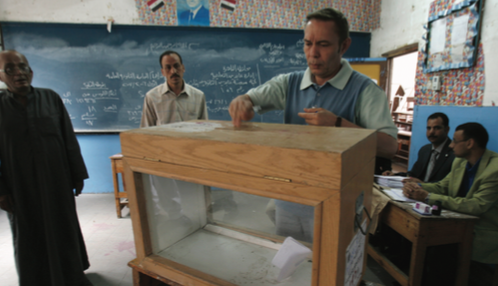
Over the past quarter century, I have witnessed countless presidential and parliamentary elections in the Middle East and North Africa. I cannot remember one that went off without voter intimidation, violence or vote rigging. In fact, every time an election is announced it almost seems as though the country holding it is preparing for war. The military is mobilized and placed on high alert; buildings housing radio and television stations as well as government offices become armed fortresses and a feeling of doom grips the nation.
As a journalist, I have had rough times covering elections in the region. I have been arrested by police on multiple occasions. In one well documented case, during the 2000 parliamentary elections in Egypt, I was beaten up and had all my photographic equipment smashed to pieces. Thugs, or ‘baltaguiya’, hired by Egypt’s ruling National Democratic Party (NDP), accosted me as I was leaving a polling station in the center of Cairo and threw me to the ground, while taking all my equipment from me. If this had happened in a dark alley it would be one thing, but the attack took place in broad daylight right in front of roughly two-dozen armed police there to protect the polling station. After getting up, I called for the policemen’s help. But all I got from the senior officer on the scene was a denial that any such attack had occurred.
Since I moved to the Middle East, there have been seven presidential elections in the United States. Each president that has come to power during this period, except for Obama, has either served the maximum two terms or was defeated after his first four years in office. Over the last 25 years, elections in the US have been free of violence, intimidation and vote rigging. The only major hiccup occurred in 2000, when votes in Florida had to be recounted by hand because of irregularities with the vote counting machines. In the end, the problem was settled in a civil manner by the Supreme Court.
Presidential elections in the US have almost a festive mood about them. They come every four years like clockwork just before Thanksgiving and right in step with the holiday season. When it’s all over there is a period of reconciliation when all Americans — Democrats, Republicans and Independents — unite knowing full well that the system put in place by the founding fathers over 200 years ago, is still alive and well.
In most instances, elections in the Arab world are anything but festive, and elections for the highest office have proven to be nothing but a farce. Of the 22 member nations in the Arab League there are eight monarchies that don’t even pretend to be democratic. When it comes to the appointment of the highest office, they just appoint the next of kin to the throne. Then there are the so-called democracies. Egypt’s Mohammed Hosni Mubarak has been in office for almost 30 years, since Anwar Sadat was assassinated in 1981. The vast majority of Egyptians have known no other head of state. Sure, he has held countless referendums, many of which I covered, but the outcome of these referendums has always been the same. Take the 2005 election, the only time in Egypt’s history that a presidential election was contested by another candidate. In the end, Mubarak took 88.6 percent of the votes and the challenger, Ayman Nour, not only lost the election but was sentenced to five years in jail for supposedly “forging powers of attorney” to secure the formation of the his political party, al-Ghad — a charge he vehemently denies. Last month, he was mysteriously released after serving three years.
In many Arab countries, democracy equals a referendum, a mechanism used by autocratic regimes to appease Western calls for democratic reforms. In reality, a referendum is nothing more than an approval rating, which rarely dips below 90 percent. Besides Egypt, referendums are popular practice in Syria, Tunisia, and Yemen.
Algeria experimented with the democratic process, but when the FIS (Front Islamique du Salut) was set to win a parliamentary majority in 1992, the military stepped in and annulled the election. The military’s action sent the country into chaos and civil war for the better part of the decade, killing an estimated 100,000 people.
Lebanon knows a thing or two about chaos and when elections are held there is always a lingering fear that the country will disintegrate once again into civil war. The next elections are scheduled for June 2009 and since they were announced almost six months ago, it is as if lines are already being drawn. Chances are that nothing major will happen, but if the fragile sectarian balance is altered, nobody knows what may happen.
America’s presidential electoral system is imperfect, but it has been tested for more than 200 years. A valid complaint is how a country with such a diverse population can have only two major political parties. Despite this flaw, with every new administration there is a major change in policy that has worldwide repercussions. Let’s all hope this new administration will repair the damage done by the last and once again shine the light on the democratic process. As one friend so appropriately put it, “not an abomination, rather an Obama nation!”
Norbert schiller is a Dubai-based photo-journalist and writer
