
The financial cost of piracy off the Horn of Africa has surged over the past year as pirates have become increasingly audacious, better funded and equipped, and able to extend their reach in the high seas. A few years ago vessels were warned to keep 50 nautical miles off the Somali coast; now, pirates are boarding ships as far away as the Seychelles, some 1,500 kilometers off the coast of Africa. The area the European Union Naval Force (EUNAVFOR) patrols is some 9 million square kilometers, almost the territorial size of the United States of America.
Just as the range of pirate operations has increased, so has the ransoms being paid out, rising from $250,000 to an average of $1.25 million in 2008. The London-based International Maritime Bureau recorded 111 pirate attacks off the Horn of Africa last year, of which 42 were successful hijackings. In the first half of 2009 there have been 130 incidents.
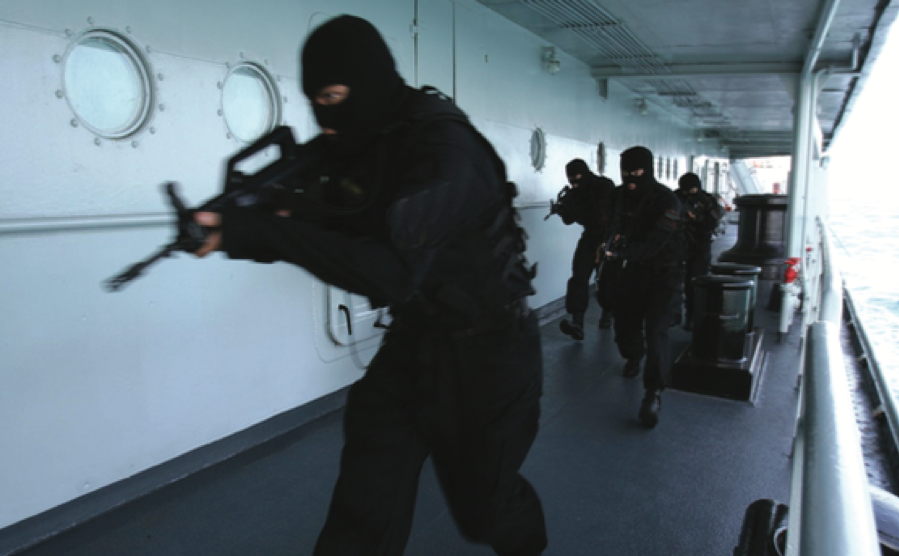
The situation turned into what was internationally deemed a “crisis” last year, prompting the European Union to establish its first naval security mission consisting of 12 ships, while Russia, the US, China and India also sent warships to the Western Indian Ocean to protect their maritime vessels. In a rare show of international solidarity, the armada patrolling the Gulf of Aden is coordinating to curb the scourge of piracy.
But covering the cost of bases in Djibouti, Kenya, Bahrain (the US naval base), Dubai and elsewhere runs in the tens of millions. The operating cost of EUNAVFOR alone is $12 million a year, excluding the cost of naval vessels, aircraft and military personnel.
The cost to the shipping and insurance industries, however, is far higher. Last year, pirates collected around $30 million in ransoms. Cyrus Mody, manager of the International Maritime Bureau, said that figure doubles when the legal fees, negotiators, delivery of ransoms and associated costs were added. “The amount paid out is pretty much equal to what the ransom is,” he said.
The cost to insure ships transiting the Gulf of Aden is estimated at $20,000 per ship per voyage, excluding injury, liability, and ransom coverage. A year ago, the cost of the additional insurance premium was only $500, according to maritime newspaper Lloyd’s List. It is estimated that the increased cost of “war risk insurance premiums” for the 25,000 ships that ply these waters, which includes an estimated 11 percent of the world’s petroleum, could reach as much as $400 million.
Keeping to the designated shipping lanes in what EUNAVFOR calls “group transit” of several ships, and paying up if captured, would seem to be the only options for the world’s shippers. The alternative of avoiding the Gulf of Aden and the Suez Canal is simply too expensive and time consuming.
According to the US Department of Transportation, to re-route a tanker from Saudi Arabia to the USA via the Cape of Good Hope adds approximately 2,700 miles to the voyage and some $3.5 million annually. A routing from Europe to the Far East via the Cape, rather than through the Suez Canal, would incur an estimated additional $89 million annually, which includes $74.4 million in fuel and $14.6 million in charter expenses. In addition, the rerouting would increase transit times by about 5.7 days per ship.
Pirate dens
The heightened international naval presence off the Horn of Africa has had a direct impact on curbing piracy. “The number of attacks has not decreased but the number of successful attacks has gone down, primarily because of the naval presence,” said Mody.
EUNAVFOR’s specific mandate protects ships of the World Food Progamme. Commander John Harbour of the British Royal Navy and chief media spokesman for the European task force, said the rate of success was one ship hijacked for every three attempts, whereas a year later it is one in nine successful pirate attacks. “Every single day there is an attempt and every day we thwart that attempt. And even when there is not a direct attack, we see many skiffs with armed men,” said Harbour.
A knock-on effect, however, of the naval presence has been the ramping up of the ransoms demanded by the pirates and heightened investment in faster speed boats, mother ships to refuel and launch skiffs on the high seas, and better weaponry.
“When the navies united under an Aden task force, the pirates needed to be more audacious,” and demand higher ransoms, said Simon Davies, a former detective and special investigator with Britain’s Scotland Yard and a consultant on financial crime and piracy in East Africa. “That [ransom] pie graph is getting more and more cuts in it as the money is shared around. There is money for bigger engines and dhows to ply the sea carrying extra oil,” he added.
The pirates run what Mody called an “extremely business orientated” operation, similar to many organized crime syndicates around the world. Up to five major pirate groups operate from bases on the Somali coastline and are either self-funded or financed by external investors.
Employing watchers in commercial hubs like Dubai, the pirates are informed of when a ship leaves port and what cargo it is carrying, or information is easily garnered from reading the shipping news published in local newspapers. A crew of armed men on speed boats or on a mother ship then head out on the high seas to track down potential targets. If successful, the pirates capture a vessel and sail it to Somalia. There, said Davies, the pirate crew is replaced with another crew for negotiations to take place. The onus is then on the owner of the ship and insurance companies to cough up the ransom.
Due to the frequency of attacks, ship owners have set up insurance cartels, with many owners paying into a pool that will then pay out in the case of a hijacking. Then the separate insurers of a ship’s cargo, hull, and other forms of insurance get involved.
“If say a cargo of sugar costs $50,000, the insurer pays 10 percent of the ransom, the owner 15 percent, hull insurer 15 percent. If [they are] maybe $150,000 short, the cartel of ships pays up,” said Davies.
Then the drop off — usually in small denominations of US dollar bills — takes place. Back in 2005, Mody said money exchanged hands in either airport lounges or hotels in Dubai.
“A phone call was made and the vessel released. In 2008, the money was taken by security companies by boat to the captured vessel,” he said. “This has been taken a step further. To make it safer for delivery, the money is now being air dropped on the vessel or nearby. This is how the delivery has progressed, as, if you have a security person on-board, he will automatically become a threat to the pirates. And sailing in with the money from, say, Djibouti or Kenya, you need to hire a crew, and the crew knows there is $1 million on-board… The air drop has made it cheaper and safer.”
Getting rid of the loot
One spin-off from the piracy business has been a boom for sectors catering to the pirates, from arms dealers to boat outfitters, car dealers, and other enterprises. Businesses have also emerged that cater to the unwilling European visitors to Somalia.
“With Europeans captured, there is a burgeoning restaurant business [in Somalia] to cater to Western palates,” said Davies.
Mody said that living standards are going up due to “lavish spending by pirates, which is encouraging local industry to build up, and flashy new cars to be driven around because of the new money.”
While part of the loot is divvied out among the pirates, some is earmarked for investment in the next venture. But if the ransom money doesn’t stay in Somalia, where does it go? There have been claims that the money is laundered in Dubai — a claim the Emirate has vigorously denied — and via Beirut. Mody said much of the money gets siphoned into Kenyan real estate, where there has been a marked increase in Somalis buying properties in Nairobi. Davies said money may also be laundered or invested in Iran, Yemen and the UAE.
Indicative of the pirates’ business savvy, there has been minimal violence toward captured crew members.
“It is a business for them and any violence towards the crew will affect this business model,” said Mody. “If violence increased, this would change the dynamic, and that could be a turning point in how nations look at piracy. Keeping that in mind, having a link to terrorism is also not in the best of their interests. If a link is established, there would be a very serious clamp down by certain external interests.”
