
Two mysterious explosions in suspected Hezbollah arms caches in the space of three months, and the discovery of Israeli electronic wire-tapping devices, provide rare glimpses into the covert intelligence war waged between Israel and Hezbollah. It is still unclear what caused the small explosion in a home in the southern village of Tayr Filsay on October 12, but the aftermath provided an opportunity for a propaganda skirmish between two masters of the art.
With the Lebanese media still buzzing about the source of the explosion and the number of casualties, the Israeli military released video footage shot by a pilotless drone, which it said showed Hezbollah men loading rockets into the backs of trucks.
Hezbollah then produced its own footage, claiming that the long rocket-shaped object seen in the Israeli video was nothing more than a rolled up steel shutter. In the absence of evidence either way, the outcome was inconclusive, with both sides accusing each other of violating United Nations Security Council Resolution 1701.
Still, the explosion in Tayr Filsay, coupled with the series of blasts that destroyed a building in Khirbet Selim in July, has Hezbollah’s cadres gossiping over the possibility that Israel is waging a sabotage campaign against the party’s facilities. No evidence has publicly emerged that Israel is conducting such a campaign, but that will not stop the speculation, especially if more buildings are blown up. Hezbollah and Israel have fought a clandestine intelligence war against each other for over two decades. Lebanese and Syrian military intelligence worked closely with Hezbollah in building spy rings inside Israel’s occupation zone in South Lebanon in the 1990s, even penetrating the upper ranks of the Israeli-backed South Lebanon Army militia.
One of the most celebrated intelligence stings involved Ramzi Nohra, a Christian drug smuggler from Ibl es-Saqi and an agent for Israeli intelligence until he switched sides in 1994. Nohra and his confederates helped abduct Ahmad Hallaq, who fought with the Syrian-backed Palestinian group As-Saiqa in the civil war, before being recruited by Israeli intelligence in the early 1990s. In 1994, Hallaq, on Israeli instructions, assassinated Fuad Mughniyah, the brother of the late Hezbollah military commander Imad Mughniyah. A year later Nohra, coordinating with Lebanese military intelligence, kidnapped Hallaq and handed him over to the Lebanese authorities.
From 2000, Nohra helped establish Hezbollah’s network of spies in northern Israel, using his old cross-border drug smuggling links. Lebanese hashish and heroin crossed into Israel in exchange for cash for Nohra and intelligence information, such as photographs of military positions, detailed maps of northern Israel and Israeli mobile phones for Hezbollah. The Israelis stepped up their own covert war against Hezbollah in 2002 when Meir Dagan was appointed head of the Mossad intelligence agency. Dagan was once described as “the old [Ariel] Sharon, less a few centimeters,” a reference to his gung-ho spirit and ruthlessness. Dagan’s appointment coincided with a string of assassinations in Lebanon. Four months after Dagan arrived at Mossad, Nohra was killed in a roadside bomb explosion in south Lebanon. In August 2003, Ali Saleh, a veteran Hezbollah militant, was killed in a car bomb explosion in southern Beirut. A year later, Ghaleb Awali, another senior Hezbollah combatant, was also killed in a car bomb assassination. The (probable) pinnacle of the Mossad assassination campaign was the killing of Imad Mughniyah in February 2008.
In the past three years, Israel appears to have redoubled its efforts to penetrate Hezbollah’s traditionally air-tight security, to compensate for its woeful intelligence failures during the July 2006 war. But Hezbollah’s counter-espionage branch and Lebanese security agencies have had some success, judging from the busting of multiple spy rings in Lebanon over the past year. The recent discoveries were reportedly due, mainly, to the efforts of the Internal Security Forces (ISF), which received hi-tech phone tapping equipment and advanced data processing computer programs from France. The equipment, according to a report in Le Figaro in October, was intended to assist the ISF in apprehending the killers of former premier Rafiq Hariri, but was used also to round up, according to the latest count, some 70 suspected agents working for Israel.
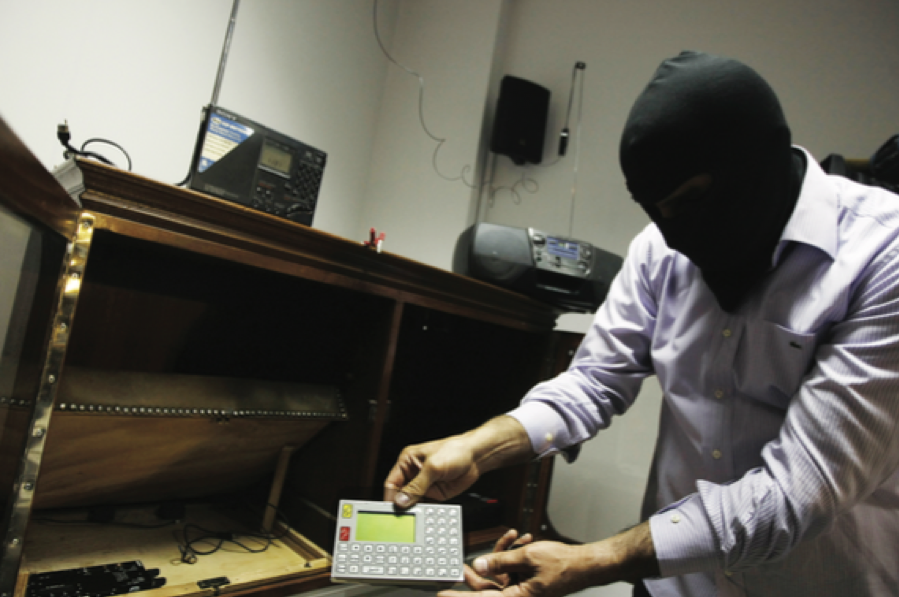
The latest development in this clandestine war came on October 18, when two explosions were heard in a wadi between the border villages of Houla and Meiss Al-Jabal. The two blasts reportedly destroyed two of three Israeli eavesdropping devices buried beside Hezbollah’s fiber-optic telecommunications cables. The Israelis blew them up by remote control after Hezbollah discovered the devices.
Hezbollah claimed a “major accomplishment” in discovering the Israeli devices, but it is reasonable to assume that where there is one (or three actually), there will be more. The covert war continues.
Nicholas Blanford is the Beirut-based correspondent for The Christian Science Monitor and The Times of London
