
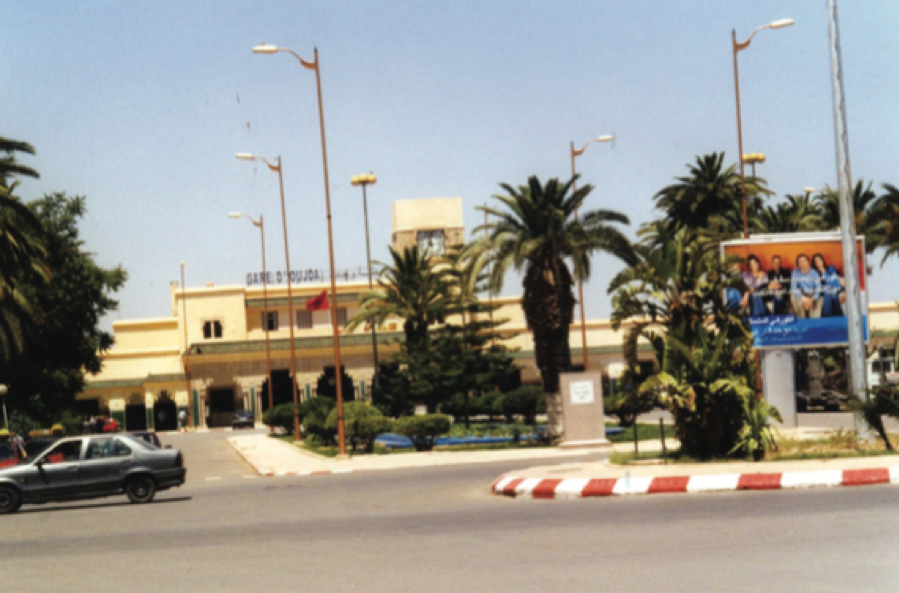
Oujda, flanked by the Algerian border and the Mediterranean Sea, is Morocco’s potential gateway to the East. Geographically cut off from the rest of Morocco, separated by a five-hour train ride from the nearest major city of Fes, Oujda should be developing its trade with Algerian border cities. But since the 1994 border closing, the Eastern region has been forced to deploy other strategies to develop its economy, buoyed largely by public spending to the tune of $40.8 million. Currently, there are plans to develop strategic infrastructure projects that aim to facilitate economic growth and the spread of ideas.
With no formal trade with its Algerian neighbors and an only insignificant black market trade, the Eastern region has earned the sobriquet of the Maghreb’s Strasbourg, modeled after the interesting positioning of its Franco-German counterpart.
In some ways Oujda remains a small case study on the larger questions of social and economic development in Morocco. With a regional population of some two million, dominated by under-25 year olds who make up 57% of the total, Oujda has the possibility to channel its abundant population, numbering 430,000 in the city comparable to the next highest figure of 133,000 in Nador, into an engine of effective human capital.
When examining the city’s and the region’s economic prospects, one finds that the city is doing better than expected, but recent moves toward rapprochement between Algerian and Moroccan authorities could open up even greater possibilities for the land-rich region.
Human capital
Université Mohammed I Oujda remains the region’s premier institution in fostering the burgeoning and young population. The university remains dedicated to investing in its students who come to study tourism, industry, and transport/logistics. For those who make it through the undergraduate and graduate programs few options are available: they can choose underemployment, find suitable work in Morocco’s more prosperous cities, relocate abroad with enough passion, or choose to engage with industries and firms involved in developing operations in the sea-hugging region, especially with maritime projects on the rise. Nador, one of the region’s main cities ranks second in passenger traffic in Morocco and the region as a whole enjoys a close proximity to Spanish enclave Melilla and the Iberian Peninsula, 200 km by sea.
One push by the government and local educational institutions is to fuel growth in supply for research and development (R&D) projects in the region, demanded to a large extent by an increasing number of European firms, who are choosing North Africa as a supply center for their R&D operations, which can be paid for on the cheap. Oujda’s university has developed five research centers to develop an interface for just this purpose, supplying the region’s engineers, business students, and workers to paired firms looking for local talent for their outsourced operations. Two institutions are driving this, Morocco’s l’Agence de Développement de l’orientale (ADO) and Belgium’s Commission for University Development.
When asked about a local brain drain, the university’s secretary general did not seem worried and cited confidence in the region’s organic macroeconomic growth in industries and trade. Other university officials also remain optimistic and believe that new industries are sustainable over the long-term.
At the same time as the region is extending its intellectual presence through such partnerships, in addition to training workers who will eventually move to develop other regions of the country, the Eastern region has established a physical infrastructure aimed at fostering stronger ties with many nearby cities, including healthy trade with Fes via the highway established between the two cities not so long ago. Additionally, moves to market and develop waterway infrastructure are taking place along the Mediterranean, with a new international harbor set up north of Oujda to facilitate growing trade with Europe.
Location, location, location…
However much the region succeeds in cultivating local talent, the question of geo-economic strategy remains, concerning the depth to which the region can find endogenous prosperity. Although major cities in the region can be accessed from the Mediterranean or by air, local infrastructure, needed for business growth, still lags behind demand, slowing growth and development in the process. In response, Morocco’s King Mohammed VI has initiated several projects aimed at putting in place the roads, rails, and connections to shuttle workers and production between cities and ultimately to market.
The Fes-Oujda highway, covering the distance between the two cities with fresh, modern pavement, was initiated in 2007 with projects of $815 million over a three year timeline, in addition to redoing the Oujda-Nador route during 2008. Local development projects will continue to absorb the nearly $4 billion pitted in public spending for job-creation prospects of 71,000 new positions by 2010.
A stronger internal economic position would doubtlessly strengthen consumer demand. This prospect has already been estimated by large Moroccan retailers like Marjane, which is planning to invest $61 million as well as a smaller investment in the region of $20 million by Asswaq Assalam.
Betting on better borders
An Algerian extremist brought about a general scare in Morocco after bombing a tourist target in Marrakech in 1994, leading the late King Hassan II to close the border with the country whose secret services were blamed for the attack. After years of civil war, Algeria’s government crushed dissent and restored order, but the border remains shut. International institutions like the International Monetary Fund (IMF) are calling on the two sides to change course, reporting that “the reopening of the border between the two neighboring countries would greatly contribute to boost trade in the region.”
The border closure has exacerbated problems inherent to the Algerian-Moroccan relationship, allowing the Western Sahara territorial dispute to fester and creating problems within multilateral bodies like the Arab Maghreb Union (AMU). In fact, confidence building measures take backseat to the Sahara question, an issue that continues to block meaningful policies on bilateral relations.
Nevertheless, moves toward rapprochement have been gaining ground, with travel possible by air between the two countries and softer, more diplomatic language towards each other. According to a communiqué from Morocco’s Ministry of Foreign Affairs and Cooperation, “The Kingdom of Morocco called on fraternal friendship and sincerity in a full normalization of relations with Algeria and a border opening between the two countries.” The ministry added that “Morocco reiterates its willingness to open a new page in relations between the two neighboring countries.” Although Algeria has responded somewhat amicably, the country’s president, Abdelaziz Bouteflika, maintains visa requirements for Moroccans wishing to travel to Algeria, failing to match his Moroccan counterpart’s move in abolishing travel visas years ago.
For now, Algeria’s government believes a closed border signifies punishment of the Moroccan economy, to the tune of $500 million. Although no one knows for sure of the economic implications of the gate opening at the border, some reports use evidence from the 1980s, when the border was briefly opened, that Algerian domestic prices, being much lower than those in Morocco, would rise while Morocco’s prices would fall, thus arriving at a new equilibrium. Conversely, with Algeria income packing more bang than Moroccan salaries, it would seem that Algeria’s prices would fall and its workers would lose in competitiveness.
Now, however, Algerians are barely richer than Moroccans and want to guard industries established in Algeria to serve the country’s larger population instead of opening production for pan-Maghreb consumption.
With rapprochement prospects still remaining lukewarm, officials believe the Eastern region should continue to focus on endogenous growth with the country’s Ministry of Land, Water, and the Environment outlining the changing nature of Morocco’s frontier regions. According to official ministerial notes, “the emergence of territories as actors of globalization signifies a profound change in the state of the spirit in actors of development regarding territories which are no longer seen as simple suppliers or receptacles of public or private assets, but as systems which they themselves produce.” Staying conscious of the region’s needs and paying mind to improving the system are essential for Oujda’s growth prospects.
