
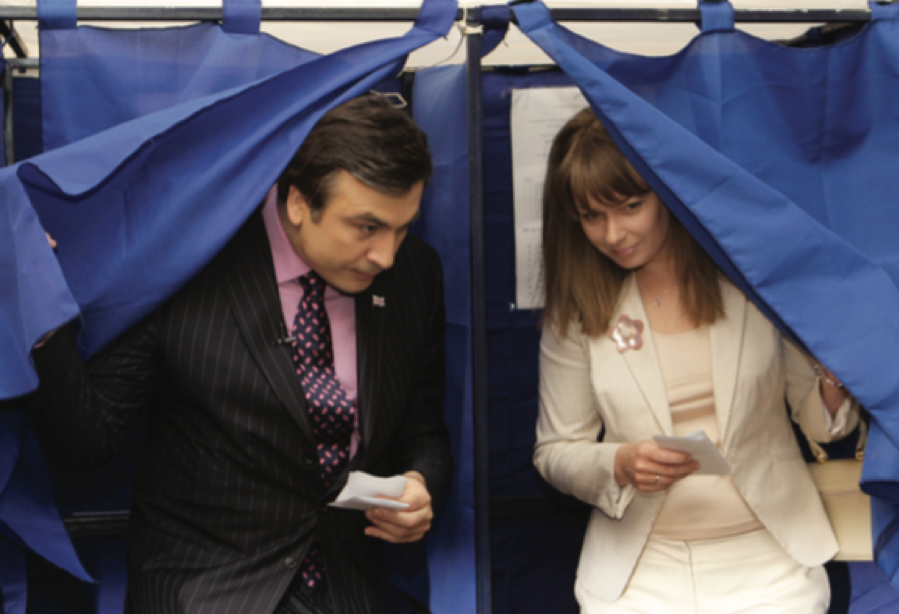
Shortly after the collapse of the Soviet Union I joined a small group of Cairo-based journalists on a tour of the former Soviet republics of Azerbaijan, Armenia and Georgia. When we arrived in the Georgian capital of Tbilisi, one of the first things we wanted to do was interview the newly elected President, Eduard Shevardnadze. Shevardnadze had held numerous political posts during Soviet times, the last being minister of foreign affairs under the leadership of Mikhail Gorbachev.
Our initial queries proved fruitless until someone at the Ministry of Information suggested we contact a particular young member of parliament who was supposedly very close to Shevardnadze. After agreeing to meet us, the young MP said that he would try his best and see what he could do to arrange an interview. With nothing else to do but wait for an answer from the president, we sat in the MP’s office while he gave us a little background into his own personal life. He said that he had received a graduate fellowship from the US State Department and during his time in America he got a masters of law degree from Columbia University in New York. He also mentioned that he was married to a Dutch woman whom he met while attending a course on human right in France in 1993.
As the small talk with the MP continued, one of my colleagues, a Dutch journalist, turned to me and asked if I would be interested in illustrating a story about the MP and his wife for a Dutch magazine. “The story of a young woman from Holland falling in love and marrying a Georgian MP would be interesting for our readers,” he said.
After we were assured an audience with Shevardnadze the following day, our group decided to leave and spend the rest of the day site seeing around Tbilisi. My Dutch colleague and I stayed behind with the young MP and he proceeded to show us around parliament and then took us over to his home to meet his wife and young son. She in turn took us out (since the focus of the story was on her) and showed us where she worked as a volunteer with the Red Cross. Later that evening we returned to their home and enjoyed drinks, Georgian and Dutch folk songs and a bite to eat. The whole time I photographed their every move, trying to get a good portrait of the family so Dutch readers could get a feel for how one of their compatriots was living her life away from her homeland in a newly independent country.
Back in Cairo I developed films and put together a nice series of photos that were eventually published in the Dutch monthly magazine along with my colleague’s story. After that, I didn’t give the Georgian-Dutch couple much thought until recently.
About six months ago, I was going through a drawer stuffed full of papers and I noticed an envelope full of large photographic prints. I emptied the contents and found numerous pictures I had made of the Georgian MP and his family along with a copy of the article that was published. At the time I must have indented to send the envelope to them, but never got around to it. All of a sudden I felt a bit guilty and began thinking whether I should go ahead and send it now, 13 years later. After a moment’s pause, I thought again, and decided against it because who knows whether they were still living in the same place or for that matter if they were still married. Not wanting to deal with it, I put everything back in the envelope and stuffed it back into the drawer.
A few weeks ago, at the height of the Russian-Georgian crisis, I turned on CNN at the top of the hour to watch the news headlines and saw footage showing the Georgian president on a visit to the town of Gori, just south of the breakaway region of South Ossetia. The president was seen close up answering questions to reporters both in Georgian and English when suddenly a Russian plane passed overhead and the president said, “Let’s leave, let’s move away.” Then there was a lot of commotion as the president, his bodyguards and the media accompanying him started running for cover and jumping into vehicles. After the video clip ended and the CNN anchor switched gears to another story elsewhere, I sat back, stared at the ceiling and tried to recall where I had seen the Georgian president’s face before. It was not like I had been following events in Georgia very closely so he was not a television acquaintance. There was something more personal about it.
I got up and went over to the drawer stuffed full of papers, pulled out the envelope once again and stared at the photographs of the young Georgian MP I took 13 years before and tried to make the connection. Then I went my computer, typed in his name on Google, and read his biography. It mentioned his masters from Colombia Law School and, more importantly, his marriage to wife Sandra E. Roelofs, a Dutch citizen.
Bingo! I was staring at none other than Georgian President Mikheil Saakashvili, the former MP who I once had the privilege of spending a day with. Maybe now I should think seriously about sending those photographs with the article so he can at least remember back to happier times when he was working in the shadows of Shevardnadze, rather than ducking for cover across television screens at the top of the hour.
Norbert schiller is a Dubai-based photo-journalist and writer
