
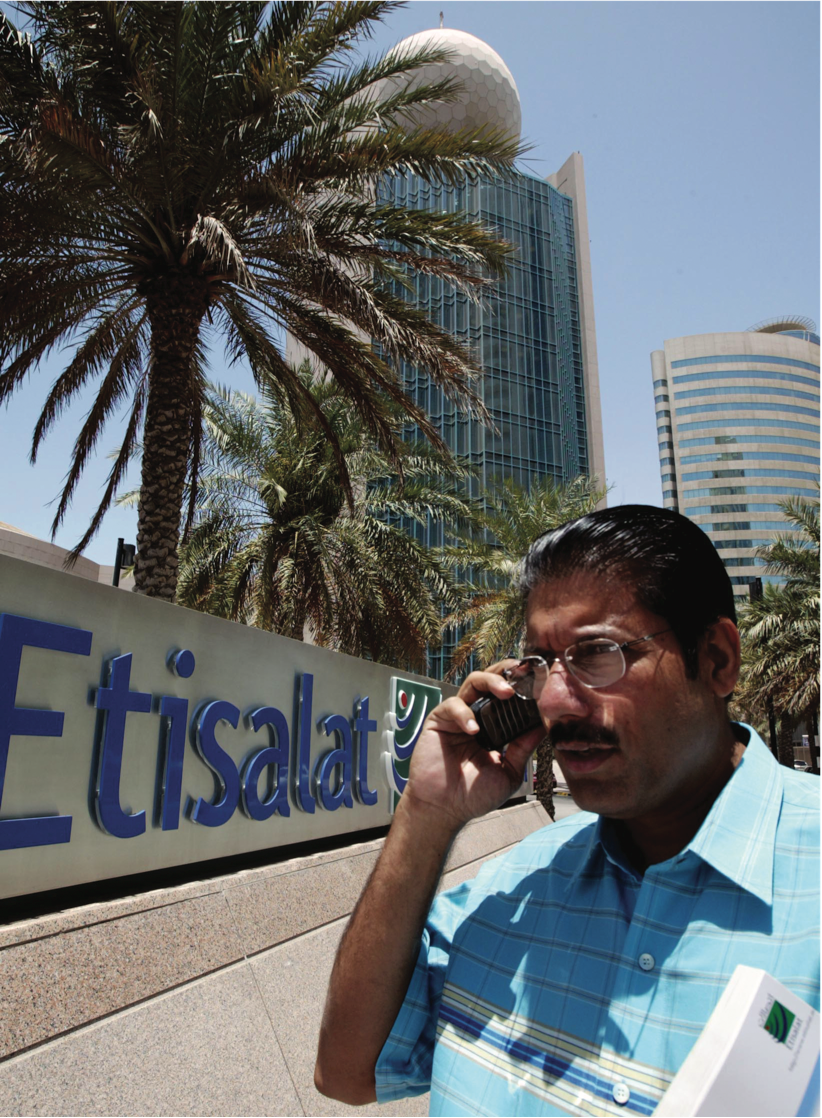
The Gulf Information Technology Exhibition 2006 – or GITEX as it is commonly known – drew in 1,347 exhibitors from 76 countries, while the inaugural GULFCOMMS, which ran concurrently, featured some of the world’s largest telecommunications firms, such as Nokia, Orange, Thuraya and local firm Etisalat.
Development of the ICT sector has become one of the main pillars of Dubai’s economic development strategy, as the government seeks to establish a successful knowledge-based economy.
Taking a front seat
In order to stimulate the ICT sector, the government initiated several projects to pave the way for the private sector. The first step was to establish infrastructure, such as the Dubai Internet City (DIC) in 2000.
Aside from the sophisticated telecommunications infrastructure, particularly advanced in a region still lagging behind in terms of ICT, a 100% exemption from personal and corporate tax, 100% ownership of business and no currency restrictions nor customs duty were some of the other measures taken to support the free zone.
The latest figures released by the DIC indicate that more than 850 companies have taken root in the free zone, up from an initial 100 in 2000. Some major firms such as Microsoft, IBM, Oracle, Samsung and Sony Ericsson have already set up regional offices within the DIC.
Currently, a $1.3 billion extension project is underway, and should be completed by the end of this year. Furthermore, the DIC is about to set up smart cities, specifically high-tech IT parks, in both Kochi, in the Indian state of Kerala, and in Malta.
The second step entailed the launch of some motivating initiatives. These include the implementation of the Dubai e-Government program, the end of mobile operator Etisalat’s monopoly and the gradual approval of Voice over Internet Protocol (VoIP), among others.
The launch of the e-Government program, one of the first of its kind in the Arab world, has not only improved the efficiency of government services, but also enhanced transparency for businesses. The target to have 90% of services online by 2007 is likely to be met. As a result, the e-Government Readiness Report 2005, published by UN Online Public Network and Finance (UNPAN), improved the ranking of the UAE to 42, up from 60 in 2004. Dubai greatly contributed to this successful ranking.
Free at last
Undoubtedly, the end of Etisalat’s monopoly was hailed as an important step towards greater liberalization of the telecom sector. New licensed operator Emirates Integrated Telecommunication Company should announce its commercial launch date at the end of November. To offer lower costs than its rival Etisalat, du has announced it will charge calls on per-second basis. In addition to the competition between the two operators, this will also generate incentives on both sides with which to woo new clients, given that Dubai’s population is growing steadily.
In addition, the Telecommunications Regulatory Authority (TRA) has just approved the use of VoIP technology, albeit for local calls within the UAE only. International calls using VoIP provider Skype remain prohibited, not for security reasons, but for financial reasons, as charges on calls represent an important source of revenue for telecom operators.
