The dank and narrow hallway outside
the office of Ayman Oueidat,
Mount Lebanon’s chief bankruptcy
judge, is almost always cluttered with visitors,
some of whom wait in line for more
than an hour for the chance to see him.
“The country is falling apart,” shouts the
impatient judge to two lawyers bickering in
front of his desk. “Try to solve this problem the office of Ayman Oueidat,
Mount Lebanon’s chief bankruptcy
judge, is almost always cluttered with visitors,
some of whom wait in line for more
than an hour for the chance to see him.
“The country is falling apart,” shouts the
impatient judge to two lawyers bickering in
front of his desk. “Try to solve this problem
between yourselves.” Smart advice.
With the economy near comatose, some
of Lebanon’s five bankruptcy courts have
been working at full throttle. “We’re seeing
35 new cases a month,” says Oueidat,
busily flicking through files on his desk. In
Mount Lebanon alone, there are more than
1, I 00 bankruptcy cases currently pending,
up from 800 two years ago. Among the
more notable enterprises to have gone bust
in recent times are Mesir and Phoenix
insurance firms. The publicly listed company
Etemit, one of the region’s largest pipe
manufacturers, fi led for bankruptcy protection
at the beginning of last year after
suffering $25 million in losses between
1996 and 1998 (see box).
Bigger caseloads have put added strains
on the already overburdened judiciary.
Bankruptcies can get bogged down in
court for as long as a decade, although
most are resolved within three years.
Financially strapped business people often
flee the country before their case lands
before a judge, taking a sizable wad of
their lenders’ money with them. And at the
end of the whole expensive and time-consuming
process, a lender often gets back
only a tiny fraction of the money he is
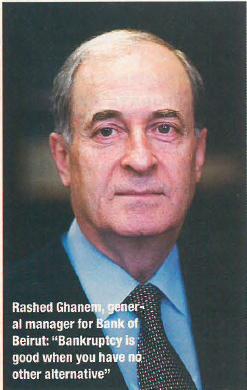
owed. “Bankruptcy is good when you have
no other alternative,” says Rashed
Ghanem, central manager for Bank of
Beirut, explaining why banks are reluctant
to take a delinquent client to court.
Many legal experts believe that the bankruptcy
system is in desperate need of an
overhaul. “We have good laws but they
need to be updated,” says Andre Nader, a
bankruptcy lawyer. Lebanon’s bankruptcy
laws date back to the 1940s and were borrowed
from the French. But, unlike France,
Lebanon has never bothered to revise them
as business evolved. “One can hardly say that the legal environment is adapted to the modem
economy,” says lawyer Akram Azouri.
Unlike the US, where scores of companies
file for Chapter 11 bankruptcy every year,
Lebanon’s bankruptcy laws provide faltering
businesses with little protection from angry
creditors. Companies or traders are usually
declared bankrupt only after the.y have been
sued for failing to pay their debts. The conditions
for filing for concurdui prevemi_f –
which allows businesses to repay their
Joans, in part or in whole, over one to three
years – are so strict that many legal professionals
cannot recall a single case when the
courts have allowed it. More than half of a
company’s creditors – claimants to no less
than three-quarters of the money owed –
must approve the tenns of the concordat
preventif. And the business must present
accurate and detailed books for the three
years prior to its bankruptcy declaration.
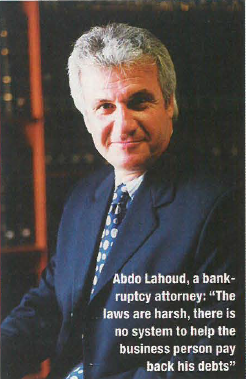
“The laws are harsh,” says Abdo Lahoud,
a bankruptcy attorney. “There is no system
to help the business person pay back his
debts.” Judges have limited flexibility in
dealing with an insolvent company. lf a
concordat preventif fails, a judge can do
little more than declare the business insolvent
and liquidate its assets.
This, when often a simple
restructuring of the company
might be enough to get it
back in the black.
The French, by contrast,
gave the power of redressement
to their courts in the
1960s. There, a judge can
appoint a receiver who has
the authority to change a
company’s management,
sell off assets or do whatever
it takes to keep the business
afloat and get creditors
their money back. “The
concept of bankruptcy at
the beginning of the century
was to liquidalt: Lht: l:Urnpany.
The concept in the 21st
century is to save the company
and liquidate only by default,” says
Azouri. ‘The interest of creditors is to gel an
enterprise back on its feet.”
Despite calls by both lawyers and judges for
bankruptcy refonn, parliament has failed to take action. But more than just new legislation
is required. Inefficient tax collection
(the rate of income tax evasion was recently
estimated by Banque Audi to be 75%)
means that businesses have little incentive to
maintain accurate books. The result is that few
struggling businesses qualify for bankruptcy
protection. The scarcity of official records also
makes it more difficult for the judiciary to
tral:k down assets or business persons once a
business has been declared insolvent.
Some, including Oueidat, feel that the
laws, although old, are not the problem. In
France, he says, there are growing calls to
reduce the judge’s power of redressemenl.
Hopelessly sick companies, says Oueidat,
are often kept limping along under the
court’s protection as their creditors wait
endlessly for the return of their money. In
the end, says Oueidat, “Lebanon’s bankruptcy
laws are good, it’s the economy
that’s bad.”
Eternit-gate
N othing demonstrates the shortcomings of the bankruptcy system better than
the story of Etemit. In what is probably the biggest bankruptcy case In postwar
Lebanon, the publicly listed pipe manufacturer filed for concordat preventif
in January 1999, after accumulating a debt of $25 miHion over thr8e years. The company
wants half its debts erased, but the courts have been mysteriously tardy in
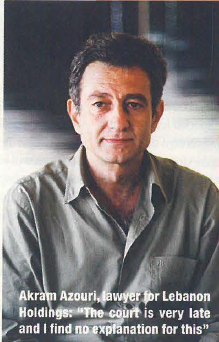
issuing a decision on the case. “The court is very late and I find no explanation for
this,” says Akram Azouri, lawyer for Lebanon Holdings, an investment fund that
bought a 20% stake in Etemit. Azouri, along with the investment bank Lebanon
Invest, which sank $3.6 million into the pipe manufacturer, sued Etemit for fraudulent
accounting. But until the court agrees to either accept or reject the concordat
preventif, by law, any lawsuit against the company remains on hold.
Lebanon’s banknJptcy laws provide a specific set of criteria by which courts have
to decide whether to accept or reject a company’s concordat preventif. If the judge
agrees to the terms of the bankruptcy, he has 30 days in which to call a meeting of
the creditors, who must vote on the tenns. “The court did not
take a position on this case even though the law says that a
decision should be taken quickly,” says Azouri. Some individuals
involved in the Etemit affair say privately that they suspect
political interference in the case. The pipe manufacturer
has worked for some powerful clients in recent times,
including the Syrian ministry of defense. Bemartt Sham, one
of Etemit’s lawyers, fervently denies any political meddling.
“That’s not at all true,” he says. “The delay Is not unusual
because the company has many relations with parties both in
Lebanon and outside. It will take time for the courts to make
sure the concordat can be implemented.”
But the courts have recently started to move on the case.
Recently, some Etemit shareholders went to court to demand
that a judicial administrator be appointed to re-audit the company’s
books and run the company until a new board of
directors can be elected. Etemit’s board of directors, who have
been quarreling over control of the company for the last few
months, were reportedly split over the appointment of a judicial
administrator. Board members Riad Mrad and Salim
Khalifah were strongly opposed to the plan, while Tony Awad,
who became general manager after the former director Pierre
Abboud was forced to resign in June 1999 (Abboud has since disappeared), was
not. The court was supposed to rule on the appointment of a judicial administrator
at end of August, but the judge in the case, in a puzzling move, delayed her decision.
Meanwhile, a ruling on the concordat preventif remains on hold.