0 ut with old, in with the new. This
has been the philosophy in Beirut
for over 50 years and nowhere
has it been applied more ruthlessly than in
real estate. Knocking down an old twostory
house and replacing it with a multifloor
residential tower is considered
progress – and a potentially great way to
make a bundle of money. It’s no surprise
then that, when the ministry of culture in
I 996 forbade the demolition of 1,100 of
Beirut’s oldest buildings and then attempted
to pass a law to preserve them,
landowners and developers cried murder.
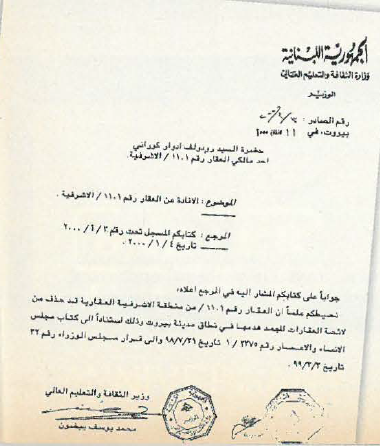
A few weeks ago, their protests paid off. In
a letter to the municipality of Beirut,
Mohammed Youssef Beydoun, the minister
of culture, released a number of protected
buildings, built during the Ottoman and
French mandate eras, from the preservation
decree. Later, according to Mona Hallak of
the association pour la protection des sites et
anciennes demeures au Liban (APSAD), he
issued demolition permits upon request
from individual landowners, although
Beydoun denies this. A dim fate for Beirut’s
remaining old buildings may be sealed. But
a growing number of developers and property
owners are discovering that there need not be
a conflict between the desire to preserve the
city’s heritage and the drive for profits. In
today’s real estate market old is often gold.
“The old buildings have great economic
potential – look at Monot street and AbdelWahab-
al-Inglisi in Ashrafieh,” says Abdul
Halim Jabr, professor of architecture at the
American University of Beirut and a member
of APSAD. The Ashrafieh area is fast
becoming the most expensive residential
section in Beirut. Along Monot street, prestigious
restaurants, including L’Entrecote,
Thai, Le Monot and Sushi Bar, are housed
inside scenic old buildings. Abdel-Wahabal-
lnglisi is home to such eateries as
Babylon and Tribeca, and offers a slew of
upscale boutiques, all of which exist within
splendid turn-of-the-century abodes.
Throughout the world’s capital cities,
areas with old buildings have proven to be the
most lucrative in terms of investment dollars:
New York’s Greenwich Village, Boston’s
Back Bay and Georgetown in Washington,
DC. ‘These are some of the most expensive
and exclusive areas in the world precisely
because of the carefully preserved old
homes,” says Hana Alamuddin Haydar,
architect and APSAD member. In Paris as
soon as the government designates an area as
a national heritage site, real estate prices
soar, says Jacques Tabet, urban designer:
“Now landowners are begging the government
to classify their old buildings just to see
the value of their homes automatically double
or triple.”
A handful of Lebanese are starting to recognize
the value of historical structures. In the
Tabaris area, near the Jardins de Tabaris II
construction site, two elegant four-story
buildings built at the beginning of the 20th
century were renovated and converted into
eight luxury apartments. The units sold within
days at an average price of $400,000. In
Gemmayzeh, on Gouraud street, a multiunit
1930s building was converted into modern
apartments. All units sold before the
work was even completed. Joe Kanaan,
owner of Sodeco Gestion, says he can hardly
keep up with the demand for older residential
units. Even though the older buildings
lack certain modern conveniences, such as
parking and elevators, people choose them as primary homes because of their architectural
splendor. “Old homes, because of such
details as high ceilings, mosaic floors and
arched windows, usually sell within weeks of
coming on the market – even in the current
real estate slump,” says Kanaan.
In a downturn, it is easier to m’ttke money
by renovating old buildings than by building
new ones, argues Jabr. “Rather than investing
$5 million to buy a piece of land with an
old building, tearing it down and building a
new high-rise, you can invest $500,000,
renovate an old building and get revenue
within months, instead of waiting for the elusive
millions that may never materialize,” he
says. He gives the example of Au Vieux
Quartier: “Here you have an enlightened
owner who saw market value in his old
building. He opened a restaurant inside an
antique building and fashioned an oldworld
theme around his business venture.”
With Beirut’s property market satwated-an
estimated 160,000 apartments are empty –
there’s little demand for new structures. Near
Tabaris, L’Hermitage, the Fayyad buildings
and a spanking new building at the end of
Shehade street, remain empty. On scenic
Selim de Bustros street, a new white-stone residential
tower that was inhabitable months ago
still has over half of it~ units available for sale.
In Ramlet Al-Baida, virtually all buildings
overlooking the Mediterranean are empty.
And along the comiche, two luxury highrises
with over 20 floors, Binayat-al-Ahlam
and the Comiche Garden, are monuments to
poorly planned investment schemes. They
are both vacant except for one lonely unit.
“Why build another residential tower fated to
remain empty?” asks Jabr. ‘There’s $12 billion
currently invested in inactive real estate
in Lebanon. The Lebanese can no longer
build their national economy on hope- hope
for regional peace, hope for the return of the
Lebanese expatriates.”
Bernard
Mouchbahani, senior
manager of project
finance at Lebanon
Invest, believes that it
will take a huge economic
boom to fill the empty new construction.
Even then, these
new units will take at
least five post-boom
years to sell out entirely.
Mouchbahani offers a
simple business strategy:
“Stop building, renovate
what you have and slash your
prices in half. It’s better to sell an
apartment for $200,000 and put
your money in a mutual fund than
to wait five, six or seven years for
an economic boom that might get
you $400,000.”
But the demolition balls keep
swinging. Among the buildings slated
for destruction are the stunning artdeco
Kourani home in Ashrafieh and
the elegant Al-Houssami home in
Ain el Mreisseh. Even the venerable
Au Vieux Quartier abode, built in the
1920s, is now on death row. Of the
original I, 100 buildings that were frozen under the preservation decree, over
half have been released. Protected buildings in
Beirut now number less than 600. In
Ashrafieh, a uniquely Lebanese twist of
events is transpiring. Developers wanting to
capitalize on the area’s desirability are tearing
down old buildings to build huge residential
towers, dt:stroying both the character of
Ashrafieh and the reason why people are
moving to the neighborhood. Au Vieux
Quartier is a compelling example because the
elegant structure, which was completely renovated
six months ago, is in excellent overall
condition. The ministry of culture has repeatedly
stated that the building was protected
and that no demolition permit had been issued
– but according to Hallak, its destruction was
approved by Beydoun himself.
Victor Najarian, general manager of
CARE group, one of the biggest real estate
brokers in Beirut, applauds Beydoun ‘s decision.
“Some old buildings were arbitrarily
placed under a preservation decree by a
bunch of students and have absolutely no
architectural value,” he says. It is this kind of
thinking that appalls architect Habib Debs. Old
buildings have value, he says, and not just nostalgic
value. “We need to think in terms of our
future, and think of Lebanon’s prospects as a
tourist destination,” he says. “Visitors will not
come to Lebanon to look at horrid residential
towers.” Other cities in the developing
world, including Istanbul, Mexico City and
Tunis, have stringent preservation codes
because they have recognized the value of
their old neighborhoods. All three cities
receive millions of visitors a year.
From his office in Ashrafieh, Debs points to
the Yared building, a pink IS-story tower
surrounded by a metal gate that was plopped
down in a particularly scenic area of
Ashrafieh. “New buildings such as Yared are
an aberration,” he says. ‘These buildings are
destroying the very essence of the city.” Less
than 3% of Beirut’s original buildings remain
standing and the once scenic Mediterranean
port city has turned into a sorry mess of huge,
empty residential towers. As Beirut’s old
homes are demolished, so are the remnants of
its nostalgic past. There are some in the real
estate business who are starting to realize the
economic value of Beirut’s remaining old
buildings. The question is: ls it too late?