

A bude Omari is known· for his charm and pit-bull mentality:
When he has an idea between his teeth, he might be pleasant
about it, but he will never let go. For the boyish-looking
entrepreneur, with his casual attire and winning smile, the world of the
Web is a natural fit. He always looks to the future, say colleagues, and
his sales pitches cany a New Economy resonance. Striking a chord with
the general public, he calls his e-venture, “Internet for everyone” and
describes his concept as “the next breed in portals.”
As co-founder of Cyberia along with college roommate Walid
Fakhry, Omari has experienced the adrenaline highs and the growing
pains that accompany the transformation and sifting of ideas into
a cohesive business. The main pressure, bigger than earnings in a
topsy-turvy environment, is to build organizations – fast- before opportunities slip away.
His breakthrough idea? ‘There is no single
idea,” says Omari. “Cyberia doesn’t operate
with a unique selling proposition.” Instead, by
strapping on a family of value-added services
such as voice services – still in beta testing
phase – webmail and news, the company hopes
to move away from its position as purely an ISP.
“Our approach is not generic,” says Omari.
“From the start, we looked specifically at what
would make _a Lebanese customer go out and
start using the Internet.”
It took barely a year for Cyberia, launched
in September 1996, to climb to pole position, and it soon became
clear that the charismatic entrepreneur had tapped into the mindset
of the New Economy. Investors were drawn to his idea of a “Net
for the people.” And why not? Lebanese consumers flocked to his
user-friendly startup kits and were able to replenish their online credits
from a large distribution of resellers – both Cyberian innovations
that were later emulated by other ISPs. Omari had already signed
up some long-term investors, including Lebanon Invest, financier
Elias Hallak, founder of Invest Corporation, and Chase
Manhattan, whose names added cachet to the venture.
So what are the payoffs? The exact answer is safely guarded in
some Cyberian high-encryption electronic vault. However, the average
growth in revenues has been of the order of 64% over the past
two years, and by estimates gathered from both the local ISPs and
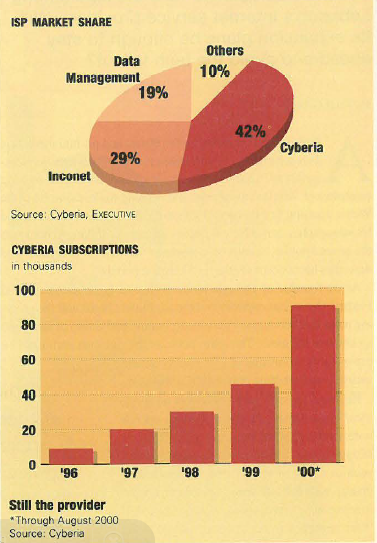
independent market research, Cyberia commands as much as
42% of the 200,000 dial-up access market, compared with
lnconet’s 29% and Data Management’s 19%.
None of the companies would divulge revenue or profit figures. But
it’s unlikely that any are profitable with their ISP services and questionable
whether they’re making money on anything else -just look
at the poor track record in that regard of Internet companies in the West.
Revenue is offset by Cyberia’s high operational costs. Other than
the overhead charges, the large office spaces in Hamra and the 54
employees, are the astronomical charges incurred by the ministry
of post and telecommunications (MPT) who have a monopoly on
phone lines and prices. Bandwidth is leased at the monthly rate of
$59,000 per 2mbs, which is split as a $27,000 fee for connection
to the Internet backbone, a further $27,000 in licensing fees and
$5,000 in charges to the international gateway. ‘The MPT still doesn’t
have a clear policy toward regulating the private sector in terms
of charges and frequency allocations,” complains Omari. “The
monthly charges hit you like a brick wall.”
This discomfort is shared by ISPs across the board, particularly when
they look with envy at the palatable US rate of $4,000 per 2mbs.
Cyberia’s Internet service runs on 8-10mbs, requiring monthly
charges in excess of $250,000. This expense is quite aside from the
$13 charge per phone – the company has some 3,000 lines nationwide.
If the company’s finances remain somewhat opaque, what is more
apparent is Cyberia’s corporate evolution from ISP to all-in-one portal
– an evolution that has its parallels and differences with other
ISPs. With mobs of new users logging onto the Net and annual growth rates of some 150%,
the future was looking bright for ISPs in
1997. Until they had the rug pulled out from
under them that is.
That year the number of ISPs peaked at over
20. Today there are just a handful of players. First
came an attack from an unexpected quarter.

Banque Audi entered the ISP market in August
1999, with a free dial-up service to win over consumer
Internet users. Offered in conjunction with
Inconet, the usual access charges were paid by
a monthly account-handling fee ofLLl0,000-at a time when unlimited access charges were
still about $30. Not wishing to be outdone by the Audi/Inconet
alliance, Byblos Bank teamed up with Data Management in a
PC/unlimited-internet package. The entrance of the bank Net accounts
spelled disaster for small ISPs and big trouble even for ISPs
like Cyberia, who hadn’t chosen a bank partner.
Barely a month later, Omari announced to a surprised Internet
community that his company had adopted a $12.99 unlimited
access price – slashed from $29 – in a desperate maneuver to consolidate
his electronic ground. The fallout was severe. The price cut
effectively signed the death warrant for many smaller ISPs.
“Many ISPs fell by the wayside,” recalls Jacques Hakimian,
Internet analyst with Dialog. “The ones who survived were forced
to differentiate in any way shape or form.”
ISPs have responded on several fronts. While some complain they
can’t survive if prices go any lower, others continue to use the access
charge as a key trump card. (Terranet has maintained a monthly $9.99;
and Libancom, having dropped its access charge to an unprofitable
$6.66 is back on $11.99.) Others still are concentrating on adding Web
services, such as website hosting, or are trying to lure customers with
promises of better service and access with less downtime.
A case in point is US-based PSINet, which entered the Lebanese market
by purchasing Lynx, a local ISP in its death throes. It is the only local
ISP with a direct fiber-optic link from Lebanon to North America. And
since about 85% of all Internet activities run on the American backbone,
this translates into significant cuts in delay – typically 53% on
the 30kpbs norm of a copper cable. This is an important selling point
in a cutthroat market that looks for added benefits. Mike Mansour, IT
consultant for PSINet Lebanon believes that speed, not ISP content,
is the way to survive. “We offer a super-carrier service that cuts out all
the middlemen,” he says. “That’s what will count in the future.”
Data Management adopted a different strategy to widen its revenue
base. Keen advocates of Web hosting, the ISP turned its focus
into helping startups find their footing such as E-comlebanon, a B2C
venture that was launched by entrepreneur, Karim Saikali. “Data
Management’s expertise was key in implementing my project,” says
Saikali. That expertise brings with it a startup fee of $25,000 for
average-sized Web ventures.
Data Management also launched Yalla! in 1999, a homegrown
Yahoo!, proving that their corporate focus had already shifted to
services, content and e-commerce. “In the Internet world, no one
is willing to invest in a company that grows slowly,” says Antoine
Haddad, advertising and marketing manager of Data
Management. “Go find an Internet company that said it was going
to be methodical.” Yalla! carries some 570 Web pages, ranging from
news and business to computing and kids, that are updated daily
or weekly and register a total 3 million hits a month.
“It’s not that ISPs are no longer providing Internet service,” says
Dialog’s Hakimian. “But they are having to evolve and cater to
niche markets.” Omari is more succinct in his assessment of the
changing ISP model: “Access will become more and more of a commodity
while content will become more and more relevant.”
Cyberia’s e-magazine was launched in July 2000 with sections
on news, business, arts &entertainment and sports, bringing to
fruition over a year of planning. Is the result another homegrown
Yahoo!? Not quite, says Wadad Awam, Yalla!’s editor-in-chief. “In
essence, we’re more of a portal than Cyberia,” she says. “Our content
is collected from various sources just like Yahoo!. Cyberia, on
the other hand, is more of an e-magazine, like CNN: that is, a one source
media.” Cyberia has four sections to Yalla!’s eight, but rather
than resorting to wirefeeds, the majority of their news and features
are written in-house by a newly hired staff of reporters and editors.
Independence comes at a cost. Cyberia’s news center carries a
running tag of about $30,000 a month- and with no significant post publication
boost to the roll of subscribers, the online magazine has
so far added little in terms of returns. With all the
other expenses, that’s quite a cash burn
rate. How long can it last
without having to
take austerity measures
that might
include staff or salary
cuts for instance?
Revenues from the online
news, if there are to be any, will come at a later stage. “For instance, a customer who reads a movie
review in the arts and entertainment section, and is interested in the film,
will want to know where it’s playing,” says Omari. ‘The next stage will
be to allow that customer to reserve and buy his ticket online- and that
becomes commerce that can generate profits.” And, reasserting its move
away from the original ISP model, Cyberia launched chat rooms and
message boards in October in a bid to drive more traffic to the site.
But some analysts believe Cyberia has done too much, too soon.
“They got going too fast,” says Sam Lutfallah, general manager of
Inconet. “They got unfocused.” The changes are draining cash, he
believes, and are wiping out any chance of profitability. “It may be
only a matter of time before they burn out.” Whereas he does see
the need for ISPs to play more of a portal role in today’s e-landscape
lnconet itself is working on plans to reposition – he maintains that
Cyberia is rushing headlong, almost impulsively. “The name of the
game is to hold on to your subscribers,” says Lutfallah – Inconet has
some 50,000 subscribers, about 45% of whom are signed up on Audi
Net-accounts. “Cyberia seems to be in the process of putting the carriage
before the horse’s head.”
Omari is certainly a young man in a hurry. But, for the time being
at least, he has a solid following among the mouse-clicking voters.
Cyberia registered some 13 million hits for the month of September
2000, an increase of roughly 450% from September 1999 and some
10 million more hits than Yalla!. And according to an inside source,
the arts & entertainment page has grown by more than 300% in hits
in the last two months.
The jury is still out on whether this new whiz kid on the media block
will meet with success. But traditional Lebanese newspapers are
extending their print operations to the Web to counter Cyberia’s
foray. Both An-Nahar and L‘Orient-Le lour have consolidated their
content into bright Internet portals that blends news with entertainment
listings and other local information.
So what next? Cyberia ‘s territorial ambitions aren’t limited to a home
turf. Plans are already afoot to expand into the relatively untapped e-markets
of Jordan and Algeria. The coming five years foresees expansion
throughout the Middle East- an e-market of roughly 2 million.
Given this pan-Arab goal, Omari can expect more competition – not
only with local rivals like Yalla! but also with such regional players as
Arabia.com, AiwaGulf and
California-based Planet Arabia.
It’s a strategy that has the support
of his shareholders. “Our outlook is
that there’s a great potential in
Cyberia’s future,” says Nicole
Gebara, assistant general manager at
Lebanon Invest. “Given the falling
prices of access charges, it makes
economic sense to extend the revenue
base by incorporating a portal
within the ISP model.” Through its
venture capital fund, the financial
house bought into Cyberia in 19% to
the tune of $1.1 million – or 15.4% •
of the ISP’s $7 .2 million value at
the time – and sold about two-thirds
a year later for about $3 million.
“Going regional is a logical progression,”
she says.
It’s a gamble that may just pay
off. In Lebanon, as in the West, the
gold-rush mentality has all but
gone, and it’s apparent that just
select dot-corns will strike the mother lode. However, in contrast
to the tortoise-like speed of development in brick-and-mortar
industries, capitalists with stars in their eyes might be more willing
to finance the handful of homegrown companies that they
believe will become the region’s eBays and Yahoos.
And why eBay or Yahoo!? ”The concepts that have the best chance
of surviving on the Web,” says Hakimian, “are those whose content
and services are not portered from traditional media and retailing, but
are purely Internet or interactive services.” Companies that fit best into
this slot are those that let consumers negotiate their own price, and the
best of these are auctions. The biggest online auction site, eBay, used
the Web’s technology to bring together an audience that had previously
been fragmented by geography. A collector of nargileh pipes, for example,
no longer needs to peruse every bazaar and souk in the Middle East
to find the perfect hubbly-bubbly; he just needs to search online.
But venture capitalists will need a lot more than theoretical models
to be moved into signing checks: They will need practical reassurances.
“Foreign capital, most of it from America, is hovering overhead
waiting to dive into Lebanon’s Internet industry,” says Joseph
Hanania, general manager of Compaq’s Middle East and North Africa
division. “All they’re waiting for is a firm commitment from the
Lebanese government to the New Economy – dropping Net phone
charges would be a start.” Others warn that capitalists, despairing of
any easy exit through which to sell their investments, may move on
to neighboring countries, leaving Lebanon’s nascent Internet industry
gasping for cash. The money could also quickly vanish or move
elsewhere because of regional instability. Foreign venture capitalists
could decide Lebanon, and indeed the entire region, is not
worth the risk, leaving people like Omari stranded.
It’s a delicate situation – but not one without its silver lining. Most
insiders and market analysts predict that Cyberia will do well in the long
haul and that its share price will eventually reflect that success. Even
in the West, the growing list of dot-com deaths is mitigated by some
good tidings. A recent report by Forrester Research, based in
Cambridge, Massachusetts, has predicted that global Internet spending
by consumers could increase to over $180 billion in the next five
years, up from $20 billion last year.
The money earned off the Internet is not yet sinking very deeply into
Lebanon’s economy. Buses and billboards that have been taken over
by dot-com advertising hardly make for a Net nation. And Cyberia’s
battle cry of ”All you need is love” can only go so far to drive the New
Economy. As mercantile Lebanese know only too well, capital is power.
Omari and other young Internet entrepreneurs will need to hang onto
their assets and make them grow if they wish to emerge as a potent force
shaping Lebanon’s economic – and political – future.
