
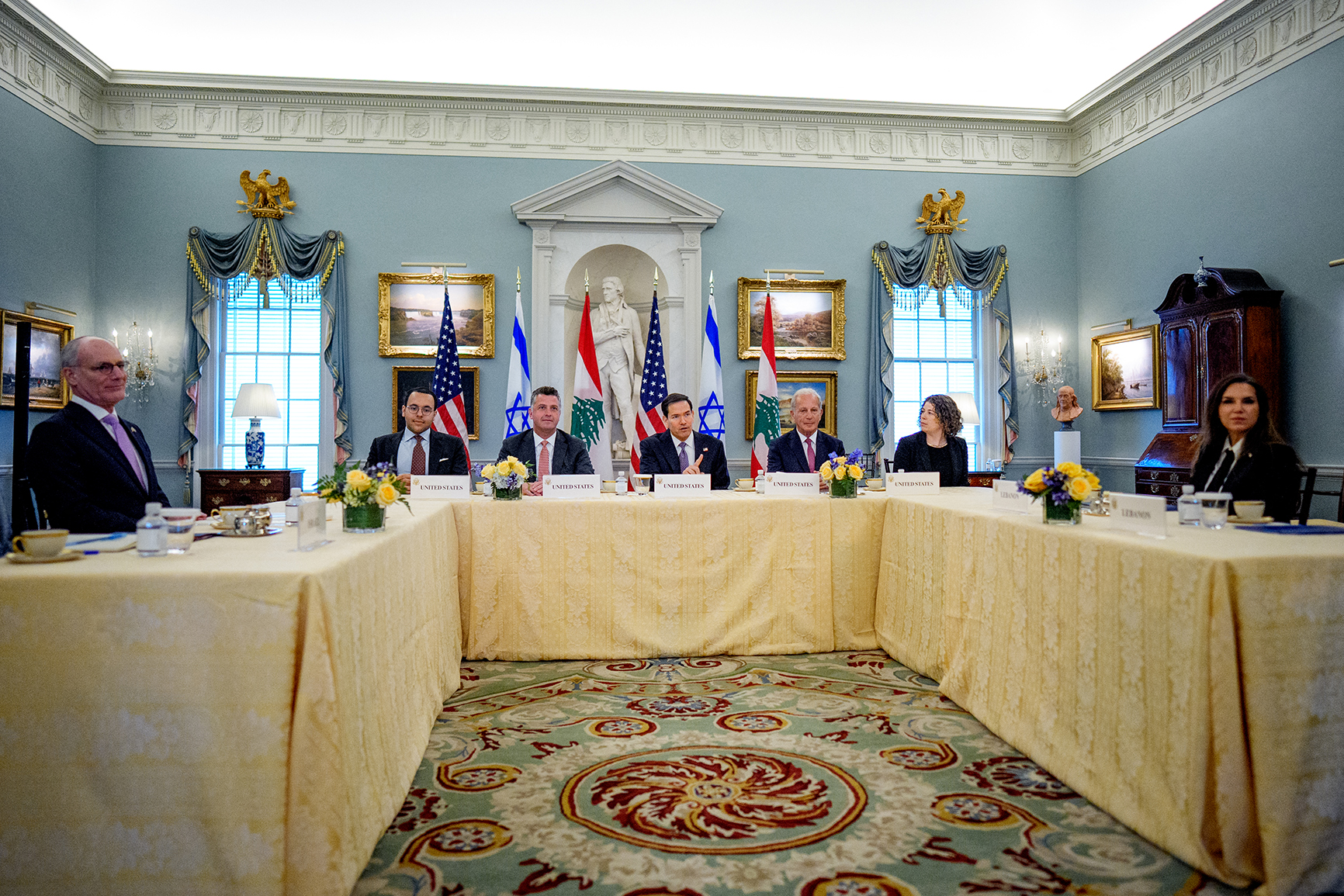
In the intricate theater of Levantine diplomacy, the ongoing trilateral negotiations surrounding the June 2026 ceasefire framework between the United States, Israel, and Lebanon are widely misread. International observers parse the diplomatic communiqués for signs of a grand bargain, analyzing the technical capabilities of the Israeli and Lebanese delegations as if they were engaged in a conventional negotiation over borders and sovereignty. But this misconstrues the fundamental architecture of the talks. Lebanon is not at the table to outmaneuver Israel; it lacks the leverage, the unified government, and the military deterrent to do so. Instead, for better or worse, Beirut is engaged in a delicate test of statehood for an audience of one: the United States.
Lebanon arrives at these negotiations fielding a state apparatus hollowed out by economic collapse, shattered by Israeli demolishment of civilian infrastructure, and sidelined by Tehran’s grip. There is no traditional diplomatic leverage. Yet, in the paradox of Lebanese statecraft, this extreme fragility serves as its primary geopolitical currency.
The strategy is one of vulnerability presented as a value proposition. The Lebanese state is banking on the premise that a total institutional collapse on the Mediterranean remains a red line for American security interests. Beirut is essentially signaling that while it holds no strong cards, its survival as a functioning state is of such paramount interest to Washington that American investment is a geopolitical necessity. To salvage the republic, Lebanon is not attempting to negotiate a sovereign peace it cannot enforce. It is attempting to convince Washington that investing in a Lebanese state is the only viable alternative to the permanent entrenchment of a sprawling Iranian proxy network.
To comprehend the posture of Beirut, one must deconstruct the illusion of the bilateral talks with Israel. The primary objective of the Lebanese delegation is not to trap Israel in a diplomatic masterstroke, but simply to remain in the room, demonstrating good faith, exhibiting state-like behavior, and signaling a willingness to engage within a shaky but still vital international order.
The true counterpart in these meetings is the United States. It is an exercise in proving institutional viability to the Americans. By repeatedly showing up in Washington, Lebanon secures the political capital required to survive. This relationship with the United States is still the primary tie that can deliver structural dividends: vital funding for the Lebanese Armed Forces, diplomatic cover, and occasional leverage to restrain Israeli escalation. Paradoxically, gaining the confidence of Israel’s primary enabler is the only mechanism Beirut possesses to extract any concessions from Tel Aviv.
The Beirut-Washington dynamic
Executing this strategy requires navigating a political landscape in Washington that is highly complex. Washington operates as a labyrinth of competing interests fractured between traditional political wings, the administration, Congress, and, where Lebanon is concerned, deeply entrenched diaspora networks that often work at cross purposes.
The Lebanese diplomatic strategy relies heavily on a triad of American power centers, deeply influenced by the Lebanese diaspora. First is the Oval Office, where familial ties and personal affinities elevate the profile of Lebanon within an administration where executive attention is paramount. The presence of influential Lebanese Americans in high level advisory roles provides Beirut with internal channels that are crucial for maintaining presidential goodwill.
The second pillar encompasses the National Security apparatus and Congress, navigated by established lobbying infrastructure like the American Task Force for Lebanon (ATFL). While executive envoys handle the White House, these task forces leverage decades of bipartisan relationship building to sustain funding and political support within congressional committees. They provide a stabilizing force, often guided by seasoned figures who understand the brutal realities of Lebanese constraints and help keep the bilateral relationship on the rails despite periodic crises.
The third and perhaps most vital pillar is the United States military. Central Command knows the Lebanese Armed Forces (LAF) better than the Lebanese state itself does. The Pentagon views the army as a critical, albeit heavily constrained, defense against total institutional collapse. While American defense officials harbor exasperation over the Lebanese army’s inability to confront Hezbollah, the uncomfortable reality is that Lebanon’s security has always been managed by proxy. The LAF’s incapacity has been shaped in no small part by decades of deliberate international underinvestment, designed to ensure that the army never posed a threat to Israel. This created the security vacuum Hezbollah moved to fill. Handing over Lebanon’s security to external powers has never led to stable outcomes in the region.
To engage this complex Washington ecosystem, Beirut has fielded a negotiating team built less for technical boundary disputes and more for political signaling. The delegation balances two distinct archetypes of Lebanese statecraft. One wing of the team, anchored by figures representing the presidency, provides unshakeable nationalist credibility. Rooted in Lebanon’s south, this presence ensures the delegation cannot be easily pressured or dismissed as out of touch with the realities of Israeli occupation. The other wing, led by Lebanon’s ambassador to the United States, provides the dynamic, fluent translation of Lebanese interests into the political language of Washington, signaling to the Americans and Israelis a genuine desire for structural stability.
Together, they are managing an international lifeline. Continued engagement forces Tel Aviv and Washington to view the Lebanese state not merely as an extension of armed factions, but as an independent entity worthy of preservation.
Vying for a piece of Lebanon
Any discussion of Lebanese state-building is ultimately haunted by the specter of Tehran. Iran insists on keeping its Lebanese card firmly in its geopolitical deck. Although the utility of Hezbollah as a deterrent against a direct Israeli strike on Iranian soil has degraded significantly since 2023, the militia remains the most potent instrument Tehran possesses for confronting Israel and extracting leverage from the United States. Iran remains committed to preserving Hezbollah’s vanguard status regardless of the catastrophic cost to Lebanon — to its civilian infrastructure, demolished by Israeli military action, and to its institutional viability, eroded by both internal dysfunction and external aggressions.
This reality imposes an absolute ceiling on what the current negotiations can achieve. The fundamental demand of Beirut, an Israeli withdrawal from Lebanese territory, is contingent upon conditions that the Lebanese state has no power to enforce. Israel systematically destroys entire villages while demanding the disarmament or significant pullback of Hezbollah; Iran categorically refuses. The current fear is that there is no foreseeable pathway for an Israeli withdrawal or the disarmament of Hezbollah. The result is a diplomatic paralysis dictated entirely by foreign capitals.
This hegemonic veto over Lebanese sovereignty exposes the desolate domestic reality of the state, which is further exacerbated by profound internal divisions. The Lebanese negotiating position is inherently hampered by a fractured government where the President, the Prime Minister, and the Speaker of Parliament often pull in contradictory directions.
Furthermore, the state is buffeted by competing international pressures. While the United States pushes for rapid stabilization, regional powers like Saudi Arabia and Turkey apply their own competing pressures. Riyadh works to consolidate Lebanon’s negotiating front while simultaneously resisting any settlement that would draw Beirut into Israel’s sphere of influence, and Ankara positions itself as a counterweight to Israeli regional hegemony rather than a facilitator of a peace agreement. These counterpressures push the Lebanese presidency to constantly triangulate between patrons and undermining the cohesion of the state. Consequently, the government has operated for decades as a junior partner in its own security apparatus, ceding the monopoly on violence to a deeply entrenched non-state actor backed by foreign powers. Today, that institutional erosion is nearly absolute. The government cannot negotiate a sovereign peace because it does not control its own territory.
Given these intractable realities, the most worrying short-term outcome of the current diplomatic push is a managed fragmentation. Should Washington and Tehran reach a broader regional accommodation, they might lean on Israel and Hezbollah to impose a lasting ceasefire, creating a tactical pause of a year or two to allow for basic reconstruction. But this would not be a restoration of the Lebanese republic.
In such a scenario, the country remains carved into three distinct spheres of influence: an Israeli military occupation entrenched in the south, Hezbollah secured in its parallel enclaves, and the Lebanese state squeezed in the middle, attempting to govern a fractured archipelago of uncontested zones. This tripartite Lebanon is inherently unstable, mirroring the volatile status quo of the 1980s and 1990s, where foreign occupation and armed non state actors trap the country in a perpetual cycle of conflict.
Scenarios for a better future
Western diplomatic rhetoric often frames Middle East peace agreements through the utopian lens of economic dividends, the promise that laying down arms will inevitably unlock regional connectivity, foreign investment, and sweeping prosperity. For Lebanon, this narrative is a flawed distraction from the grim, immediate work of national survival.
A sharp line can be drawn between two distinct economic horizons. The seismic, transformative boom that would follow full regional normalization, drawing massive investment and linking Lebanon into a Mediterranean economic corridor with Israel, Syria, Cyprus, and Turkey is an inaccessible vision in the current strategic and socio-political environment.
What remains accessible, however, is a realist’s path to greater stability. This does not require resolving the century old Arab-Israeli conflict; it simply requires the Lebanese state to resume the fundamental duties of governance in the areas it still nominally controls. A lasting ceasefire would allow the state to begin cleaning up the catastrophic banking crisis, overhauling the paralyzed electricity grid, stabilizing digital infrastructure, improving transportation networks, and completing a second airport. These are the basic mechanics of survival, fueled by diaspora remittances and independent of the weapons of Hezbollah or the occupation of Israel.
Furthermore, the economic rationale for a ceasefire centers around stemming apocalyptic hemorrhaging before new wealth can be generated. The most lucrative economic policy Lebanon can adopt regarding Israel is simply avoiding the recurring total wars that annihilate billions of dollars in infrastructure and capital every few years. Merely averting that cyclical destruction constitutes a massive economic benefit.
To achieve this, Lebanese policymakers must look to the cold, pragmatic models of Egypt and Jordan, rather than the expansive commercial normalization seen in the Gulf. The normalization model of the United Arab Emirates relies on fundamentally different social and economic backgrounds that simply do not translate to the Levant. The goal for Lebanon is not cultural normalization, which remains socially and politically unpalatable to vast segments of the population, but strict, state to state conflict management.
In Egypt and Jordan, a cold peace allows state ministries to manage shared electricity grids, gas rights, and border security at arm’s length. Even a highly restricted relationship, where Lebanese and Israeli ministries manage maritime borders and energy needs through indirect channels, much like how Beirut historically engaged with Damascus to resolve infrastructure and digital crises during periods of political tension, would yield massive economic relief.
Pursuing this pragmatism is incredibly difficult given the volatile political climate in Israel, where ruling right-wing factions push aggressively for territorial seizures at immense human and environmental costs, making the state a severe, ongoing regional disruptor. Yet, for the Lebanese policymaker, this hostile geography cannot be an excuse for institutional paralysis.
The alternative is a commitment to endless, open warfare. But for a state facing economic and institutional collapse, perpetual war offers no viable future. Governance, in this context, requires severe realism. The state must find a way to stabilize the country and protect its citizens, even when the underlying regional conditions remain hostile.
It is a deeply uncomfortable reality, but one that demands rigorous pragmatism. This unsentimental approach to crisis management should not be framed as a choice between desirable outcomes, but as a severe triage where the preferences of the state are irrelevant. Policymakers must focus entirely on the treatment required for survival, regardless of how unpalatable the underlying geopolitical conditions may be.
Institutional triage
For policymakers in Beirut and Washington, the path forward requires abandoning the search for a silver bullet. There is no immediate diplomatic maneuver that will unilaterally disarm Hezbollah, evict Iranian influence, or guarantee a permanent Israeli withdrawal. The Lebanese state remains crippled by institutional atrophy and foreign hegemony. But acknowledging this reality is the prerequisite for a functional strategy.
The immediate mandate for the Lebanese government is an incremental, almost tedious, reclamation of domestic sovereignty. The longer the state delays, the greater the chance that the outcomes Lebanon most fears—namely, cyclical wars and Israeli territorial seizures—will come to pass. The state cannot yet challenge Hezbollah in the South or in the Dahieh, but it can aggressively reassert control where it does not have to fight for it. This means consolidating unquestioned authority over critical infrastructure like the airports and the seaports, securing administrative Beirut, and reinforcing the presence and services of the state in uncontested regions such as Kesrouan, Metn, Chouf, Jbeil, Batroun, and Akkar.
By proving its competence and monopolizing security in these safe zones, the state can begin to rebuild its institutional credibility, both with a deeply cynical Lebanese public and with the skeptical international partners whose financial and military support is vital for its survival.
There are glimmers of hope on the distant horizon. Broader geopolitical realignments, particularly potential shifts in Syria, may eventually precipitate a strategic eclipse of Iranian proxy influence, opening a window for the reemergence of a fully sovereign Lebanese republic. But waiting passively for regional tides to turn is not a substitute for governance.
Until that window opens, the survival of the republic depends entirely on treating its profound vulnerabilities through rigorous, unglamorous institutional rehabilitation. The state must function as a defense against total collapse, patiently accumulating capacity, territorial control, and international goodwill until the geopolitical weather finally breaks.
