
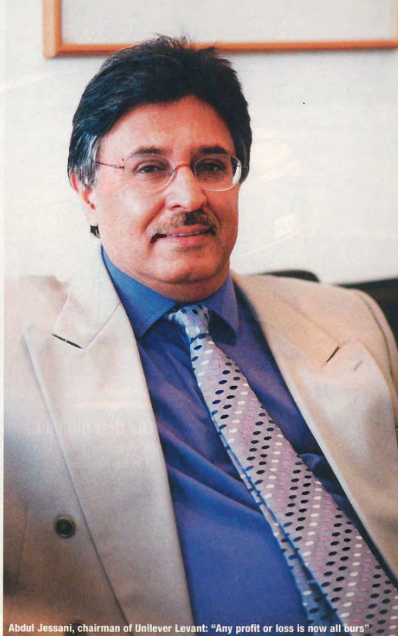
Abdul Jessani is reveling in newfound
independence. “Any profit
or loss is now all ours,” says the
confident first chairman of Unilever
Levant. Jessani came to Lebanon two years
ago to set up a regional subsidiary of
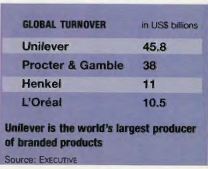
Unilever, the world’s largest producer of
branded products, including Lipton tea,
Signal toothpaste and Lux soap. Global
revenues totaled $45.8 billion last year.
Jessani’s arrival followed a massive corporate
restructuring of the company.
Decisions concerning international markets
were moved from the European
boardroom to the regional headquarters.
The UK-based Export Division, previously
responsible for handling regional markets
through a myriad of local distributors, was
dismantled. Today, Unilever supplies the
capital, key human resources and global
brand strategy while the local outfits are
responsible for marketing strategies and
turning profits in their respective territories.
Jessani now sits at the helm of Unilever
for Jordan, Syria and Lebanon, where he is
responsible for the performance of 16 key
brands. The firm’s rise or fall in this part of the world is his responsibility and Jessani
relishes the challenge. His sales target for
the Levant is $150 million by 2003, up
from less than $20 million in 1998, a very
ambitious goal considering that the region
is in the midst of a recession. That figure is
based on expectations of grabbing at least
25% of the $600-million Levant market
for product categories where Unilever
competes here. So far he is on target, having
increased sales by 200% in the first
two years.
How did he do it? Jessani reduced
Unilever Levant’s portfolio of brands from
44 to 16, to focus on brands that have the
greatest potential for growth. Products like
Ragu spaghetti sauce, Timotei shampoo
and Gibbs Sport aftershave were dropped.
The move preceded a similar restructuring
by the mother company. Over the next five
years, Unilever will reduce its brand portfolio
from 1600 down to 400.
“Our experience has shown that, when we
focus on a more limited number of brands,
we excel. If you have big brands, then you
have an advantage of scale in terms of production
and marketing costs and an advantage
in distribution. If you look at our big
brands, you notice that they are more profitable,”
says Jessani.
Unilever has boosted local manufacturing
for specific ‘champion brands’ products,
thereby reducing import costs. Some new
products have also been added to the local
manufacturing line-up.
Two years ago, Unilever manufactured
from one factory in Lebanon producing
only Lifebuoy soap. But since Jessani’s
arrival, the company acquired a second
factory. Now the company produces Lux
soap, Comfort fabric softener, Jif, Sunsilk
and Organics shampoo. In Syria, where the
company manufactures Sunsilk shampoo,
Omo and Surf laundry detergent and
Signal toothpaste, it has increased its production
of Sunsilk from 200 to 1000 metric
tons in the last two years. Unilever has
a total of six factories in the Levant.
Jessani has also streamlined the manufacturing
operations by reducing the number
of work shifts, changing the plant layouts
and machinery, designing systems
that reduce wastage and reorganizing loading
and unloading procedures. “We have cut a lot of costs at the factory and from the supply
chain,” says Jessani. With manufacturing
costs reduced, the company has been
able to reduce prices on brands like Omo at
a time when sluggish economies have cut
into people’s purchasing power. In Syria, the
shop price of the 2.7kg pack of Omo laundry
detergent was cut to 235 Syrian
pounds, just 10% more than local brands
and 20% cheaper than the only other foreign
brand produced under license in Syria,
Obegi’s Persil. But Jessani stresses that
price cutting must be selective so as not to
harm brand image.
Unilever Levant has also begun offering
more affordable options. About a year ago,
it started importing Good Morning, an
olive oil based soap, which is manufactured
at its sister company’s plant in Egypt
and is 40% cheaper than Lux. According to
Jessani, the brand has proven to be a strong
performer in Syria because it is less expensive
and superior to local competitors.
The company is also reorganizing its
imports, which include Dove soap,
Impulse deodorant, Close Up toothpaste,
Lipton tea and Vaseline. The breadth of
Unilever’s network can make imports a
more viable and cheaper alternative than
manufacturing. “We went through our
inventory across the world and checked
which brands were the most relevant for us,
which would suit our requirements best,”
says Jessani. For example, he found that the
cheapest way to supply the Jordanian market
with Organics shampoo was to import it
from Saudi Arabia, where it is manufactured. A trade agreement between those
two countries means that tariffs are near
zero. Unilever has also changed the marketing
strategy of some key products, like
Lipton tea and Vaseline.
So far, Jessani’s measures to boost sales
have had mixed results. On the positive
side, the market share of Lux soap has
increased in Lebanon from 8.6% in the
spring of 1998 to 10.3% by the fall of last
year, according to a retail audit conducted
by AMER Research. (AMER’s bi-monthly
retail studies were taken from surveys of
medium-sized supermarkets and did not
include statistics from hypermarkets or
cooperatives prior to 2000). The company
made this gain by keeping the price of Lux
down and hiring former Miss Lebanon,
Joelle Bohlok, to promote the product.
“They pushed Lux into the top three in the
soap category in Lebanon. They used to be
well behind,” says Georges Obegi, president
and CEO of Obegi Consumer Products. As
producers of everything from Persil laundry
detergent to Fa soap, the Obegis are one of
Unilever Levant’s main competitors.
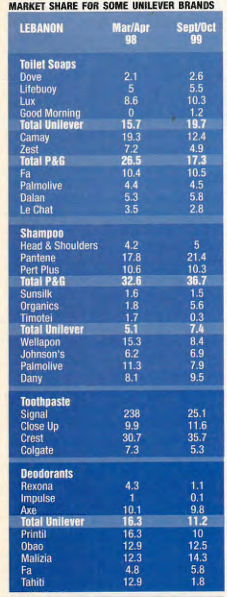
Today, says Jessani, Unilever is the
Levantine leader in the sale of personal
wash products. With Dove covering the
premium market, Lux covering the middle
ground, and Lifebuoy and Good Morning
at the bottom end of the market (see table),
Unilever had carved out a 19.7% share of
the Lebanese soap market by October of
last year, according to AMER. This compares
with a 15.7% market share in early
spring of 1998. By contrast, the share of
Procter & Gamble (P&G), with their
Camay and Zest brands of soap, declined
from 26.5% to 17.3%.
In Lebanon, the company has also managed
to push up the local market share of
Comfort fabric softener from 48.5% to 56.2%
in the same time period. By manufacturing
locally, Unilever has drastically
reduced shipping costs, which were high
because of the bulkiness of the products. In
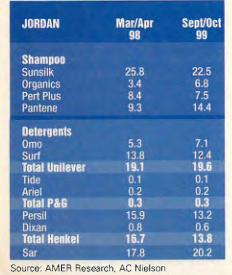
Syria, says Jessani, sales of Sunsilk shampoo
have increased nearly ten times while in
Jordan it’s the leading brand with a 22.5%
market share.
But in fact, not all
Unilever bets have
paid off. While demand for Sunsilk
in Jordan and Syria
has been strong, the
brand’s performance
in Lebanon
has been disappointing.
According to
AMER, the brand
controls just 1.5% of
the market. Results
were so poor that
Jessani was recently
forced to relaunch
the product.
Organics shampoo,
another major Unilever brand, has
made some gains in Lebanon and Jordan, but
is still struggling with less than a 7% share in
both countries.
“Organics achieved some market share
gains in Lebanon, but not as much as they
had been expecting,” says Nazar Najarian,
the general manager of Cosmaline, a Sarraf
Group company. “The brand’s message,
‘health from the roots’, is not unique.
Procter & Gamble has already used it. It
made Unilever look like imitators, not
innovators.” Locally, Unilever has a long
way to go if it wants to challenge P&G’s
near dominant position in the shampoo
market. The three Unilever brands of
shampoo, Sunsilk, Organics and Timotei,
control just 7.4% of the market, compared
to P&G’s 36.7% with Head and
Shoulders, Pantene and Pert Plus.
By its own admission, Unilever needs to
pay more attention to the lucrative detergent
business in Syria. It already cut the price of
Omo but it’s still not clear whether the
move has helped the brand retain its estimated
15% share of the market against a
strong push by Obegi to increase Persil’s
5%. In Lebanon, where a tiny number of well-established brands dominate the market,
Unilever has decided against entering
the race for the time being. “Unilever is not
a competitor. Persil, Ariel and Bold have
90% of the market,” says Nadim Tabet,
managing director of Transmediterranean
that distributes P&G products. Only in
Jordan has the company been successful in
marketing detergents.
Unilever’s
more middle-range brand Surf, with a
12.4% share, is the
third most popular
detergent, behind
Sar with 20.2% and Persil at 13.2%, according to AMER’s figures.
Coupled with Omo’s
7.1%, Unilever has
the second best selling
portfolio of detergents there.
Jessani might
introduce new products
to the market, though he declined to say
which ones. The Levant market for all
product areas where Unilever international
competes is about $1 billion, compared to
the $600-million market Jessani is currently
fighting over. Bringing in a few more key
products could provide a boost.
Despite Unilever’s strength as a multinational,
the future won’t be an easy ride for
Jessani. Competition in the region is getting
more fierce. L’Oreal has opened its own
offices in Lebanon and there are strong
rumors that Colgate-Palmolive will follow
suit. P&G reached an exclusive local
distribution agreement with the Joud trading
company in Syria six months ago.
Joud has assembled and trained a 100 person
sales and distribution team and has a
sales target of $10 million for this year.
Jessani is also looking east.
Unilever’s sales are divided about equally
between the three countries. But with a
population that is nearly double that of
Lebanon and Jordan combined, Jessani
feels that Syria really represents the greatest
potential for the future. All that is needed
now is for the economy to liberalize.
Jessani is betting it will.
