
The Messiah?
Chafic Muharram, former vice governor
of the central bank, has been asked to
take over the helm of the faltering Banque
Libanaise pour le Commerce (BLC) by the
bank’s general assembly. As chairman and
general manager, it is hoped that he will
steer the financial institution out of what has
been an almost unending series of troubles.
First came the nasty break-up of the
Byblos Bank–BLC merger. Then, what
seemed like a flawless marriage between
BLC and the United Bank of Lebanon
turned into a disaster when the central
bank demanded that Safi Harb, the bank’s
new chairman and the mastermind behind
the merger, get the boot after he was implicated
in illegal money lending.
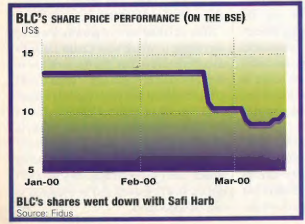
Confidence has been waning on BLC, a
listed bank on both the GDR market and
the Beirut Stock Exchange (BSE). This comes not only
from the botched mergers. Analysts have
also become disgruntled over the BLC’s tardiness
in reporting its yearly results. They
claim that the bank lacks transparency,
with very little in the way of public access
to the consolidated financial statements for
the recent merger.
According to one analyst, “The appointment of Muharram is what
BLC needs today. He has experience in
the central bank, is conservative and the
bank needs stability. This may bring confidence
back to the bank.” He adds that the
major shareholders were put to the test:
The central bank requested a $40 million
raise in capital and a $50 million subordinated
loan to the central bank, and they complied.
But, throughout the Harb fiasco,
the performance of the bank’s shares has
been dismal, with stocks plummeting 27%
on the BSE and 28% on the GDR market so
far this year.
Holding on
The only closed-end investment fund listed
on the Beirut Stock Exchange suffered
a second disappointing year in 1999. The
value of Lebanon Holding’s portfolio
dropped 13%, from $45.8 million in 1998 to
$39.7 million last year. It started at $50 million
when it was launched in August 1997. Its net
asset value fell from $9.16 to $7.99.
The fund, which invests strictly in local
companies, got hurt the most by its stake in
two industries. Liban Beton, a leading
ready-mix cement company, has been hit
hard by the paralysis in the construction
sector and has suffered heavy losses.
Lebanon Holding also had to write off its
$4.4 million investment in the pipe maker
Eternit, which is filing bankruptcy after
several years of losses.
The bulk of the fund’s portfolio is in listed
banks – such as Banque Audi, Byblos Bank
and Banque du Liban et d’Outre-Mer. But,
despite their solid fundamentals, the banks’
shares, like the remainder of Lebanese
stocks, have been performing poorly.
Lebanon Holding is trying to buck the downturn. In the fourth
quarter, the company increased its stake in
Société des Grands Hotels du Liban
(SOHL), owner of Vendome and Phoenicia
Hotels, and First National Bank. Phoenicia
just opened last month, and, says Khalil
El-Khoury of Lebanon Holding, “It is the only
five-star hotel with five-star service in Lebanon. It
will have excellent cash
flow in the future, and its
stocks will probably
surge.”
But the future of the
fund and its shares, which
dropped 21% in 1999,
remain doubtful. According to one analyst,
“It can only see brighter
days when there is peace.”
A new Bou
Bou Khalil Markets (BKM) will be
adding a fifth supermarket to its chain,
this one in Ras Beirut. The new store –
smaller than the others at 2,800 m² –
is the second
to open in the last five months, following
the opening of a 4,000 m² Bou Khalil in
Tripoli last October. More are planned during
the next five years.
Sales, in the meantime, have been on the
rise for the supermarket chain, increasing to
$15.47 million by June 1999, 17.25%
above sales figures for the same time in
1998. But earnings have been declining,
dropping to $602,000 during the first half of
1999, 17.3% below earnings for the first
half of 1998.
“The chain is undergoing
heavy expansion, bigger than expected,”
says Walid El Khalil, head of the investment
firm Tulip Investments, who helped take
Bou Khalil public when he worked for
Banque Libanaise pour le Commerce’s
capital markets division. “Expenses shoot
up more than revenues during expansion.”
Bou Khalil’s shares have also suffered in
1999, down 17.6%.
A quick and
efficient IDAL,
hopefully
The Investment Development
Authority of Lebanon (IDAL) is trying
to make Lebanon a little more
investor-friendly. The organization has
opened a special office called “One-Stop
Shop,” which will assist investors in
getting through what is seen by many as a
maze of bureaucratic procedures.
IDAL is also planning to set up an
“Investors and Business Information
Center” to provide statistics, economic
data and relevant information for starting
a business in Lebanon.
“It’s a great idea because it will
reduce a lot of the bureaucratic difficulties
and red tape that investors have to go
through in order to invest in Lebanon,”
says Nassib Ghobriel, a Lebanon Invest
research analyst. “The real question,
however, is whether they will be able to
follow through with their intentions.”
IDAL recently announced that the long
delayed Linord project to rehabilitate
Metn’s northern coastal highway, from
Antelias to the Beirut port, will be relaunched
by summer. The project
requires the reclamation of 2.4 million
m² of land, the construction of a new
sewage plant, the development of an oil
storage facility, a marina and a small harbor
at an estimated cost of $550 million.
Last year, when the project was first proposed,
IDAL had trouble finding
investors. It remains to be seen if any of
them have changed their minds.
Top of Form
Gobbled up
Bank of Lebanon and Kuwait SAL
(BLK) may have a new owner.
Jordan’s Al-Ahli Bank, which has five
branches in Lebanon and has been operating
here for 39 years, signed an agreement
to acquire an 85% stake in the financial
institution for $22 million.
The deal, part of
the bank’s strategy to expand in Lebanon,
Jordan, and throughout the Arab world,
will create a medium-size bank with 11
branches, total assets of $250 million and
customer deposits of $200 million.
“When
a foreign bank wants to expand in
Lebanon, the best way is through acquisition;
they won’t be allowed to get a license for more than two branches a year,”
says an analyst at Lebanon Invest.
The
owners were looking to sell at a time Al-Ahli
was shopping around. “After studies
were done, we chose BLK because it’s a
clean bank, with a clean loan portfolio and
high capital,” says Rafic Aramouni, Al-Ahli’s
general manager. “Based on the
bank’s ratios we don’t expect any surprises,
unlike many other banks, and the size of
its staff and the number of branches were
appropriate.”
The bank’s aim, Aramouni
adds, is to become one of the larger financial
institutions in the country. The central
bank has given its preliminary approval to
the purchase and final approval is expected
within weeks.
Bottom of Form
Canning them
kindly
When your business starts suffering
losses, the first thing to do is cut
costs. That often means making the tough
decision to let go of workers. Société des
Ciment Libanais, Lebanon’s largest cement
producer, had plans to lay off 300 employees
after the company’s net income fell
from $14 million in 1995 to a net loss of 1.1
million in 1998.
The news, obviously, was
not greeted kindly by the company’s labor
union, which promptly intervened to try
and stop the move. After a six-hour meeting,
a compromise was reached between SCL’s
management and staff. Instead of layoffs, the
company would offer a cushy early retirement
package to hundreds of its employees,
giving them 36 months’ salaries in addition
to end-of-service indemnities they would
receive from social security.
“There are already nearly 100 people who accepted
the offer,” says Antoun Antoun, head of the
SCL employees’ union.
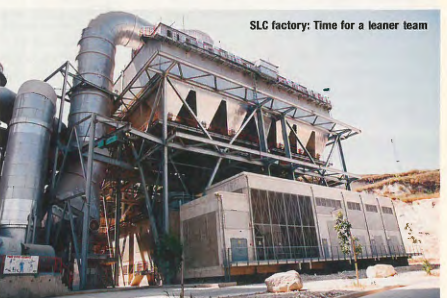
SCL invested in a
$165 million furnace before discovering
that demand for cement was below expectations.
With construction grinding to a
halt, demand for cement nose-dived, with
deliveries dropping 25%, from 4 million tons
in 1995 to 3 million in 1999. Insiders feel
that the company’s losses in 1999 will be
much higher.
Cyber trading
A new online trading website called
myTrack.com was recently introduced
in the Middle East by Dot-LB, the
agent of Net2Phone. The company is marketing
myTrack in 9 countries: Lebanon,
Syria, Jordan, Kuwait, Egypt, the United
Arab Emirates, Saudi Arabia, Cyprus and
Turkey.
The website requires users to download
special software (5 MB) and open a
minimum cash account of $500. Non-US
citizens are exempt from a tax on profits, but
they are required to open an account at
the Bank of New York for trading on
Nasdaq and over-the-counter (OTC).
Commissions will cost $15.95, and customers
will have to choose between three service
plans ranging in price between $20 and $80
a month. According to marketing manager
Ibrahim Choueiry, Dot-LB’s revenue
will depend on the number of clients it signs
up. So far, the company’s client base has
grown to 200 in 50 days, mostly Lebanese
and Lebanese expatriates in Arab countries.
“We expect to break even in about five to six
months,” says Choueiry.
