
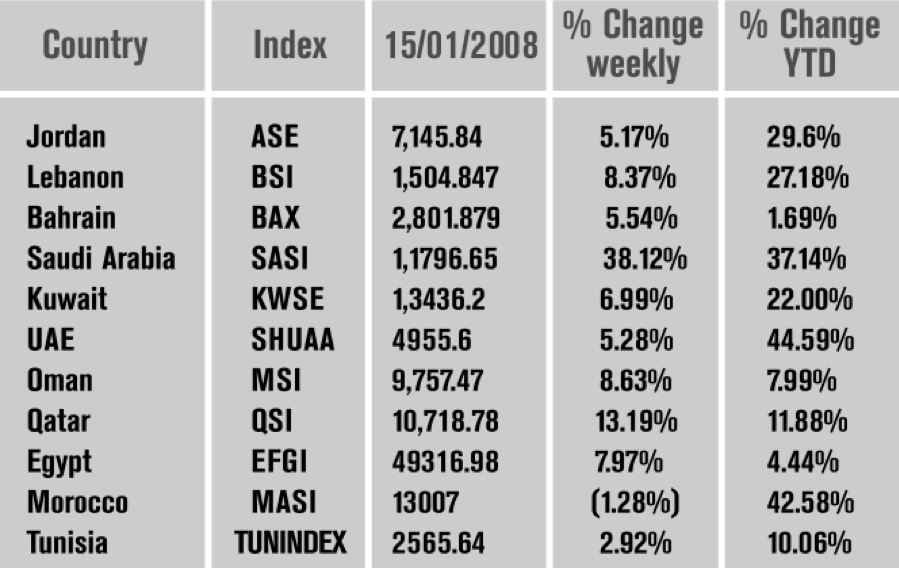
Regional stock market indices
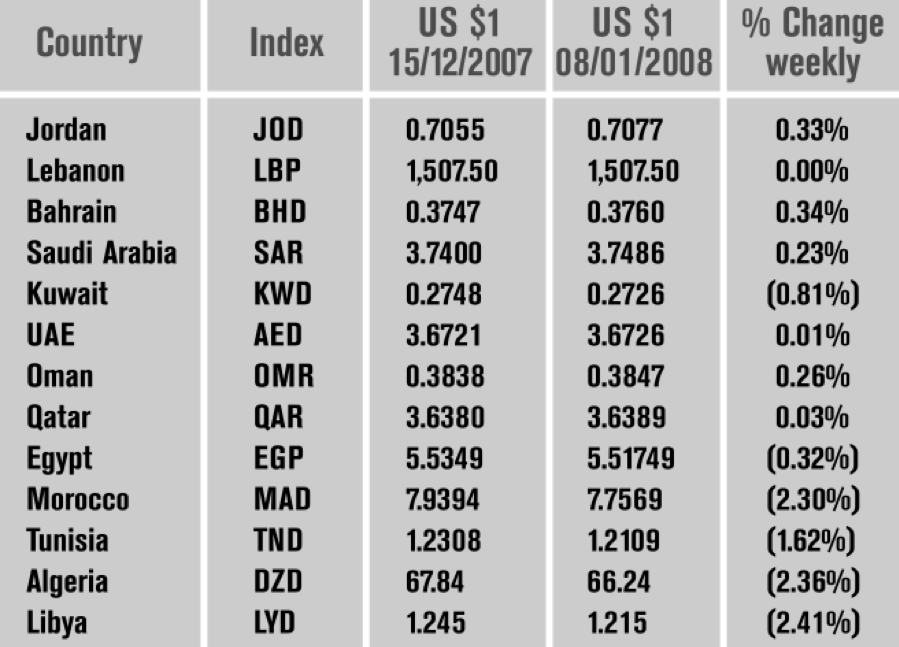
Regional currency rates
United Arab Emirates buys French nuclear reactors
The United Arab Emirates will be signing agreements with French companies Areva, Total and Suez to build two third-generation nuclear plants for civilian use. The deal comes during French president Nicolas Sarkozy’s visit to the region. UAE authorities who have been in talks with Areva confirmed their preference to sell their oil, which is trading at close to $100/barrel, rather than use it for electricity production. Areva has already signed power transmission agreements worth $1.15 billion with Qatar. The Gulf Cooperation Council is also in talks with the UN Atomic Energy about developing a joint nuclear energy program.
Saudi National Bank recommends diversification from the dollar
Saudi Arabia’s largest state bank, National Commercial Bank (NCB), urged the government to reduce the kingdom’s exposure to the dollar by diversifying government investments across asset types, countries and currencies to hedge against the weakening dollar and subsequent reduction of US interest rates. The NCB has called for the freeing of the Saudi Riyal’s steady exchange rate at 3.75 from the US dollar peg. Surplus revenues from oil exports are partly managed by the Saudi Arabia Monetary Agency (SAMA), which holds $285 billion in foreign assets. Saudi Arabia is under growing pressure to severe its dollar peg policy as part of its monetary union partners’ measures to reduce their exposure to the dollar as Kuwait did last year.
Egypt maintains positive balance of payments despite growth in imports
In its latest assessment for Egypt’s current accounts, the Middle East Monitor has revised downward its forecast of 2% of GDP in FY06/07 to 1.1% of GDP for FY07/08. This was due to a 24.3% increase in total imports coupled with rising oil prices and consumer appetite. However, continuous growth in total exports (19.3%) and 44% in non-oil exports, in addition to higher revenues from Suez Canal and tourism and workers’ remittances, seem to limit the decline in the country’s balance of payments. Egypt’s diversification of its export destination help cushion its export activity where 40% of goods go to Europe, 31% to the US, 12.4% to the Middle East and 13.5% to Asia. The same applies to Egypt’s FDI inflows where 42% come from the US, 36% from the EU and 30% from the Middle East. All of these factors help reduce instability in the Egyptian economy.
