The Ministry of Culture (MoC) has launched a new strategy for Lebanon’s creative and cultural industries (CCI). Based on inhouse research and stakeholder interaction, the surprisingly extensive document is as economic as it is cultural. As it stands, it seems the strategy is intended to diagnose and invigorate a struggling sector, but also to signal a more proactive, collaborative, facilitating, and ultimately powerful role for the ministry itself.
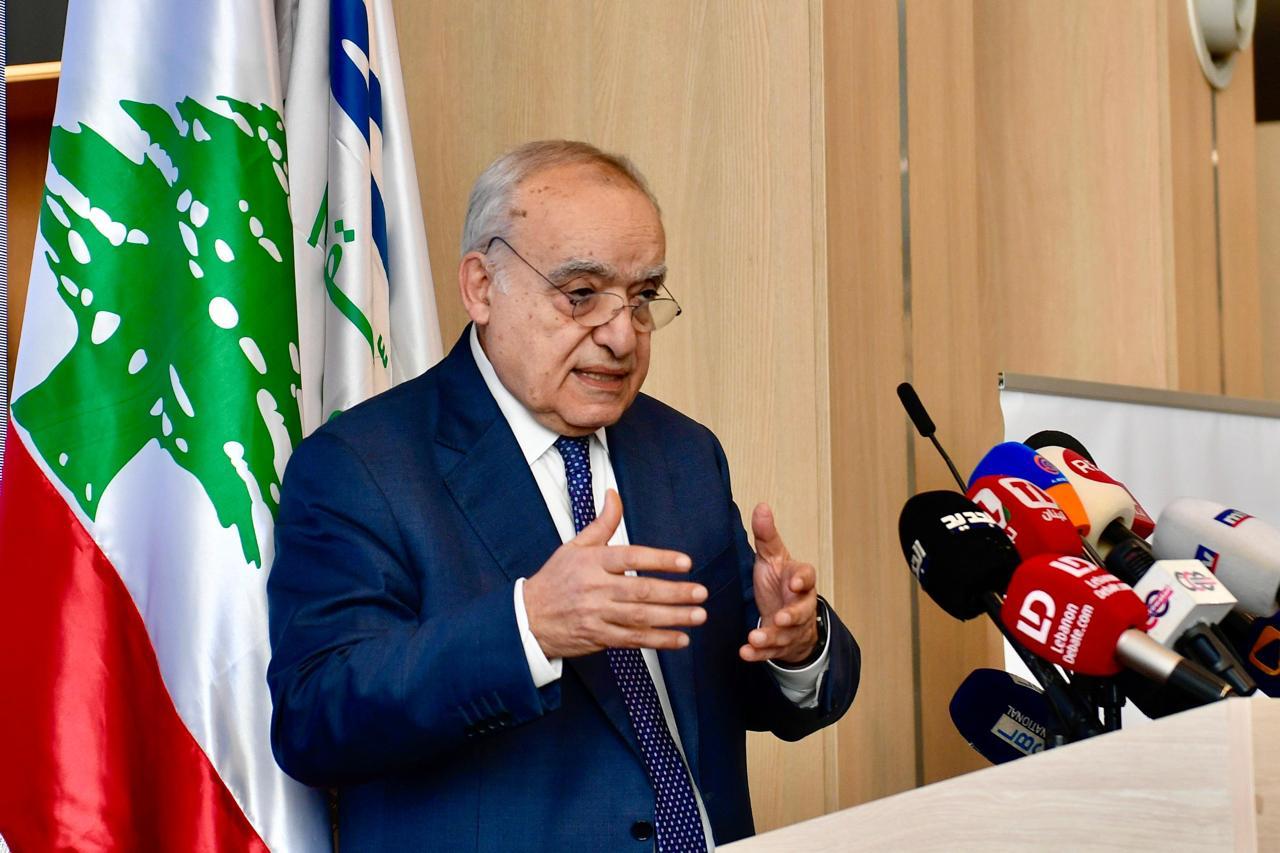
As stated in the strategy, it aims to “strengthen the cultural and creative ecosystem so that it can contribute to its full potential to economic recovery, social cohesion, and better positioning of our country in the region and the world.” Presenting this ambitious framework to ministerial colleagues, stakeholders and media on February 10 (almost exactly one year since ascension of the current council of ministers), Ghassan Salameh, the minister of culture, repeatedly described the plan as “ambitious.” It is difficult to disagree. The question is whether the level of ambition exceeds reality.
Identifying the challenges
Nearly a year in the making, the strategy is the product of a bottom‑up process in which over 500 professionals from the subsectors of the CCI have been invited to focus groups, questionnaires and workshops. These sectors include film/audiovisual, music, heritage, museums, performing arts, visual arts, public libraries and design. Additionally, a representative has been chosen from each sector to act as a link between the respective subsector and the ministry.
Even newer creative and content spheres in the digital realms, which are deemed by economists crucial for future wealth, are however not given an own category in the CCI strategy as provided on the ministry’s website. There are over a dozen references to digital issues sprinkled across the almost 50 content slides of the strategy, including reference to a strategic imperative of “investing selectively in cultural infrastructure and digital capabilities”. Nonetheless, the strategy does not elaborate on how and whether the required public policy safeguards or capital expenditures would be implemented for such a demanding endeavor.
Despite these omissions, the final document identifies wide-ranging interventions recommended for each sector – such as improving the legal status of designers, drafting a new heritage law, advocating the removal of taxation on non-commercial performances and many more. In total, the strategy contains 162 initiatives throughout the nine subsectors.
The obstacles facing Lebanon’s cultural industries are extensive: outdated laws, years of underinvestment, underdeveloped digitalization, lack of data collection and talent flight – just to name a few that have been on the minds of stakeholders for several decades. And since 2019 the CCI has been shaken badly by the succession of economic crises, COVID-19 pandemic, Beirut Port explosion and the latest regional conflicts. During the pandemic, which means early during these years of intertwined social, economic, and creative calamities, full-time employment in the CCI fell by more than two-thirds and unemployment or underemployment increased by nearly 1,000 percent, according to a 2021 survey commissioned by GIZ (Deutsche Gesellschaft für Internationale Zusammenarbeit).
Not explicitly stated but reverberating throughout the presentations and debates of the MoC launch event was the subliminal message that the quagmires of CCI stakeholders are mirrored in challenges faced by the institution that produced the strategy. Beneath the splash of aspiration to make CCI succeed as economic growth drivers in a new Lebanon, is a message that the MoC has set its sights on ploughing more extensive economic grounds than in the past.
Not only does the culture ministry seem to in this way be departing from the pre-crisis economic paradigm where financial services were perceived as the sole services sector worthy of serious administrative and strategic attention but it appears determined to jump over its shadows of having a lesser weight than the line ministries that were in control of cash cows and fiscally attractive portfolios.
But while the ministry’s domicile at the National Library is, from several cultural perspectives, awe inspiring, the ostentatious dignity of the venue cannot hide the fact that the MoC is still a budgetary stepchild of a financially exhausted governmental parent. Remarks by MoC staffers and the minister reveal that underfunding and understaffing in the budget year of 2025-26 are even greater challenges for the MoC today than they were in the less fiscally desperate years before the crisis. Still more troubling could be the still lingering stigmata of being a government unit beset with crumbling building assets, issues of censorship, and polarized and arduous disagreements over Lebanon’s true cultural identity.
Strategy by estimation
That the path of CCI development will not be as easy as one can make it look in a slide presentation becomes unmistakable when delving deeper into the document. The strategy’s many specified recommended interventions are a timely analysis of what needs to be done to support the growth of the CCI. But there is a gap between idea and execution – and here the strategy becomes more unspecific.
With 162 initiatives, it could be rather difficult to choose where to start. Therefore, the strategy classifies initiatives into three categories according to feasibility, sequencing and dependencies, allowing priority to be given to the most realistic and urgent implementation recommendations. These 162 initiatives range in size with one of broadest reaching being the establishment of “a cultural incubator program through select partners,” while others reach a smaller interface like reopening the National Cinémathèque or developing and publishing the archaeological review BAAL online. All these are called “recommended interventions”, which – even with the prioritizing – makes it difficult to identify which parts of the strategy are promised and which are just recommendations for what could be done.
The only real benchmark presented by the minister at the launch was the goal of the CCI to contribute 7 percent to GDP by 2031. But this goal is not written in the final strategy document, nor supported by any micro- or macro-economic data projections. Yasmine Helou, Chief of Staff at the Ministry of Culture, tells Executive that the minister’s statement indicates the institution’s hopes for having a role in fortifying the council of ministers’ economic growth program and that implementation of the CCI strategy could help, five years down the road, the currently much lower CCI share in GDP recover to 5 percent – or even reach 7 percent.
When asked about how the calculation for this “hope” was done, Helou explains: “It is a projection based on the limited pre-crisis data available on the economic performance of the CCIs. It is based on their documented contribution to GDP prior to the crises, combined with an assessment of sectoral resilience and recovery potential. Given existing data constraints, this figure is an indicative estimate rather than a formally adopted target within the strategy.”
While it is acknowledged that the CCI has a high value for the Lebanese economy, and while we can’t know whether an implied world-leading role of Lebanese CCI in their national economy will become obtainable, there is no denying that such hopes are running up against multiple walls of economic uncertainty.
Between vision and implementation
To be fair, the specific interventions are clearly defined. And it is commendable that the sector stakeholders have been thoroughly included. But the road to implementation seems more uncertain, which is deeply discontenting because the two systemic weaknesses that presently still obstruct any governmental economic aspirations are failure to implement and failure to collaborate among ministries with adjacent and overlapping realms of authority.
The strategy’s breadth poses its own risks. In total, the interventions require multi‑year efforts and dedicated institutional capacity – resources the ministry simply does not possess at present.
In practice, the ministry has relied heavily on voluntary contributions.
“We’ve seen in the past year how willing volunteers in this country are to help, to get involved and to actually work. So, the idea arose to establish commissions where we name people from the private sector who want to get involved and allow us to link and follow up with the ministry in a more institutional way without having to go through the whole hiring process. This is one thing we’re trying to find,” Helou says.
Besides acting effectively by virtue of harmonious inter-ministerial collaborations, securing institutional continuity within ministries is a paradigm that has hardly been demonstrated in the political track record on post-civil war Lebanon. Achieving trustworthy institutional continuity at the Ministry of Culture would in this light be an amazing and laudable feat once the next council of ministers comes into their own at an indeterminate time point after the parliamentary elections scheduled for this spring.
But this feat seems easy when the ambition is to become an economic enabler of unprecedented dimensions. To name one example, the establishment of a “cultural incubator program,” which the CCI strategy lists as primary core cross-sectoral need (i.e. spanning several sectors identified as constituting CCI) must be read in the economic context of entrepreneurship and entrepreneurship ecosystems.
According to Helou, the program would have to be “very big”. Also, it would best be run by an institution with significant capacities in coaching and mentoring on business plans, financial sourcing and management, legal compliance, best practices in corporate governance, and subsector-specific operational priorities for varied CCI startups or young enterprises. The MoC has not yet designed and developed the incubation idea to a point of having set a target number on how many cultural entrepreneurs it wants to enroll per cohort, nor to a maturity of having scored a commitment from an existing provider of business incubation services.
Finding a financially and culturally capacious provider with sustainable appetite for becoming involved in what effectively would not so much be the “strengthening” of a Lebanese cultural and creative ecosystem as the construction, from below ground, of a CCI ecosystem that combines being cultural and creative with prospects of economic sustainability. Helou notes, “I think that CCI has a lot of incubation potential but many of those [cultural institutions] that we have covered did not actually become economically viable.”
The vague idea for an incubation program reinforces the ruling image of previous Lebanese administrations that the ministry of culture has historically promulgated state positions regarding cultural affairs but has not been a central actor in fostering viable subsidies for cultural actors, let alone economic markets for CCI. Local experience of entrepreneurship ecosystems supporting the viability of young tech and agricultural enterprises confirms that an incubation program with all the bells and whistles for supporting startup entrepreneurs, will embellish the potential of CCI to deliver an aspirational slice to GDP, however large the slice and the total might be in five or ten years’ time.
It further confirms, however, that a state-supported or internationally sponsored incubator program does not an ecosystem make. The task of establishing an ecosystem actually is complex and has proven anything but pitfall-free or fast in the two primary efforts of fostering entrepreneurship in the Lebanese context: the tech incubators and accelerators under the knowledge economy imperatives of the Lebanese central bank’s massive push in the 2010s (“circular 331”) and the Agrytech entrepreneurship development push for inclusive and productive agriculture ventures spearheaded by Berytech where first, in GDP terms quantifiable, success came years after it was kicked off with considerable foreign sponsorship / donor support.
For the time being, meaning the outlook for at least this year and possibly a full parliamentary period of four years, dedicated human and financial capital, or vulgo quality employees and money, is not what the ministry of culture can be expected to have reliably at its disposal.
In principle, the recent practice of depending heavily on unpaid labor introduces both continuity risks and increasing likelihood of emergent conflicts of interest and outright corruptibility. The political uncertainty after the next elections further calls into question the durability of the strategy. The ministry is attempting to finalize as many agreements as possible, but implementation of the full strategy clearly extends well beyond the current political cycle.
And all that does not yet touch upon the question how digital Lebanon will define its cultural identity in a global and regionally polarizing environment of divergent desires and external pressures. The future will be digital, or nothing, but who will design it?
You could wonder how sustainable these preconditions are for implementing all the various pillars of the strategy. But the ministry is aiming to do as much as possible with the resources they have at hand. They have already started the implementation of some interventions, like the digitization and standardization of the national libraries. This indicates a shift in progression. However, attempting to address all the issues outlined in the strategy appears to be an overreach. One could even wonder whether the minister’s explicit acknowledgment of the strategy’s level of ambition is a way of admitting that the goals may not all be attainable. It seems as if the ministry itself is aware of the uncertainty:
“You try for the best and then you do as much as you can,” says Helou.
With contributions by Thomas Schellen