

“Boring banking,” said Freddie Baz, “is why Lebanese banks have been insulated from the crisis.”
Baz, the group chief executive and strategy director at Lebanon’s biggest bank, Bank Audi, said the “lack of sophistication” in commercial banking was the key factor protecting the Lebanese banking sector from the financial turmoil plaguing the rest of the world.
Other factors have been the conservative policies set by Banque du Liban (BDL) — Lebanon’s central bank — and traditional, prudent strategies used by domestic banks. Last year the average profit for the top five banks topped 20 percent. Those record breaking profits are in the past, but early 2009 numbers seem to indicate Lebanon’s banks are doing just fine: Bank Audi, BLOM Bank and Byblos Bank — the three largest in Lebanon — posted total profits of $149 million in the first quarter of 2009, a 13 percent gain on the same quarter last year, according to a BLOM Bank report.
Still, Lebanon has not been immune to the financial crisis, said Francois-Pascale de Maricort, chief executive officer of HSBC Lebanon.
“It’s quite obvious that Lebanon has been affected by the global markets,” he said. “If you look at the growth rates, Lebanon recorded a very high rate of 8 percent last year. This year we forecast growth to be between 3 to 4 percent.”
But at least it’s still growing, unlike Lebanon’s regional brethren. To deal with the slowdown, banks have maintained the status quo, using the same strategies to try to mimic last year’s success. But while Lebanese commercial banks have been insulated from the global turmoil and remain resilient, they are not isolated, nor immune.
As a natural repercussion from the global circumstances, profitability among banks is expected to slow year-on-year, but still achieve positive results. Foreign remittances from Lebanese expatriates working abroad may also decline. It is important to note, however, that confidence in Lebanese banks remains high.
“So far in Lebanon we have been quite protected, we haven’t seen a decrease in remittances; the real estate market is doing quite well,” said de Maricort.
Banque du conservatism
The BDL prohibited Lebanese banks from purchasing sub-prime products and derivatives in the West and built up its foreign reserves to $13 billion, which acted as a preventive measure to guarantee the Lebanese lira’s stability. The central bank ordered banks to have a minimum of 30 percent of their total assets in cash and also set rigid loan level ceilings for real estate projects.
In November 2008, central bank Governor Riad Salameh announced the combined assets of Lebanon’s banks totaled more than $100 billion — four times the country’s gross domestic product. Bankers agree that BDL and domestic banks take pride in shying away from complex investments and structured products that they do not understand. Although criticized by some bankers at first, the policy turned out to be prudent and beneficial, given the events of the last eight months.
Most recently, the central bank has been working on freeing Lebanese banks from mandatory reserves for projects financed in Lebanese lira between 2009 and mid-2010, excluding real estate projects and consumer loans. This move would cause Lebanese lira interest rates to fall by 2.25 percent, thus lowering the cost of borrowing in local currency to a favorable 7 percent.
EFG-Hermes research believes that the “central bank is seeking to lower interest rates indirectly to preserve high interest rates on deposits, which are vital in ensuring capital inflows at a time when other inflows, including remittances, are expectd to decline.”
Clearly, higher interest rates on deposits in local currency will entice and encourage depositors to place more capital in domestic banks. Dollarization of accounts dropped from 77 percent in March 2008, to 67.7 percent by March 2009, a four-year low, as mass capital inflows streamed into the local banks after the infamous fallout of Lehman Brothers in September 2008, in order to benefit from divergent interest rates between the Lebanese lira and the US dollar.
The central bank’s strategy seems to be working well, as deposits in Lebanese lira have risen nearly 10 percent from the end of 2008 and by almost 62 percent year-on-year. Deposits in foreign currencies increased by a mere 0.7 percent since the end of 2008, and only 2.9 percent year-on-year.
After the fallout of Lehman Brothers, the somewhat unexpected influx of liquidity allowed Lebanon to bask in balance of payment surpluses of $1.4 billion in the first quarter of this year, as opposed to a $200 million deficit in the first quarter of 2008. This plan is in line with other BDL steps aimed at increasing lending in Lebanese lira, hence giving the central bank an even larger role in stimulating the economy and reducing risk potentials.
The role of the central bank is a contentious subject among banking experts and executives.
Economist Marwan Iskandar said BDL has “done a good job of making banks and individuals avoid very large [losses],” but that the “central bank has become the biggest private bank in Lebanon.”
“This is not its role,” he said.
For example, Iskandar said it is atypical for a central bank to own shares of a casino — BDL currently owns 42 percent of Intra Investment Company, which owns Casino du Liban — or own a national airliner, in this case Middle East Airlines.
Yet, the argument against such statements is that the central bank saved these entities from demise when no one else could, and that privatization will eventually happen. Iskandar said he does not want to see the central bank go ahead with plans to amplify its role.
“In recent months, the central bank has received a truly inflated image and they need to settle on the basics,” he said. “With the governor, [the four new deputy governors] should concentrate on trimming the role of BDL, not expanding it further; it has expanded beyond principles of real guidance for a free economy.”
Most experts are less harsh on the central bank, as over the years it has established a very positive relationship with local banks.
Laila Sadek, associate director in the financial institutions group at Fitch Ratings in London, said the relationship between BDL and Lebanese banks is “mutually supportive.”
Saad Azhari, chairman and general manager of BLOM Bank, echoed this perspective.
“We have an excellent dialogue,” he said. “There is a lot of trust between the banks and the central bank, which has proved to be very important in critical times such as 2005 and 2006.”
Unfortunately, one thing the central bank cannot protect the sector from is political instability.
Red, white and green
Infamously known for its volatile social and political environment, Lebanon made a comeback after the Doha Accords in May 2008. With the scheduled June 7 parliamentary elections, the question of confidence in the Lebanese economy arises.
Salim G. Sfeir, chairman and general manager of Bank of Beirut, said the biggest threat to the banking sector is “any disruption in the country’s political stability.”
“There is no financial soundness in the presence of political shakiness,” Sfeir said.
“There is always a problem of uncertainty,” said Azhari. “So for people wanting to make major investments in Lebanon, they won’t want to do so before the period of uncertainty passes.”
HSBC’s de Maricort said that so long as the situation remained relatively peaceful, the country’s economy and banks wouldn’t take any major hits.
“So far things are going well, we haven’t seen specific tensions,” de Maricort said. “Investors may delay some projects or investors wait until after the elections.”
Even with the regular political instability, it seems Lebanese confidence both inside and outside Lebanon has not waned.
Foreign remittances by expatriates were the best confirmation that Lebanese abroad viewed local banks as safe havens, totaling $6 billion by the end of 2008. The Economist Intelligence Unit (EIU) believes that the elections will bring political uncertainty, which could have a negative impact on the flow of foreign remittances.
As the country remains highly dependent on remittances, Salameh and others have forecasted a worst case scenario of a 10 to 30 percent drop in remittances by the end of the year. Bankers in the country claim otherwise, though the second quarter is yet to be closed and no numbers can validate such forecasts just yet.
“It’s just speculation,” said Walid Raphaël, deputy general manager of Banque Libano-Française (BLF). “A reduction in remittances has not materialized, but we have not seen any figures.”
With the undeniable regional and global recession, it seems inevitable — and a natural consequence from the ripple effect of the crisis — that remittances will decline to some extent. This is not to say that the Lebanese diaspora will not continue to send money back home, just that their capital will not be as plentiful as before.
The perils of public debt
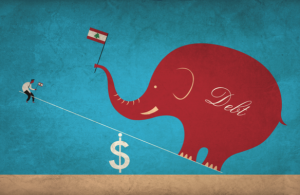
One of the chief problems the Lebanese economy faces is the size of its national debt. Currently, the net public debt stands at $47.8 billion, constituting an increase of 1.8 percent from the end of 2008 and a 10.7 percent rise from the end of March 2008. As of March 2009, commercial banks account for 56 percent of the total debt, while BDL holds 21 percent of the debt.
The government borrows from the local banks in the form of treasury bills and Eurobonds. Bank of Beirut’s Sfeir explained that domestic banks’ “aggregate subscription in Lebanese treasury bills and Eurobonds exceeds 30 percent of their deposits base.”
With interest rates ranging between 8 and 11 percent (depending on the maturity date), it is favorable for the government to continue borrowing from the domestic banking sector rather than foreign entities.
According to Sadek of Fitch Ratings, the loan relationship between the government and local banks is beneficial for both sides.
“It’s a very lucrative business, but on the whole banks would be happy to reduce their exposure to the sovereign if that were possible.”
With the government’s worrisome finances negatively affecting Lebanese banks’ international credit ratings, domestic banks would, unquestionably, like to see the debt reduced.
Nassib Ghobril, head of economic research and analysis at Byblos Bank, agreed, saying the “last thing” banks want is for public debt to increase. The government’s debt is already estimated to increase by $4 billion this year. Ghobril said banks would prefer to redeploy their liquidity elsewhere.
“[The] bloated public sector is an obstacle to economic growth in the country overall,” he said. “The government has to reduce its structural, fiscal deficit and the public debt by doing reforms, improving the investment climate and the business environment, which would help raise the rating of the country.”
Georges Abou Jaoude, chairman and general manager of the Lebanese Canadian Bank, said banks are treating the Lebanese government with kid gloves.
“We are making life easier for the politicians. We should put many more conditions when we lend [to] the government,” Abou Jaoude said.
On top of properly addressing the public debt, there are many benefits to the government conducting financial reforms.
“The Lebanese economy has a huge potential and we need politicians to help raise this potential, but this will only happen through new reforms,” said Raphaël of BLF.
Similarly, Ghobril urged politicians to get their house in order.
“Whoever wins [the election] and whatever the formation of the cabinet, they need to realize the urgency of putting financial and economic issues as top priorities, and letting political decisions be taken to serve these priorities,” Ghobril said. “This is long overdue, because politics trump economy and finance.”
BLOM Bank’s Azhari would like to see the new government accomplish what the present administration and its predecessors have been unable to do. He said privatizing Electricité du Liban, the mobile networks and MEA would be a good start. Also, the structure of the public debt should be improved, in order to boost the economy’s potential and increase bank capitalization. The good news is that even with the turbulent circumstances in the global markets, Lebanese banks continue to enjoy high levels of liquidity.
According to Sfeir, the Lebanese banks’ robust balance sheet liquidity is one of the highest in the world.
Cash is king
Although liquidity is abundant in the banking sector, the structure of this cash has changed since May 2008. This modification is due to the large conversion of US dollars to Lebanese lira after the Doha Accords, when depositors gained confidence in the Lebanese currency.
And while the structure of the liquidity has changed, it has undoubtedly been altered to the benefit of the Lebanese economy as confidence in the local currency continues to rise. HSBC’s de Maricort said no matter what its form, liquidity is a key ingredient to a successful banking sector and economy.
“For all banks one of the top issues is to make sure we keep a high level of liquidity, because we’re in a very volatile global environment,” he said.
Rule of many, by the few
The number of banks in Lebanon has left top bankers anticipating a serious consolidation in the near future. Lebanon boasts 52 commercial banks and could easily cut this figure in half, while still being able to cater well to its population at home and abroad. Byblos Bank’s Ghobril said Lebanon must get down to 20 banks. Iskandar describes the banking sector as “oligopolistic,” as the top 10 banks account for 90 percent of the total balance sheet of all domestic banks in Lebanon.
De Maricort said he would not be surprised if mergers and acquisitions take place in the near future.
“It would make a lot of sense to consolidate, due to the over-banked nature of the banking sector.”
Frustrated with the central bank for not encouraging consolidation in the sector, Bank Audi’s Baz said he would like to see two or three mega-mergers within the top 10 banks. Although a number of mergers have taken place, they’ve been anything but momentous.
“What we have witnessed so far is lobsters eating shrimps,” Baz said. “What we need in Lebanon is lobsters marrying each other.”
According to Baz, the big banks “swallowing” medium and small banks are “not real consolidation.”
Raphaël, of BLF, highlighted the fierce competition that exists between local banks.
“The Lebanese are getting the benefits of this competition through unbelievable rates for their deposits and their credits,” said Raphaël. “Mergers and acquisitions are something that banks need to be larger, stronger and play a major role in the regional and global scene.”
Even with the current international circumstances, regional expansion is seen as a key for Lebanese banks to widen their presence and capitalization. Abou Jaoude of Lebanese Canadian Bank considered expansion as “a necessity” for domestic banks.
Conclusion
Lebanese banks will soon begin to see the inevitable slow down in economic growth in the coming months. Economic growth is set to slow in 2009, while consumer spending looks set to dip, with the volume of imports declining by 9.1 percent in just the first quarter of 2009, perhaps marking the beginning of a slowdown in domestic consumption.
Georges Saghbini, deputy general manager of SGBL, said that due to the anticipated slowdown in the real economy, banks will feel “a slower dynamic and a shortfall in transfers, thus a slowdown in consumption as well.”
The factors effecting the country’s growth are mainly political uncertainty, economic contraction of Western markets and the sluggish growth rates in the Gulf. These elements are also likely to have an implicit impact on foreign remittances and Lebanon’s tourism, real estate, construction and financial sectors, according to the EIU.
But the potential for damage is cushioned by the Lebanese banks conservative management and the central bank’s policies. With the high levels of liquidity, little exposure to real estate lending, robust deposit bases and strong support from the central bank, Lebanese banks are well positioned to weather the global economic storm.
