
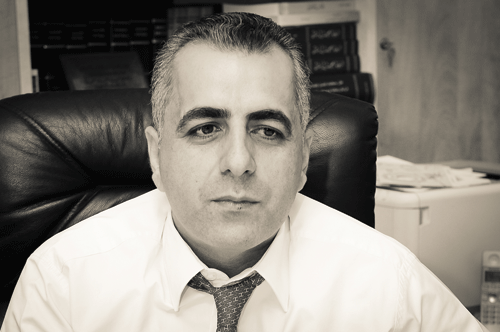
The National Social Security Fund (NSSF) is Lebanon’s main social security program and the country’s largest insurance provider, covering approximately 30 percent of the population. Famed for its endless queues, appalling delayed payments and highly underdeveloped services — requests for this interview were required to be sent by fax machine — ‘daman’, as it is commonly known in Lebanon, provides healthcare, family allowance and end-of-service indemnity (EOSI) to 1.3 million Lebanese citizens. To discuss the issues faced by the daman, Executive sat with Mohamad Karaki, the NSSF’s director general.
E On my way to meet with you, I heard a man on the radio complaining that the NSSF was closed at 10:30 am today and he could not get his payment….
That cannot be true. Employees of the NSSF have the same working hours as government employees [8:00 am to 2:00 pm]. But you know, it is Ramadan now and today it is Friday so they might leave earlier for Friday prayers.
E A government draft bill called for reforming the NSSF back in 2004 and it has not been signed yet. What is delaying the implementation of this law?
From a practical point of view, we can agree over two to three sessions on the key points in the draft law and in a month it would be over. The bigger issue, however, and the one which is taking a political dimension, is whether the EOSI fund gets spun off and managed by an independent company with a separate management or whether it remains under the umbrella of the NSSF. This is the issue that keeps on delaying the implementation of the new law. Many people in the government, for no economic or practical reason, want to have an independent company running the EOSI fund. I disagree. Their arguments are that the NSSF has issues and can’t manage itself. If the government can’t improve the NSSF then where will it find the right people to run this independent company? Also, it would be duplicating jobs.
E Why do they want to put the EOSI into a separate company? Because it is the only fund among the three funds of the NSSF that is not in a deficit?
Many people are saying that is the reason they want their hands on the funds of EOSI. I am just saying EOSI needs to be in its natural place, which is within the NSSF.
E As of the end of last year, the sickness & maternity fund and the family allowance fund reported an accumulated deficit of $239 million and $252 million respectively. What needs to be done to stop these deficits from increasing?
Unfortunately in 2001, the contributions to the NSSF were brought down by 40 percent in one go [contributions to the NSSF were reduced from 38.5 percent to 23.5 percent by lowering the contributions to the family allowance fund from 15 percent to 6 percent and to the sickness and maternity fund from 15 percent to 9 percent]. The only solution is to increase the contributions or the ceiling of the contributions.
E But how much would you want to see the contributions increased?
I am not asking for an increase to 2001 levels but a few percentage points. The raise in the minimum wage this year will bring in new revenues for the NSSF and then we will see how much contributions need to be increased.
E How are the funds of the NSSF invested and is there a way of raising the returns?
The funds of the NSSF stand at $5 billion as of the end of 2011; 70 percent of the funds are invested in treasury bills and the remaining 30 percent are placed in deposits with local commercial banks. As the sickness and maternity and family allowance funds are in deficit, the funds being invested now are from the EOSI fund. There is a committee charged with preparing how to invest these funds. There is no article in the current law allowing diversification, even within currencies. There was no political agreement in the 11 years I have been running the NSSF to diversify in other currencies, as we have to invest everything in Lebanese pounds. With the current law being discussed in parliament, it should open the possibility to invest in other currencies.
We are proposing several investment options both domestically and abroad. The [government officials] are trying to limit the options and are suggesting equities in Lebanese and foreign listed companies and investments in Lebanon’s real estate sector. We wanted to go further and have equities in all companies in Lebanon [and not just the listed ones]. Investing in other currencies is the least we can expect as the NSSF pays all contributions in Lebanese pounds but medical costs are in foreign currencies.
E I hear that evasion of contributions is common in Lebanon. What are you doing to better control evasion from the contributions and alleviate the deficits of the funds?
We have controllers who check evasion from contributions. Now we have 100 controllers, whereas a year and a half ago we had just 30 to 40 controllers, so there will be better controlling going forward. One of the main issues that the NSSF faces is the lack of human resources. We should have 2051 employees and we have 1112 so we are working at 50 percent capacity.
E What is the 2051 figure based on?
When the organization was founded, the law stated that the NSSF should have 2051 employees so we have 939 missing employees. The NSSF used to have its independence when it came to hiring of employees, until 2004 when the hiring process was put under the Civil Service Council. Now every time we need to hire employees, we need the approval of the government that will ask the council to conduct exams and this is delaying our hiring process. We have recently received approval for the hiring of employees and exams are starting in a month.
E Isn’t the lack of electronic services also one of the main issues of the NSSF?
Now we have 35 offices with 1,000 PCs linked online throughout the country. So from a technological point of view, we are among the most up-to-date companies in Lebanon.
E But you don’t offer any services online and you don’t even have an NSSF domain email?
Let me explain. The first step was to train our employees and explain PCs to them. The second step and the most important one is to link hospitals, doctors, pharmacies and all providers of services electronically to the NSSF and start electronic services. I am happy to tell you that the administration recently approved putting in place a department dedicated to electronically linking all services with the NSSF. We will start by linking pharmacies then move on to hospitals and doctors. We hope that by the end of the year we would have started to provide electronic services and that by the end of 2013, we will be providing services such as online registration and providing certificates on employee headcounts online. We also have a new website which we are working on internally and it will be made public within five to six months, allowing people to enjoy services online.
E How about the board of directors that has expired in 2006?
There are no elections yet planned for the board and the current board members are still here and different committees meet on Tuesdays and Thursdays. We need new blood in the organization but unfortunately the current problems in the country are not allowing for elections.
E Do you think the government should provide a private pension plan with tax incentives?
In my opinion, what is missing in Lebanon is an unemployment fund so that if the citizen finds himself without a job, he does not end up on the street without an income. If the NSSF is given the human resources necessary and with the required improvements in place, it can provide all social services to the country. These plans need approval by the government and I am waiting for their approval. I want to improve the NSSF to provide better services to the population. The biggest problem for now is the lack of human resources.
