
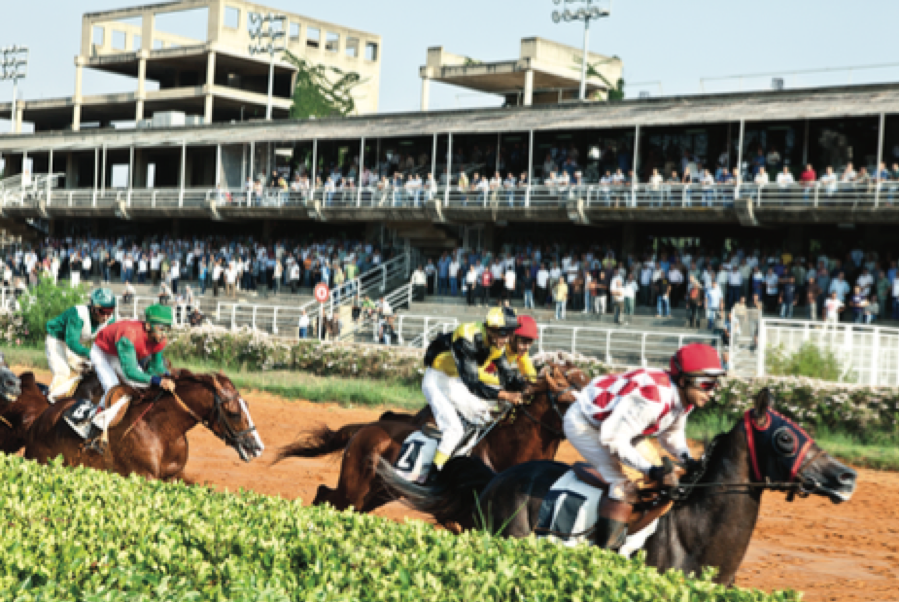
While a British day at the races is known for its champagne and women in outrageous headgear, a typical afternoon at the Beirut Hippodrome is a largely hatless, all-male affair. Each Saturday in summer and Sunday in winter these race aficionados gather at the walled track in between the National Museum and the residence of the French ambassador to Lebanon.
Every weekend six races take place, each with five to 10 competing horses bestowed with heroic names such as “Tiger of Lebanon,” “Son of the Sheikh,” “King of Horses” or “Symbol of Justice.” Before the race starts, they are paraded at the green behind the Hippodrome’s grandstand for the connoisseurs to check out the fitness of the competitors and pick their steed.
And they’re off…
While the horses are led to the track, the spectators head to the betting offices. Most will bet on the winner or the winner and runner-up in a single race, or in a combination of races whereby bets are placed on the number, not the name of the horse. The minimum bet is only LL 3,000, and while there is no official maximum bet, in reality the bets rarely exceed LL 100,000, as the Hippodrome’s limited betting volume produces a natural ceiling.
Just before the race starts, a near total silence descends on the stadium, which erupts in a cacophony of cries as soon as the horses fly out of the gates. One man placed a LL 10,000 bet on “6-2:” Horse No. 6 to win; 2 as runner-up. It was almost his lucky day. No. 6 dominated the race from start to finish. On the very last meter however, horse No. 2 was overtaken by horse No. 1. The man could not believe his eyes. He cursed with gusto before sinking into silence. Meanwhile, the lucky winners danced in front of the grandstand.
“I’ve been coming to the races since I was 18, for almost 60 years,” said another man inside the Hippodrome’s air-conditioned first class stand. “I love horses and I love horse racing. It’s like a drug, a weekly rush of adrenaline.”
Beirut horse racing has been organized by the Society for the Protection and Improvement of the Arabian Horse in Lebanon (SPARCA) — which also maintains the Hippodrome — since 1970. It is a non-profit organization recognized by international horse racing bodies. Furthermore, SPARCA is the keeper of the stud book for Lebanese horse racing, which among other things checks the horses’ paternity through DNA typing and marks them with micro chips.
In addition to organizing the local races, SPARCA signed an agreement with its counterpart France Galop to allow people at the Hippodrome to bet on horse racing in France. “We receive some 1,500 people per racing day,” said the Hippodrome’s General Manager Nabil Nasrallah. “The total volume of betting amounts to some $250,000 per week, with a peak of around $350,000 in the mid-1990s. Illegal bookmakers however, may make up to five times that amount. Many of Lebanon’s bigger players place their bets with them because they offer a discount of up to 35 percent in case of a loss, as well as credit facilities.”
The illegal bookies are able to offer such lucrative deals because they operate with minimal costs. They do not invest in the race track nor pay the prize money. In other words, they make money from horse racing, yet channel nothing back into the sector. Illegal bookies have long been a problem in Lebanon, yet were never a priority for Lebanese law enforcement. Why? Ask anyone at the Hippodrome and the answer will be the same: because the bookies are protected by the authorities.
According to article 62 of the 2001 budget law, the Beirut municipality, which owns the land, receives 5 percent of the Hippodrome’s betting income. Depending on the total volume of betting, the Ministry of Finance receives a progressive tax of 1 to 20 percent, which last year amounted to some 7 percent. SPARCA receives 15 percent, while the winning tickets divide the remaining amount.
“Racing horses is a luxury, like owning a football team. Currently, a horse owner, at best, may cover 25 percent of his costs”
For love, not money
SPARCA uses its 15 percent commission to maintain the Hippodrome, organize the races and pay the race winners prize money, which averages $2,000 per race. According to SPARCA’s statistics, Lebanon has close to 700 racehorses, some 350 of which are stabled at the Hippodrome, while there are some 600 horse breeders, mainly located in Akkar and the Bekaa Valley. It is estimated that, from breeder to jockey, around 3,000 families depend on horses and racing for their livelihood.
To a large extent, the sport is kept alive by Lebanon’s stable owners, with Mounir Dabaghy, Michel Pharaon and Nabil de Freige the three kingpins of the trade. Having started in 1965 with just handful of horses, SPARCA Secretary Dabaghy currently has the country’s biggest stable with some 80 racehorses.
“I don’t breed horses, I buy them in Lebanon or Syria,” he said. “The average price for a one-and-half-year-old is some $5,000. It takes 1.5 years of preliminary training before the horse will run its first race. Including the cost of food, the salaries of trainers, jockeys and stable boys, training a horse costs an average of around $600 a month.”
His most famous horses are Mosleh, which won the Presidential Cup twice, followed by Ibn al-Zawat and Maazour, which each won it once. The Presidential Cup is Lebanon’s leading race with a prize of LL 10 million (nearly $7,000). The prize money is divided 70 percent to the winner, 20 percent to the runner-up and 10 percent to the second runner-up. The winning trainer and jockey each get a 10 percent commission, while the remainder flows in the pocket of the stable owner.
Does that make horse racing a profitable business? “Not at all,” Dabaghy said. “Breeding horses is an industry. Racing horses is a luxury, like owning a football team. Currently, a horse owner, at best, may cover 25 percent of his costs. One or two horses may actually make money, but the profit of a stable as a whole is zero, nil, zip.”
Nasrallah estimated that in order to give the industry a boost, the prize money should be upped to at least $5,000 per race. Bigger prizes would encourage more people to breed, raise and train horses, which would lead to more races and a bigger betting volume, which would enable SPARCA to pay bigger prizes, and so on. It would also allow the organization to renovate the Hippodrome.
The Hippodrome and the pine forest next door offer one of the few oases of greenery amid the dense urban jungle that is Beirut
A storied past
Interestingly, if everything had gone according to Ottoman plans, the Hippodrome would today be the beating heart of an extensive gambling and entertainment complex. Former Beirut mayor Kenaan Taher Bey granted a 50-year-concession to Alfred Sursock to develop such a complex in 1915.
Yet while the Hippodrome hosted its first races in 1918, the planned restaurants, cafés and cinema were never built, and World War One ended plans for a casino. The victorious French decided that the mansion south of the racetrack should become the residence of France’s representative to Lebanon rather than a gambling haven.
Much like Casino du Liban, the Hippodrome had its golden years in the 1950s and 1960s when the region’s blue-blooded and well-heeled would descend on Beirut for a day at the races. Famous regulars included the former Shah of Iran and King Hussein of Jordan. The Civil War brought an end to all that, even though the racetrack remained open during most of the conflict years and regularly served as a neutral meeting ground for representatives from all sides.
One of the darkest chapters in the Hippodrome’s history occurred in 1982, when the invading Israeli army blew up the arched Belle Epoch grandstand and burnt down the once extensive pine forest. Some 23 horses at the Hippodrome were killed during one particularly nasty spell of fighting, while more than 300 horses in the stables were trapped without food or water.
The incident produced perhaps the most effective display of diplomacy in 15 years of civil war. The current SPARCA president and a member of Parliament, Nabil de Freige, called then-Lebanese President Elias Sarkis, himself an ardent horse lover, who informed US mediator Philip Habib, who in turn contacted Israeli Prime Minister Menachem Begin: the next morning a five-hour ceasefire was in place which enabled SPARCA to relocate the horses.
A tough nut to crack
The Hippodrome had barely survived the war before it was confronted with a threat of a very different nature. In November 1989, Lebanon’s government announced a plan to demolish the racetrack to make way for a new presidential palace and an extensive complex of government buildings. Yet a series of public protests, including a much publicized sit-in by everyone from breeder to stable boy forced the government in January 1990 to shelve its ambitions. Racing resumed shortly after.
Today, there are no plans to concrete over the Hippodrome, but that does not mean its future is safe and sound. The track is in a prime location that property developers are no doubt eager to get their hands on.
It would be an eternal shame if that were to happen. The track and racing make up an essential part of the effort to safeguard the future of the Arabian horse, while the Hippodrome and the pine forest next door also offer one of the few oases of space and greenery amid the dense urban jungle that is Beirut.
A night at the Casino
A government cash-cow heads back toward its former glory
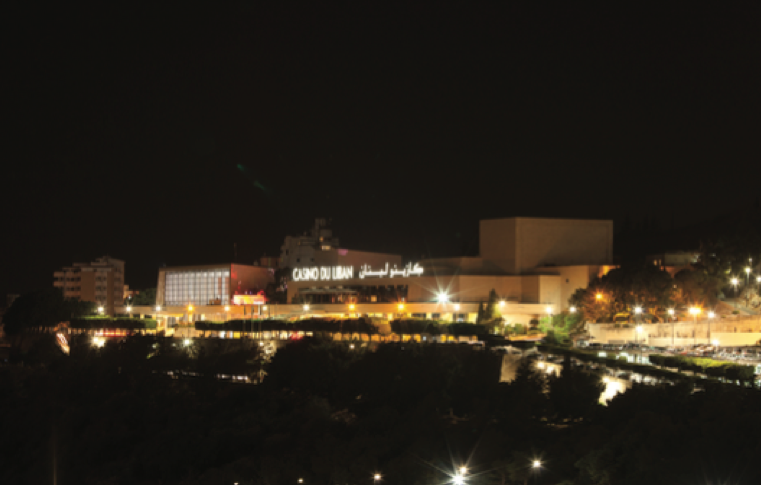
It is Saturday night and Casino du Liban (CDL) is packed. With a bucket of coins in one hand and, more often than not, a cigarette in the other, row after row of people try their luck on the machines in ‘Slots Palace.’ A regular cascade of coins brings relief to one and hope to all that the ‘big one’ is yet to come.
The International Room, opposite the Slots Palace, is home to both slot machines and table games, the most popular being roulette, blackjack and stud poker. It’s hard to find an empty seat to join the fray. At the blackjack table, a man in a white suit runs out of chips. He changes $500 worth with a fellow player and immediately puts all in on two hands of cards.
Winning one, loosing one, he bets all again, but is less lucky this time as the bank sweeps the table with 21. With his pockets $500 lighter in less than a minute, he decides to call it a day. A night at the casino can be fast and furious, and is never an affair for the faint-hearted.
Founded by presidential decree in 1957, CDL first opened its doors in 1959. It enjoys a monopoly on all Lebanese gambling, except horse racing, although it should be noted that Beirut in particular boasts numerous slot machine-filled “amusement centers.”
CDL is a privately owned concession company, albeit one with a significant public face. The biggest shareholder is the Intra Investment Company (IIC) — formerly known as Intra Bank — which holds a 51.87 percent stake. However, 35.16 percent and 10 percent of the IIC is owned by Banque du Liban, Lebanon’s central bank, and the Ministry of Finance, respectively.
The family-owned Abela Tourism Development Company owns a 14 percent stake in CDL, while the remainder of the shares are held by a number of other private investors. The Lebanese state is entitled to 40 percent of gross annual revenues, with the casino taking in some $250 million in recent years.
High stakes
Anyone reasonably well-dressed and older than 21 can enter the casino, with the exception of “government employees, military personnel and cashiers at banks or other commercial establishments.” A registration procedure, at least for the gaming tables, aims to make sure the guideline is implemented.
Home to nearly 500 slots machines and 60 gaming tables, the casino offers thrills — and disappointments — for all budgets. While one can play the slot machines for as little as LL 500, the minimum bet at the gaming tables is LL 10,000. This increases to LL 100,000 at the Cercle d’Or tables on the first floor. In addition, CDL is home to two private rooms for the so-called ‘high rollers’, where the minimum bet is often LL 250,000 or more.
“It is hard to define a high roller,” said CDL Marketing Manager Lara Hafez. “One player may lose $200,000 on the night but never come again, while another player looses only $10,000 but visits twice a week. We rather speak of a ‘good client:’ someone who visits regularly and at times may lose up to $30,000.”
Most of the casino’s gamblers operate on smaller budgets. While the average guest visits the casino for the entertainment of gambling, for a core group gambling becomes an obsession, one that can lead to financial and personal ruin.
“I used to go to the casino once a week to play horses on the slot machines,” said 35 year-old Jad. “For a while I regularly won up to $500 and I really thought I had figured it out. Then my luck turned and I started losing. But at first I couldn’t accept it. I thought if I keep playing, my luck will turn again, but it didn’t. I actually sold my car to continue playing, but after that I had nothing left, so I stopped.”
According to the American Psychiatric Association, pathological gambling is an impulse control disorder, a chronic and progressive mental illness. A gambling addiction shares many characteristics with a drug or alcohol addiction, such as preoccupation (to have gambling on one’s mind), tolerance (ever larger and more daring bets are needed to develop a rush) and lying (to hide the true extent of one’s habit). Addicts often value gambling above all else, including their relationships.
“My mother divorced my father because of his gambling habit,” said Eliane, a 43-year restaurant owner. “The thing that struck me most about his behavior was that, no matter how often or how much he lost, he always thought he was in control. He was convinced that, sooner or later, he would win because he ‘knew’ the game.”
Glory Days
A night at Casino du Liban is not per definition all about gambling. One can wine and dine with a view over Jounieh Bay or attend a show at the Salle des Ambassadeurs. CDL, like most casinos, defines itself an entertainment complex rather than a gambling firm.
A decade ago, some 70 percent of annual turnover stemmed from the gaming tables and 30 percent from the slot machines. Today they evenly make up some 95 percent of revenue. The remaining 5 percent stems from non-gaming activities, such as food, beverages and show tickets.
Annually, CDL attracts an average of 300,000 visitors, some 70 percent of whom are Lebanese, while some 21 percent are from the wider Middle East and North Africa region. The remainder mainly come from the United States and Europe.
“In 2009, the ratio slightly changed,” said CDL’s Hafez. “The number of Lebanese customers decreased to 65 percent, while the number of MENA visitors increased to 27 percent, which is a reflection of the growing number of tourists coming to Lebanon.”
Over the years, the casino’s fortunes have reflected those of Lebanon. The casino experienced its golden years in the 1960s and early 1970s, when it rapidly rose to fame on the international gambling circuit and became a “must-see” attraction.
Photos hanging on the walls recall the glory days when Omar Sharif was a regular visitor, as were King Hussein of Jordan, Shah Mohammad Reza Pahlavi of Iran, Prince Albert of Monaco and Greek shipping billionaire Aristotle Onassis. These were also the days when CDL staged its own theatrical and musical productions, which could run for months on end.
The international clientele quickly vanished when the civil war broke out in 1975. The casino was damaged, yet by and large remained operational until 1989 when it was forced to close completely. It reopened in December 1996, thanks to a $50 million state injection.
Expansion
Today, CDL is once again the region’s leading “playground.” Not taking into account illegal casinos, its few competitors are located in Egypt, northern Cyprus and Greece. Syrians make up half of the casino’s foreign clientele, followed by Jordanians and Gulf nationals. While in recent years there has been a notable increase in Iraqi players, the number of Syrian gamblers is likely to decrease, as Damascus aims to open a casino of its own.
“CDL is looking at ways to attract more people from the region, from Turkey, Cyprus and Greece, yet as we nearly operate on full capacity, we need to expand first,” said Hafez. The same is true for attracting the region’s high rollers. While people from the Gulf states, for example, do visit the casino, most big players prefer to fly to more prestigious and high spending casinos in Monaco, London or Las Vegas, where they are welcomed with extensive junket programs.
“A junket program aims to reward players by reimbursing their expenses in terms of travel, accommodation, food and beverages,” said Hafez. “Of course, in return the player is required to commit to play at a certain level in terms of length, level and type of play.”
Like every casino, CDL has an extensive database in which clients are characterized in terms of visit frequency, the level of cash swap and the level of win and lose, but so far it has not offered junket programs.
Casino Du Liban’s new management team has been quiet regarding future plans. More gaming facilities and perhaps a hotel would seem to be the minimum conditions for future expansion. If it plays its cards right, CDL could put itself back on the international gambling map.
