
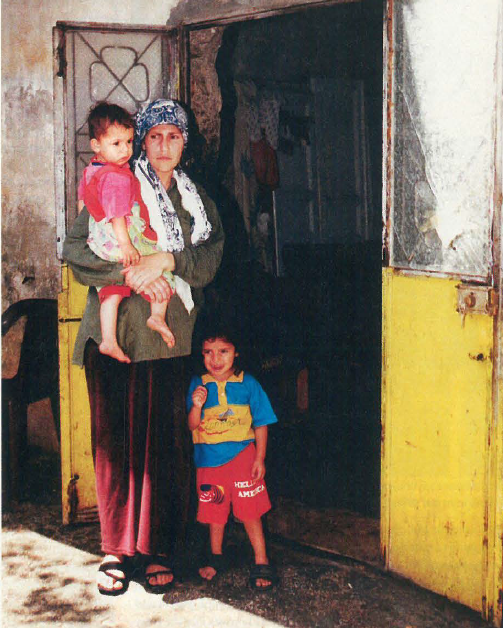
A t just 27 years of age, Halimeh is
the mother of six young children.
Her husband is a laborer and
looks for work on a day-to-day basis.
Sometimes there is none. With about $100
to $130 to survive on each month, life is a
constant struggle for this family of eight that
inhabits the northern village ofTekrit, high
in the remote mountains of Akkar. “We
manage to get by with enough food so we
don’t go hungry, but we can’t afford
healthcare or education for the kids,” says
Halimeh, adding that one child is handicapped
and requires extra medical attention.
While there is running water available, the
whole area is devoid of a sewage system.
Doubling as a bathroom with just a washboard
and bucket to one side, the family’s
cramped stone-floor kitchen adjoins a shed
that houses a cow. The stench of manure
permeates the air.
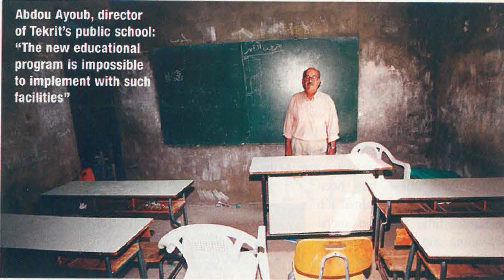
About half a kilometer up the road, lies the
town’s derelict public school, where annual
costs are about $ 130 per child. There
are no computers, no library, no gymnasium
and virtually no lab equipment or art supplies
for their learning. Squeezed in like sardines,
the kids sit three to a bench that is
meant to seat only two. The floors are bare
cement, the wall paint badly chipped and the
chairs and tables beat up. Naked light
bulbs provide dim lighting in the classrooms.
“I can’t tell you how difficult it is to
teach in such circumstances,” says Abdou
Ayoub, the school’s director. “And now
the government has created a new educational
program that is impossible to implement
with such facilities.”
The inhabitants of this remote village are
some of Lebanon’s seemingly forgotten people. And while there is no official poverty
line that adheres to international standard
measures, experts on the subject say poverty
is becoming a growing concern in terms of
a deprivation of basic needs and a drop in the
resources of households. “I think that the situation
is getting worse,” says RandaAboulHosn,
assistant resident representative of
the United Nations Development Program
(UNDP). “I don’t think we’ve hit the roof yet,
but it is pretty bad.”
About one-third of the Lebanese population
falls below the deprivation threshold,
while about 7% to 8% are living in abject
poverty, says Adib Nehme, project manager
for improving living conditions with the
ministry of social affairs (MoS). That
stands roughly in correlation with a 1998 survey
by the central administration for statistics
(CAS), in which 37 .1 % of households
stated that their income was not sufficient to
cover their needs. Some 40% of five-person
households earn less than LLS00,000 a
month, according to the latest nationwide survey by CAS in 1997, while another 19%
earn under LL550,000 a~d 6% make less
than LL300,000. Economists are quick to
point out, however, that these income figures
do not include money sent from relatives
abroad. The general labor confederation
recently issued a report stating that 48% of
the Lebanese population is livmg below the
poverty line, but that study has been branded
as overstated and politically motivated by
economists and others working in the field.
Lebanon isn’ t Burkina Faso or Ethiopia.
Nonetheless a significant portion of the
population endures poor living conditions.
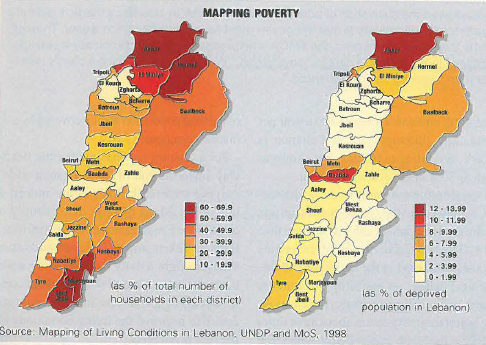
Many talk of the two faces of Lebanon – the
center and the periphery. This means that the
further an area is from large centers, especially
Beirut, the poorer it tends to be.
Compared to the national average of 32%,
more than 60% of households in Akkar,
Herrnel and Bint Jbeil are considered to be
living below the deprivation threshold,
according to a joint UNDP-MoS study on
the satisfaction of basic needs. (These
include housing, water and sewage, education
and income-related indicators.) In
another six districts, largely on the peripheries,
40% to 60% falls into that category
(see maps below).
But because these areas have relatively
small populations, in absolute numbers the
poor are m~stly concentrated in urban
areas – the southern suburbs of Beirut,
Baalbek, the northern suburbs of Beirut. The
one exception is Akkar, which at 12.5%, is
the district that is home to the largest number
of Lebanon’s poor. “This is because
Akkar is the only exception in the rural
population where the people are still living
there,” says Nehme. “Registration of those
urban areas showed that they are largely
from rural areas and migrated to the cities.”
As is generally the case for Lebanon’s
outlying areas, the poor living conditions of
Halimeh and her fellow inhabitants of
Tekrit is not simply the result of the economic
recession: Their deep-rooted poverty
is the consequence of decades of
neglect. Even before the civil war, this
country was marked by unbalanced
regional development, with a concentration
of high-income generating activities in Beirut and Mount Lebanon and higher
levels of poverty on the peripheries. “But
the war caused the major breakdown of the
standard of living conditions,” says
Nehme. Some 800,000 citizens were displaced
and 170,000 housing units were
damaged or destroyed. Rampant inflation
wreaked havoc on people’s purchasing
power, education and health standards
deteriorated and losses to infrastructure
and production facilities were in excess
of $25 billion.
Now with the continued recession, high
unemployment and high cost of living, people
are being dragged even further down.
“There are certain levels of intervention
that need to be done immediately and that
should be pure charity for those way down
there. Other levels of interventions are
required in order to keep people from
falling into poverty,” says Aboul-Hosn.
“And there’s a third level of intervention that
is needed to keep the rich from getting richer
at the expense of the poor.”
To be fair, some measures are being taken
by both non-governmental organizations
(see box) and the Lebanese administration,
including the creation of the ministry for
the displaced, the development plan for the
South and the opening of health centers in the
regions. But the impact of such projects is
mostly weak because of limited finances,
political interference and bureaucracy.
There is no national plan dedicated to
reducing poverty and redressing disparities.
But according to those working in the
field, that is precisely what must be included
in this country’s economic development policy. “If we don’t have ecgnomic growth
and productivity, we cannot have social
welfare,” says Nehme. “But it’s not
enough. We should have a more comprehensive
policy that deals with both the economic
and social components.”
Lebanon’s post-war economic policy has
focused on monetary stability, eontrolling
inflation and rebuilding infrastructure. At the
same time, there has been
increased taxation, minimal job
creation, little effective social
spending and higher prices on
public services despite their ineffectiveness.
The negative repercussions
of these have been felt
more acutely in the less privileged
segments of society. “The majority
of the annual budget goes
toward salaries, but the impact and
output of this administration is
minimal, meaning the private sector
charges you for services that the
state cannot provide, regulate, delegate
to civil societies or decentralize
to the municipalities,” says
Aboul-Hosn. “So you’re paying
on both ends. One of the main
causes of the rise of poverty is the
fact that we are spending more for
much much less.”
Combating poverty through a
national plan will be no easy task. It will
require the coordination of numerous ministries
as well as NGOs in order to address
a wide range of issues. These include
basics like running water, electricity and
sewage; a readjustment of wage scales; a
more equitable taxation system; job creation
and improving agricultural infrastructure.
And despite the perceived advance of
Lebanon’s education and healthcare, these
are two sectors that need special attention,
according to experts. Two areas where the
private sector has picked up the public sector’s
slack, education and healthcare eat up
more than 20% of the household budget.
Education is considered to be one of the
most important factors in breaking the
cycle of poverty, but the entire Lebanese
educational system is seen as inadequate for
the demands of today’s marketplace. And for
those who cannot afford private schools,
the public system – although substandard at best – still costs an average $300 a year per
child. The illiteracy rate in Lebanon is
13.6%, according to Nehme, but climbs as
high as 30% in the district of Akkar.
Despite efforts to improve the health sector,
estimates put the out-of-pocket portion
of the total national health bill at more than
50%. The high participation of the private
sector is reflected in the high cost and disparities,
while accessibility to primary
health care is still problematic. For example,
the infant mortality rate is about three times
higher in the North than in Beirut, while 58%
of the total population are not covered by any
insurance scheme.
For a country that has made little headway
since the end of the war, such wideranging
structural changes are indeed a
tall order. Many believe it is simply a
question of management and priorities.
Back in Tekrit, where Halimeh and other
villagers fight a daily battle to make ends
meet, it’s a question of whether this country’s
leaders are sincere in their apparent
desire to improve the living conditions of
the less privileged.
Providing solutions
While those in the capital argue the merits of wide-ranging reform, the YMCA is
quietly working the beat to improve the living conditions of Lebanon’s underprivileged
through its community development programs. “We are among the major
promoters of rural development, because the rural areas in this country have been
the hardest hit and the most deprived since independence,” says Ghassan Sayah,
head of the YMCA’s Lebanon chapter. “We are helping people to make a living where
they are, rather than them quitting the area.”
The YMCA’s program addresses developmental issues through its six cluster programs
in Akkar, the Bekaa and the South. The communities
themselves are expected to provide 30% of total
funding, while $6.5 million is provided by USAIO. They
are also expected to set their own priorities and
decide where the money should be spent. The idea
is to make the inhabitants of these areas responsible,
accountable and partners in the project, so that
they are in charge of their own development.
Inhabitants of these areas are also aided in finding
ways of earning a living. One example is the recent
creation of a cottage industry for processed food in
Akkar, in a town whose only source of employment
had been the army, agriculture and the school.
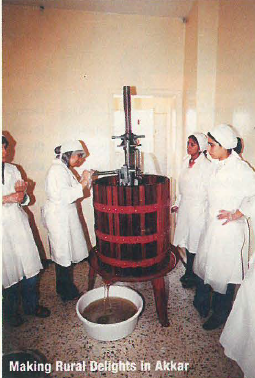
Run by a cooperative, it counts over 80 products,
including sun-dried tomatoes and fruits, herbs,
vinegar and rose water using newly introduced
techniques for standardization, quality and
hygiene. Selling under the brand name Rural
Delights, its products are being sold at small health
stores and Monoprix, while negotiations are underway
with Bou Khalil, Idriss and Spinneys. One
achievement was in convincing the conservative
Muslim community that women should be fullfledged
members of the cooperative.
In the village of Akkar el Atika, massive road works
are underway to improve access for agricultural vehicles, while a potable water network
has been installed for the area. Higher up in the mountains of Akkar, a three-kilometer
irrigation channel with accompanying agricultural access has been installed. This
project directly benefits four villages and some 3,000 families, while reduced water loss
has allowed the cultivation of additional land. The YMCA also has a medical aid program
for the chronically ill that the government funds with $2 million a year. Through
more than 300 dispensaries, the YMCA is helping some 16,000 chronically ill patients.
“I think the Y is lighting a candle,” says Sayah. “We believe that lighting a candle is better
than swearing against darkness.”
