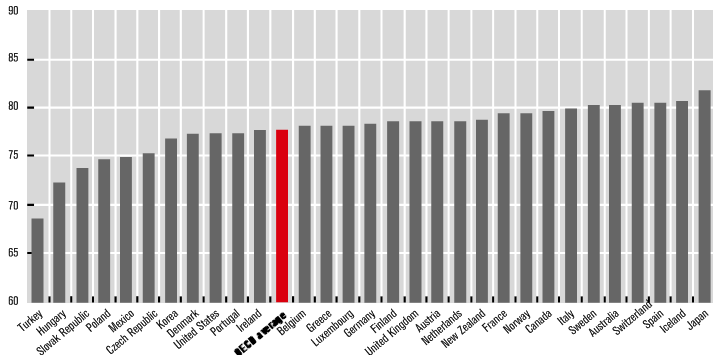
Life expectancy at birth remains one of the most frequently quoted indicators of health status. Gains in life expectancy in OECD countries in recent decades have been due to a number of important factors affecting mortality rates, including rising living standards, improved lifestyle and better education, as well as advances in access to care. Other factors, such as better nutrition, sanitation and housing also played a role, particularly in countries with developing economies. Higher national income is generally associated with higher life expectancy at birth across OECD countries, although the relationship is less pronounced at higher levels of income.
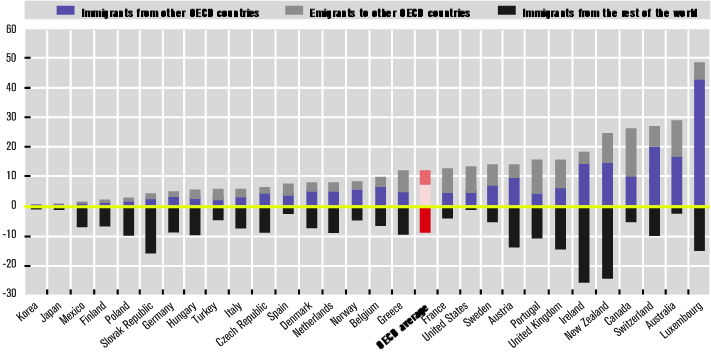
Foreign-born persons with tertiary education
As a percentage of all residents with tertiary education, circa 2000
n In many countries, foreign-born persons represent a significant percentage of persons with tertiary education. Many OECD countries “gain” more than they “lose” from migration of the highly educated. The table shows foreign-born persons with tertiary education living in or from OECD countries as a percentage of the number of residents with tertiary education.
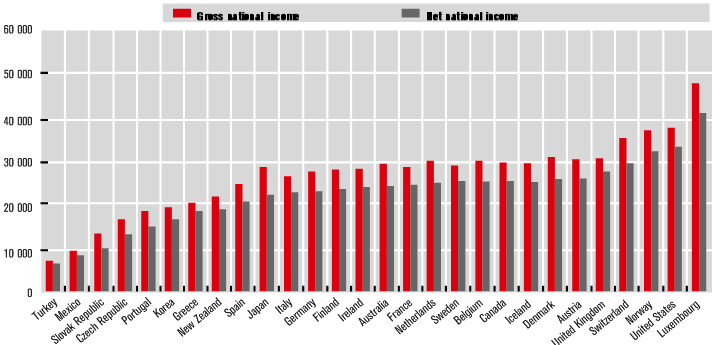
Gross and net national income per capital
US dollars, current prices and PPPs, 2003
Per capita gross national income (GNI) and net national income (NNI) are often preferred by analysts when comparing income levels. GNI is defined as GDP plus net receipts from abroad of wages and salaries and of property income. Guest-workers and other migrant workers who live abroad for twelve months or more are considered to be resident in the country where they are working. Property income from abroad includes interest, dividends and all or part of the retained earnings of foreign enterprises owned fully or in part by residents.
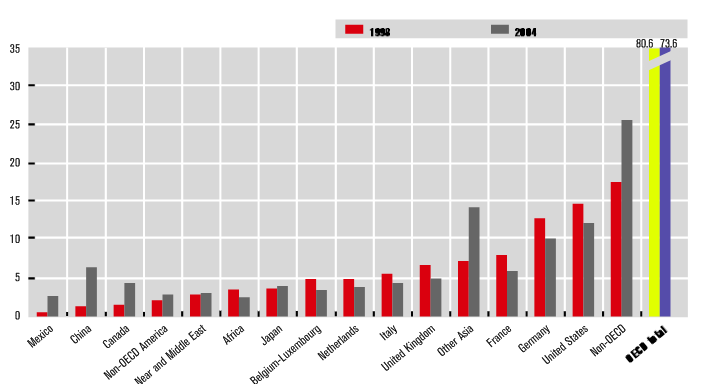
Partner countries and regions of OECD merchandise trade
As a percentage of total OECD merchandise trade
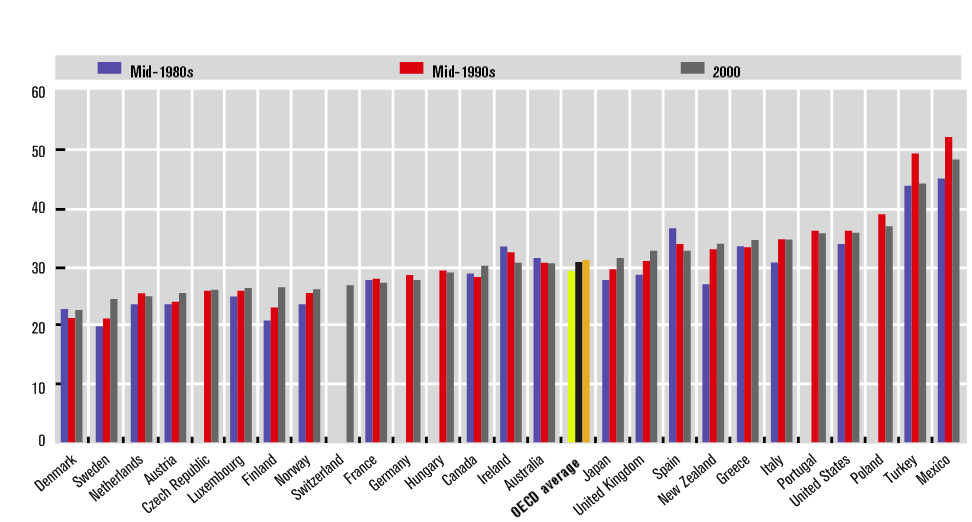
Distribution of household disposable income among individuals
Measure by Gini coefficients
The distribution of incomes within a country is important for two reasons. Inequalities create incentives for people to improve their situation through work, innovation or acquiring new skills. However, crime, poverty and social exclusion are linked to inequalities. Income is defined as household disposable income. It consists of earnings from work, property income such as interest and dividends, and pensions and other social security benefits; income taxes and social security contributions paid by households are deducted. The equality of disposable incomes among individuals ranges from 0 in the case of “perfect equality” (each share of the population gets the same share of income) to 100 in the case of “perfect inequality” (all income goes to the share of the population with the highest income). Household income is adjusted to take account of household size.
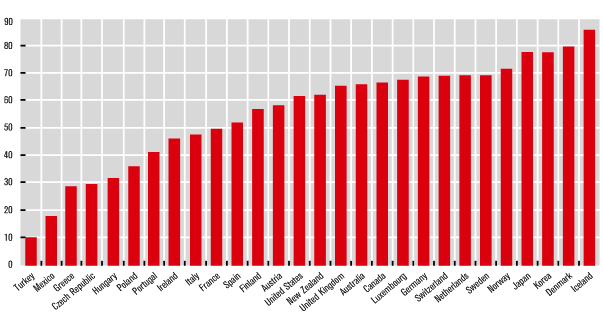
Households with access to a home computer
Percentage of all households, 2004 or latest available year
The table shows the number of households that reported having at least one personal computer in working order. The second part of the table shows the percentage of households who reported that they had access to the Internet. In almost all cases, this access is via a personal computer, either using a dial-up, DSL, fiber optic or other broadband access.
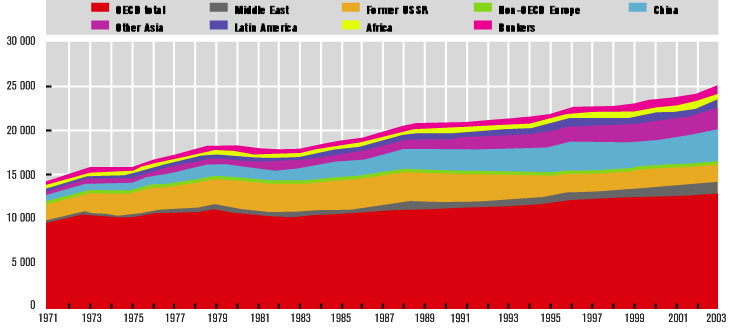
World CO2 emissions from energy use, by region
Million tons
Carbon dioxide (CO2) makes up the largest share of “greenhouse gases.” The table refers to emissions of CO2 from burning oil, coal and gas for energy use. Carbon dioxide also enters the atmosphere from burning wood and waste materials and from some industrial processes such as cement production. Emissions of CO2 from these sources are a relatively small part of global emissions and are not included in these statistics. The Revised 1996 IPCC Guidelines for National Greenhouse Gas Inventories (see below) provide a fuller, technical definition of how CO2 emissions have been estimated for this table.
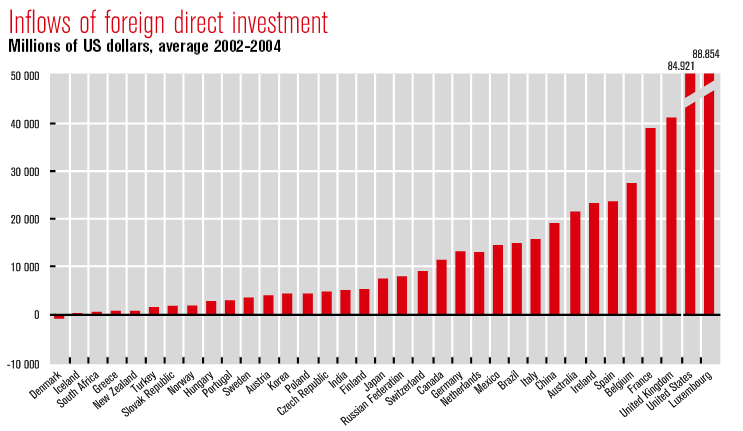
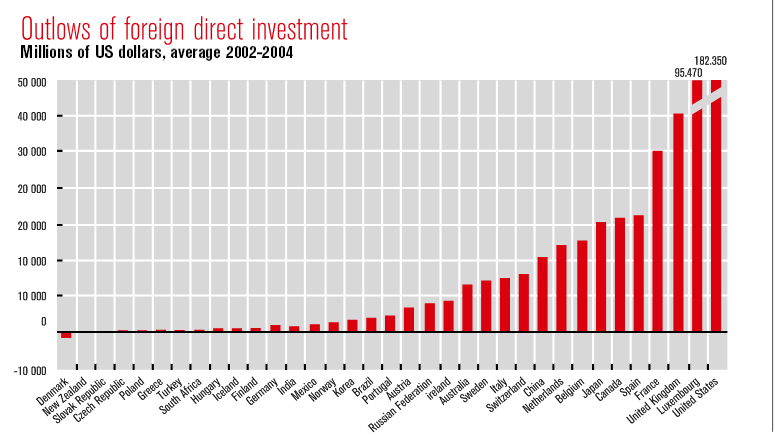
Foreign direct investment (FDI) is a key element in the rapidly evolving process of international economic integration. FDI creates direct, stable and long-lasting links between economies. FDI is an additional source of funding for capital investment. Foreign direct investment (FDI) is defined as investment by a resident entity in one economy with the objective of obtaining a lasting interest in an enterprise resident in another economy. The lasting interest means the existence of a long-term relationship between the direct investor and the enterprise and a significant degree of influence by the direct investor on the management of the direct investment enterprise. Absolute control by the foreign investor is not required, and ownership of 10% of the ordinary shares or voting stock is the criterion used. Inward stocks are the direct investments held by non-residents; outward stocks are the investments held in other economies.