
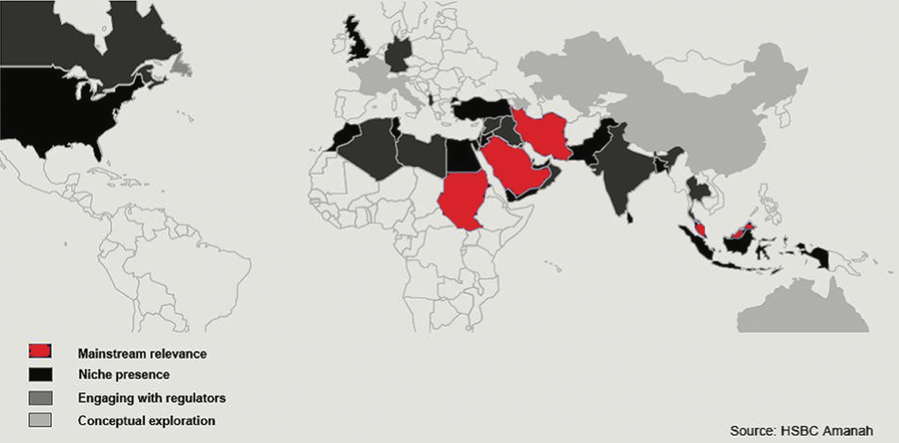
Assets managed within Islamic banking and finance are massive and growing rapidly in both monetary and geographic terms. In Sudan, Saudi Arabia, Iran and Malaysia, Islamic banking is the premier form of financial transaction. The industry also has a niche presence in the rest of the MENA region and many other countries around the world are toying with the idea of sharia-compliant banking.
On a technical level, analysts often separate the sector into four separate segments: commercial Islamic banks, investment Islamic banks, takaful institutions and Islamic finance houses.
But Abdel-Maoula Chaar, the Islamic finance project manager at the Beirut-based Ecole Supérieure des Affaires, applies what he considers a more important dichotomy. Chaar believes it is more helpful to view the industry in terms of “Islamic banks versus sharia-compliant banks.” He suggested that Islamic banks, like Dubai Islamic bank, have a moral underpinning to their operations. Banks of this nature tend to hold all of their products and actions under the microscope of sharia.
On the other side of the equation are sharia-compliant banks. Most of the time the big Western banks with Islamic windows, like Citi Islamic and HSBC’s Amanah, receive the attention in that category. Nevertheless, this group also includes conventional banks based in Arab countries, like the Arab Bank for Investment and Foreign Trade (ARBIFT). ARBIFT was established in 1976 as a joint venture between the federal government of the United Arab Emirates, the Libyan Arab Foreign Bank and Banque Exterieure d’Algerie. Reflecting the era in which it was born, the bank initially had a strong Arab unity character and the establishment stressed promoting the collective ownership of Arab capital funds in the international financial markets. This has, however, recently begun to change.
Just this year ARBIFT changed its name to Al Masraf. Furthermore, the bank has been steadily increasing the number of Islamic financial products it offers with an eye to capturing part of the growing Islamic finance market. According to Saeed Khan, Head of Corporate Banking at Al Masraf, the bank started offering sharia-compliant products in 2006 as “we had to cater to our customer’s needs. Our clients in the emirates were asking for Islamic products.”
He added that “the launch of Islamic products has yet to touch the corporate sector and that within the retail division Islamic products represent just five percent of the portfolio.” It seems that the most popular type of Islamic product at Al Masraf is murabaha. When compared to the counterpart conventional car loan offered by the bank, the products are almost identical. The repayment period is flexible up to 72 months, no down payment is required and there are no processing fees.
When one compares the cost, however, discrepancies appear. The conventional car loan interest rates start at 2.99%, while the profit rates for the vehicle murabaha start at 4.25%. The 1.26% difference in cost is significant when tacked on to the sticker price of a new car. Perhaps this factor is keeping interest in the bank’s new Islamic products low.
Khan said the existence of conventional, interest-earning products next to the newly established Islamic ones does not bother the bank’s customers. Khan said that his customers have “no concerns over the presence of both products,” and that this is normal in many banks in the region. Furthermore, he implied that the bank’s sharia-compliant offerings would only grow, saying that “Islamic finance is the future of banking” in the region.
Regulation
The Islamic banking and finance industry is predominantly regulated on the national level. In addition to the in-house sharia supervisory boards present in most Islamic financial institutions, those entities are also obliged to follow the standards set by the advisory board of their respective national central bank. The industry, and its strongest central bank supporters, have also recognized the importance of international regulation and have formed two strong self-regulatory bodies: the Accounting and Auditing Organization for Islamic Financial Institutions (AAOIFI) and the Islamic Financial Services Board (IFSB).
According to a handbook published by the Securities and Investment Institute, based in London, “AAOIFI is the autonomous entity responsible for the formulation and issuance of accounting, auditing, ethics, governance and sharia standards for the international Islamic banking and finance industry.” Despite the overarching and unifying image accorded to AAOIFI, the organization itself recently fell pray to the ubiquitous growing pains of the Islamic finance world.
Late last year, Sheikh Muhammad Taqi Usmani, chairperson of AAOIFI’s advisory board, declared 85% of sukuk to be un-Islamic. The specifics of the statement were not immediately clarified, throwing Islamic investors and institutions into a panic. After three months of debate, the organization issued a statement saying that any financial product with a buyback clause was un-Islamic because this effectively eliminated the risk-sharing aspect of the investment, a necessary part of sharia compliance.
The advisory board also declared that, in order to be considered Islamic, sukuk must be asset-backed, and not merely asset-based. This development will make things difficult for CFOs, as they will be forced to adapt to new structures. Under the new ruling it appears that those original 85% of sukuk are still un-Islamic and it is likely that the market will now bifurcate under the pressure of the ruling, with half of the investors adopting new asset-backed products, while the other half pursues new structures. The organization has taken a lot of heat for the ruling and AAOIFI’s leadership is reticent on the topic.
In an interview with Executive, Dr. Khairul Nizam, AAOIFI’s Assistant Secretary General, was quick to note that the standards of the body are five-fold: accounting, auditing, governance, ethics and sharia standards. Nizam stated, our “sharia standards have been adopted by most of the world’s Islamic financial centers. And in fact, all Islamic banks in the world follow our sharia standards.”
However, when asked about the AAOIFI ruling that would effectively make 85% of sukuk un-Islamic, Nizam took a different tack, saying that, “Although our standards are used by almost all of the banks around the world, each bank also has its own sharia supervisory board and has to decide for itself. And this may vary as different products are designed for different markets… We are part of the finance industry and we have to work with that industry.”
Given the massive amounts of capital at stake and the relative youth of the industry, more sukuk-style episodes are likely in the future. It is also likely that regulatory authorities will come under immense pressure to make the ‘right decision’ when it comes to controversial products.
All this is bound to make the future developments of Islamic financial product regulation a challenging and exciting process.
