
This month EXECUTIVE recognizes Lebanon’s newest entrepreneurs
by introducing a section dedicated to start-up companies.
Despite a slump in the economy, there are still
those who pursue the dream of starting a business. The three
start-ups profiled have ventured into competitive fields,
trade, advertising and travel, and faced similar challenges.
All three were established on personal savings. In Lebanon,
it’s almost impossible for start-ups to obtain credit, even well-established
small and medium-sized enterprises (SMEs)
have difficulties. A study by the Lebanese Center for Policy
Studies revealed that 81% of credit goes to 9% of borrowers.
But there is some encouraging news. The European
Investment Bank recently granted a loan of about 30 million
euros ($29 million) for SMEs and start-ups. The loan will be managed
by the central bank and distributed by nine commercial
banks. Applicants can request loans of 50,000 euros ($48,000)
to 2 million euros ($1.92 million). They will last for eight years,
with a two-year grace period, at interest rates that have not yet
been determined. To qualify, applicants must present a project
to one of nine commercial banks and have it approved by the
Council for Development and Reconstruction.
A new office has also been established to guarantee loans to
SMEs within the agricultural, industrial or technology sectors,
up to 75% of their value, to about $67,000.
Standing among giants
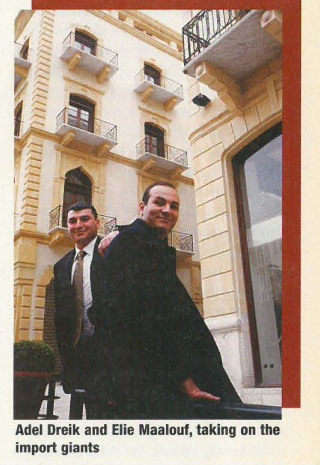
Armed with conviction and $70,000, Elie
Maalouf and Adel Dreik established
Key Brands in late 1997, distributing such
mid-range toiletries as Club Sport, Baylis &
Harding and Vuarnet. The new company
refused to divulge revenue figures, but last year
sales grew by 60%, according to Maalouf.
Key Brands is stepping into an import
market that is dominated by big companies
such as Unilever, Obegi and Fattal. Its strategy
is to target price-driven consumers. The
recent 20% hike in customs on cosmetics and
toiletries to 55%, as well as the recession, has
made high-end products unaffordable to
many. This has helped Key Brands’ line of
Club Sport spray deodorants, which retails
at under LL4,000 for a 150ml bottle. The
same size bottle of Malizia, the number-one
seller last year with 14.3% market share,
costs about LL6,400.
“You have a transfer from the high-end to the
low-end,” says Raymond Abou Adal, president
of the Abou Adal Group, distributors of
Colgate-Palmolive. Even Obegi, one of the
largest distributors, did away with its high-end
cosmetic lines.
Having successfully penetrated the market
in just one year, Maalouf and Dreik went
searching for new product lines. This
required additional funds so the partners
formed a joint venture with Meteco, another
new company. Key Brands added to its portfolio
Babaria, Bypsa, Looney Tunes toiletries
and fragrances for kids, as well as a line of
mass-market perfumes called Prestige.
Today, the company’s database comprises
over 150 items. Bypsa, a line of mass-market
toiletries, is Key Brands’ best seller. A 750ml
bottle of Bypsa shampoo retails for about
LL5,000. The same size bottle of Pantene, the
number one seller with 21.4% market share
last year, sells for about LL8,500.
After just one year, Fransabank granted the
company overdraft facilities of $75,000. “We
have not used one-third of it, that’s how
focused we are on our finances,” says Dreik.
“We keep reinvesting, we watch our costs
closely and we follow up on our payments.”
Last year the partners agreed to reinvest all
profits made in the first three years. “No profits
are being taken out. We are focusing on
increasing the size of the company, our sales
and our market share,” says Dreik. This year
Key Brands is targeting a new market segment, small mini-markets and grocery stores.
Unlike big supermarkets, smaller shops don’t
demand big discounts. “This market is huge,”
says Maalouf.
The partners also plan to invest $400,000 in
a factory to package in-house lines of personal
care products. Key Brands secured a medium-term
loan to finance the plant, which should
be up and running within a few months. By producing locally, it will be able to avoid the
steep tariff on imports.
In a short period of time, Key Brands has experienced good growth. “It’s a competitive
market, but if you work well you
can succeed,” says Dreik.
Standing out in a crowd
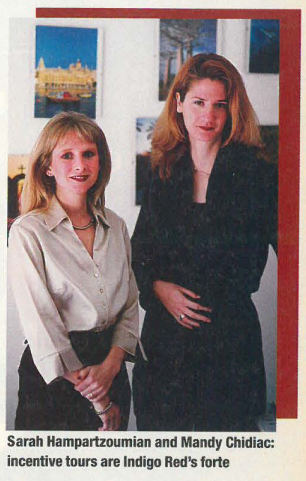
Sarah Hampartzoumian and Mandy
Chidiac have worked for years in the
travel business. The market, says
Hampartzoumian, “is saturated with agencies
offering every type of travel service, but
not specializing in one.” At the same time,
the economic crisis has cut into outgoing
tours, while the stalled peace process is
hurting incoming tours. “At the moment
business isn’t good,” says Fouad Kurban,
president of the association of travel and
tourist agents in Lebanon.
Despite the bleak conditions, the two
young women sensed an opportunity. Last
July, they invested $15,000 in Indigo Red, a
company focusing on specialized tourism.
The company runs honeymoon packages,
adventure trips and motivational programs
aimed at organizations.
Increasingly, people are opting for affordable
package tours. But this is a complicated
and costly affair that requires high volume.
For this reason, smaller agencies often sell
packages for larger agencies, receiving a
commission of about 5%. By specializing in
specific types of travel, Indigo Red is able to
create its own packages. This increases
profit margins to about 10%.
Incentive tours might prove to be Indigo
Red’s forte. Local firms already offer these
to employees as team-building events and
they have so far proved popular. Indigo Red
hopes to attract international companies to
Lebanon in this way, but that will require substantial
funds and a more stable political
environment. The company wouldn’t disclose
sales figures, but its strategy seems
to be paying off. As an official from the
ministry of tourism says, “the future is for the
agents that specialize.”
Good things come in small packages
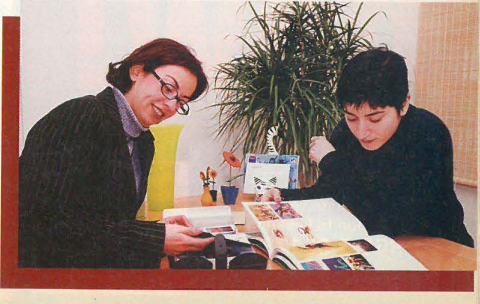
Samar Aouad and Maya Metni don’t just
look trendy, they think that way too.
The two young women met while
employed at a local advertising agency and,
frustrated by the general lack of cooperation
and administrative scrutiny, casually joked
about opening a small advertising agency of
their own. In May of last year, they did just
that. On a budget of only $10,000, they
established Pomme S.
But times are tough and Jean-Claude
Boulos, president of the international advertising
association’s Lebanon chapter says:
“They’re coming in at a bad moment.”
Competition is fierce. There are about 100 ad
agencies in Lebanon and countless more sell
advertising space, while the recession has
prompted many companies to reduce their
advertising budgets.
But, says Boulos, the newcomers can succeed
if they show “creativity and seriousness,”
two qualities that Aouad and Metni
say they have. The partners had already
earned a reputation as freelancers for a number
of top ad agencies. Thanks to their experience,
Aouad and Metni were able to draw an
impressive list of clients when they started,
including their biggest client, Credit
Bancaire. Freelance work continues to generate
about 20% of revenues. Through
word-of-mouth, the reputation of Pomme S
has been growing. “We have around 12 regular
clients, plus about five every month that
we do one project for,”
says Metni.
Lower overheads
enable Pomme S to
charge competitive
rates. For example, a
corporate image,
which includes
business cards, letterhead,
second
page, envelopes and compliment cards, costs $600 to $1,000.
Larger agencies charge up to $5,000. But
being new in the business is tough. “We have
to make about $4,000 to $5,000 a month to be
on the safe side,” says Aouad. Both admit that,
before opening Pomme S, life was easier.
Nonetheless, the two say that opening
Pomme S has been professionally and personally
gratifying. “We are happy,” says
Metni. “Having your own company is better
than having a new car.”
