
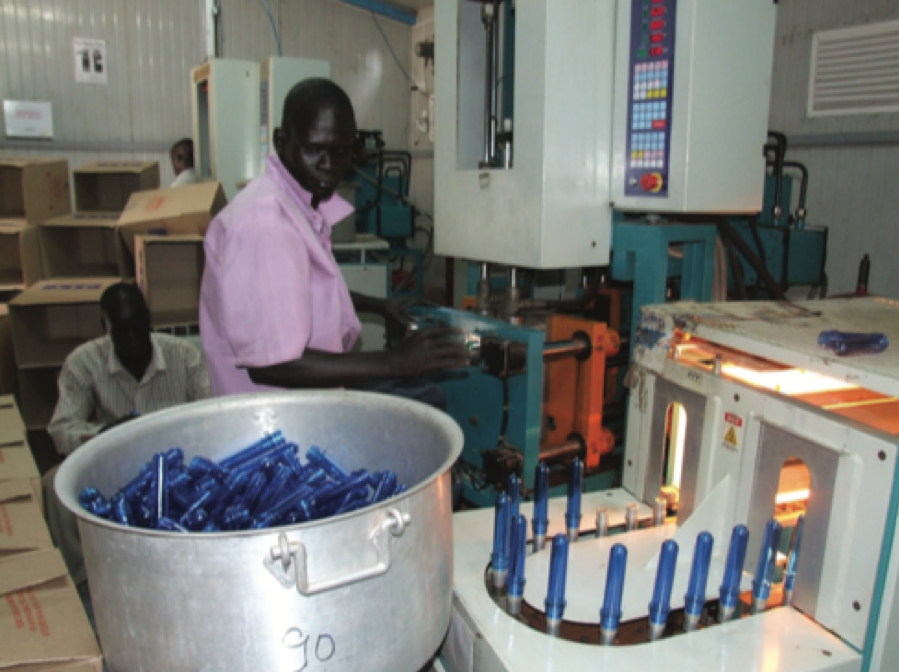
One of the world’s greatest rivers passes through Africa’s newest capital. Unlike much of the dry country, mango green Southern Sudan’s Juba does not look like it should have water problems. But the river is more than just murky; it is reputed to contain a wide variety of waterborne diseases.
Most certainly — and most seriously — it carries cholera, the bacteria that has thousands in agony every year and kills dozens. Bottled water was one of the first products trucked in after the 2005 peace accord and because anyone with money will not risk drinking any other water, it became one of Juba’s most lucrative businesses. The cost of the product was also one of the first to stabilize across the town and then go down as a growth in the number of distributors pushed down prices for businesses buying the plastic bottles.
Three and a half years out of a war that lasted more than two decades, Juba is still without any kind of treatment plant. There is little left of a colonial-era water system that was further destroyed by recent road-building efforts by the semi-autonomous southern government.
Juba’s residents get raw water trucked in from the Nile for showers and taps. Blue barrels, originally used for storing and transporting corn syrup, are common in most households. Filling these, around 200 liters, costs $2, however the barrels are often decorated with growths of brilliant green algae, and boiling the water sometimes produces a strange scum.
Few would choose to drink the water that is often thick with silt. More than one has complained of worms rushing out of taps and showerheads when the water is turned on.
Another can of worms altogether is the problem in those parts of the South that are endemic to Guinea Worm, a three-foot (one meter) long parasite that looks like cooked spaghetti and grows in the human body, wrapped around muscle tissues. It pushes its head out of a blister, usually on the arms or lower legs, after around a year of growth and on contact with water ejaculates around a million fertilized eggs into the water source. When these are drunk the life cycle continues.
Like cholera, Guinea Worm smacks of the mediaeval, and the South has far more than its fair share. When the American Carter Center — formed by U.S. President Jimmy Carter — first got involved with preventing the spread of the disease in 1986 there were 3.5 million cases. By 2006 only 25,217 cases were recorded in the world. Over 20,000 of those were in Sudan.
A study by Juba’s branch of the Red Crescent found that many of the town’s boreholes — far too few for its growing population — were also contaminated with E. coli bacteria. It’s presence in borehole water is used as an indicator of further contamination.
What the wealthy drink
Hotels and richer households commonly use bottled water not only in kettles but also to wash vegetables and fruit.
“We get through dozens of bottles everyday, in the kitchen,” said Bhandari Guruvir, Indian manager of the Sunflower Inn. A sub-manager of the Juba Raha Hotel — at three years new one of Juba’s oldest — said the cost of water is so high that Raha and a group of other hotels in partnership wanted to build a mini-water treatment plant for their use only.
Like Juba’s international and national aid and development workers, businessmen and everyone else who can afford it, the government from ministers to low-ranking civil servants, is dependent on bottled water. Thousands of crates are trucked in every month from east Africa.
Unlike neighboring Kenya or Uganda, where anyone with a steely stomach can drink from the tap, southerners prefer to drink Rwenzori, Aquasipi or other East African brands which, used up and flattened, pave the roads of Juba Town and stack up in banks on their sides.
While water is a great expense for Juba’s hotels and restaurants it is also a money-maker. Most of the flattened bottles and the giant translucent plastic rubbish piles that have been dumped on the road out of town hold a mere 500 ml. In Juba’s heat these small bottles represent only one sixth the recommended daily minimum water intake but are by far the most popular. Part of hospitality across Sudan — whether in the south or north — demands the provision of water and many offices or homes will provide the visitor with one of the small bottles.
Many expensive restaurants charge two Sudanese pounds ($1) for one of the little bottles. Shops and cheaper restaurants charge half that and the lack of small change in the new currency introduced in 2006 has driven up prices that lack graduation. But even this cheaper price is still more than twice what the mostly Ugandan brands cost in their home country.
“Bottled water is the most environmentally harmful, economically inefficient and wasteful way of providing drinking water to a population,” Sam Huston, a water engineer working in the South for an international NGO, said. “These small bottles are the worst.”
But so far there is little choice and, with the small bottles, vendors provide a thirst-quencher that is easy to handle and light.
Already this year 5,878 cases of cholera across the South have been reported with 44 deaths. The bacteria responsible for the disease, which killed many thousands in Europe in centuries long past, live and multiple not only in the human body but also in water.
The local government and the UN children’s agency UNICEF have tried to reduce the spread of cholera through regulating the water trucks, including registration, chlorination of the tanks and controlling where the truckers collect water. But so far they have been unable to stop the tankers filling up where it is easiest — beside the river. Attempts to get small businesses to take over the management and maintenance locations where the tankers can collect clean water have not yet succeeded.
Cholera figures this year are smaller than in the past two years, around 8,000 cases in 2007 and 20,000 in 2006. Figures are not known for the wartime, but health workers think the crowding of urban areas with former refugees and displaced people and a vastly increased amount of travel are partly responsible for the high caseload.
Almost nothing home-made
The South produces little but crude oil, and everything from cooking oil to soap is imported — water is no different.
“We bring up and distribute up to 3,000 cartons a week,” said John Wosuk, a southerner working for Shalom, a Ugandan-owned distribution company.
Each carton of Juba’s favorite Rwenzori product — 24 bottles of 500ml — sells for around 14 Sudanese pounds ($7). The cartons are purchased for around $6 at the factory in Uganda and after transport over the rough roads of the South and passed through the as-yet unregulated customs system there is little profit left, although there is increasing demand and always new business to be found whether for new non-governmental agencies, hotels or consular offices.
Rwenzori — with its attractive and robust-looking bottle — is still the most-asked for water, hotel managers say. It is also the most common type of water on sale and was the first company to enter the market almost as soon as the peace deal was signed.
The bottle’s distinctive shape has also worked its way into many small home grown industries: now liquid soap, car oil, cooking oil, kerosene and numerous other products are sold in the bottles. But Wosuk said there is also another reason for the hundreds of empty bottles collected by street children.
“Some people are trying to make fake water using the empty Rwenzori bottles,” Wosuk said. Bottling, unfortunately, is at the Nile banks. Newer brands have benefited from this and Wosuk said companies like Aquasipi and Hemma are making their mark.
Also growing in popularity is JIT water. The 1.5 liter bottles, decorated with an unlikely looking green island next to a lake, are taking over from the large Rwenzori bottles in most of the small roadside shops.
This water is Juba Nile Water but has been through a reverse osmosis process (the same technique used for desalination — water molecules are pushed through a membrane to a more pure solution, the reverse of normal osmosis) and treated using ultraviolet light that breaks down micro-organisms.
Others, faced by the difficulties of transport — nothing reached Juba from Uganda for a month last year when an underground spring flooded the road — and its high cost are also planning similar plants.
Shalom’s parent company Mkwano — a massive company producing a wide range of soap, oil and other domestic products with 400 distributors in the region — is also interested in setting up its own factory.
“Of course there are issues, or raw materials and land availability,” Wosuk said. But becoming independent from overland supply is crucial. He remembers when the road became a giant lake in 2007. “We just came to the office without doing anything.”
