
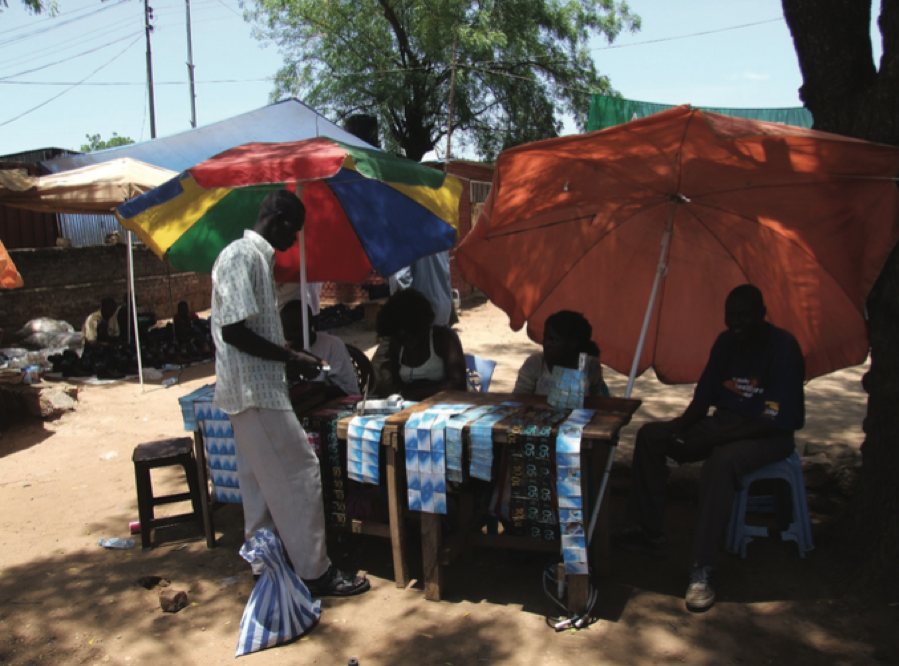
Identifying the commander amongst the mishmash of uniforms that made up the southern rebel army during the years of Sudan’s vicious North-South war was easiest done by finding the man with a large grey and black Thuraya satellite telephone in his hand.
A North-South peace deal in 2005 ended the war and allowed for a semi-autonomous southern Sudanese government headed up by the former rebel party. The same army elite are now ministers and governors; internationally recognized as in charge of the vast wilderness of the South and the garrison towns that formerly eluded them.
The Thurayas were indispensable, not only for military communication in the bush but also to mark sites with GPS coordinates. A +88216 number for the UAE company phones is still usual on government business cards. Although satellite telephones are rarely switched on in towns and have no reception inside the new offices, this is not just a war time throwback.
Despite the fast growth of the indigenous mobile phone operator Gemtel, connected through neighboring Uganda, and the much slower spread of Khartoum-based companies, outside of some eight main southern towns officials and humanitarian workers are again dependent on the dollar-a-minute Thurayas.
The satellite phone still rules southern Sudan’s communication network. Without one, vital work from drilling boreholes to building health centers can be delayed for months while workers sit in the field without spare parts.
But now, after some political wrangling, the government is spending millions of dollars to better the environment for mobile operators to change this and bring the war-torn South on line, to link people to each other and into the regional economy.
Rebel licenses
The southern government has said it is committed to ensuring that all operators move out further than just urban areas and provide mobile services to all southerners.
But it hasn’t always encouraged some of the companies to work at all.
Under the peace deal only six operators — four signed on by Khartoum and two by the southern rebels — are allowed to work in Sudan, all of which had pre-existing contracts. Until 2010, also under the deal, they will have no new competition.
While in the bush, the rebels signed Gemtel and NOW (Network of the World) to work in what the contracts called “New Sudan”. The term was made famous by Dr John Garang who led the southern movement until he died in a helicopter crash in 2005.
He knew most southerners wanted independence from Khartoum but he saw the whole of Sudan change by the movement’s efforts into a secular, democratic and decentralized state.
But the southern government was told that the two new networks — very little more than names at the time — would not be allowed to operate outside of the South. The southern telecommunications minister, Maj. Gen. Gier Chuang Aluong, said this was because Khartoum viewed ‘New Sudan’ licenses to mean they are only applicable for the South.
A census began on April 22, 2008, to discover the true southern population but it is already clear the North has up to three times as many people as the South — currently estimated to be around 10 million — more cash and a much better fiber-optic system for operators than the South — dependent on satellite dishes — can offer.
The former rebels wanted their companies to have access to the whole Sudanese market. Thus, a row ensured, about which Aluong said that until Khartoum allows access northwards for the southern-signed companies, he would disallow the four North-signed companies from operating on his turf.
The one low-capacity station in Juba, owned by Khartoum’s Mobitel was not allowed to expand. Another North-signed company already working in the South, Sudatel with its Sudani network, was labeled ‘illegal’ by ministry officials. Both systems were almost unusable.
New growth
But a memorandum of understanding signed last year between the two former foes — in Khartoum’s favor — has meant the four Khartoum-signed companies now have the go-ahead to move into the South.
These four — that also include Areeba and Canatel – have already begun surveying new areas, the Southern Sudan Ministry of Telecommunications and Postal Services Undersecretary Juma Stephen said.
This should please Juba residents. Already, those who can afford it usually carry around at least two mobile phones, one with a Gemtel SIM and another one with a Sudani SIM card.
Both networks are frequently busy and everyone has become used to being cut off mid-conversation and paying for long periods of useless fuzz. “When there are more operators, there will be less congestion,” said Sudani’s Juba manager, Nyero Felix Peter.
Encouraged by the political agreement Sudani has recently opened three new base terminal stations (BSM) that are the reason for the network’s vast – if not perfect — improvement, Peter said. “In order to improve our technology, we needed the freedom to expand horizontally,” he explained.
Sudani, like Mobitel, is still using Khartoum’s gateway for international calls and its switch — the mechanism that sends a call from one phone to another. Because calls have to travel from a Juba BSM to a Juba satellite dish, then to a Khartoum satellite dish, then to the Khartoum switch to, finally, be sent back to Juba — via the same satellite route, but in reverse — calls typically take up to ten seconds to connect.
But the southern government, keen to be able to monitor their own calls and hoping to start generating income, is building its own gateway and switch. Contracted last year, Swedish Ericsson will complete the job by October 2008, Stephen said, and money for the total cost of the project, $17 million, has already been set aside by the government.
“It will be better. At the moment, using Khartoum there is a big wastage of the network,” Peter said. He also pointed out that at the moment the government cannot know how much traffic is going on in the South.
“With the gateway we will bring back money to the government,” Stephen said, noting “operators will pay to their government 2.5% of their traffic revenues generated in southern Sudan.” Under last year’s MOU, the South and the North will be allowed different numbering for international calls — probably +2491 for one and +2492 for the other.
Protecting their own
The appearance of southern Sudan’s Gemtel SIM cards on the market was one of the few major signs of new development in 2006. Some people talked to family members in neighboring countries for the first time in 15 years. UN and non-governmental agencies reduced their dependence on radio communication within the town. Traders could reach and affordably talk to partners in Uganda and Kenya.
The South had entered into an agreement with neighboring Uganda to rent out its gateway at $50,000 a month for the company and the phones will continue to use the Ugandan international numbering +256, and not Sudan’s +249, until the South’s own gateway takes over the job. Officials say that, once this is accomplished, it should dramatically reduce costs for customers.
Created in 2003 through an agreement with Huawei Technologies Co. Ltd. — China’s largest telecoms equipment company – and the rebel leaders, Gemtel already had 23,000 subscribers by June 2007 although, because the SIM cards are sold through the black market, exact numbers are impossible to come by.
The government still owns part of the company and is trying to buy off the equipment from the Chinese enterprise including the satellite dish that is based there, Juma said.
But Gemtel proved to be too much of a good thing. A scarcity of SIM cards drove prices up as high as $200 per piece. Announcements of new stocks to be sold led to massive queues and many disappointed in the crowds as often the bulk would already be taken by huge government pre-orders.
Normal civilians began to purchase the cards in much smaller towns hours down the road, and then brought them back to the capital. Even as more and more towns come online, overcrowding in the capital has steadily reduced the quality.
One of the reasons the South wanted access to northern Sudan for its two indigenous networks, is so it could more easily sell the currently un-operating NOW — owned by private investors outside of Sudan and members of the former rebel party – to foreign investors. The sale of the network is now halfway done, ministry officials said.
Although the southern government did not win access to northern Sudan for Gemtel and NOW in negotiations, they did win more control. Under the MOU the South will get a branch of the regulating National Telecommunication Corporation in Juba. This will allow the southern government to protect the head start Gemtel has made in the South against its northern competitors.
“We will establish a regional branch here and we can regulate costs and tariffs,” said Juma Stephen, explaining the southern companies need protection from the northern companies. “Those operators are already established in the market. Gemtel is still an infant, growing up.”
