
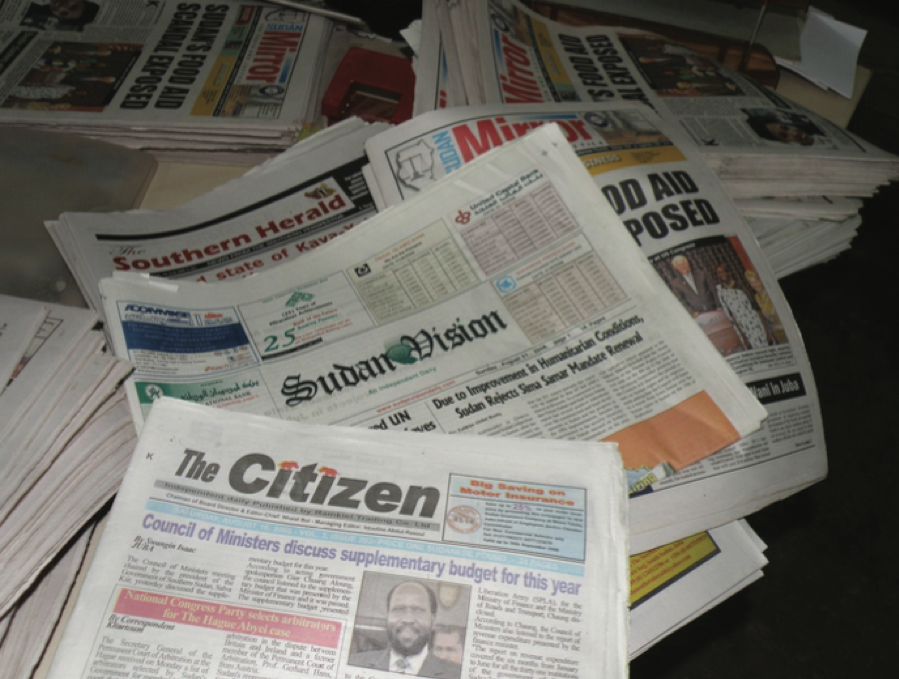
September was a bad month for Nhial Bol, editor and owner of Sudan’s The Citizen newspaper. Shut down by the national government Bol had to move printing from Khartoum to the Ugandan capital of Kampala, nearly 2,000 kilometers away, and completely restructure his company.
The newspaper business has never been easy in a country strangled by war, dictatorship and a complex ethnic and political make up and The Citizen has been through a myriad of troubles before, including forced closures and censorship.
And like most of the other few South Sudanese-owned and orientated papers Bol has struggled in the South’s narrow, post-conflict economy to get a good advertising base for the paper, well trained journalists and some kind of a decent readership.
But Bol is passionate about getting information and news to his people, who had been deprived of such access by decades of war. A well-known maverick figure in the South’s capital Juba, he is confident that his new plans to adjust the way his newspaper works will mean that it will slowly also become lucrative.
Shut down
On September 1, The Citizen and fellow South Sudanese paper Sudan Tribune received letters from Khartoum’s National Press Council (NPC) announcing that their printing licenses had been revoked.
Bol and Sudan Tribune’s editor and owner William Ezekiel were told they had to move head offices to Khartoum, hire at least 10 NPC-approved journalists each — a financial death knell — and fire those already on their books if they wanted to be able to print in Khartoum again.
The editors said they believed the real reasons for the shut down were political; they had both been accused of being over-critical of the Khartoum government in the past. Media watchers agreed.
“Khartoum is using the NPC as a tool,” said Richard Mogga, the Juba representative for the Association for Media Development in South Sudan. He added that the action was strongly against the spirit of the 2005 North-South peace deal that ended more than 20 years of civil conflict.
Under the accord, the South was given its own semi-autonomous government, meant to use its share in Sudan’s oil revenues to start putting infrastructure in place and encourage economic growth. The media and civil society in both the North and South was supposed to flourish in the liberal atmosphere of peace and promised democratization.
Whatever the cause of the closure, the papers bled money every day of it. Ezekiel estimated a total loss of up to $300,000 during his five days off print and in weeks before when complete print runs were seized almost every morning by Khartoum’s security men.
For Bol, it was the final straw. He had already lost thousands of dollars in advertising through previous shutdowns that had let clients down. Censorship often meant The Citizen’s hottest political news and editorial was removed, lowering sales. “There were times I was selling only 1,000 copies. They even took photos out,” Bol said.
He traveled to Kenya and Uganda and negotiated a new printing contract with Kampala’s major daily, The Monitor, which also owns its own press. The new deal provided Bol with a solution to Khartoum’s strictures. But printing will be more expensive and getting the paper into the South will involve new complex logistics.
“Now we will only print twice a week. We will bring 4,000 copies by land and 1,000 by air,” Bol said, adding that he will also have to double the price of the paper to 2 Sudanese Pounds in order to make up for higher transport costs. He has also lost his Khartoum market and has dropped his print run from 7,000 copies an issue to 5,000.
In Khartoum he was printing daily and Bol knows fewer issues will mean less advertising overall, possibly less interest from advertisers generally for spots in the bi-weekly and a decline in readership.
“But we will improve the quality and the size of the paper,” Bol said. He is also planning on including longer features and informative articles hoping to draw in more readers. “We will also include a lot of opinion and editorial. We are going to be even more critical of the regime than before,” he said cheerfully.
The Sudan Tribune is also planning something similar, but less drastic. Ezekiel was given back his license and will continue to print in Khartoum but will also sign a deal with the printing house that produces the Nairobi Star tabloid to print in Kenya as well. South Sudan will be supplied from there. It is a difficult way to run a paper, but Ezekiel said he cannot afford to rely just on Khartoum.
Bol also wants to wean his paper off its dependence on the Internet. All of the South’s papers are bulked up with articles cut from the World Wide Web, pasted together with bleary photographs.
Many of the pilfered articles are of not much interest to average southern Sudanese, which means that the papers often lack focus or a sense of integrity. For example, one paper recently printed a plagiarized iPod care guide for its war ravaged readership that mostly has no access to electricity. Because all the papers do it, they often also end up being near-identical reads except for the fiery editorials.
“The educated are looking for more analysis and wider and better news,” said Stephen Tut, old media hand and editor of Post, a South Sudan magazine. But he understands that the cut-and-paste culture is partly a result of a lack of funds and under-trained journalists in the southern papers. Like other magazines, his is fully funded by a western non-governmental organization interested in supporting democratic change and media rights.
Some aid and development agencies with “softer” pursuits in the South — governance and rule of law as opposed to increasing bore holes — have proved keen direct supporters of magazines and papers.
They also pay for expensive supplements on the benefits of democracy or condom use or on any of a range of other contemporary issues. It seems like a good deal: the agency gets to tell its donors it has encouraged free and fair elections, safer sex and other noble goals and the paper gets quick cash and educative material.
But Bol is serious about not allowing The Citizen to rely on this kind of income, although his first Kampala-printed edition ran a UNICEF insert that earned him $500, because, as he pointed out, “It encourages editors to just search for donors. Nobody is focusing on the newspaper.”
New business
Together with a new printer, Bol said he will adopt a leaner approach to the paper, by shutting down his main office in Khartoum and firing most of his staff that cost him $8,000 a month on salaries, even though with the South’s intensively protectionist labor rules he will have to pay some $30,000 in pay-offs. He is also looking for buyers to take over up to 50% of the paper.
But Bol is most excited about plans to get to the root of his — and the rest of the southern papers’ — problem.
“We have collected letters of interest from papers here. We are looking for a loan of $600,000 to buy a second-hand printing press,” Bol explained. Juba’s branch of the Kenya Commercial Bank is looking for 18% interest but Bol thinks with the buy-in of three or more local papers he will be able to pay back up to $50,000 a month.
Few copies of any of the South’s papers are sold outside of Juba. The South’s extremely low literacy rate — a joint United Nations and government report put it at 15% — is partly to blame as is the widespread use of Arabic rather than English in the larger towns that are usually former garrisons controlled by Khartoum during the war.
But sheer geography — the under-populated South is the size of Turkey — and a very poor road network also form major challenges. One town within easy reach and on the bus route from Uganda to Juba has already proved good for sales.
Bol is planning a distribution network for The Citizen that other papers can also buy into. Transporting the papers in bulk will make the effort worthwhile and slowly encourage readership.
Buy me
The Juba Post reached international fame in 2006 when the British Broadcasting Service (BBC) website picked up the ‘Man Marries Goat’ story that became one of the BBC’s most read stories that year.
The first issue had come out on January 9, 2005, the day the North-South peace deal was signed. The paper did much of its important growth and training with donor money. But it then struggled through a sudden loss of this cash source and now survives off advertising in the 3,000 copies of each edition printed. However, it has been hard to cover printing costs of $450 per run and editor Charles Rehan admitted the paper has a hand-to-mouth existence. Flying the papers from the Khartoum printer costs another $500 per edition.
The bulk of advertising is not from the small private sector. Most of the ads are from non-governmental organizations and United Nations agencies looking for local staff. Luckily for the Juba Post, NGOs are happy to pay $1,000 for a full page spread large enough to include requirements for the job on offer. Regulations for institutions like the government and World Bank force them to advertise for construction and other contractors and these ads also drum up important income for the paper.
But these kinds of institutions often come with large bureaucracies that take months to clear payments often from as far away as New York. The paper has lost staff and lacks flexibility because of the associated cash flow problems, Rehan said.
But according to the editor, the private sector is just not orientated towards advertising. The South’s post-peace business community wants to make profits as quickly as possible in case war breaks out again, he said, and is not interested in investing in increasing awareness of their brands. And there is just not enough business for competitive thinking to have kicked in, he added. Large international companies, like Zain, that could easily afford the advertising seem to not think it is worth their while to bother with the southern papers’ small print runs.
“We need a bigger business community here to make that work,” Rehan said, although he also admitted that the Juba Post’s donor money origins may also be why the paper’s marketing is so weak.
Other problems are also encountered in the hunt for advertising cash. “Advertisement in Sudan is associated with corruption. We are not using the right language and we don’t take bribes (from officials placing adverts),” Bol said.
Rehan also admitted that part of the problem could be exposure. All of the South’s papers — not just the Juba Post — are underexposed. While few of the papers could afford to do a serious advertising campaign, it is less understandable why it is so difficult to find a paper. Only a handful of shops sell all the papers every day.
Rehan thinks the time could be ripe now that traffic jams have begun to develop in the South’s capital to begin a new technique. “We have found three boys and they are going to sell the papers on the streets on commission,” he said.
But to Paul Jimbo there is nothing wrong with the business environment, young and raw as it may be: the papers are just not working hard enough. He works as a journalist for the Southern Eye — a colorful Ugandan-printed paper — but is also paid on commission for any adverts he finds.
And it is clear where the money is. Jimbo has just signed an agreement with one of Juba’s numerous new hotels for $14,000. He has come up with an imaginative idea, familiar to many readers in the region: the Southern Eye will do a two-page puff piece on the hotel and in exchange its owners will buy a series of ads.
When there is an especially interesting front page on the paper, Jimbo will start knocking on doors, offering front page banners and full color ads to run next to the headline, unheard of behavior in Juba but lucrative.
The content of the paper is similar to the others, but the Southern Eye looks familiar to Southerners who have spent time in neighboring Kenya or Uganda during the war years, a group that includes most of the educated. This professional look may be partly why the paper does better on the advertising than the others even though it is irregular in its appearance in Juba.
“There are more hotels now so there is more competition; they are keen to advertise,” Jimbo said. He pointed out Juba’s newest acquisitions, huge billboards. “There’s money to be made,” he laughed. “You just have to see it and try.”
