
Just outside South Sudan’s three-year-old capital, a stationary line of ancient Fiat and Bedford trucks are at the end of hundreds of dusty, rough kilometers from Kenya, bringing with them the cans of tuna, vegetables and soap on which the town depends. The last leg of the journey is to cross the one half of Juba’s bridge that still spans the Nile, but before they can enter town, the traders will have to pay again for the goods they already cleared through border customs.
The South’s tax and investment laws, together with a mass of new
legislation, are still being developed. In the meantime businessmen and traders are facing a complex and shifting set of costs especially in the form of multiple taxes. These, they say, are keeping costs of goods high and maintaining Juba’s reputation as Africa’s most expensive capital.
On the other side of town trucks from Uganda pile up for another set of officials. They are bringing tomatoes that cost $2 for five and cabbages that sell for $2.50 a piece. Sugar, oil, spaghetti and even loaves of bread are all consistently priced far above the average in neighboring East African countries.
The 2005 peace deal between northern and southern Sudan ended more than 20 years of war and for the first time opened up the South to development and trade. Keen to encourage investment, the new semi-autonomous southern government — allowed for by the peace accord — set customs taxes fairly low; mostly under 10%.
But there are other, “unofficial” agents at the border and on the roads, and because Central Equatoria State, the governorate where the southern capital is located, also taxes businessmen on entry to Juba, the overall cost of bringing food or building materials can be as high as 30-40% of their value.
“The charges at the border you can calculate, but at Juba it can be anything,” one businessman said. “It depends on the guy’s mood.” He added that drivers’ papers from the border were sometimes torn up outside Juba and then declared useless.
“That cost is dumped on the consumer,” said Ram Sundaram, who works with Amla Distribution and has the exclusive distribution rights for Heineken and Amstel beers for the region.
Sundaram has also had problems predicting the varying cost of clearing goods across the last barrier into the capital, and has paid clearance to Central Equatoria State even if he only passed through Juba to other parts of the South. His trucks are often held for up to three days. “They don’t respect official letters. It’s all a mess and at the end of the day you just want to retrieve your goods so you pay,” Sundaram said.
Only certainty is insecurity
South Sudan is bristling with small arms massed during the conflict and the two main trade routes into Juba — from Kenya and Uganda — have both suffered spats of insecurity from bandits, leftover militiamen and other armed groups. The empty and burnt-out shells of trucks that met their end at the hands of the Ugandan rebel Lord’s Resistance Army, who moved into the thick southern bush before the peace deal, litter the roadsides.
Doing business in the South means taking a risk, entrepreneurs say, and the harassment of truck drivers by soldiers, who are also double or sometimes triple-taxed by seemingly legal officials, can seem an unfair addition to the struggle.
On a day’s drive on one of the South’s main trade roads, the traveler meets several unofficial roadblocks, manned by armed soldiers from the South’s former rebel army.
Cars pass without problems but trucks carrying goods are waved down. A borehole drilling team recently reported having to pay soldiers $50 per truck; a fine levied because the drivers were wearing open-toed sandals. All truckers make sure they have plenty of small change to lubricate their trip.
“It’s blatantly getting worse, it is almost mandatory to bribe,” said Eritrean businessman Aron Hiwet.
Confusion reigns
South Sudan’s President Salva Kiir, also Sudan’s First Vice President, often calls for “illegal” road blocks to be dismantled but so far without complete success. Businessmen say central government officials are aware of the cost presumably legal state authorities are putting on their trade, and have agreed to try and help cut down on costs.
But a key promise of the southern rebels who now run the government was devolution of powers from central government to the states and Juba’s officials are not keen on now again taking away authority from state administrations.
The peace deal is also ambiguous on taxation. While customs are under the authority of the national government in Khartoum, different levels of government — including state authorities — are also allowed to tax. Until a legal system is established that makes it clear how, how much and by whom taxes can be levied, observers say southern and foreign businessmen will likely continue to face problems.
Officials from Central Equatoria agree that there is a problem with the high costs of basic commodities in the town but also say that they are “entitled to certain taxes according to our competencies.” But Leonard Logo Mulukwat, head of the state assembly’s finance body,
admitted that in the confusion practices are taking place that should be stopped, and that some individuals who should not be taxing, are.
A member of parliament in the state assembly explained that, officially, the Central Equatoria State Revenue Authority puts down a 10% charge on all goods entering the town; far higher than the official southern customs tax. Traders entering Juba might also have to pay a 10% tax to the central Ministry of Trade and Commerce if they do not already have a license, and a 22% customs tax if they do not have the correct paperwork from the border, far higher than official border costs.
But the border points themselves are also a challenge for traders, explained Agrey Tisa, undersecretary in the South’s Ministry of Finance.
“(Officially) the maximum cost at the border is 20% for a luxury car. A lorry would be 8-10% … (most goods are) between zero and five percent,” Tisa said. “But there are definitely shortcomings, people collecting revenue who should not be there. There are people collecting without books or receipts.”
Tisa said in some border posts, like Kaya or Nimule on the Ugandan border, there had been up to 12 taxing agents from county, state, South Sudan and national authorities as well as different ministries and tribal chiefs, each getting a cut.
A National Problem
The irony for the southern government is that they are not yet receiving any money from customs, despite their efforts to try and make costs for businessmen interested in the South considerably lower than in northern Sudan.
During the conflict, southern rebels controlled the posts and towns along the borders with Kenya and Uganda. The hand-over to Khartoum, who under the peace accord will control all national borders and customs, is still not complete and the official taxes have remained at the rates set by the rebels, and many of the collecting officials remain the same, although they are now under the authority of Khartoum. Much of the money collected was lost to southern graft in 2006, but officials now claim the customs cash is sent to Khartoum.
The southern government is due half of all revenues collected in the South but still has not received anything from the national government.
“At the moment, the two rates, South Sudan and Khartoum’s are not yet harmonized,” Agrey said, adding that a committee has now been formed to decide how the two systems can be brought together. The same body is also supposed to calculate how much official customs money has been collected in the south. Half of that sum, which Agrey estimated could be about $50 million, will then be funneled back to the southern government.
Khartoum has also continued to collect taxes — at much higher national customs rates — in the former garrison towns including Wau, Malakal and the capital Juba.
Clearing customs in Juba is furiously expensive. Goods from satellite telephones to sodas are charged 25% customs tax and 15% VAT. Clearing a car through Juba customs will set the owner back 40% in customs, 50% in business profit tax and, of course, 15% in VAT.
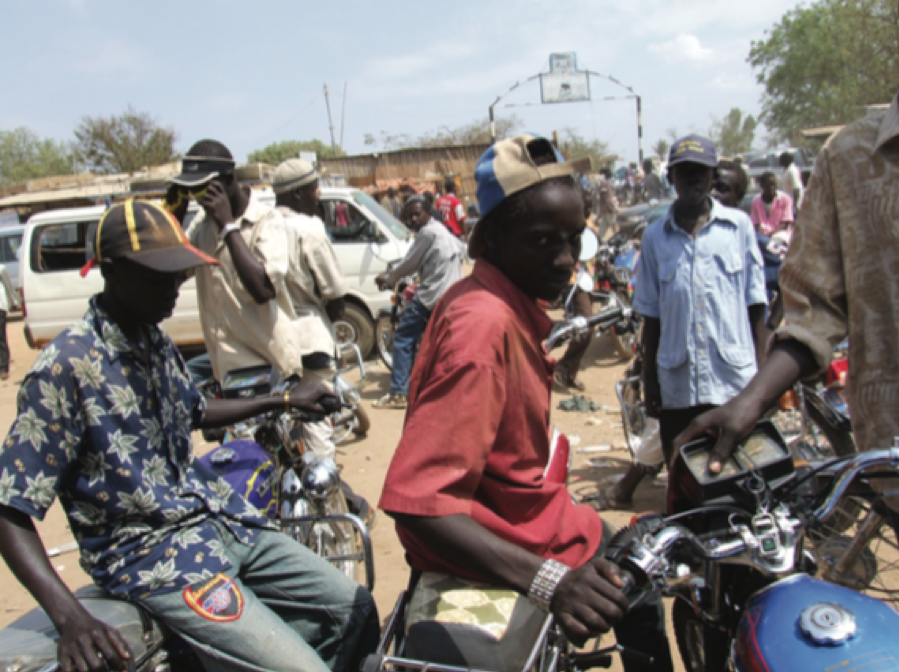
This hits average southerners hard, and not just investors and businesses. As the state government begins to come down harder on vehicles without plates, the thousands of Juba residents who are dependent on their cheap Chinese motorcycles will need to clear them through this office. The cost of the motorcycle itself is only around $600, but clearance will add another $300 to the overall bill, too much for southerners struggling to survive.
More than one businessman described the taxes as killing the South’s tiny new economy and encouraging dealers to bring in substandard machines and materials in order to cope with the costs. Or as Sundaram put it, “This kind of ‘power in hand’ way is not attractive to the investor. Some days you just think, there’s got to be an easier way of making money.”
