
At the end of 2011, it was still unclear whether or not Hezbollah was playing a direct role in assisting the regime of President Bashar al-Assad. Syrian refugees streaming into Lebanon had insisted since nearly the beginning of the uprising in March 2011 that Hezbollah and Iranian Revolutionary Guards were among the Syrian troops sniping at protesters from rooftops. But there was little hard evidence.
Adding to the skepticism was Hezbollah Secretary General Sayyed Hassan Nasrallah’s toned-down rhetoric on Syria around February and March 2012. Earlier, he had lambasted the West for seeking to oust Assad. Now, he was calling for dialogue and warning that continued violence would resolve nothing. Some diplomats and commentators took this to mean that Hezbollah was beginning to distance itself from a regime that seemed doomed.
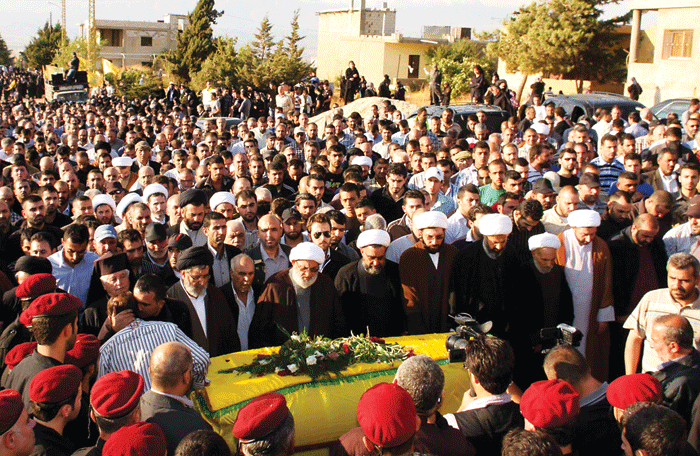
However, at the end of 2012, few would still cling to the notion that Hezbollah is uninvolved in the Syrian conflict. Throughout the summer, there were growing whispers within Shia circles about various Hezbollah units deployed across the border or of the bodies of dead combatants being repatriated for quiet burial. The death in early October of Ali Nassif, a veteran Hezbollah commander, finally spurred Nasrallah to admit that some Lebanese Shiites, including some Hezbollah men, were fighting to defend their homes just across the border which were coming under attack by armed opposition groups.
On a recent trip to the Hermel area in the northern Bekaa, there was little disguising Hezbollah’s activities. As shells exploded across the border and the crackle of small arms fire could be heard nearby, a column of what appeared to be Hezbollah vehicles (Sport Utility Vehicles, usually Grand Cherokees, with tinted windows and no license plates) and minibuses filled with young men thundered down a narrow road heading to the border 300 meters away. Other Hezbollah vehicles raced up and down the potholed roads of the area; fighters in uniform rode rally bikes while others stood on the roadside communicating with radios.
It appears that there is some unease within Hezbollah’s ranks, both at a leadership level and among the cadres, regarding their continued assistance to a regime that surely will founder at some point. However, the fate of the Assad regime is a strategic issue for Iran and as such Hezbollah does not have the latitude to make independent unilateral decisions.
Indeed, it is evident that siding with the Assad regime to the extent that Hezbollah has is actually detrimental to the party’s domestic political interests. Openly supporting Assad and battling Syrian Sunnis in the armed opposition is deepening the divide between Lebanese Shias and Sunnis. Many Lebanese Sunnis already harbor deep feelings of bitterness, resentment, humiliation and frustration toward Hezbollah, stemming from the May 2008 events to the collapse of the Saad Hariri government in January 2011.
For now, there appears to be little indication that Iran and Hezbollah intend to change their position on Syria. And a glance at the balance of power on the ground suggests that the Assad regime could continue to hold out for a while longer, even if a restoration of the pre-uprising status quo has become impossible. The Syrian army is being whittled down to a hard core of mainly Alawite troops replete with armor, artillery and air power. The army is supported by a Hezbollah-trained loyalist shabiha paramilitary force as well as Hezbollah combatants. The regime enjoys the continued logistical backing of Iran and diplomatic support of Russia and China. Collectively, that represents a fairly formidable front against a lightly-armed, ill-trained, poorly organized bunch of militias that lack strategic coordination. The recent signs of unity in Qatar among the external political opposition is an encouraging first step (if it lasts) but there remains a long uphill struggle before achieving a cohesive and effective political and military front against the Assad regime.
Even if the opposition can remove the Assad regime from Damascus, it does not necessarily signal the end of the conflict. Iran and its allies may still possess sufficient military might in Syria to perpetuate instability to ensure that no administration antithetical to Iranian interests can take over in Damascus. The Iranian plan (of which Hezbollah is a component) may not be geared so much to saving Assad, but looking to see what advantages can be accrued from a prolonged period of turmoil and civil strife.
Toppling the Assad regime may only be the end of the first gloomy chapter in a depressingly long book.
Nicholas Blanford is the Beirut-based correspondent for The Christian Science Monitor and The Times of London
