
At a Washington Institute for Near East Policy conference in October 2007, Walid Jumblatt was asked by Dennis Ross, now Barack Obama’s point man on Iran, what Washington could do for Lebanon. Jumblatt, with a twinkle in his eye, replied: “If you could send some car bombs to Damascus, why not?”
The audience, few of them sympathetic to the Syrian regime, greeted Jumblatt’s comment with delighted laughter and prolonged applause.
Jumblatt, understanding his audience well, continued: Hezbollah is a “brigade or division of the Iranian Revolutionary Guards that occupy half of Lebanon, paralyzing the economy and facilitating Syrian efforts to kill us.”
It was vintage Jumblatt. Well, 2007 vintage anyway.
Among the leaders of March 14, Jumblatt, the “weathervane,” has typically been first to react to the changing climate: in the past 12 months, he has forged a rapprochement with his traditional Druze rival Talal Arslan in the wake of the May 2008 fighting, toned down his anti-Syrian rhetoric and more recently spoke of Hezbollah’s weapons in the context of a national defense policy.
It culminated in mid-June with a long-awaited meeting with Sayyed Hassan Nasrallah, Hezbollah’s secretary-general, in which the two discussed the need for a comprehensive reconciliation in the country.
The spirit of goodwill settling on Lebanon in the aftermath of the June 7 election largely derives from the rapprochement between Saudi Arabia and Syria in recent months, as both back rival political camps in Lebanon.
Vituperative rhetoric has been scaled down in the Syrian and Saudi media and there have been several low-profile diplomatic exchanges between Damascus and Riyadh.
If the Saudi-Syrian detente holds, it could spell a period of political calm in Lebanon, allowing for a relatively smooth transition from Fouad Siniora’s outgoing government to the new one, likely headed by Saad Hariri. The opposition could well forego their demand for a one-third veto-wielding share in the next government in exchange for guarantees by Hariri on key issues, chiefly Hezbollah’s arms. Hariri has said the fate of Hezbollah’s arms should be left to the national dialogue sessions, where the subject doubtless will be buried.
All this comes at the end of an eight-month wait-and-see period during which several elections, parliamentary and presidential, have been conducted. But the results of those elections have been something of a mixed bag.
The first was the election of Barack Obama as the new United States president. Obama, facing the immediate challenges of a global financial crisis and two wars, initially was not expected to focus much effort on the Middle East. But he has confounded expectations by emphasizing the importance of the Israeli-Palestinian peace process. In his recent address to the Arab world in Cairo he spoke at length on the Israeli-Palestinian conflict. However, he did not mention Syria once, indicating where his preference for progress lies. Indeed, the appointment of Jeffrey Feltman, who was US ambassador to Beirut during the Lebanese-Syrian crisis in 2005, as his main interlocutor with the Syrians was a signal in itself. Yes, Obama is willing to explore dialogue with Syria, but the administration is under no illusions about its success.
But Obama also has to contend with a right-wing government in Israel under the premiership of Benjamin Netanyahu, who took office in March. Netanyahu’s fragile coalition is dependent on the support of hardliners, such as his foreign minister Avigdor Lieberman. The initial test of Obama’s resolve, to many Arabs, lies in his ability to freeze Israeli settlement building on occupied Palestinian territory, and not to allow Netanyahu to fudge the issue with excuses about “natural growth.”
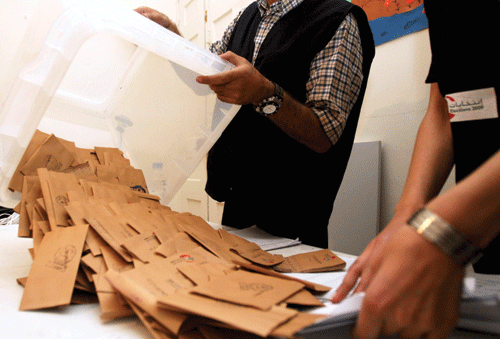
The third key election was in Lebanon, where the continuation of the status quo was confirmed by the March 14 coalition’s victory. Developments in Lebanon tend to be corollaries of developments elsewhere in the region, which is why the outcome of the Iranian presidential election, the last of the big four, is so important.
If Mir Hussein Moussavi had been elected president, it is unlikely that there would have been any significant changes to Iranian foreign policy, especially regarding the Arab world, support for anti-Israel groups and pursuing the nuclear program. The differences between the incumbent, Mahmoud Ahmadinejad, and his reformist challenger were over domestic policies. The importance of the result was one of perception rather than substance.
The US would have preferred to seek engagement with an Iranian government led by a reformist president, rather than someone distinctly lacking in diplomatic tact and widely vilified as a “Holocaust denier.” Ahmadinejad’s re-election will do little to ease the phobias of the Arab Gulf states toward their powerful Iranian neighbor.
So, a US administration committed to an Israeli-Palestinian breakthrough; a right-wing Israeli government squirming to maintain US goodwill while making no meaningful concessions to its Arab neighbors; no change in a Lebanon that is hoping for a period of stability; and an Iran, troubled by internal dissent, but still led by a president who relishes his image of defiance and obduracy.
How will this play out? Perhaps, we should keep an eye on Jumblatt for early hints.
Nicholas Blanford is the Beirut-based correspondent for The Christian Science Monitor and The Times of London
