• Donate
  • Our Purpose
  • Contact Us
Executive Magazine
  • ISSUES
    • Current Issue
    • Past issues
  • BUSINESS
  • ECONOMICS & POLICY
  • OPINION
  • SPECIAL REPORTS
  • EXECUTIVE TALKS
  • MOVEMENTS
    • Change the image
    • Cannes lions
    • Transparency & accountability
    • ECONOMIC ROADMAP
    • Say No to Corruption
    • The Lebanon media development initiative
    • LPSN Policy Asks
    • Advocating the preservation of deposits
  • JOIN US
    • Join our movement
    • Attend our events
    • Receive updates
    • Connect with us
  • DONATE
The Buzz

Business briefing: 3 Sept 2013

by Executive Staff September 3, 2013
written by Executive Staff

Economics and Policy

Syria has canceled an urgent tender to buy sugar two weeks after scrapping a bid to purchase wheat in the latest signs that President Bashar Assad’s government is losing its ability to buy food as civil war destroys its harvests.

More from Reuters


An attack by assailants on a container ship in the Suez Canal has heightened risks for merchant shipping using the vital waterway, with further threats considered likely as political turmoil continues in Egypt.

More from Reuters


Lebanese banks will close their businesses Wednesday in solidarity with the Economic Committees, a body that represents private sector groups, to demand the immediate formation of a Cabinet.

More from The Daily Star


Despite this action, the governor of Lebanon's Central Bank has reiterated his belief that the country's banking system is immune from the impact of the Syria crisis.
 
More from The Daily Star


Companies and Business

Qatar’s sovereign wealth fund, one of the world’s most aggressive investors, is hiring senior bankers and industry executives to lessen the fund’s reliance on Europe and diversify its investment portfolio.

More from Reuters


Elsewhere, Bahrain sovereign fund Mumtalakat has had signed a $250 million loan to help refinance part of a larger five-year facility.

More from Reuters


Dubai International Financial Centre (DIFC) registered 67 new companies in the first half of the year, bringing the total number of active registered firms in the centre to 979, an increase of seven per cent from year-end 2012.

More from Gulf Business


September 3, 2013 0 comments
0 FacebookTwitterPinterestEmail
The Buzz

Business briefing: 2 Sept 2013

by Executive Staff September 2, 2013
written by Executive Staff

Economics and Policy

US President Barack Obama has delayed an imminent military strike against Syria to seek approval from the US Congress.

More from Reuters

Egypt's state prosecutor says he has referred ousted President Mohammed Morsi for trial on charges of inciting the murder of protesters.

More from the BBC


Yemen's transport minister has called on Middle Eastern companies to participate in a $500 million tender next month that would revamp the country's airport infrastructure and improve services and operations management.

More from The National

Companies and Business

HSBC will stop offering wealth management products in Lebanon, Bahrain and Jordan as the British lender continues to exit small or insufficiently profitable operations globally as part of a strategic review, the bank said.

More from The Daily Star


General Motors said it expected the automobile industry in the Middle East to show growth that is sustainable, but at a slower rate than in the last few years, hurt by uncertainty and political crisis in markets such as Egypt and Syria.

More from Reuters


Saudi Arabia's No.3 telecom operator Zain Saudi has appointed industry veteran Hassan Kabbani as chief executive with immediate effect.

More from Reuters


The US military has not renewed its contract to buy jet fuel from Emirates National Oil Company (ENOC) in the United Arab Emirates (UAE) because other suppliers made cheaper bids, the US Department of Defence said.

More from Reuters


Etihad Airways expects a $600m investment in Jet Airways to be cleared by Indian authorities imminently.

More from Reuters


September 2, 2013 0 comments
0 FacebookTwitterPinterestEmail
Editorial

Fading into darkness

by Yasser Akkaoui September 1, 2013
written by Yasser Akkaoui

We have strived to build a better Lebanon. Month after month, we have highlighted the failings of the state and trumpeted the successes the Lebanese have had, both at home and abroad.

Slowly but surely after the end of the 15-year civil war in 1990, the country and its ingenious people have moved forward. There were the good times; summers of plenty, when tourism and trade grew and it looked as though we were leaving our troubles behind us. There were also the tough times. We endured the lack of governance, the war with Israel, the rampant corruption, and the spree of assassinations. But through it all we still believed that things would get better.

Now that hope is fading. Sunny skies have given way to darker clouds, as the threat of war again knocks on the country’s door. But this time it is not a foreign enemy bringing death to our doors but Lebanese again turning on themselves.

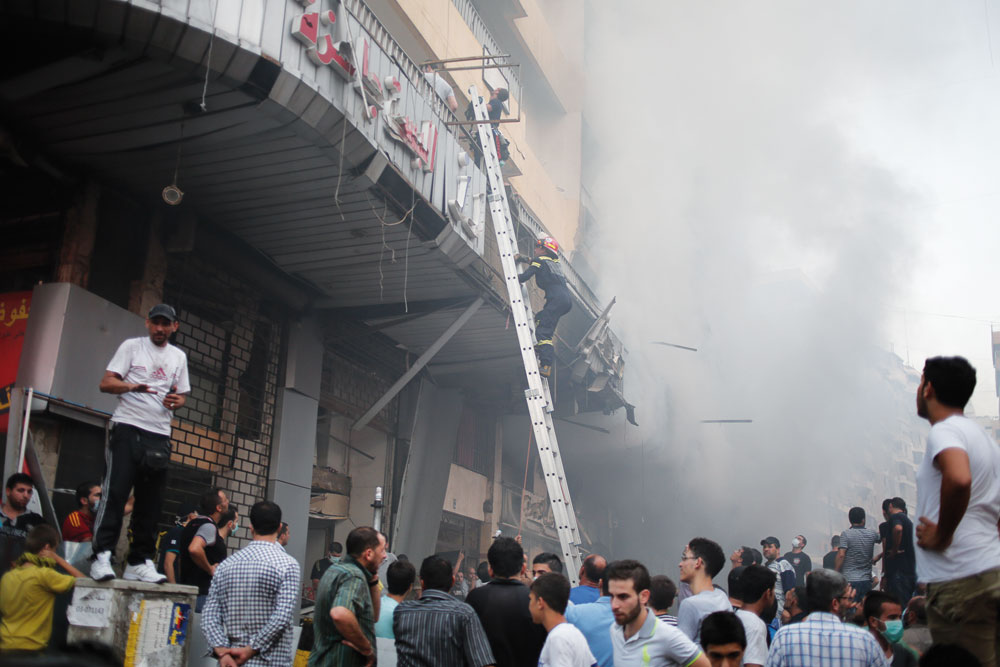
Last month three bombs struck Lebanon — one in the Beirut suburb of Rweiss and two targeting mosques in Tripoli during Friday prayers — with around 80 people killed. While we do not know the culprits, and many have pointed to outside forces, the deaths are a result of the failure to inoculate Lebanon from the winds battering the region. We have allowed ourselves to become part of the crisis next door.

Some of Lebanon’s brightest are already planning to leave. Those that remain have a feeling of inertia — there is little that we can do as civil society and journalists to stop the tolls of war.

For those of us that have stayed here, the echoes of the 1980s are resonating. In those dark days, we turned in on ourselves. The café, the place of worship and the friendly gathering all become poisoned with a looming suspicion that death lies around the corner.

Without the security that comes from a legitimate government and a strong military, dark times lie ahead.

September 1, 2013 0 comments
0 FacebookTwitterPinterestEmail
The Buzz

Business briefing: 30 Aug 2013

by Executive Staff August 30, 2013
written by Executive Staff

Economics and Policy

Total deposits at Lebanese banks grew 5 percent in the first half of the year, head of the Association of Banks in Lebanon Francois Bassil said on Thursday.

More from The Daily Star


Strong growth in the U.S. economy and signs of a delay in expected Western military strikes on Syria lifted equities worldwide on Thursday.

More from Reuters


Kuwait and Saudi Arabia have shelved their project to develop the Dorra offshore gas field after disagreeing over how to share the gas back on land.

More from Reuters


Despite this dispute, Saudi Arabia is set to pump 10.5 million barrels a day of crude in the third quarter, a million bpd increment over the second quarter and its highest quarterly level of production ever.

More from Reuters


Companies and Business

Al Jazeera's new American TV network attracted poor audience figures for its first full week, according to Variety magazine.

More from Arabian Business


Around 50 entrepreneurs in Beirut took part in an intensive training session hosted this week by the Amman-based accelerator Oasis 500.

More from The Daily Star


In the UAE, meanwhile, while start-ups are benefiting from a more positive economic environment in Dubai, getting financing to grow their businesses remains an obstacle.

More from The National


August 30, 2013 0 comments
0 FacebookTwitterPinterestEmail
Economics & Policy

Bassil – ‘Minor’ delay to oil and gas bids possible

by Joe Dyke August 30, 2013
written by Joe Dyke

Lebanon’s energy minister has provided the clearest hint yet that he expects a delay to the bidding process for the country’s offshore oil and gas, ahead of a Monday deadline.

In an interview with Executive, Minister of Energy and Water Gebran Bassil said that a “minor” delay was possible as the country’s political situation was preventing the signing of key decrees.

In order to continue with the process, Lebanon’s caretaker cabinet must meet before Monday to sign two laws regarding the oil and gas sector. One of these confirms the terms of agreement between the government and international oil companies, while the other formally demarcates the offshore blocks that companies can bid on.

Related articles: Oil and gas should fuel negotiations

The beginner's guide to Lebanon's oil and gas

These decrees were supposed to be agreed in July, but the fall of the government in March has led to a political stalemate, with the country’s oil and gas prospects being the victim.

Bassil said that he was still hopeful that the laws would be passed, but that there was a possibility that an extension would be necessary. “We have to recognize that the government resigned and that there was no new government until now,” he said. “This could be a reason for a delay that I would describe, if it happens, [as] minor. It can happen in any bidding round to have a minor delay or extension. What matters is not to have it major.”

Asked to speculate on the potential length of the delay, the minister declined. However, industry insiders have suggested that the bidding would be opened for at least a month longer, with the potential for it to be extended for a number of months. If the process were delayed, it would be the first time that Bassil has failed to hit his self-made targets.

Bassil denied, however, that it was now too late for a deal ahead of Monday’s deadline, saying that the laws were ready to be signed immediately if the caretaker Prime Minister Najib Mikati and President Michel Sleiman agreed on it. “It can happen in two minutes by convening the Council of Ministers (cabinet) – the decrees are there, they [have been] ready a few months, we have the approval of the Shura (Council). It is a two-minute meeting, we say ok and we move on.”

Bassil said the situation was all the more urgent as Lebanon’s neighbors Israel and Cyprus have continued to improve their relations with regard to offshore oil and gas. Earlier this month the two countries and Greece signed a deal to cooperate over energy policy. This followed a memorandum of understanding between Larnaca and Tel Aviv to establish a liquified natural gas plant in Cyprus which both countries would use.

Asked if he was concerned that any delays to the bidding process would mean Lebanon falling further behind its neighbors, Bassil said: “If it is long enough yes. If it is long enough, let's say we will stay for a few more years doing nothing, yes. This is the aim of Israel, to delay us. So the big question for our politicians is do they want to help Israel by giving Israel more time?”


The interview will appear in full as part of a report on oil and gas in Executive's October edition

August 30, 2013 0 comments
0 FacebookTwitterPinterestEmail
Business

Can you make money out of Lebanese e-Commerce?

by Livia Murray August 30, 2013
written by Livia Murray

Natasawak in Arabic means “we shop,” explain Imad Karam and Rami Audi, co-founders of the Lebanon-based online shopping platform of the same name. Their challenge is to push Lebanon’s shopping trends online.

Lebanon’s e-commerce market is hardly mature. According to a recent Ipsos poll of the 1,700,000 internet users in the country, less than 1 percent make purchases online. Compare this with the United Arab Emirates – where that figure is over 7 percent – and it is clear Lebanon’s market is still in its infancy. Moreover the country’s regulatory framework makes for me challenges.

“Let me be honest with you – Lebanon is not the best country to operate an e-commerce website from typically because you have high customs, and you have high delivery fees, and you have certain obstacles that are not present in the UAE,” says Karam.

This did not stop them from launching Natasawak in Lebanon in January this year and the men claim that, despite the hurdles, it has been a valuable learning experience. “You learn a lot trying to solve those problems,” says Audi, “and that’s why we think that starting a business in Lebanon, even though it might be difficult, gives lots of insights… and makes you ready to go and open it in another country.”

Natasawak brings together three different shopping platforms in one website. Unlike their competitors, who either use a model of online boutiques or flash sales, Natasawak has incorporated both of these alongside of a local designer section. The flash sales section offers certain items at a discounted price for a short amount of time. The online boutique section permits any store to open an online shop for free. Finally, the local designer stores features hand-made items from designers in Lebanon. Natasawak currently features eight to 10 new flash sales a week, 17 permanent boutique stores and 10 local designer stores.

This diversification has apparently had some success. Though they haven't computed the percentage yet, Karam estimates that 25 percent of people who bought from them on a flash sales offer came back and bought from another section of their website. “This decision was really a very successful strategy for us,” says Audi, “and also there was lots of added value in terms of providing something, in terms of being a one-spot shop, let’s say, for lots of people.”

According to Karam and Audi, they have made $25,000 in sales over the past seven months, which comprised of 200 different orders from 120 different users. They said that Natasawak brought in two to three sales a day in the month of August. Though they did not wish to share the exact margin of profit they made, they said they made an average of 25 to 50 percent cut of the sales thanks to agreements with the suppliers who are trying to liquidate their stock.

Like many startups in their early stages, the company is not yet profitable. They received a first round of funding of 75,000 from a Lebanese-American angel investor, which helped them launch the website and secure the operations of the company for one year. This included hiring staff, online advertising and closing agreements with Aramex, the company handling deliveries for the countries of the Gulf Cooperation Council.

Before breaking even, they are already looking at further rounds of funding in order to facilitate geographical expansion, particularly into the Gulf region where online retail is more established. “We’re looking at raising half a million dollars in order to take the business to the next level. We want to implant or establish an operation in the GCCs, mainly in the UAE in order to expand, first of all, our coverage, to improve our prices, and to improve our margins,” said Karam. “Expansion is our next natural evolution,” added Audi.

The dangers of competition loom, however. If Natasawak were to move into the UAE, their competitors would include the regional giants Souq.com, Cobone and MarkaVIP. How they would mark themselves out from the crowd remains a potential challenge.

Nataswak is the pair's second business venture together after co-founding the online advertising company Clouds Media. Since the launch they have acquired two other partners – who remain unnamed – as advisers. The first works in the luxury goods industry, and the second – the most recent addition – works for one of their competitors and has recently opened a branch of his e-commerce website in Dubai. They have one full-time employee who handles operations, as well as a driver who handles deliveries within Lebanon on a scooter.

For the creators of Natasawak, the most important factor determining expansion was controlling the costs of operations. “Once we felt that we can control costs, that’s where we felt that we can make it in other markets. Cause, you know, we can sell a lot. However if you sell a lot and you have a lot of costs you might stay negative. And you might stay negative for many years,” says Audi. They anticipate the site will be profitable within a year.

August 30, 2013 2 comments
0 FacebookTwitterPinterestEmail
Business

Sending it by bike

by Nathalie Rosa Bucher August 29, 2013
written by Nathalie Rosa Bucher

As a student, Karim Sokhn used to cycle to Université Saint-Joseph, frequently returning late at night. “Beirut is charming at night. It is small, everything’s close and it’s fascinating to experience the contrasts between old and new areas.”

An intense love for cycling and strong environmental concerns motivated him and Matt Saunders to set up Deghri Messengers – the first bicycle messenger company in the Arab world – as a project run by CyclingCircle s.a.r.l . As of next month, Beirutis will be able to send goods by bike.

“Bike messengers are found all over the world in congested cities with large economies, particularly service-based ones,” Saunders explains. “It was a logical step to apply this idea to Beirut.”

As co-owner and manager of CyclineCircle, Sokhn has successfully been organizing bicycle rides and bike-related activities, including night rides, around Beirut since its inception a year ago. Saunders, who worked three years as a bike messenger in Zurich, Switzerland, has been sharing his logistical know-how, training local cyclists and teaching them about being safe on the road and how to best and safely deliver letters and parcels of up to 10 kilograms that must fit into the giant, waterproof messenger bags the crew will don.

He says they have only carried out limited tests on the market, but are confident their service will succeed. “Market research has involved extensive opinion-gauging but stopping short of commissioning surveys and finding out about the strengths and weaknesses of existing delivery services.”

Sokhn adds, “some people argue that motorcycle companies are faster and charge the same price. That’s some of the feedback we get but by and large we get mostly positive responses — also from members of the cycling community. Many of them are business owners or managers.”

Deghri has had a fair bit of exposure from major national and international news organizations wanting to profile Deghri Messengers as a service, CyclingCircle as a movement and the Beiruti cycling scene in general. “Our promotion strategy relies on a combination of word-of-mouth promotion, social media activity and traditional advertising,” according to Saunders.

The two young entrepreneurs bank on the messengers' ability to speedily and reliably zip through all kinds of traffic and deliver on time. Customers will ultimately choose Deghri for their professionalism, competitive edge and for something motorized delivery services can’t offer: environmental benefits of a carbon-neutral service.

The $6,600 start-up capital needed to establish Deghri was fundraised. With this amount secured, the money has been invested in branded shirts, messenger bags and phones as well as locks, comprehensive insurance and corporate identity and advertising material.

The eight messengers who will ride on their own bicycles include two women. But in a city where few cycle, the danger to cyclists is clear. All the messengers are experienced cyclists and the messengers have to undergo a thorough training course during which a very strong emphasis is placed on safe cycling practices, minimizing risks and proper safety equipment. “It is also worth noting that all messengers are privately insured,” Saunders, who runs the training sessions, added. Deghri hopes to be increasing the team in early 2014 to 15.

While bike messengering has declined somewhat in Europe and North America, Sokhn points out that in Lebanon, electricity and reliable Internet are not a given. “There is still a value here of personally written and stamped documents,” Saunders adds. “We’re hoping private people will use our services, which generally is for everybody who needs to send or receive something urgently.” Anything can be couriered by bike messenger, including hard drives, fabrics, proofs, brochures, blood samples and promotional materials. Every item to be dispatched will be checked.

Bike ‘messengering’ does not constitute a hugely lucrative business, but Deghri pursues different aims. “We want the messengers to get a good pay,” Saunders explains. Sokhn, who runs CyclingCircle on the side of his full-time job, concurs: “Money is not a priority. Dispatchers and messengers will be earning based on a generous commission system, with the messengers earning most of the delivery fees.”

A regular delivery request within Beirut City (delivery within two hours of a request placed) costs LL9,000 ($6), while express service (within one hour) costs an additional LL3,000 ($2). Operations will run in line with office hours during the week and half-days Saturdays. Customers must pay in cash.

Deghri will cover the city of Beirut as well as greater Beirut, including Bouchrieh, Dekwaneh, Mkalles and Hazmieh in the East, and Hadath, Mreijeh and Bourj al Brajneh in the South.

Customers thus far include companies and NGOs. Saunders expects the customer base in Beirut to mirror Europe’s, and include hospitals, labs and clinics for medical deliveries. “We expect a similar customer profile and we want to prove our reliability.”

“Beirut is small and very compact,” Saunders points out. “Beirut city is only 6-7km across, distances are so cycle-able, and the heavy traffic makes it even more sensible, and more secure to ride.”

August 29, 2013 0 comments
0 FacebookTwitterPinterestEmail
The Buzz

Business briefing: 29 Aug 2013

by Executive Staff August 29, 2013
written by Executive Staff

Economics and Policy

Brent crude oil is likely to rise towards $125 a barrel if the West launches air strikes against Syria and could go even higher if the conflict spills over into the rest of the Middle East, Societe Generale said on Wednesday.

More from Reuters


Major tour operators in Finland, Sweden, Norway and Denmark say they have canceled at least 60,000 trips to Egypt through the winter season that lasts until April due to recent unrest.

More from Associated Press


Despite this news, Egypt’s Cabinet approved Wednesday an additional 22.3 billion Egyptian pounds ($3.19 billion) in investment projects to boost the economy over the coming 10 months.

More from The Daily Star


The Economic Committees, Lebanon’s leading private sector association, geared up Wednesday for a nationwide strike planned for next week over the country's political vacuum.

More from The Daily Star


Companies and Business

The Arriyadh Development Authority (ADA) in Saudi Arabia has announced the two winning international consortia who will oversee the design and construction of Riyadh's new $22.5bn metro system.

More from Reuters


Saudi Aramco has signed agreements with a Japanese-Saudi consortium to build and operate cogeneration power plants.

More from Arabian Business


Passenger traffic at the Dubai International continued to increase in July and the world’s second busiest airport for international passengers maintained a double-digit growth for the first seven months of the year, compared to the same period in 2012.

More from Khaleej Times

August 29, 2013 0 comments
0 FacebookTwitterPinterestEmail
Society

Homosexuality is not an illness, Lebanese scientists decide

by Benjamin Redd August 29, 2013
written by Benjamin Redd

Homosexuality is not an illness and cannot be ‘cured’, two leading Lebanese mental health organizations have agreed in a landmark ruling. The Lebanese Psychiatric Society (LPS) and the Lebanese Psychological Association (LPA) declared that gay people could not be treated as it was not abnormal, the first time scientific organizations had made such statements in the Arab world.

In a joint press conference with the Lebanese Medical Association for Sexual Health (LebMASH) on Wednesday, the participants noted that the worldwide consensus of their respective professions is that these therapies have no medical or scientific basis.

During the joint press conference, organized by local LGBT-rights group Helem, representatives from the three associations outlined their reasons for the change in policy. “Reparative” or “conversion” therapy, which attempts to change a person’s sexual orientation, has no medical or scientific basis, according to the organizations.

Furthermore, such therapy can be harmful to the patient — delegitimizing the practice in the eyes of the professional associations. “No real psychologist does reparative therapy,” claims Dr. Leyla Akoury-Dirani, a clinical psychologist with the LPA, adding that were a member of the LPA to engage in such practices, the organization would take action: asking the psychologist to stop or banishing them from the association.

However, since the LPA has no legal authority over psychologists — no organization does in Lebanon — they would be unable to take further punitive measures or force the offender to stop. This is a problem in Lebanon, says Akoury-Dirani, because “anyone with a bachelor’s degree [for instance] can act like a psychologist and treat people.”

The LPS, on the other hand, is part of the Lebanese Order of Physicians, a professional syndicate with legal powers. As such, the LPS’s Dr. Georges Karam says that if a doctor is found to be “using a treatment that causes harm” — as ‘reparative’ therapy is now classified — “they will be referred to the ethics committee” for punishment. So for psychiatrists, who are doctors and able to prescribe medication, there now exists an enforcement mechanism to stop these harmful therapies.

Despite the proclamations, homosexuality is far from accepted in Lebanon, with a recent poll finding that only 18 percent of Lebanese thought it should be accepted, down from 21 percent in 2002.

The need for the LPS and LPA statements is clear to Hamed Saleh, a board member at Helem. “We were struggling with people — especially young people — who are being taken to doctors who claim they can change their sexuality using spiritual and dogmatic [techniques] and others twisting science” to support ‘reparative’ therapy, he says.

But Helem’s ultimate interest in the matter is more legal than medical. “Our main focus is on the decriminalization of homosexuality,” says Saleh. Lebanon’s Article 534, which is usually applied to homosexuality, bans ‘unnatural’ acts. If homosexual acts are not unnatural from a scientific viewpoint, as the LPS and LPA statements imply, this “discredits 534” and its application to homosexuality, according to Saleh. “Why are you charging a person, if he’s not doing anything wrong or unnatural, so what is the point of 534?”


A full report on Lebanon’s gay economy can be found in September’s edition, out on Saturday

August 29, 2013 0 comments
0 FacebookTwitterPinterestEmail
Society

Steering clear

by Tamara Rasamny August 28, 2013
written by Tamara Rasamny

When the dealer for Italian luxury marque Maserati is asked to talk of his business, he dips straight into childhood pleasures. “In my generation, when we were young, we used to play with small toy cars. These were my toys during my childhood, and I still live it ‘til this day.  So I went from playing with small cars to playing with big cars,” says Nabil G. Bazerji, managing director at G.A. Bazerji & Sons, explaining how the passion that drives his business today has remained the same since his family first started representing Maserati in Lebanon in 1969. 

Family passion for top-of-the-line cars is also the lifeblood of the Saad & Trad dealership which represents Bentley, Jaguar and Lamborghini in Lebanon. When his late father, Robert Trad, was traveling abroad, “he saw a Jaguar on a road and was so struck by the beauty of the car that he decided to import the car to Lebanon,” says Wissam Trad, director of the dealership. 

For Assaad R. Raphael, it was neither the Italian elegance nor the British noblesse but the power of Germany’s Porsche that made his pulse race years before he entered the automotive industry in 2002. Today he is the chairman and general manager of Porsche Center Lebanon. His favorite set of blazing wheels is the 911 GT3. He enthuses, “Until today, it has only been offered as a manual gearbox, because it is a car that you can drive on road and on track without any modification to it.”

The passion of these dealers is ever more important for keeping Lebanon’s luxury car market afloat in the current economy. Sales of all three dealers were hit in 2012. Porsche, which reported record global exports of 81,500 units in the first half of 2013, is the top-selling luxury sports car in Lebanon, but sales decreased from 311 cars in 2011 to 297 cars in 2012. Customers are not in the mood to spend, and “doing business during these times in Lebanon has become very difficult,” says Raphael.

The Maserati GranTurismo MC Stradale


Although Maserati sales ticked up from 17 to 19 cars between 2011 and 2012, the demand was significantly below the 26 units sold in 2010. For Bazerji, the local clientele of Maserati is defined by “the people who are behind the growth of the economy”, but the economy may just have grown too little for them to celebrate.

Trad can point to two reasons Jaguar sales slumped from their peak in 2010. Besides the weak local economy, Arab travel bans came to bear negatively on demand for the make, which is a favorite in the luxury rental car market. “This year has been my worst year in terms of sales for rental cars,” he says. 

 A particular soul for each brand

Bazerji, Trad and Raphael all say that luxury car brands each attract a distinct customer base, but some also appeal to a wide range of potential buyers.

The Maserati Quattroporte “is a four-door car with a sports heart”, says Bazerji. As the Quattroporte usually targets businessmen who are above the age of 50, Maserati will be introducing a smaller sedan by the end of this year in the hopes of attracting customers over thirty and women. According to Bazerji, female customers are usually first drawn to the  GranCabrio and the Coupé model, but he expects the smaller sedan to appeal to women. 

Approximately half of Jaguar’s customers are women.  “Women love Jaguar,” says Trad. The two other luxury car brands in his stable, Bentley and Lamborghini, are a different story. Very few women opt for a Bentley and, at least in Lebanon, absolutely none fancy driving the Lamborghini as their luxury transport. 

Raphael says that Porsche does not have a typical client, but an increasing proportion of its buyers in Lebanon are women. Besides having the wealth that it takes to afford a luxury car, his clients are “usually well-educated, know what they want and are very demanding”.  

The Jaguar XJ


The introduction of the Porsche Cayenne in 2002 was a breakthrough for the company. It was Porsche’s first SUV, and it was able to suit a larger clientele. “The sales drastically increased, almost twice as much,” says Raphael. The Cayenne was not only the highest selling model for Porsche in the United States but also in Lebanon, where 153 models were sold in 2012, nine more sales than those of the rest of the Porsche models, combined.

Care beyond the dealership lot

Even though the Cayenne has helped generate cash flow, the obvious challenge remains Lebanon’s current economic and political situation. What do these automotive companies do to try and boost their sales? Raphael explains that Porsche Center Lebanon “does everything it takes”. The company allows potential customers test drives, and it personalizes its contacts by keeping in touch with clients and welcoming them to the Porsche community.  

“A Porsche customer should be led through the Porsche experience in an excellent way,” Raphael says. A month after a customer purchases a car, they receive a ‘welcome kit’ which includes a frame of a signed Porsche logo, the car’s engine number, the chassis number and an invitation to join the Porsche Club. A Porsche customer also receives a package for their car’s first anniversary. In addition to this, the company has hosted events such as the “Porsche Kids Driving School” in partnership with Kunhadi, an organization dedicated to promoting road safety. 

Trad, Lebanon’s dealer of Bentley, Jaguar and Lamborghini, is offering special conditions and discounts to customers to improve sales. These include free options on the car. “We find ways to give attractive options to our clients,” says Trad.  

Bazerji emphasizes how important it is to find potential customers — which he refers to as leads — who show interest in his cars. He “[creates] contact between the lead and the car with the aim to motivate enough interest until they become customers”. However, he explains that “the difficult part is finding leads” because of the current political and economic situation in the country. Bazerji introduced the Maserati Club to Lebanon two years ago. The club hosts a variety of events. According to Bazerji, “What is amazing is that even if people do not know each other, by putting them together, we see that they can mix easily because of the love they have for their cars.”

For those who want to indulge in their passions, feel the thrill of the accelerator, or just show off their wealth, Lebanon’s high-end dealers are waiting with keys in hand. 

August 28, 2013 0 comments
0 FacebookTwitterPinterestEmail
  • 1
  • …
  • 237
  • 238
  • 239
  • 240
  • 241
  • …
  • 686

Latest Cover

About us

Since its first edition emerged on the newsstands in 1999, Executive Magazine has been dedicated to providing its readers with the most up-to-date local and regional business news. Executive is a monthly business magazine that offers readers in-depth analyses on the Lebanese world of commerce, covering all the major sectors – from banking, finance, and insurance to technology, tourism, hospitality, media, and retail.

  • Donate
  • Our Purpose
  • Contact Us

Sign up for our newsletter

[contact-form-7 id=”27812″ title=”FooterSubscription”]

  • Facebook
  • Twitter
  • Instagram
  • Linkedin
  • Youtube
Executive Magazine
  • ISSUES
    • Current Issue
    • Past issues
  • BUSINESS
  • ECONOMICS & POLICY
  • OPINION
  • SPECIAL REPORTS
  • EXECUTIVE TALKS
  • MOVEMENTS
    • Change the image
    • Cannes lions
    • Transparency & accountability
    • ECONOMIC ROADMAP
    • Say No to Corruption
    • The Lebanon media development initiative
    • LPSN Policy Asks
    • Advocating the preservation of deposits
  • JOIN US
    • Join our movement
    • Attend our events
    • Receive updates
    • Connect with us
  • DONATE