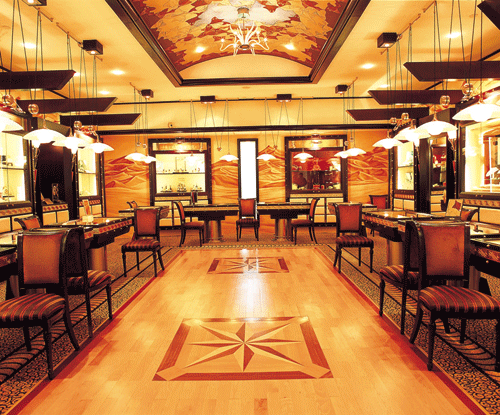
Damas is the leading jewelry chain in the United Arab Emirates and a luxury venture that claims to have a 17 percent share of the domestic market. The roots of its founding family in the precious business go back more than a century. Today the company is owned by regional investors. Fortified with a recent business restructuring and a clear strategy of concentration on its core market, namely the Gulf Cooperation Council countries, it is positioning itself for growth, specifically in Saudi Arabia, but also seeks to further expand its standing in the UAE, chief executive Anan Fakhreddin told Executive.
“When the restructuring started two years ago, we put the first priority on our core markets. Our core markets definition today is the GCC. These are the markets where Damas started and where we have a very strong understanding of consumer trends and preferences,” Fakhreddin said.
Organizational and marketing initiatives in the recent past included new partnerships with international jewelry brands, investments in quality assurance, including collaboration with UAE authorities for training customs officers on purity of gold, and the hiring of a Bollywood celebrity for a marketing campaign for the Diwali Hindu festival. The festival, which this year falls in November, is a huge jewelry buying occasion for the Asian customer segment in the UAE and stores can get so crowded with customers that one can hardly move, explained a Damas spokesperson.
The outcome of the 2012 business year for Damas is going to be determined to a large part by the last two months of the year, Fakhreddin said, due to the role of the Diwali and overall contribution of the year-end holiday season to sales.
So far, so normal. But the corporate narrative of this jewelry house in 2012 is more than some lore of doing business in gold and precious stones. It is a cautionary tale that a corporate centenarian can make a pretty bundle of mistakes, that mature individual age and folly are not mutually exclusive, and most importantly, the most recent chapter of its story is that a turnaround is possible at over 100 years old.
A Shaky start
About five years ago, the successful family group Damas, which since 2005 included a minority stake holding by two regional private-equity players, was preparing for its future. At the time, a business prophecy was making the rounds among the family-owned enterprises in the Gulf region. This prophecy, with many good success stories and references from developed economies, said that the future was for them to become listed companies.
The UAE stock markets were not even 10 years old for the Dubai and Abu Dhabi bourses and the youngest, then known as Dubai International Financial Exchange (DIFX), was still in its diapers, full of promise. Many who appeared as wise consultants advised the business families of Dubai and anywhere in the Arab region that it would be a boon for the national economy and a far-sighted decision for any large and ambitious family enterprise to undertake an initial public offering.
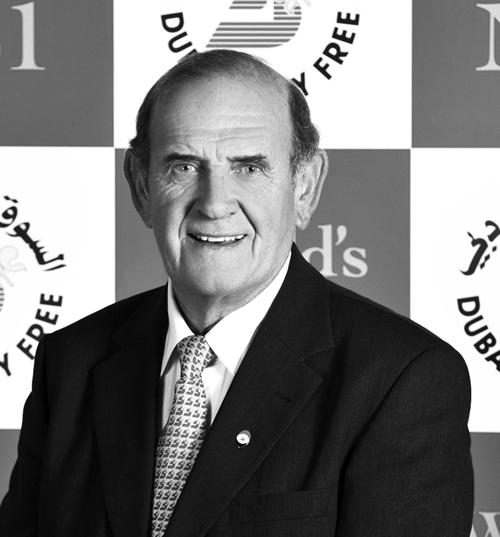
The Abdullahs (Tawfique, Tawhid, and Tamjid), three brothers whose grandfather had laid the foundations for the Damas Group, decided to go for an IPO. The company picked the highly-touted DIFX (today Nasdaq Dubai) and embarked on its flotation. Smack in the middle of 2008.
What happened then lends itself to the perception that no financial thriller writer could have imagined a worse time and place for any company to go public than June/July 2008 on the DIFX. Damas announced that its IPO successfully raised $270 million by floating 28 percent of its capital at $1 a share, valuing the enterprise at close to $970 million. It did not announce that one of the Abdullahs — Tawhid, who was chief executive of Damas — had done a circular investment pact with several investment companies in Dubai, including a unit of Dubai Holding, by which he lent them cash used to buy 100 million shares in the IPO. In 2009, the loan was reportedly converted into an investment that seems to imply that Damas had effectively bought itself and all it got out of it was a huge, non-performing loan, according to a report in Abu Dhabi-based newspaper, The National.
Moreover, the Abdullah brothers had run Damas with a piggy bank approach, taking out cash and borrowing gold at will and with no control, to the tune of hundreds of millions of dollars. The feudal approach to corporate governance might have perhaps been manageable in better times, but with the global economic crisis, the burst of the Dubai economic bubble and many soured investment gambles by the Abdullahs, it all came out. The Abdullahs were obligated to resign and banned by the financial authority from managerial roles, for 10 years, at any company based at the Dubai International Financial Center (DIFC).
Left behind was an orphaned company with hundreds of scattered stores (in a July 2008 Reuters news item on the Damas IPO it said the company operations entailed 438 stores in 18 countries) and a big financial problem. Deals were struck and a formula for repayment of their obligations to creditors including Damas was agreed upon with the Abdullahs. As often with grim fairy tales, many gaps in the narrative of this corporate crash were left for interested readers to fill with their own assumptions.
The turnaround of Damas entailed a restructuring under Fakhreddin’s captaincy that commenced in 2010 and a buyout by regional investors in the spring of last year. The new parents, Mannai Corporation of Doha, Qatar, and EFG Hermes, the Egyptian investment bank, paid 45 cents on the dollar for each share in Damas and took control of 85 percent in the company, according to stock market reports.
Mannai Corp, owning a 66 percent controlling stake in Damas, says on its website that it is Qatar’s largest trade and services conglomerate; it is affiliated with the ruling al Thani family. The other 15 percent in Damas remained with the Abdullahs.
Future expansion
Fakhreddin said he could not discuss the owners’ plans for the jewelry company but told Executive that “they have been investing in terms of assets, resources, and support and are investing very generously on the brand. The Damas brand will see a lot of growth in the coming years because of this takeover and the level of attention and support that we are getting from the new owners.”
Importantly, the new shareholders’ investment decision was long-term, he said. “It is not a turnaround project where you buy something, fix it, and sell it.”
Besides sorting out the financial obligations of the mismanaged enterprise, the restructuring of Damas entailed structural changes of operations that had been convoluted with less-than-strategic investment decisions and movements into new markets. The GCC was always the center of Damas’ retailing strength but this was “unfortunately sometimes overlooked” and the weeding of overseas operations was needed, Fakhreddin said. “Today we follow the strategy that makes sure that investments are placed in core markets. Until we are satisfied with penetration levels in those markets, I don’t think we will look at expansions in any other markets.”
In line with this business plan, Damas appears to be not aggressively approaching the market in India where it has a joint venture (JV) managed by the JV partner. It has bought out its partner in Saudi Arabia, on the other hand, and is planning to attack this market vigorously. According to Fakhreddin the past 18 months since the full acquisition in Saudi Arabia saw growth but the main task achieved was refocusing the organization on serving the high-end and middle-class luxury segments.
The Damas chief executive expects the “real success story” will commence in 2013 when the expansion plan of stores in Saudi Arabia kicks off. The company understands well the currently very fragmented Saudi jewelry market because of many similarities to the Arab segment in the Dubai and Abu Dhabi markets. Fakhreddin said, “Potential for market share in Saudi, one of the top jewelry markets in the world, is still open for growth.”
Performance of Damas in financial terms has been stable in the past three years on the side of gross revenues. As the company de-listed from Nasdaq Dubai this summer (and is switching its financial year to the calendar year in 2012), Fakhreddin said that the company has more or less completed the restructuring and has only “to sort out files in some non-core markets where we have business relationships that we want to realign.”
That should be achieved in the first quarter of 2013, he added, and then they want to grow much more than in the past four or five years, in which things had been “a little static because of the global recession and our issues. We are planning lots of improvement in terms of brand, [the] look and feel of the shops, [and] customer service. Much of that will be tackled in 2013.”