• Donate
  • Our Purpose
  • Contact Us
Executive Magazine
  • ISSUES
    • Current Issue
    • Past issues
  • BUSINESS
  • ECONOMICS & POLICY
  • OPINION
  • SPECIAL REPORTS
  • EXECUTIVE TALKS
  • MOVEMENTS
    • Change the image
    • Cannes lions
    • Transparency & accountability
    • ECONOMIC ROADMAP
    • Say No to Corruption
    • The Lebanon media development initiative
    • LPSN Policy Asks
    • Advocating the preservation of deposits
  • JOIN US
    • Join our movement
    • Attend our events
    • Receive updates
    • Connect with us
  • DONATE
Economics & Policy

Theory of evolution

by Executive Staff December 3, 2011
written by Executive Staff

Telecommunications in Lebanon has come to embody the fault line along which Lebanese business and government split. While the people who use the communications networks try to progress and join the information age, the sector has lain dormant for years because of both publicly-owned, ineffective infrastructure, and political scuffles over who should control Lebanon’s most profitable public service. In 2011 the plates on either side of this fault shifted, sending economic shockwaves, both positive and negative, throughout the economy.

It all started in January when the then-caretaker Telecommunications Minister Charbel Nahas announced that third generation mobile Internet (3G) would be introduced to the country. 3G technology is a means of incorporating high-speed Internet with mobile devices such as smartphones or using a ‘dongle’ to enable users to access the service on their computers the way they currently use other wireless Internet products, such as the pervasive Mobi and Wise Box. In September, Nahas (by then labor minister) promised speeds averaging 7 megabits per second (Mbps) and up to 21 Mbps. That would equate to 27 times faster than the speed available at the time via a digital subscriber line (DSL), 70 times faster than those available using the general packet radio service and 500 times faster than those available to ordinary cell phone subscribers, according to Nahas.

The initial deadline set by the previous minister was missed. But by mid-November both of Lebanon’s mobile networks had introduced the service to the public. Even so, the average speed of 7 Mbps was not to be.

“It is a work in progress,” said Claude Bassil, general manager of MTC Touch, one of Lebanon’s two mobile telephone operators, owned by the Kuwaiti telecoms giant Zain. “I cannot promise you that the wireless transmission network, meaning the microwaves, will be capable of providing the maximum capacity [21 Mbps] that the sites can handle,” he said in an interview with Executive. Bassil admitted that it will take a year for the network to reach the promised speeds because the transmission networks between the cell towers that correspond with phones and the Internet network are not optimized. 

In the interim, mobile operators will have to connect to existing fiber-optic cables, a process that will take months, according to Bassil. Even when that happens, without a complete fiber-optic network installed in the country — something only the government is legally allowed to do — the full potential of 3G will not be reached.

Ogero and Ministry of Telecoms

The 3G project was made possible by an undersea Internet cable dubbed the ‘India-Middle East-Western Europe 3’ (IMEWE3), which has finally been opened up to Lebanon. It was originally been scheduled to come online in March 2010. 

The IMEWE3 cable has a total capacity, shared between the many countries connected, of 3.84 terabytes per second. Lebanon’s allocation is 120 gigabits per second (Gbps), up from around 2 Gbps before the IMEWE3 opened up, with the potential to be upgraded to some 300 Gbps at a later stage. The problem with the cable was, perhaps predictably, politics.

Abdulmenaim Youssef, the head of Lebanon’s publicly-owned fixed line operator Ogero, refused to hand over administration of the cable to Minister Nahas in 2011. Ogero is financially and administratively independent of the ministry and has, for the past several years, been at loggerheads with telecommunications ministers, who have been members of the Free Patriotic Movement, which opposes Youssef. Conveniently, Youssef also occupies the post in the ministry that is supposed to oversee Ogero, something also granted by a previous cabinet headed by the opposition. Speaking to Executive in September, he argued that this is not a conflict of interest because the ministry has annulled all contracts with the company because of a dispute over the way invoicing and receipts were conducted; this, however, was not always the case. 

According to Youssef, Ogero was appointed to carry out negotiations on the IMEWE3 project by the Council of Ministers. The ministry rejects this as they claim that ‘Ogero Telecom’ — the company listed on the contract with IMEWE3 consortium — was never a commercial company and thus control of the cable should have been returned to the ministry. Even so, Youssef said that while the cable may have been ready for operations in December 2010, a commercial agreement had to be worked out by Ogero in Marseille (where the cable ends) to transfer data from there to the rest of the world, something that was completed in May. 

Youssef, who in the past was close to the current opposition and is now believed to be supported by Prime Minister Najib Mikati, is in charge of doling out the necessary international capacity to companies such as service providers MIC1, MIC2, the digital signal processors (DSPs) and the Internet service providers (ISPs) at the telecom ministry. This is done by distributing 2 Mbps bandwidth packages to those who request them.

The ministry recently decreased the price of such packages from $2,700 to $420, ostensibly to facilitate the expected consumption increase and sell them to private sector providers. According to the current telecom minister’s advisor Firas Abi Nassif, 10 Gbps of extra capacity have already been opened up through the IMEWE3 cable. This freed up a major bottleneck in Lebanon’s Internet infrastructure and allowed for the telecom minister to announce a new pricing and capacity structure that would be implemented on October 1.

Fixed and constant problems

The date came with mixed results. Some people benefited from the increase while others were still waiting as Executive went to print. The reasons for the delay are many and technical, but the heart of the matter is that, while the ministry decides to implement, Ogero actually carries out the implementation. The ongoing row between the two government bodies has in effect left people waiting and the promises unfulfilled.

Habib Torbey, president of the private sector Lebanese Telecommunications Association (LTA), explained that many of the problems are related to the transmission network between cabinet offices   — equipment in each neighborhood that connects users to the system. “The users that the [Internet Service Provider] has put on the Ogero [infrastructure] have a problem and this is where things get stuck,” he said. “We see a huge delay in the upgrade and we don’t have a lot of visibility as to when this upgrade will occur. Even when it happens, it’s up to 1 Mbps. They are not giving us 2 Mbps and 4 Mbps.”

“Every few days they upgrade four or five [cabinet offices],” he said, adding that he estimated the upgrade to be around 25 percent complete.

Based on current rates, Torbey estimated it will take around six months for the private sector to be let into all the cabinet offices.  Private sector entities have only been allowed into more cabinet offices since November 2010. According to a statement issued by Minister of Telecommunications Nicholas Sehnaoui, the process aims “to break the grapple hold over the private sector by a political group represented by people in the [ministry’s] administration,” a clear reference to Ogero and Youssef, whom the minister has not met with since taking office.

The problems between the two sides also manifested themselves in a lack of modems for new Internet subscriptions and call cards for payphones because of the dispute over Ogero’s budget, which comes through the ministry. The minister has now found a way to issue both through the postal office but, if history is anything to go by, the row seems far from resolved. ­­

The structure

The telecoms industry is still the only public service that is partially privatized, but only on the retail end. This is because the law that is supposed to govern the sector is not fully applied, resulting in a market landscape where the regulator, the Telecom Regulatory Authority (TRA), cannot fulfill its prerogatives or be financially sustainable because it cannot sell the infrastructure licenses that the private sector seeks. Thus, at the end of the day, the TRA and the private sector remain dependent on the ministry, as do public finances. In February 2012 a new board of the TRA will have to be appointed by the cabinet, something that took five years the first (and last) time around.

Give me my cash cow

By August the revenues of the telecom ministry had reached $961 million and the finance ministry’s telecom revenues are predicted to hit $1.2 billion this year, even after it pays off all its contracts and dues. Making sure that the ministry keeps raking in the money for Lebanon’s cash-strapped government has been the driving force behind sky-high prices for telecom services.

Now there has been an agreement between the finance minister and the private sector to keep government revenue stable in order to decrease prices. “Basically what they agreed with us is that they can reduce their prices, and we are for it,” said Finance Minister Mohamad Safadi in an interview with Executive. “In the end we feel that the revenues are not going to be less and there is a very big chance that they will [rise]… because of increased usage. The intention is to open the market [to the private sector] at the end of the day.”

What that will require is that the minister issues his ‘general policy’ so that the TRA can exercise its right to issue long-term licenses to the private sector, which can then start investing in long-gestation infrastructure projects and bring prices down. The law also stipulates the formation of a corporatized company called Liban Telecom that would replace Ogero and would be able to set prices and standards according to business realities and circumstances.

If this does not happen, the progression of government-run 3G, the inclusion of a new fiber-optic backbone due to arrive in September 2012 and a large discrepancy in operating costs due to government-imposed measures (such as a 20 percent revenue share) will likely box-out the private sector because they will not be able to compete.

One company, Cedarcom, jointly owned by Minister of State Marwan Kheireddine and the son of a former telecom minister, has already submitted a case in Lebanon’s highest court over the government’s 3G project because they claim it will destroy their business. The court already ruled that the government had to stop 3G for one month in 2011 to adhere to a request for information. Now the 3G project is back on and the clock is ticking. Other private sector companies are also worried but are looking for a compromise in the form of a Mobile Virtual Network Operator (MVNO) contract, an industry term for a company in agreement with the owners of a telecom asset that performs services ranging from complete resale to merely offering back office services. LTA’s Torbey confirmed that he was still in negotiations but refused to comment on the level of progress. In the end, no matter what the outcome of the case or the MVNO, if the law is not applied, the direction the telecom industry takes in 2012 will likely remain subject to the political winds of change rather than any plotted economic course.

“I sincerely hope that we put new polices and regulations in place to allow the private sector to play,” said Bassil. “The private sector needs to play a lot in this area and the infrastructure is coming. We are not pretending it’s up to scratch, but it’s coming.”

December 3, 2011 0 comments
0 FacebookTwitterPinterestEmail
Economics & Policy

Q&A – Vrej Sabounjian

by Executive Staff December 3, 2011
written by Executive Staff

Vrej Sabounjian took the reins at the Ministry of Industry in June, taking his experience from the business boardroom to the political cabinet. It has been a bumpy ride for industrialists in 2011 and demands for government leadership and support are high. Executive sat with the minister to find out how he has dealt with his first months in office.

E  You told Executive back in July that you were confident that this government was pro industry, yet there was not a single mention of industry in the draft budget. What positive actions or proposals by the cabinet have shown support for industry?
I think we can say anything we have presented so far has not met any objection at all.  That’s sign enough for me that I have enough support from this government to push ahead with our industrial programs and we are going to sign a lot of bilateral agreements with other countries; it’s coming. We are going to make agreements with Sudan and Armenia and other countries and these agreements will help industry in Lebanon. 

E  The negotiations for these agreements are already underway?
Two are already ready… they will be signed very soon.  

E  With these agreements there will presumably be a decrease in trade barriers. Is this a trend you see developing?
The barriers to trade have already come down as we have moved into a global economy for some time. But the bilateral agreements help facilitate the relations between the two countries and their business people [with] measures such as visa agreements, more flights, accreditations and tax deals so there is no double taxation.

E  Is Lebanon still en route for accession to the World Trade Organization?
Yes.

E  Is that prudent in the troubled and uncertain global economic environment we are currently in?
Prudence is always good but I think we have also to understand we are living in an environment where all borders are opening and trade should be easy and accessible to all parties. But it has also to be fair in the sense that there are some countries which are bigger and stronger and others smaller and weaker, so we have to note those details in the agreements.

E  Can you provide details of the draft proposals you submitted to the minister of finance in relation to the tax exemption on exports?
The answer is very simple: if you manufacture a product in Lebanon and you export it you will be eligible to get a 50 percent tax credit on your profits, [depending] of course on whether the law passes the cabinet. Our tax rate is 15 percent so on your exports you would only pay 7.5 percent. 

E  Is there a time limit on this or would it be indefinite?
No.  It would be indefinite.

E  And how confident are you that this is going to get passed in the cabinet?
I’m pretty confident and I’m also relying on the support of our prime minister [Najib Mikati] and the minister of economy [Nicolas Nahas]. He’s my good friend and we have discussed this issue, and I am also sure the minister of finance [Mohamad Safadi] will not object.

E  Have the committees tasked with creating the nation’s industrial zones been created, as was promised in the ministerial statement?
We are almost finished. There are still some little details, and in a few weeks it will be ready.

E  The plan will be ready or the creation of the committee will be ready?
Both. On the plan we are doing some modifications and the committee is already under study.   

E  There is going to be a committee, or there is a committee?
There is going to be. There is not now. We are forming a committee. We will have a banker, an accountant, an engineer, an auditor and these kinds of people who can bring the maximum contribution for this project.

E  In the draft budget there was no mention of this project.  How do you envisage it being financed?
There are a few ideas which I don’t want to elaborate on now, but I would like to give a chance for the committee to come up with some ideas. We have ideas at the ministry and I have my ideas and I would like the committee to add on those ideas and bring their own.

E  Is the industrial sector able to absorb the blow of the proposed minimum wage increase?
I don’t think the industrial sector is waiting on the increase in minimum wage. I think all business people have already done the necessary adjustments related to inflation. 

E  But there are employees in the industrial sector whose pay would be affected by the proposals…
There are certainly people working close to the minimum wage, and that’s why it is the government’s responsibility to look at it, which we did in a responsible way. The increases are acceptable but I don’t want to elaborate on the percentages because there are differing views.

E  So in theory you support an increase in the minimum wage but not explicitly these figures?
I supported the increase in the minimum wage but I would also say I am not with the idea of increasing wages [other than] the minimum wage. It is the government’s duty to help minimum-wage workers but it should not get involved in any other kind of wages. However, this is my personal opinion and I will support my government whatever its decision is.

E  When you came into office you told Executive you were going to get an additional 25 percent added to your budget. Have you?
There is a problem in all of the ministries concerning their budgets. It’s a fact that we have a problem with the budget. So I guess we will still try to help the ministry of finance but at the same time we have to find a way to help our ministry because we really need the increase in budget.

E  But as of yet you have not received the 25 percent you were hoping for?
Not yet, no. The budget has been put to the cabinet and each minister is looking at it and is going to go back with his comments.

E  And yours will be?
I will stick to my plan. I will definitely ask for my 25 percent. 

E  How have the events across the border in Syria impacted Lebanese industrialists?
I’m sure some sectors or companies that had large business with Syria will have been impacted, but if that is the case then I advise them to take this opportunity to find new markets. They should not consider this as a setback but as an opportunity to find other markets.

E  With regards to the proposed electricity law, does it go far enough in addressing Lebanon’s energy infrastructure crisis and can industrialists be assured that there is the political will and ability for it to be delivered?
I think Lebanon has stability now. I think you could say we are one of the most stable countries in the Middle East. 

E  You’d hope so!
[Laughs] As for electricity, we have passed this law and, yes, we will have a much better electricity situation a year and a half from now.

E  You have encouraged industrialists to establish their businesses in the north, south and Bekaa, outside of the industrial heartlands. What incentives exist for them to do so?
If you move to the north or south the land is much cheaper and you can find lots of minimum-wage workers in those areas. You have more space…

E  Does the government have a role to play in the regionalization of industry or is it something that has to happen naturally?
It has to happen naturally. It is natural to expand.

E  How will the industrial sector have to adapt over the coming years if it is going to remain internationally competitive?
Governments don’t make companies competitive. I advise every chief executive officer or president or owner to have a good vision and be flexible. Times now benefit those who are flexible. Drop things that are not profitable, keep your ego away and be objective. I encourage Lebanese business people to be open-minded with regards to merging, which is still not much in the culture of the Arab world.

E  How would you sum up your first several months in office?
I am working hard but I will leave the assessment to others. I am working hard to finish my ideas. I am trying to finalize licenses and encourage people to come and do whatever they need from the ministry as soon as possible. We’re finishing their requests in a very short period of time… One more thing: we are planning to bring to the schools and the colleges [a program] which will give the students a chance to know more about industry in the country. I want the Lebanese to have trust in their industries and to have faith in a productive Lebanon and not just commerce. Look at some of the countries in Europe that depended too much on services and tourism. Shouldn’t we learn from that?

December 3, 2011 0 comments
1 FacebookTwitterPinterestEmail
Comment

A myriad of moving pieces

by Nicholas Blanford December 3, 2011
written by Nicholas Blanford

The tumultuous start to 2011 with the collapse of the Saad Hariri government in Lebanon and the establishment, after several months of hard bargaining, of a new administration headed by Najib Mikati did not bode well for stability and economic improvement. But as the year draws to a close, the Mikati government has fared better than its detractors predicted.

The Tripoli businessman took a gamble by accepting the premiership in January, something of a poisoned chalice for a Sunni given the acrimonious manner of the ousting of Hariri, the leader of Future Movement and the pre-eminent Sunni political leader. Although Hezbollah engineered the downfall of the Hariri government and remains the quiet power behind the current government, Mikati has shown that he is no puppet of the Shiite party.

He has a reputation and international contacts in his own right, which in some ways make him a more useful partner for Hezbollah than an obedient drone.

One example is the debate over Lebanon's share of the funding for the Special Tribunal for Lebanon (STL), which has dogged the political debate since the summer. Hezbollah has consistently said it opposes Lebanon paying its 49 percent share of the funding, a rejection echoed vociferously by the party's allies, especially Michel Aoun. Mikati, however, has assured the UN that Lebanon will honor its obligations and pay its share, going so far as to threaten resignation over the matter, and eventually fund it through a government body under his authority.

A Mikati who retains international credibility and is allowed to win some political tussles is not a threat to Hezbollah. On the contrary, Hezbollah is likely to pick its battles with the STL with care.  Hezbollah clearly will stick to its stance of rejecting the STL funding, but that does not mean the government will follow suit.

Still, the STL funding issue is a mere hiccup compared to the historic events roiling Syria. There is a feeling in Lebanon that if Syria continues its descent into violence, it will inevitably spill across the border into Lebanon. Barely a day goes by without the local press reporting rumors of assassinations or militants arriving in the Palestinian refugee camps plotting nefarious deeds. The government faces the dilemma of juggling its loyalty toward the Assad government and accepting the reality that the regime may well founder in the coming months. The former stance will spare the government Assad's wrath but the latter will reshuffle the political cards in Lebanon in potentially dangerous ways.

Generally, international and regional players recognize the dilemma facing the Lebanese government and cannot be surprised when Lebanon is one of only three countries to vote against an Arab League proposal to suspend Syria's membership in the organization. Burying one's head in the sand is an essentially Lebanese means of dealing with unpalatable problems. But the influx of Syrian refugees escaping the violence and the prospect that some Sunni-populated areas in Lebanon near the border could become small-scale staging grounds for Syrian opposition fighters and activists will complicate Lebanon's ability to distance itself from the upheaval next door.

It is inevitable that Lebanon will feel some of the shockwaves emanating from Syria in the coming months, particularly if the struggle develops further into a sectarian conflict. But the real earthquake for Lebanon could occur if and when Assad is toppled, especially if the next regime better reflects the Sunni majority in Syria and aligns itself further from Iran and closer to Saudi Arabia and Turkey. Such a development will give a boost of adrenaline to the March 14 movement, especially Future Movement. Would it sufficiently embolden them to make a fresh play at confronting Hezbollah, which, after all, will still remain Lebanon's strongest military and political player even without the strategic depth provided by an Assad-led Syria?

Hezbollah has a habit of reacting forcefully and decisively against any moves that threaten its resistance priority and the party will already have made plans to counter a reinvigorated March 14. Much depends on the tenacity of Assad to remain in power and how a deteriorating Syria will impact more broadly on the region. But 2012 appears to be shaping up to be a most interesting — and potentially unsettling — year.


NICHOLAS BLANFORD is Beirut correspondent for The Times of London and The Christian Science Monitor.

December 3, 2011 0 comments
0 FacebookTwitterPinterestEmail
Society

Fast rides on rocky terrain

by Executive Staff December 3, 2011
written by Executive Staff

Minimal economic growth and lower purchasing power have affected sales of luxury cars to a greater degree than the rest of the market, with the segment down by an estimated 30 percent to 40 percent on last year.

“The potential buyer of a BMW, Mercedes or Maserati isn’t buying, not because they don’t have cash but because they are not economically comfortable in the current situation,” said Nabil Bazerji, managing director of GA Bazerji and Sons, a Maserati dealer. Sales of the luxury Italian car are down roughly 25 percent from 26 cars in 2010 to 20 this year. BMW sales have dropped by more than 50 percent, from 816 units to 396 as of October 2011, while Jaguar had sold 99 units in the same time, compared to 200 at the end of 2010.

“We have demand but it has not been an exciting year,” said Michel Trad, Director of Saad & Trad, dealer for Fiat, Abarth, Jaguar, Bentley and Lamborghini. Only eight Bentleys were sold this year, compared to 22 in 2010, and just one Lamborghini. Trad is hoping a new convertible Bentley model will boost sales next year. The company is also the sole distributor for British super car McLaren, which launched its long-awaited new model, the MP4-12C, in Dubai in November. 

What made surprising inroads is a compact designer car, the Gucci Fiat 500. “Lebanon was the only place that got the Gucci 500 outside of Europe, as Fiat thought Lebanon was a trendy place to sell,” said Trad. “You won’t find 100 on the roads — only around 10 and a max will be 25.”

Warding off potential buyers of super cars is a tax of 63 percent, equivalent to a minimum of $150,000.

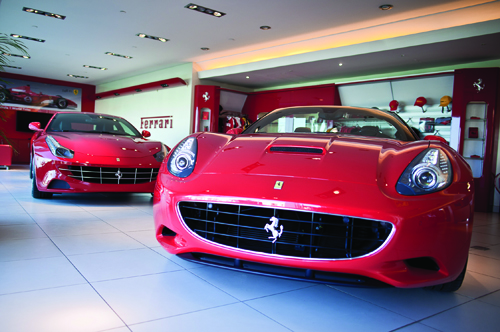
“With such high taxation, customers expect something in return, such as good roads free of pot holes,” said Marie-Claire Chammas, marketing manager of Sports Motor Group, exclusive distributor of Ferrari. “As a result, our main competitors are the Gulf countries, as tax is only 5 percent there.”

But this has not held sales back for Ferrari, which are up 200 percent since 2009, with the company selling around 40 cars per year.

“For us, the luxury segment is getting better. None of our competitors have even a third of our sales. There is a two year waiting list for the 458 Spider, and nine to 14 month waiting list for other models,” said Chammas.

Pushing sales has been the Ferrari California, a two-door, four seat sedan. “The California has attracted new clients,” she said. “Before, Ferrari drivers were all about racing, but the California is more about lifestyle and is more versatile. And there are more women drivers than before.”

Mana Automotive, dealer for Range Rover, Land Rover and Aston Martin, is hoping that the recently launched four-door Aston Martin Rapide will find similar popularity as the Ferrari California. “The Rapide will do well as Lebanon is a four-door market,” said Nadim Tewtel, president and managing director.

Bucking this year’s downward trend alongside Ferrari is Porsche, with similar sales as in 2010 at 285 units. “We should end the year with around 320 to 325 units, and in 2012 we’ll grow by 10 percent or more,” said Charles Tarazi, assistant general manager of the Porsche Center Lebanon. Sales were heavily skewed towards the Cayenne sports utility vehicle, whose share doubled to 68.8 percent of all Porsche units sold, from 33.3 percent in 2010. “Some of our sports car sales were down as new models will be out in 2012 — the 911 in February, which we’ve been waiting a year for now, the Cayenne GTS and the Panamera GTS.”

At least for some models, the belt-tightening can wait.

December 3, 2011 0 comments
0 FacebookTwitterPinterestEmail
Economics & Policy

Plugging the gaps

by Executive Staff December 3, 2011
written by Executive Staff

Every year the rain passes over in Lebanon, endowing it with a resource that much of the Middle East can only dream of. But even as those rains fall and the country’s roads turn to rivers, many Lebanese still look up at the sky and ask why their water tanks are empty and their faucets are spitting out nothing but air.

The reason is that since the end of the civil war little has been done to improve water reuse, although a lot of words have been spent. Only one large dam has been built in the Chabrouh area, 40 km outside the capital, holding a maximum of 15 million cubic meters (MCM). The only other major infrastructure project, the Qaraoun artificial lake, carries a maximum of 300 MCM of water and was built in 1959. Combined, their total storage capacity is less than 6 percent of renewable water resources, compared to 56 percent in Tunisia and 117 percent in Syria. 

Thus it is little wonder that the water balance, or the relationship between total supply and demand, is estimated at a deficit of around 420 MCM average per year, with Greater Beirut alone facing a daily shortage that ranges between 145,000 and 275,000 cubic meters.

In 2010 the Ministry of Energy and Water issued its National Water Sector Strategy, which gave an unprecedented look at the state of the country’s water sector. The strategy replaced an older document that explored the idea of building dams between 2000 and 2010. Of course, little of that ever happened.

“To me at least we have a kind of plan for once,” says Nadim Farajallah, professor of hydrology and water resources at the American University of Beirut. “At least we know what we have and how much it’s costing us; what we need to do is move forward.”

This time around the strategy is to build a series of dams, artificial lakes and other infrastructure elements to alleviate the entire water sector from shortages. In total it will cost the country around $7.9 billion (LL11.85 trillion) in capital expenditure and another $2 billion  (LL 3 trillion) in operational expenditure by 2020 to rectify the situation, not just in water supply, but also in wastewater and irrigation. And that’s if Lebanon’s notorious geological formations allow for the dams to be built at cost.

That will also require several initiatives on the financial, regulatory and legal fronts, of which none were started in 2011. To begin with the water establishments (WEs), the public sector administrations dealing with water in each region, will have to be staffed and restructured so they can exercise their prerogatives according to Law 221, which lays out how the sector should be organized. In theory the WEs should be financially and administratively independent, but they are far from it. They are also grossly understaffed, as is the Ministry of Energy and Water and the general directorates within it that are concerned with water management.

Regarding financing, the money for all the infrastructure looks like it will have to come from sources other than the national treasury. The Ministry of Finance has a proposed budget of only $46 million for dams and $4 million for consulting services in the 2012 budget proposal, and this is yet to be hacked away at by cabinet and Parliament. “Concerning the remaining allocations for dams, the Ministry of Finance finds it necessary to resort to donor countries and funds, given their willingness to extend soft loans at much lower interest rates than what it would cost if the projects were funded through budget allocations,” the proposed budget reads.

Conflicting messages

The minister in charge seems to disagree. “It appears that again and again the value of deposits in Lebanon are large and Lebanon secures larger funding than is required… hence all that remains is the decision to invest,” said Gebran Bassil, Lebanon’s minister of energy and water at a press conference in October. He also stated that investment should be “translated fully” in the upcoming budget (if it breaks the mold and passes) and was “awaiting discussions.” Previously, a similar debate over funding Lebanon’s decrepit energy sector almost brought down the cabinet. In the time it takes for the government to haggle over the budget — something that began to happen in November — there is no telling where the debate may take the sector or the country.

The problems with international loans are that they require long and extensive feasibility plans and environmental impact assessments, which take time. In March, Minister Bassil’s advisor Randa Nimer told Executive that the only project which was ready and had received approval was the Greater Beirut Water Supply Project (GBWSP), also known as the Awali project. It aims to provide constant water supply to Baabda, Aley, parts of the Metn/Mount Lebanon region, as well as to an estimated 350,000 low-income residents in Beirut’s  southern suburbs. The total cost would come to approximately $370 million, of which the World Bank would put up $200 million in loans, the Beirut and Mount Lebanon Water Establishment some $140 million and the Lebanese government the rest. It will take 50 MCM of water from the Qaraoun reservoir in the Western Bekaa, fed by the Litani River. The water will then be rerouted to the Awali River, treated and then conveyed to Greater Beirut, where, according to the Ministry of Energy and Water, a new network is currently being built that will distribute it to consumers whose homes are to be fitted with new meters.

The project has come under fire for reasons that range from polluted water in the Qaraoun (which was recently found to contain cancerous trace metals) to reportedly less expensive alternatives, which the ministry says will have to be built anyway. Nevertheless, Lebanon’s cabinet has signed off on a number of projects including the GBWSP and the completion of two major projects for irrigation out of the Qaraoun (Canal 800 and Canal 900).

Furthermore, Minister Bassil highlighted at the press conference that the proposed Bisri dam project between the Shouf and Saida is also an “inseparable and integrated” part of the GBWSP and that moving ahead with the larger project without first building the dam would be “an investment that is useless, resulting in paying a lot of money for a little bit of water.”

However, an official World Bank response to a complaint put in by around 50 residents against the project stated: “The Bisri Dam is not a component of the GBWSP nor is it relevant to, or necessary for, the achievement of the objectives of the GBWSP.” This obviously puts the whole issue in question and thus the only project due to start relieving Beirut of its water woes may just run dry before the tap is even turned on.


Sidebar: Wasting away

Lebanon is the country with the lowest amount of re-use in treated water in the region. Although the percentage of wastewater network coverage is 6 percent above the Middle East and North Africa average of 48 percent, the portion that actually gets treated is an abysmal 4 percent, according to the Ministry of Energy and Water’s estimations. Much has been done in the wastewater sector over the past few years, mostly because of international funding. Since the early 1990s investments in the sector have exceeded $1.4 billion, mostly through the Council for Development and Reconstruction (CDR).

However, the results are still far from palpable. Today the recently built wastewater treatment plants in Chekka, Tripoli, Nabatieh and Jieh are complete but not fully operational, some for over four years, because of a vicious combination of a lack of staff, money, maintenance and even connection to the sewage line. The prerogatives over the sector are also split between the municipalities, the CDR and the water establishments. A national strategy for the wastewater sector that was issued in December 2010 seeks to spend a total of $3.1 billion on the sector, none of which has yet been spent. So, if history repeats itself, the result will be ever more waste to accompany the wastewater down the drain.

December 3, 2011 0 comments
0 FacebookTwitterPinterestEmail
Society

Beating the hordes

by Executive Staff December 3, 2011
written by Executive Staff

With 434 cars per 1,000 people, Lebanon has one of the highest vehicle-per-capita ratios in the world, in large part due to an almost non-existent public transport system. The 1.6 million vehicles in the country are the primary contributor to air pollution in Beirut, with more than three quarters of the capital having nitrogen dioxide levels 95 percent above the World Heath Organization’s threshold limit, according to research by the American University of Beirut.

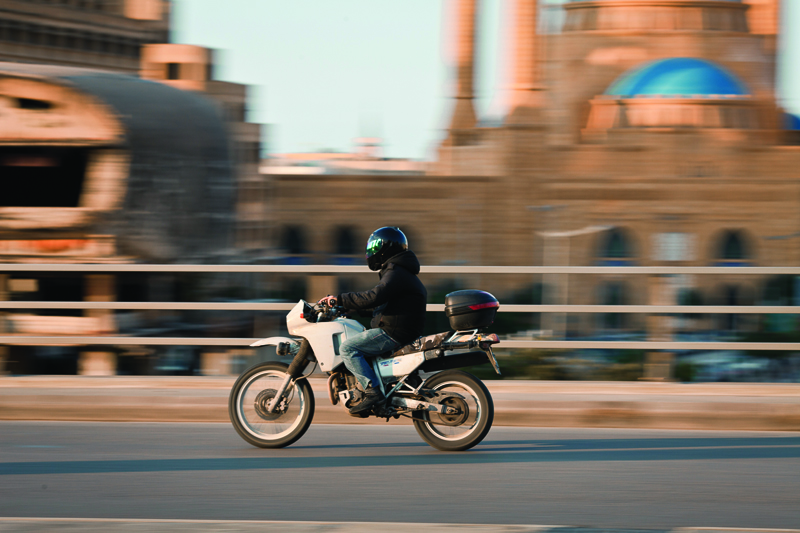
To improve congestion and pollution levels, motorbikes can provide the solution, believes Anthony Boukhater, General Manager of AN Boukhater, dealer for the Piaggio Group.

The fast lane

“The only solution for traffic today is for more motorbikes, as there’s no metro, and taxis and service taxis are expensive and unpredictable,” said Boukhater. “Many factors are making it more interesting to buy a bike, especially traffic, taking 1.5 hours in a car to drive 15 kilometers. The second factor is the price of gasoline is going up, and the third is the lack of parking space in town. All of this is pushing people to go for a two or three wheeler.”

AN Boukhater have witnessed a 25 percent spike in sales this year. Negib Debs, brand manager of Kawasaki at Rymco, said that while there are no statistics due to the lack of an import association, demand is on the rise. “Two years ago we sold 70 motorbikes per year, but this year we’ll go above 100 bikes,” he said. Anticipating increasing demand, Rymco is upping its range, adding four more models next year to its current 14.

Holding back sales, however, particularly of motorbikes with engines above 250cc, is the lack of bank loans, a primary factor in boosting car sales over the past five years. “Banks won’t lend as they think the risks are higher with a motorbike, so we are doing in-house loans and will work to promote safety,” said Debs.

Dealerships have worked with Kunhadi, an organization to promote safety on two-wheels, by giving away free helmets, for example, and have set up motorbike clubs for weekend rides, with bikers required to abide by traffic laws. Meanwhile, Boukhater has established a motorbike school to train prospective riders for Lebanese roads.

“We are trying to change the image of the motorcyclist in Lebanon. When you talk to old people they only see mopeds swerving through traffic or bikers doing wheelies on the highway. This is not motorbike riding but suicidal riding,” said Debs. “We all want to change this image. In discussions with the police they know it is a problem but say its something they cannot change.”

Changing perceptions

One problem are used scooters, with an estimated 5,000 entering the country every month that sell for between $50 to $100. “If the police stop such unregistered mopeds, they impound them. But to get the moped released is more expensive than it is worth, so the owners don’t care. Then the police sell it back to the market as the law forbids destroying them,” added Debs.

Boukhater thinks the mentality towards motorbikes is slowly changing, and within two or three years there will be a 100 percent increase in sales year-on-year. “Next year I think will be even better than 2011; we are moving in the right direction.”

December 3, 2011 0 comments
0 FacebookTwitterPinterestEmail
Economics & Policy

Q&A: Mohamad Safadi

by Executive Staff December 3, 2011
written by Executive Staff

Tasked with putting together a national budget, managing a crippling public debt, as well as paying for a bloated public sector rife with patronage and sectarianism, Finance Minister Mohamad Safadi sat down with Executive to assess how he has fared since taking the helm, and to get his outlook for the country in 2012.

On what basis are we assuming that gross domestic product growth next year will hit 4 percent in real terms considering the Syrian situation, delayed infrastructure reform, a global economic crisis and the fact that most economists do not agree with your projections?

The assessment is basically that we had, in the first six months of 2011, zero growth and the economic growth took place in the second six months [during which] we are enjoying 4 percent growth up until now. So in 2011, growth will not be more than 2 percent, at best. As such, we forecast that we should have growth of something like 4 percent in 2012, if things do not deteriorate further, based on the situation today. But later, who knows? In the best-case scenario, we are looking at 4 percent.

Without growth the whole logic behind the budget is thrown off. Why do you not use scenarios to look at growth and inflation?

Whatever scenario we use, in any case we do not wish to increase our deficit. We have an increase in wages that we are looking at that we have to give. So technically, on top of the 2012 proposed budget [spending], we are going to introduce extra expenditure of roughly $650 million, which should be accounted for. Basically we are revisiting the entire budget because we are not going to say that we had a deficit of $4 billion and then say that we are going to increase it by $650 million. The deficit is not going to increase so we have to find the $650 million from different sources. Whether you cut some expenditure and increase some taxation, or you do it all by cutting expenditures… it’s a work in progress.

If it is not done by January then you will have missed the constitutional deadline, in which case we go another year without a budget…

Not necessarily. We don’t have to go another year without a budget. Yes, it is supposed to be passed in January but even if you pass it a bit late it’s not a catastrophe.

You are giving yourself more time despite the constitutional deadline?

We are not giving ourselves more time. I know that it is going to take more time in the Council of Ministers and the Parliament. What I am saying is there is an expenditure list, and an income list and a deficit figure. The deficit figure is not open for debate; all the other items are. That’s what we are insisting: that the deficit item is not going to increase.

You said previously that a minimum wage increase would be approved based on three conditions: first of all that subsidies to the needy would be given out…

I did not say that. What I said was that it should be done.

Ok. The other two stipulations were that the competition law is passed and that inflation does not eat up the [wage] rise. What measures have we taken to get there?

Yes. Yet the competition law is not passed by parliament.

So there is no intent to do so? If we want to open the market and allow prices to fall we have to get rid of oligopolies, don’t we?

Yes. Unfortunately, it’s not on the books yet. The law is…

…Too sensitive

It’s not too sensitive. It should have been passed. It’s stopping us from joining the WTO [World Trade Organization]. It’s stopping us from really using the law to make sure that there are no cartels. If you look at the structure now — what we call the syndicate of this, or the syndicate of that — it’s basically cartels of this or cartels of that. So basically we need to pass this law, and there is a lot of work being done so it is not passed. We cannot keep on going down the same route we are.

But as finance minister you can say ‘I won’t accept that it is not passed’ before you sign the minimum wage increase…

Of course I won’t accept that it is not passed. People say that we need the Ministry of Economy and Trade to get involved to check prices and make sure they are not manipulated. But really, the ministry has no legal tools. You can go and say: ‘Ok fine. You are not supposed to raise the prices.’ He [the trader] says: ‘Ok, but what can you do about it?’ There is nothing you can do about it. There is no law. What can you do? Turn your back to him and that’s it.

But obviously inflation will be affected if you increase the minimum wage and even more if you increase value added tax [VAT] as well. This will make poor people more vulnerable.

This is absolute bull, if I may say that. The effect on the poor will not be more than half a percent, and the safety net that we are working on in the 2012 budget will not only compensate for half a percent, it will compensate by far, far more than anything that a VAT rise will produce.

But in principle the latest proposals show that the government has an over-reliance on indirect taxes. A progressive income tax would be fairer and probably garner more revenue. How far are we from this on an infrastructure level and in terms of political will?

It is not just a matter of infrastructure; it’s a matter of ethics. It’s a combination of ethics and infrastructure and unfortunately in certain areas we lack both.

Which one do we lack more?
[Laughs and shrugs shoulders]

We have seen the public-private partnership [PPP] law proposed ad nauseam as a way to decrease the burden of infrastructure investments on the treasury. Why is there so much resistance to this?

There is a misunderstanding about these things. There is a misunderstanding about privatization, and there is a misunderstanding about PPP, even though countries like Egypt and even Syria have passed it. There are a lot of countries that we have always claimed we are ahead of in our economic thinking, and we find out that, in reality, we are lacking in certain areas. The misunderstanding is, basically, that the private sector is going to create a monopoly. I agree that the private sector always has the tendency to create monopolies if we do not have the laws [to prevent that]. But a partnership between the public and private sector makes sure that the private sector cannot create a monopoly. It’s actually exactly the opposite.

Since the Egyptians cut off our gas supply, how much of an increase do you anticipate to the Électricité du Liban’s [EDL] subsidy? What was the reason for the cut? And is there a plan to resolve the issue?

A $2.2 billion [increase] this year. What is clear now is that we cannot rely on the Arab gas line. Egypt promised us a good quantity initially, then that was reduced to half, then to a quarter; they gave us that quarter for three to four months and then they stopped it. So basically, we have an empty gas line. Syria was continuing the Arab gas line from Homs all the way up to the Turkish borders and we were happy that we would be connected with Turkey so we could shop for our gas from sources other than Egypt. Unfortunately, with the events that are occurring in Syria they were stopped and we are not sure how long it will be before that gas line is ready to be used.

The idea is to put an LNG [Liquefied Natural Gas] plant in the south and keep the gas line input in the north. So when we have gas from the north it can go all the way to the south, and when we don’t have gas in the north we can actually feed from the south, or a combination of both — whatever makes economic sense. So basically if you look at this it’s the only scenario we can live with, and it’s an expensive one. That is why we have allocated LL255 billion [$170 million] in 2012 to continue the work of extending the gas line from the north to the south. If we increase production of electricity and do not lower the cost of that production it means the deficit is going to increase. It’s going to bite even more.

You are part of the committee looking at the amendments to the electricity law and have advocated for the Electricity Regulatory Authority (ERA). What prerogatives will the ERA have and what amendments are being discussed? 

We are not reinventing the engine but we know that there are things that do not work. Take for example that the law talks about restructuring the whole company [EDL] and unbundling it. Basically, it says, without saying it, that Électricité du Liban has got to do that work themselves. Well, they can hardly do their accounts. So basically it does not allow for anything else to be done. But what is really important today is to allow for the privatizing of management. Once you do that, you can do everything else.

But the energy minister is worried about the regulator taking over his authority. This is the crux of the issue, is it not?

Yes, but this can be worked out.

Do you have any specifics on how?

Not yet, but we are meeting and moving forward.

E  In the year to come what needs to be done for the economy to recover?
It’s not going to be an easy year. We have to be watchful on every level. We have to make sure that we do not overspend and that we invest as much as possible in improving our infrastructure.

December 3, 2011 0 comments
0 FacebookTwitterPinterestEmail
Economics & Policy

Lacking a spark

by Executive Staff December 3, 2011
written by Executive Staff

Uprisings in the region, financial tumult on the global markets and the ever-capricious dramas on the domestic political rostrum have not made life easy for Lebanon’s industrialists in 2011. Yet the sector has doggedly managed to hold ground on its shaky shores. Just. 

In the first eight months of the year, industrial exports — a good indicator of the sector’s competitive performance — were up 7.4 percent on the same period in 2010. If not quite cause to crack open the champagne, the figures may at least elicit a sigh of relief from Lebanon’s industrialists. 

Keen to tout the successes of his sector, Minister of Industry Vrej Sabounjian struck an upbeat note in November, glowing over the fact that 206 industrial licenses were issued in the first half of the year. However, a closer inspection of the figures blurs this rose-tinted depiction of the industrial landscape in Lebanon. Only 41 of the licenses are for new operations while 18 are for plants whose construction has been completed and are now ready for production — that is to say 59 are for genuinely new operations, while the rest included items such as license renewals and transfers of ownership. The ministry also provided no record for the number of factories that closed down in 2011.

Thus it is difficult to verify the facts when the minister declares: “With new industries — and I know there are from the licenses we have signed — come new jobs as these people are all in business now.”

The President of the Association of Lebanese Industrialists (ALI), Neemat Frem, offers a somewhat more muted assessment of the past year in industry: “2011 can be considered the year where growth stopped in the industrial sector. We have not started, to date, to enter into negative growth, but I am worried that is coming very quickly if we don’t do something.”

His concern seems justified. The 7.4 percent rise in exports from January to August pales in significance when compared to the 29.5 percent leap from 2009-2010, which was in step with previous years’ increases (apart from in 2008 when exports were shaken by the global financial crisis). What’s more, imports of industrial machinery, an index to the levels of investment in manufacturing, rose by a paltry $300,000 over the same eight-month period.

Sign of the times

Growth in the Lebanese economy has dwindled to 1.5 percent this year, according to the latest International Monetary Fund estimates, with foreign direct investment (FDI) levels plummeting. According to statistics compiled by the Financial Times, the industrial sector has been hit disproportionately hard. In 2010, 36.4 percent of FDI in Lebanon was to industrial activities, but in the first 5 months of 2011 that proportion fell to 24.7 percent.

Despite his confidence in the acumen of Lebanese business leaders, Charles Arbid, founder of Rectangle Jaune and president of the Lebanese Franchise Association (LFA), warns that the situation is very precarious. “Looking at the Gulf and the Mediterranean, 2011 has been a terrible year. We are in the middle of this crisis. What will happen in the future? We have to take [great care] now,” he warns.

Chartering a course out of these troubled waters will not be plain sailing and may involve tough calls from industrialists and policy-makers alike. Jad Chaaban, acting president of the Lebanese Economics Association and a professor of economics at the American University of Beirut (AUB), contends that the Lebanese industrial sector will have to focus on its comparative advantages if it is to remain internationally competitive.

“Something basic in economics is that if you have a product that is not competing well then perhaps you need to shut it down,” he says. “What we can do is to see which sectors and products we have a comparative advantage in and then we can compete.”

ALI’s Frem goes a step further, identifying the electromechanical, agro-food and jewelry sub-sectors as areas that proffer particular promise for growth. “With the adverse conditions, many sectors regressed, but these grew, which tells us they survived the test and we have a comparative advantage in these fields,” he reasons.

In the latest available study on Lebanese industry — published in 2010 — food products and beverages were identified as the biggest subsector, accounting for 25.7 percent of industrial output, contributing 26.9 percent to the total value added of Lebanese industry and employing 24.9 percent of the industrial workforce. In the first nine months of 2011 prepared foodstuffs accounted for 10.5 percent of Lebanon’s industrial exports.

In the same study, electrical machinery and related apparatus manufacturing were reported to have grown significantly over the previous decade. In 1998, this area accounted for less than 0.5 percent of the industrial establishments employing more than four workers, and produced just 2.8 percent of total industrial output. In 2007, the same type of establishments represented 2.1 percent of the total number of enterprises and produced 10.6 percent of industrial output. The study suggested electrical machinery was set to expand further, with 16.7 percent gross fixed capital formation over fixed assets — more than twice the ratio of all other industries combined.

A perusal of the most recent export statistics also lends credence to the argument that jewelry is a potential area of growth for Lebanese industry. In the first 8 months of this year, pearls, precious and semi-precious stones (excluding gold ingots) represented 24.47 percent of total industrial exports, rising steadily from $39.2 million in January to $99.3 million in August — where it topped the list as the number one export.

Exploiting the niche

Ramzi Cortas presides over the family business, Cortas Canning and Refrigeration Company, which first opened in 1927. Having weathered the vicissitudes of doing business in Lebanon for more than eight decades, Cortas argues that developing a niche is vital for individual industrialists and the sector as a whole.

“You cannot compete in mainstream items. There has to be know-how and niche markets that have a barrier to entry,” he says.  For Cortas one of his niches is high-end jams. “It took us years to develop the process and somebody starting in this area will not be able to produce this by just throwing money at it. You can compete [in areas such as this],” he says. 

Whilst the dictates of the markets will inevitably push Lebanese industrialists into areas where they are more able to maintain their competitive edge, concerted efforts in both the private and public spheres could help facilitate the process.

ALI’s Frem argues that, as well as more merging and greater consolidation within the sectors, you need “the right infrastructure around [the clusters], the right labs, the right packaging companies… you need to create a whole system that would be self-justifying.”

One of the first steps would be progress toward the development of the oft-promised, but as of yet undelivered, industrial zones. When the new cabinet was formed in June, it pledged “[the government] will also create a committee to administer industrial centers and look for industrial zones.”

It has been six months since the cabinet was formed and still there is no committee and hence no tangible developments with regards to the establishment of the zones.  

According to AUB’s Chaaban, the move to allow, or perhaps encourage, some areas of industry to flourish and others to wither would likely meet resistance from vested interest groups within the government and among industrial leaders. He believes the government is held captive by private interests that are dominant in certain sectors, while companies that have already established products lobby for protection.  

Chaaban reasons any structured approach to developing Lebanese industry will have to involve a mixture of public and private input. “A hybrid of entrepreneurs in the private sector and bankers and investors, along with academics and elements of the government; it has to be a broader alliance that drives this strategy, that is not confined to a single entity. No one can claim to have a magic wand to solve this.”  

An important element of the “holistic system” says ALI’s Frem is a greater emphasis on research and development (R&D). To incentivize spending on R&D he is lobbying the government to tweak an existing decree for tax credits on reinvestments. “If you reinvest you get a tax credit and we think it would be a great and creative idea to include R&D in this,” says Frem. “By just tweaking this law we can create a new momentum in R&D.”

As he envisages it, development in R&D goes hand in hand with his plans for the development of specific sub-sectors. “We have a cluster in Lebanon for sectors such as electromechanical or food, whereby with the universities we have, we can bridge a gap between them,” says Frem.

Chaaban agrees that there is too little spending in R&D, but also argues there is a mindset within the industrial establishment that has to be overcome if spending in the field is to increase. “[There] is risk aversion by companies not wanting to invest money given the whole uncertainty and also there is a culture of people not wanting to wait,” he says. “Research takes time, and many companies want quick solutions, especially in Lebanon, because of uncertainty; they can’t wait for the results of R&D.”

Pressure from piracy

For Nassib Ghobril, head of economic research at Byblos Bank, the development of more innovative and creative industries, and thereby the creation of niche products, not only necessitates developments in R&D, but also greater protection of intellectual property rights.

“Piracy and the losses from piracy are bad for the image of the country, deter FDI in the economy and prevent the development of parts of the economy that are dependent on [intellectual property rights] protections,” he reasons. The laws do exist, although many intellectual property rights advocates argue they should be strengthened, but they are not properly enforced.

Industrialist Charles Arbid lobbies in his capacity as the president of the LFA for the development of stringent intellectual property rights in Lebanon.

“We are working with WIPO [World Intellectual Property Association] and the Ministry of Economy to implement this culture. There is an education issue because unfortunately in this country we used to think we can just take any service or innovation,” he says, before adding, “There is also a lobbying issue. There are many laws stuck in the parliament itself because the political crisis makes the enactment of laws a very slow process.”

No help from the helm

The impotency of the political establishment in implementing the measures necessary for the evolution and development of Lebanese industry is a perennial gripe with industrialists.

“The Lebanese private sector has learnt to believe when it sees, so we have the right to be skeptical about promises and plans and so on,” says Ghobril. A particularly pertinent case in point for industrialists is the $1.2 billion electricity bill, which after ludicrous histrionics and political wrangling was passed in September. 

Although the Minister of Industry Vrej Sabounjian is confident that, based on these proposals, “we will have a much better electricity situation a year and a half from now,” the response from industrialists is tempered with caution.

“This [decree] will not give us confidence,” says Frem. “What will give us confidence is when we see how ideas, or decrees, are going to be physically implemented, because we have learned there is a major difference between the map and the territory in Lebanon.”

Lebanon’s debilitating high energy costs raise issues beyond the fate of the nation’s crumbling infrastructure. When Cortas grumbles that “the prices of [oil imports] are fixed so you have to pay the high price for fuel and this is not at all healthy for business,” he is echoing a widespread perception that the system is rigged in favor of those in power.

Economist Chaaban believes this has a most pernicious influence on Lebanon’s industries. “Most of the people in power have links to monopolies or oligopolies in the private sector, including industry,” he reasons, and oil imports is one of the areas where he argues this holds true. Furthermore, Chaaban argues that the prevalence of exclusive dealerships reinforces these power structures, driving prices up for industrialists.

“All of the petroleum imports have to go through the cartel that is in place… There are 11 companies that dominate the market and three of them have more than 60 percent of the market,” he explains.

It is debatable whether the absence of a coherent vision for Lebanese industry is due more to organizational and political incompetence or malevolent and duplicitous dealings, but what is clear is that without a concerted and viable plan, industry will flounder.

The economic forecast for Lebanon in 2012 is conservative at best; the tumult in Europe and Syria shows no sign of abating and the infrastructure deficits at home will not be put straight in the short term at least. If industry is to emerge from the maelstrom emboldened, then it is in need of responsible and transparent stewardship to guide it through.

December 3, 2011 0 comments
0 FacebookTwitterPinterestEmail
Economics & Policy

Energy short of solutions

by Sami Halabi December 3, 2011
written by Sami Halabi

Lebanon has spent enough money to build enough nuclear power plants to power the country several times over and still suffers from chronic power cuts and losses. According to the energy ministry, this year the country should lose around $3.9 billion from inaction in the electricity sector, or almost 10 percent of our economy’s estimated value. 

According to Finance Minister Mohammad Safadi, the country will spend up to $2.2 billion to subsidize losses of the publicly owned electricity company Électricité du Liban (EDL) in 2011, constituting a 19 percent rise on the previous year. The reason for the hike is that Lebanon’s power plants are mostly powered by expensive gas oil, while a supply of cheaper natural gas from Egypt has been cut off for unknown reasons, said Safadi. Other potential sourcing from Turkey has been made unavailable because of the uprising in Syria. The cost to the government’s coffers does not factor in the close to $330 million spent by households on private electricity generation, according to the latest World Bank estimates, or the losses incurred by businesses, factories and so on. 

The lack of action on the part of the Lebanese government is a result of there having been no definitive plan for the sector before 2009 and no investment in it since the 1990s. Not helping matters is the fact that since 2005 there has been no national budget or exceptional spending (extra-budgetary allocation of money that can be approved by the cabinet) on electricity. In the meantime, the price of publicly supplied electricity has remained stable since 1996 and thus, in effect, it has become less onerous to the consumer with rising inflation.

Time to invest

After years of inaction, 2011 will likely be remembered as the year the proverbial ball was at least picked up and put back at the top of the hill. When it will start rolling, however, is another matter.

A five-year strategy to bring 24-hour power to the country was unveiled by the energy ministry in 2009 and approved by the previous cabinet. But as that cabinet crumbled in January 2011, with it went the plan. The stagnancy persisted until August this year when the issue of spending $1.18 billion from the treasury for the production, transmission and distribution of 700 megawatts (MW) of electricity capacity, to augment the current output capacity of around 1,500 MW, was proposed as a draft law by Free Patriotic Movement Leader and Member of Parliament Michel Aoun.

On the surface, perhaps, the issue should not have proved so divisive. Lebanon will need up to 5,000 MW of additional output from various sources to reach 24-hour power. The extra 700 MW was already part of the approved electricity strategy and had been proposed in the 2011 budget.

But the issue set off a political crisis that almost took down the cabinet. The objections to the plan were both technical and political, as cabinet members tossed and tussled over the draft law in August and September. “We can’t tell what the problem is because every day there is a new issue,” said Minister of Energy and Water Gebran Bassil at a September 2011 press conference.
Many cabinet ministers and opposition MPs decried funding from the treasury as a plot for the energy minister to dole out contracts with little oversight as to where the money was heading. Others pointed out that international funds hold lower interest rates than government bonds, but that the energy minister did not want to take that course because doing so would mean increased financial oversight. In response, the energy minister and his office has rejected the suggestions that there will  be insufficient oversight as politically motivated given that the cabinet will monitor spending, along with the Public Tenders Administration and the Audit Court, Lebanon’s financial supervisory body, and that the time it takes to secure funding from international loans is too long.
According to the energy minister, every 1 percent drop in the interest rate on a loan to finance the sector is equal to the subsidies required for two days without electricity, and, he alleges, it would require 18 months to acquire international funding. In the end the energy minister more or less got his way, and an amended form of the original law was passed to spend the money to generate an additional 700 MW, while the cabinet also reinstated the previous five-year electricity strategy. Nevertheless, still another year has passed with no added output in electricity for the Lebanese.

Lost time

“I think 2011 was a lost year… despite the fact that the minister pushed through the $1.2 billion project,” said Albert Khoury, deputy general manager of the Electrical Utility of Aley, a concession that distributes electricity to the district.
As a mild concession to the demands of the opposition and certain acting ministers, the cabinet also agreed to amend the current electricity law, Law 462, and to appoint members to an independent regulator, the Electricity Regulatory Authority (ERA).

Law 462 is meant to replace the existing legal structure that grants EDL a monopoly over production, transmission and distribution of electricity. The law proposes that the sector be unbundled — separated into generation, transmission and distribution functions — and possibly partially privatized so that the private sector would be allowed to generate and distribute electricity to then sell to the government. Overseeing all of this would be the ERA, which would set standards, give out licenses for production and distribution and set price ceilings and perform tenders.

The energy minister had been staunchly opposed to the regulator because he viewed its prerogatives as something that would impede his authority. The minister himself has a history of being at loggerheads with regulatory authorities, such as the Telecom Regulatory Authority (TRA) during his tenure as telecommunications minister. “Under the present constitution, the minister is the head of his ministry, and we cannot create any other body that can shackle him or prevent him from exercising his prerogatives,” said Cesar Abu Khalil, advisor to the Minister of Energy and Water, to Executive in September. “We can’t create bodies and entities just to complicate things.”

Regardless of the ministry’s objections, the ERA should in theory be formed in December 2011 by the cabinet under the recommendation of a ministerial committee and would submit to parliament amendments to the electricity law by January.

“We are not reinventing the engine but we know that there are things that do not work,” said Finance Minister Safadi, who is on the ministerial committee and close to the prime minister.

“I think that we have conflict between the minister, who is in a sense trying to clip the wings of the ERA, and the prime minister who thinks the sector should be run by professionals,” said Khoury. “I think that the PM will have the upper hand… [and] it will happen in 2012.”

The energy ministry and EDL, like most public administrations in the country, do have professionals working with them but suffer from a lack of staff at all levels.
A major function of the ERA would be to give out licenses for power production and distribution (transmission would remain publicly owned and operated under the law) in order to allow the private sector to participate in the electricity sector.

Waiting again

The five-year strategy also calls for increasing the electricity tariff, something the energy minister says will not happen before more public sector electricity is available. In effect, that means the current level of losses in the sector will increase for the time being, especially as oil prices are expected to stay relatively high.

“You can’t put the carriage before the horse,” said Jad Chaaban, acting president of the Lebanese Economics Association and professor of economics at the American University of Beirut. “People will refuse to pay if they don’t see the change. So it’s probably better to get money for financing and get money from the people later on.”

What are also on the books are laws covering the production of renewable energy and a still-evasive law regarding public-private partnerships that could facilitate further investments in 2012.

Moreover, a new distribution project which splits Lebanon into three parts and allows private companies to conduct planning, design, asset management, construction of distribution facilities, meter reading, bill collection and project management is also on the books, although there are legal issues that are stalling the project being awarded.

“What is really important today is to allow for the privatizing of management,” said Safadi. “Once you do that, you can do everything else.”

All this notwithstanding, the electricity sector is one in which things take time. Increasing capacity by 700 MW alone will take four years to complete, and other projects will also need time and money to tender and construct, not to mention operate and maintain. “We might see results of the $1.2 billion project bid on in 2012,” said Khoury. “We can have all the contracts in the world, but I doubt they will finish anything next year.”

December 3, 2011 0 comments
0 FacebookTwitterPinterestEmail
Economics & Policy

Q&A – Nazem Khoury

by Executive Staff December 3, 2011
written by Executive Staff

Lebanon’s Minister of Environment, Nazem Khoury, has one of the tougher jobs in government — to raise the profile of a nascent ministry in an already crowded field. Khoury spoke with Executive about his priorities for improving the environment, and how he feels the Ministry of Environment (MoE) has performed over the last year.

E  The Ministry of Environment has few resources at its disposal. How are you achieving the goals you’ve set out for the ministry?
We’re understaffed and underfinanced. So on both levels we’re very squeezed. Despite this, the MoE has been able to bring in financing from international donors — the Italians, the European Union (EU), and various foreign governments who have been funding projects in Lebanon. This is how we’ve survived. Our annual budget is just $8 million, and this includes all of the salaries for our staff.

This ministry should have 108 staff members. We have 40, with another 20 who have passed exams in civil service; we are waiting for them now [along with] some 20 others who are funded through the Italian grant to help with capacity building. But these positions will expire in a few months, and with the current financial crisis in Italy, we just can’t ask for more. The Italians have been very generous.

But, we are now on track for two major grants. One is from the EU, for 8 million euros, to help with capacity building and environmental governance, and to strengthen this ministry through the establishment of offices across Lebanon. The other grant is for 12 million euros, for sustainable development and creating job opportunities for Lebanese.

This is from the EU delegation in Lebanon, and the first one is from the European Commission. Both will take effect in 2012 and will last for a period of four years.
These grants are coming from countries that are suffering from great economic crises, so it is very important that these funds are spent the right way because they are not coming back.

E  In terms of environmental law enforcement, has anyone in Lebanon been charged for, say, environmental degradation violations?
No, not to my knowledge. I am in the midst of a big legal workshop because this ministry lacks jurisdiction and law enforcement. This ministry is just now trying to find its place within the government.

I have presented eight decrees to the Council of Ministers. For instance, I would like a public prosecutor to handle environmental issues; to create a national council for the environment; to have an environmental impact assessment become law in Lebanon as well as a strategic environmental impact assessment.

And we need to have environmental police. I’m keen to have this police force separate from any existing security forces in Lebanon. We need our own police that are trained in environmental issues and are conscious of the great importance of these issues. They should be highly motivated for this kind of job. This is not a police force that is going to try to impose drastic measures on the population — it has to communicate well and create awareness. We don’t want to just fine people. We must educate them first, and help them understand why this is important. Public awareness is very important.

E  Several non-governmental organizations (NGOs) have said that the MoE reached out to them last summer seeking input. Can you tell us about this?
We got in touch with local NGOs as soon as I came in, because we consider them to be our strategic partners. I come from a background where I was very active with NGOs in Lebanon [and] involved with volunteering and academia for over three decades. So I intend to bring this system of work to this ministry. The MoE needs strategic partners and these can only be found in the local NGOs. We are a government ministry, but we operate with the mentality of an NGO.
The ministry’s motto now is that we want the political environment to be at the service of environmental policy. This is very important, because this ministry is not a part of any political faction. This is a rarity in the government here. The environment is not an issue of politics. We have differences of opinion, sure, but these are mainly technical issues. The environment affects all Lebanese.

We took a conciliatory approach, which was intended to be the plan of the ministry, not of the minister. Because sometimes, with all due respect to ministers, when they are appointed they believe that the ministry starts with themselves, so they bring in people to write up their plans and that’s all. But who is going to implement them?

E  Which do you consider to be the most urgent environmental issues in Lebanon today?
Quarries, solid waste, waste management and hunting. For quarries and hunting we have established national councils.

We recently adopted new criteria to obtain quarry licenses that are much stricter than before. The government has a master plan for quarries in Lebanon. Ninety percent of the quarries in Lebanon are outside of the master plan, and of this 90 percent, very few are licensed.

I have extended the licenses until the end of this year for those quarries that had them before, but I have not issued any new ones. I have stopped giving out licenses. We will not stop all of the quarries in Lebanon, but they must abide by the law and [adhere] to the master plan. It has to be strictly regulated. Current rehabilitation efforts for quarries are unacceptable. None of the quarries here have done any rehabilitation.

Everything up until now has been a temporary solution and we cannot go on this way any longer. It has been going on ‘temporarily’ for decades.

E  How would you rate the MoE’s performance since you were appointed as minister in June?
I’m not going to rate myself. But I think that what I’ve mentioned up until now, considering all of the reforms we’re trying to implement, as a person, as an individual, I’m quite satisfied with what we have done up until now. But there is a lot more to be done. I’ll be more satisfied when we have achieved more.

E  What would you consider to be the greatest success, and failure, of the last year in terms of environmental issues in Lebanon?
I can’t define success and failure, because the standards to evaluate success and failure are very different from other ministries. But, for example, we were able to achieve, in a modest manner, national laws for hunting.

Hunting was not considered to be a legitimate concern. It was not considered real. But we have established very strict criteria for regulating hunting — you must take an exam to get a license, you should have an insurance policy that covers third-party liability, you must take orientation classes and the government will establish hunting seasons. The laws also cover which animals are allowed to be hunted.

And we were able to add the issue of quarries to the agenda of the Council of Ministers. I consider these to be achievements. However, we still need to keep pursuing and following up on these achievements.

While this is not a failure, we were not able to achieve much as far as controlling solid waste. We are facing a huge problem in Lebanon with solid waste management. Air pollution also is a major issue. But these are not things that we can solve by any decree or any quick action. They cannot be done in one or two months. This is a process that has been established and we are working on this.

E  Looking ahead to 2012, what is the MoE’s main priority?
Solid waste is our priority. We are working on waste-to-energy programs. And some environmental NGOs are against it, but we are getting sound technical advice and gathering all of the facts. We have found more pros than cons in terms of waste-to-energy technology.

And we have a campaign for the Saida dump. They have started building a wall and shortly we’ll be launching the entire [cleanup] project. Seventy percent of the dump will be recycled.

December 3, 2011 0 comments
0 FacebookTwitterPinterestEmail
  • 1
  • …
  • 353
  • 354
  • 355
  • 356
  • 357
  • …
  • 686

Latest Cover

About us

Since its first edition emerged on the newsstands in 1999, Executive Magazine has been dedicated to providing its readers with the most up-to-date local and regional business news. Executive is a monthly business magazine that offers readers in-depth analyses on the Lebanese world of commerce, covering all the major sectors – from banking, finance, and insurance to technology, tourism, hospitality, media, and retail.

  • Donate
  • Our Purpose
  • Contact Us

Sign up for our newsletter

    • Facebook
    • Twitter
    • Instagram
    • Linkedin
    • Youtube
    Executive Magazine
    • ISSUES
      • Current Issue
      • Past issues
    • BUSINESS
    • ECONOMICS & POLICY
    • OPINION
    • SPECIAL REPORTS
    • EXECUTIVE TALKS
    • MOVEMENTS
      • Change the image
      • Cannes lions
      • Transparency & accountability
      • ECONOMIC ROADMAP
      • Say No to Corruption
      • The Lebanon media development initiative
      • LPSN Policy Asks
      • Advocating the preservation of deposits
    • JOIN US
      • Join our movement
      • Attend our events
      • Receive updates
      • Connect with us
    • DONATE