• Donate
  • Our Purpose
  • Contact Us
Executive Magazine
  • ISSUES
    • Current Issue
    • Past issues
  • BUSINESS
  • ECONOMICS & POLICY
  • OPINION
  • SPECIAL REPORTS
  • EXECUTIVE TALKS
  • MOVEMENTS
    • Change the image
    • Cannes lions
    • Transparency & accountability
    • ECONOMIC ROADMAP
    • Say No to Corruption
    • The Lebanon media development initiative
    • LPSN Policy Asks
    • Advocating the preservation of deposits
  • JOIN US
    • Join our movement
    • Attend our events
    • Receive updates
    • Connect with us
  • DONATE
Society

Beating the hordes

by Executive Staff December 3, 2011
written by Executive Staff

With 434 cars per 1,000 people, Lebanon has one of the highest vehicle-per-capita ratios in the world, in large part due to an almost non-existent public transport system. The 1.6 million vehicles in the country are the primary contributor to air pollution in Beirut, with more than three quarters of the capital having nitrogen dioxide levels 95 percent above the World Heath Organization’s threshold limit, according to research by the American University of Beirut.

To improve congestion and pollution levels, motorbikes can provide the solution, believes Anthony Boukhater, General Manager of AN Boukhater, dealer for the Piaggio Group.

The fast lane

“The only solution for traffic today is for more motorbikes, as there’s no metro, and taxis and service taxis are expensive and unpredictable,” said Boukhater. “Many factors are making it more interesting to buy a bike, especially traffic, taking 1.5 hours in a car to drive 15 kilometers. The second factor is the price of gasoline is going up, and the third is the lack of parking space in town. All of this is pushing people to go for a two or three wheeler.”

AN Boukhater have witnessed a 25 percent spike in sales this year. Negib Debs, brand manager of Kawasaki at Rymco, said that while there are no statistics due to the lack of an import association, demand is on the rise. “Two years ago we sold 70 motorbikes per year, but this year we’ll go above 100 bikes,” he said. Anticipating increasing demand, Rymco is upping its range, adding four more models next year to its current 14.

Holding back sales, however, particularly of motorbikes with engines above 250cc, is the lack of bank loans, a primary factor in boosting car sales over the past five years. “Banks won’t lend as they think the risks are higher with a motorbike, so we are doing in-house loans and will work to promote safety,” said Debs.

Dealerships have worked with Kunhadi, an organization to promote safety on two-wheels, by giving away free helmets, for example, and have set up motorbike clubs for weekend rides, with bikers required to abide by traffic laws. Meanwhile, Boukhater has established a motorbike school to train prospective riders for Lebanese roads.

“We are trying to change the image of the motorcyclist in Lebanon. When you talk to old people they only see mopeds swerving through traffic or bikers doing wheelies on the highway. This is not motorbike riding but suicidal riding,” said Debs. “We all want to change this image. In discussions with the police they know it is a problem but say its something they cannot change.”

Changing perceptions

One problem are used scooters, with an estimated 5,000 entering the country every month that sell for between $50 to $100. “If the police stop such unregistered mopeds, they impound them. But to get the moped released is more expensive than it is worth, so the owners don’t care. Then the police sell it back to the market as the law forbids destroying them,” added Debs.

Boukhater thinks the mentality towards motorbikes is slowly changing, and within two or three years there will be a 100 percent increase in sales year-on-year. “Next year I think will be even better than 2011; we are moving in the right direction.”

December 3, 2011 0 comments
0 FacebookTwitterPinterestEmail
Economics & Policy

Q&A: Mohamad Safadi

by Executive Staff December 3, 2011
written by Executive Staff

Tasked with putting together a national budget, managing a crippling public debt, as well as paying for a bloated public sector rife with patronage and sectarianism, Finance Minister Mohamad Safadi sat down with Executive to assess how he has fared since taking the helm, and to get his outlook for the country in 2012.

On what basis are we assuming that gross domestic product growth next year will hit 4 percent in real terms considering the Syrian situation, delayed infrastructure reform, a global economic crisis and the fact that most economists do not agree with your projections?

The assessment is basically that we had, in the first six months of 2011, zero growth and the economic growth took place in the second six months [during which] we are enjoying 4 percent growth up until now. So in 2011, growth will not be more than 2 percent, at best. As such, we forecast that we should have growth of something like 4 percent in 2012, if things do not deteriorate further, based on the situation today. But later, who knows? In the best-case scenario, we are looking at 4 percent.

Without growth the whole logic behind the budget is thrown off. Why do you not use scenarios to look at growth and inflation?

Whatever scenario we use, in any case we do not wish to increase our deficit. We have an increase in wages that we are looking at that we have to give. So technically, on top of the 2012 proposed budget [spending], we are going to introduce extra expenditure of roughly $650 million, which should be accounted for. Basically we are revisiting the entire budget because we are not going to say that we had a deficit of $4 billion and then say that we are going to increase it by $650 million. The deficit is not going to increase so we have to find the $650 million from different sources. Whether you cut some expenditure and increase some taxation, or you do it all by cutting expenditures… it’s a work in progress.

If it is not done by January then you will have missed the constitutional deadline, in which case we go another year without a budget…

Not necessarily. We don’t have to go another year without a budget. Yes, it is supposed to be passed in January but even if you pass it a bit late it’s not a catastrophe.

You are giving yourself more time despite the constitutional deadline?

We are not giving ourselves more time. I know that it is going to take more time in the Council of Ministers and the Parliament. What I am saying is there is an expenditure list, and an income list and a deficit figure. The deficit figure is not open for debate; all the other items are. That’s what we are insisting: that the deficit item is not going to increase.

You said previously that a minimum wage increase would be approved based on three conditions: first of all that subsidies to the needy would be given out…

I did not say that. What I said was that it should be done.

Ok. The other two stipulations were that the competition law is passed and that inflation does not eat up the [wage] rise. What measures have we taken to get there?

Yes. Yet the competition law is not passed by parliament.

So there is no intent to do so? If we want to open the market and allow prices to fall we have to get rid of oligopolies, don’t we?

Yes. Unfortunately, it’s not on the books yet. The law is…

…Too sensitive

It’s not too sensitive. It should have been passed. It’s stopping us from joining the WTO [World Trade Organization]. It’s stopping us from really using the law to make sure that there are no cartels. If you look at the structure now — what we call the syndicate of this, or the syndicate of that — it’s basically cartels of this or cartels of that. So basically we need to pass this law, and there is a lot of work being done so it is not passed. We cannot keep on going down the same route we are.

But as finance minister you can say ‘I won’t accept that it is not passed’ before you sign the minimum wage increase…

Of course I won’t accept that it is not passed. People say that we need the Ministry of Economy and Trade to get involved to check prices and make sure they are not manipulated. But really, the ministry has no legal tools. You can go and say: ‘Ok fine. You are not supposed to raise the prices.’ He [the trader] says: ‘Ok, but what can you do about it?’ There is nothing you can do about it. There is no law. What can you do? Turn your back to him and that’s it.

But obviously inflation will be affected if you increase the minimum wage and even more if you increase value added tax [VAT] as well. This will make poor people more vulnerable.

This is absolute bull, if I may say that. The effect on the poor will not be more than half a percent, and the safety net that we are working on in the 2012 budget will not only compensate for half a percent, it will compensate by far, far more than anything that a VAT rise will produce.

But in principle the latest proposals show that the government has an over-reliance on indirect taxes. A progressive income tax would be fairer and probably garner more revenue. How far are we from this on an infrastructure level and in terms of political will?

It is not just a matter of infrastructure; it’s a matter of ethics. It’s a combination of ethics and infrastructure and unfortunately in certain areas we lack both.

Which one do we lack more?
[Laughs and shrugs shoulders]

We have seen the public-private partnership [PPP] law proposed ad nauseam as a way to decrease the burden of infrastructure investments on the treasury. Why is there so much resistance to this?

There is a misunderstanding about these things. There is a misunderstanding about privatization, and there is a misunderstanding about PPP, even though countries like Egypt and even Syria have passed it. There are a lot of countries that we have always claimed we are ahead of in our economic thinking, and we find out that, in reality, we are lacking in certain areas. The misunderstanding is, basically, that the private sector is going to create a monopoly. I agree that the private sector always has the tendency to create monopolies if we do not have the laws [to prevent that]. But a partnership between the public and private sector makes sure that the private sector cannot create a monopoly. It’s actually exactly the opposite.

Since the Egyptians cut off our gas supply, how much of an increase do you anticipate to the Électricité du Liban’s [EDL] subsidy? What was the reason for the cut? And is there a plan to resolve the issue?

A $2.2 billion [increase] this year. What is clear now is that we cannot rely on the Arab gas line. Egypt promised us a good quantity initially, then that was reduced to half, then to a quarter; they gave us that quarter for three to four months and then they stopped it. So basically, we have an empty gas line. Syria was continuing the Arab gas line from Homs all the way up to the Turkish borders and we were happy that we would be connected with Turkey so we could shop for our gas from sources other than Egypt. Unfortunately, with the events that are occurring in Syria they were stopped and we are not sure how long it will be before that gas line is ready to be used.

The idea is to put an LNG [Liquefied Natural Gas] plant in the south and keep the gas line input in the north. So when we have gas from the north it can go all the way to the south, and when we don’t have gas in the north we can actually feed from the south, or a combination of both — whatever makes economic sense. So basically if you look at this it’s the only scenario we can live with, and it’s an expensive one. That is why we have allocated LL255 billion [$170 million] in 2012 to continue the work of extending the gas line from the north to the south. If we increase production of electricity and do not lower the cost of that production it means the deficit is going to increase. It’s going to bite even more.

You are part of the committee looking at the amendments to the electricity law and have advocated for the Electricity Regulatory Authority (ERA). What prerogatives will the ERA have and what amendments are being discussed? 

We are not reinventing the engine but we know that there are things that do not work. Take for example that the law talks about restructuring the whole company [EDL] and unbundling it. Basically, it says, without saying it, that Électricité du Liban has got to do that work themselves. Well, they can hardly do their accounts. So basically it does not allow for anything else to be done. But what is really important today is to allow for the privatizing of management. Once you do that, you can do everything else.

But the energy minister is worried about the regulator taking over his authority. This is the crux of the issue, is it not?

Yes, but this can be worked out.

Do you have any specifics on how?

Not yet, but we are meeting and moving forward.

E  In the year to come what needs to be done for the economy to recover?
It’s not going to be an easy year. We have to be watchful on every level. We have to make sure that we do not overspend and that we invest as much as possible in improving our infrastructure.

December 3, 2011 0 comments
0 FacebookTwitterPinterestEmail
Economics & Policy

Lacking a spark

by Executive Staff December 3, 2011
written by Executive Staff

Uprisings in the region, financial tumult on the global markets and the ever-capricious dramas on the domestic political rostrum have not made life easy for Lebanon’s industrialists in 2011. Yet the sector has doggedly managed to hold ground on its shaky shores. Just. 

In the first eight months of the year, industrial exports — a good indicator of the sector’s competitive performance — were up 7.4 percent on the same period in 2010. If not quite cause to crack open the champagne, the figures may at least elicit a sigh of relief from Lebanon’s industrialists. 

Keen to tout the successes of his sector, Minister of Industry Vrej Sabounjian struck an upbeat note in November, glowing over the fact that 206 industrial licenses were issued in the first half of the year. However, a closer inspection of the figures blurs this rose-tinted depiction of the industrial landscape in Lebanon. Only 41 of the licenses are for new operations while 18 are for plants whose construction has been completed and are now ready for production — that is to say 59 are for genuinely new operations, while the rest included items such as license renewals and transfers of ownership. The ministry also provided no record for the number of factories that closed down in 2011.

Thus it is difficult to verify the facts when the minister declares: “With new industries — and I know there are from the licenses we have signed — come new jobs as these people are all in business now.”

The President of the Association of Lebanese Industrialists (ALI), Neemat Frem, offers a somewhat more muted assessment of the past year in industry: “2011 can be considered the year where growth stopped in the industrial sector. We have not started, to date, to enter into negative growth, but I am worried that is coming very quickly if we don’t do something.”

His concern seems justified. The 7.4 percent rise in exports from January to August pales in significance when compared to the 29.5 percent leap from 2009-2010, which was in step with previous years’ increases (apart from in 2008 when exports were shaken by the global financial crisis). What’s more, imports of industrial machinery, an index to the levels of investment in manufacturing, rose by a paltry $300,000 over the same eight-month period.

Sign of the times

Growth in the Lebanese economy has dwindled to 1.5 percent this year, according to the latest International Monetary Fund estimates, with foreign direct investment (FDI) levels plummeting. According to statistics compiled by the Financial Times, the industrial sector has been hit disproportionately hard. In 2010, 36.4 percent of FDI in Lebanon was to industrial activities, but in the first 5 months of 2011 that proportion fell to 24.7 percent.

Despite his confidence in the acumen of Lebanese business leaders, Charles Arbid, founder of Rectangle Jaune and president of the Lebanese Franchise Association (LFA), warns that the situation is very precarious. “Looking at the Gulf and the Mediterranean, 2011 has been a terrible year. We are in the middle of this crisis. What will happen in the future? We have to take [great care] now,” he warns.

Chartering a course out of these troubled waters will not be plain sailing and may involve tough calls from industrialists and policy-makers alike. Jad Chaaban, acting president of the Lebanese Economics Association and a professor of economics at the American University of Beirut (AUB), contends that the Lebanese industrial sector will have to focus on its comparative advantages if it is to remain internationally competitive.

“Something basic in economics is that if you have a product that is not competing well then perhaps you need to shut it down,” he says. “What we can do is to see which sectors and products we have a comparative advantage in and then we can compete.”

ALI’s Frem goes a step further, identifying the electromechanical, agro-food and jewelry sub-sectors as areas that proffer particular promise for growth. “With the adverse conditions, many sectors regressed, but these grew, which tells us they survived the test and we have a comparative advantage in these fields,” he reasons.

In the latest available study on Lebanese industry — published in 2010 — food products and beverages were identified as the biggest subsector, accounting for 25.7 percent of industrial output, contributing 26.9 percent to the total value added of Lebanese industry and employing 24.9 percent of the industrial workforce. In the first nine months of 2011 prepared foodstuffs accounted for 10.5 percent of Lebanon’s industrial exports.

In the same study, electrical machinery and related apparatus manufacturing were reported to have grown significantly over the previous decade. In 1998, this area accounted for less than 0.5 percent of the industrial establishments employing more than four workers, and produced just 2.8 percent of total industrial output. In 2007, the same type of establishments represented 2.1 percent of the total number of enterprises and produced 10.6 percent of industrial output. The study suggested electrical machinery was set to expand further, with 16.7 percent gross fixed capital formation over fixed assets — more than twice the ratio of all other industries combined.

A perusal of the most recent export statistics also lends credence to the argument that jewelry is a potential area of growth for Lebanese industry. In the first 8 months of this year, pearls, precious and semi-precious stones (excluding gold ingots) represented 24.47 percent of total industrial exports, rising steadily from $39.2 million in January to $99.3 million in August — where it topped the list as the number one export.

Exploiting the niche

Ramzi Cortas presides over the family business, Cortas Canning and Refrigeration Company, which first opened in 1927. Having weathered the vicissitudes of doing business in Lebanon for more than eight decades, Cortas argues that developing a niche is vital for individual industrialists and the sector as a whole.

“You cannot compete in mainstream items. There has to be know-how and niche markets that have a barrier to entry,” he says.  For Cortas one of his niches is high-end jams. “It took us years to develop the process and somebody starting in this area will not be able to produce this by just throwing money at it. You can compete [in areas such as this],” he says. 

Whilst the dictates of the markets will inevitably push Lebanese industrialists into areas where they are more able to maintain their competitive edge, concerted efforts in both the private and public spheres could help facilitate the process.

ALI’s Frem argues that, as well as more merging and greater consolidation within the sectors, you need “the right infrastructure around [the clusters], the right labs, the right packaging companies… you need to create a whole system that would be self-justifying.”

One of the first steps would be progress toward the development of the oft-promised, but as of yet undelivered, industrial zones. When the new cabinet was formed in June, it pledged “[the government] will also create a committee to administer industrial centers and look for industrial zones.”

It has been six months since the cabinet was formed and still there is no committee and hence no tangible developments with regards to the establishment of the zones.  

According to AUB’s Chaaban, the move to allow, or perhaps encourage, some areas of industry to flourish and others to wither would likely meet resistance from vested interest groups within the government and among industrial leaders. He believes the government is held captive by private interests that are dominant in certain sectors, while companies that have already established products lobby for protection.  

Chaaban reasons any structured approach to developing Lebanese industry will have to involve a mixture of public and private input. “A hybrid of entrepreneurs in the private sector and bankers and investors, along with academics and elements of the government; it has to be a broader alliance that drives this strategy, that is not confined to a single entity. No one can claim to have a magic wand to solve this.”  

An important element of the “holistic system” says ALI’s Frem is a greater emphasis on research and development (R&D). To incentivize spending on R&D he is lobbying the government to tweak an existing decree for tax credits on reinvestments. “If you reinvest you get a tax credit and we think it would be a great and creative idea to include R&D in this,” says Frem. “By just tweaking this law we can create a new momentum in R&D.”

As he envisages it, development in R&D goes hand in hand with his plans for the development of specific sub-sectors. “We have a cluster in Lebanon for sectors such as electromechanical or food, whereby with the universities we have, we can bridge a gap between them,” says Frem.

Chaaban agrees that there is too little spending in R&D, but also argues there is a mindset within the industrial establishment that has to be overcome if spending in the field is to increase. “[There] is risk aversion by companies not wanting to invest money given the whole uncertainty and also there is a culture of people not wanting to wait,” he says. “Research takes time, and many companies want quick solutions, especially in Lebanon, because of uncertainty; they can’t wait for the results of R&D.”

Pressure from piracy

For Nassib Ghobril, head of economic research at Byblos Bank, the development of more innovative and creative industries, and thereby the creation of niche products, not only necessitates developments in R&D, but also greater protection of intellectual property rights.

“Piracy and the losses from piracy are bad for the image of the country, deter FDI in the economy and prevent the development of parts of the economy that are dependent on [intellectual property rights] protections,” he reasons. The laws do exist, although many intellectual property rights advocates argue they should be strengthened, but they are not properly enforced.

Industrialist Charles Arbid lobbies in his capacity as the president of the LFA for the development of stringent intellectual property rights in Lebanon.

“We are working with WIPO [World Intellectual Property Association] and the Ministry of Economy to implement this culture. There is an education issue because unfortunately in this country we used to think we can just take any service or innovation,” he says, before adding, “There is also a lobbying issue. There are many laws stuck in the parliament itself because the political crisis makes the enactment of laws a very slow process.”

No help from the helm

The impotency of the political establishment in implementing the measures necessary for the evolution and development of Lebanese industry is a perennial gripe with industrialists.

“The Lebanese private sector has learnt to believe when it sees, so we have the right to be skeptical about promises and plans and so on,” says Ghobril. A particularly pertinent case in point for industrialists is the $1.2 billion electricity bill, which after ludicrous histrionics and political wrangling was passed in September. 

Although the Minister of Industry Vrej Sabounjian is confident that, based on these proposals, “we will have a much better electricity situation a year and a half from now,” the response from industrialists is tempered with caution.

“This [decree] will not give us confidence,” says Frem. “What will give us confidence is when we see how ideas, or decrees, are going to be physically implemented, because we have learned there is a major difference between the map and the territory in Lebanon.”

Lebanon’s debilitating high energy costs raise issues beyond the fate of the nation’s crumbling infrastructure. When Cortas grumbles that “the prices of [oil imports] are fixed so you have to pay the high price for fuel and this is not at all healthy for business,” he is echoing a widespread perception that the system is rigged in favor of those in power.

Economist Chaaban believes this has a most pernicious influence on Lebanon’s industries. “Most of the people in power have links to monopolies or oligopolies in the private sector, including industry,” he reasons, and oil imports is one of the areas where he argues this holds true. Furthermore, Chaaban argues that the prevalence of exclusive dealerships reinforces these power structures, driving prices up for industrialists.

“All of the petroleum imports have to go through the cartel that is in place… There are 11 companies that dominate the market and three of them have more than 60 percent of the market,” he explains.

It is debatable whether the absence of a coherent vision for Lebanese industry is due more to organizational and political incompetence or malevolent and duplicitous dealings, but what is clear is that without a concerted and viable plan, industry will flounder.

The economic forecast for Lebanon in 2012 is conservative at best; the tumult in Europe and Syria shows no sign of abating and the infrastructure deficits at home will not be put straight in the short term at least. If industry is to emerge from the maelstrom emboldened, then it is in need of responsible and transparent stewardship to guide it through.

December 3, 2011 0 comments
0 FacebookTwitterPinterestEmail
Economics & Policy

Energy short of solutions

by Sami Halabi December 3, 2011
written by Sami Halabi

Lebanon has spent enough money to build enough nuclear power plants to power the country several times over and still suffers from chronic power cuts and losses. According to the energy ministry, this year the country should lose around $3.9 billion from inaction in the electricity sector, or almost 10 percent of our economy’s estimated value. 

According to Finance Minister Mohammad Safadi, the country will spend up to $2.2 billion to subsidize losses of the publicly owned electricity company Électricité du Liban (EDL) in 2011, constituting a 19 percent rise on the previous year. The reason for the hike is that Lebanon’s power plants are mostly powered by expensive gas oil, while a supply of cheaper natural gas from Egypt has been cut off for unknown reasons, said Safadi. Other potential sourcing from Turkey has been made unavailable because of the uprising in Syria. The cost to the government’s coffers does not factor in the close to $330 million spent by households on private electricity generation, according to the latest World Bank estimates, or the losses incurred by businesses, factories and so on. 

The lack of action on the part of the Lebanese government is a result of there having been no definitive plan for the sector before 2009 and no investment in it since the 1990s. Not helping matters is the fact that since 2005 there has been no national budget or exceptional spending (extra-budgetary allocation of money that can be approved by the cabinet) on electricity. In the meantime, the price of publicly supplied electricity has remained stable since 1996 and thus, in effect, it has become less onerous to the consumer with rising inflation.

Time to invest

After years of inaction, 2011 will likely be remembered as the year the proverbial ball was at least picked up and put back at the top of the hill. When it will start rolling, however, is another matter.

A five-year strategy to bring 24-hour power to the country was unveiled by the energy ministry in 2009 and approved by the previous cabinet. But as that cabinet crumbled in January 2011, with it went the plan. The stagnancy persisted until August this year when the issue of spending $1.18 billion from the treasury for the production, transmission and distribution of 700 megawatts (MW) of electricity capacity, to augment the current output capacity of around 1,500 MW, was proposed as a draft law by Free Patriotic Movement Leader and Member of Parliament Michel Aoun.

On the surface, perhaps, the issue should not have proved so divisive. Lebanon will need up to 5,000 MW of additional output from various sources to reach 24-hour power. The extra 700 MW was already part of the approved electricity strategy and had been proposed in the 2011 budget.

But the issue set off a political crisis that almost took down the cabinet. The objections to the plan were both technical and political, as cabinet members tossed and tussled over the draft law in August and September. “We can’t tell what the problem is because every day there is a new issue,” said Minister of Energy and Water Gebran Bassil at a September 2011 press conference.
Many cabinet ministers and opposition MPs decried funding from the treasury as a plot for the energy minister to dole out contracts with little oversight as to where the money was heading. Others pointed out that international funds hold lower interest rates than government bonds, but that the energy minister did not want to take that course because doing so would mean increased financial oversight. In response, the energy minister and his office has rejected the suggestions that there will  be insufficient oversight as politically motivated given that the cabinet will monitor spending, along with the Public Tenders Administration and the Audit Court, Lebanon’s financial supervisory body, and that the time it takes to secure funding from international loans is too long.
According to the energy minister, every 1 percent drop in the interest rate on a loan to finance the sector is equal to the subsidies required for two days without electricity, and, he alleges, it would require 18 months to acquire international funding. In the end the energy minister more or less got his way, and an amended form of the original law was passed to spend the money to generate an additional 700 MW, while the cabinet also reinstated the previous five-year electricity strategy. Nevertheless, still another year has passed with no added output in electricity for the Lebanese.

Lost time

“I think 2011 was a lost year… despite the fact that the minister pushed through the $1.2 billion project,” said Albert Khoury, deputy general manager of the Electrical Utility of Aley, a concession that distributes electricity to the district.
As a mild concession to the demands of the opposition and certain acting ministers, the cabinet also agreed to amend the current electricity law, Law 462, and to appoint members to an independent regulator, the Electricity Regulatory Authority (ERA).

Law 462 is meant to replace the existing legal structure that grants EDL a monopoly over production, transmission and distribution of electricity. The law proposes that the sector be unbundled — separated into generation, transmission and distribution functions — and possibly partially privatized so that the private sector would be allowed to generate and distribute electricity to then sell to the government. Overseeing all of this would be the ERA, which would set standards, give out licenses for production and distribution and set price ceilings and perform tenders.

The energy minister had been staunchly opposed to the regulator because he viewed its prerogatives as something that would impede his authority. The minister himself has a history of being at loggerheads with regulatory authorities, such as the Telecom Regulatory Authority (TRA) during his tenure as telecommunications minister. “Under the present constitution, the minister is the head of his ministry, and we cannot create any other body that can shackle him or prevent him from exercising his prerogatives,” said Cesar Abu Khalil, advisor to the Minister of Energy and Water, to Executive in September. “We can’t create bodies and entities just to complicate things.”

Regardless of the ministry’s objections, the ERA should in theory be formed in December 2011 by the cabinet under the recommendation of a ministerial committee and would submit to parliament amendments to the electricity law by January.

“We are not reinventing the engine but we know that there are things that do not work,” said Finance Minister Safadi, who is on the ministerial committee and close to the prime minister.

“I think that we have conflict between the minister, who is in a sense trying to clip the wings of the ERA, and the prime minister who thinks the sector should be run by professionals,” said Khoury. “I think that the PM will have the upper hand… [and] it will happen in 2012.”

The energy ministry and EDL, like most public administrations in the country, do have professionals working with them but suffer from a lack of staff at all levels.
A major function of the ERA would be to give out licenses for power production and distribution (transmission would remain publicly owned and operated under the law) in order to allow the private sector to participate in the electricity sector.

Waiting again

The five-year strategy also calls for increasing the electricity tariff, something the energy minister says will not happen before more public sector electricity is available. In effect, that means the current level of losses in the sector will increase for the time being, especially as oil prices are expected to stay relatively high.

“You can’t put the carriage before the horse,” said Jad Chaaban, acting president of the Lebanese Economics Association and professor of economics at the American University of Beirut. “People will refuse to pay if they don’t see the change. So it’s probably better to get money for financing and get money from the people later on.”

What are also on the books are laws covering the production of renewable energy and a still-evasive law regarding public-private partnerships that could facilitate further investments in 2012.

Moreover, a new distribution project which splits Lebanon into three parts and allows private companies to conduct planning, design, asset management, construction of distribution facilities, meter reading, bill collection and project management is also on the books, although there are legal issues that are stalling the project being awarded.

“What is really important today is to allow for the privatizing of management,” said Safadi. “Once you do that, you can do everything else.”

All this notwithstanding, the electricity sector is one in which things take time. Increasing capacity by 700 MW alone will take four years to complete, and other projects will also need time and money to tender and construct, not to mention operate and maintain. “We might see results of the $1.2 billion project bid on in 2012,” said Khoury. “We can have all the contracts in the world, but I doubt they will finish anything next year.”

December 3, 2011 0 comments
0 FacebookTwitterPinterestEmail
Economics & Policy

Q&A – Nazem Khoury

by Executive Staff December 3, 2011
written by Executive Staff

Lebanon’s Minister of Environment, Nazem Khoury, has one of the tougher jobs in government — to raise the profile of a nascent ministry in an already crowded field. Khoury spoke with Executive about his priorities for improving the environment, and how he feels the Ministry of Environment (MoE) has performed over the last year.

E  The Ministry of Environment has few resources at its disposal. How are you achieving the goals you’ve set out for the ministry?
We’re understaffed and underfinanced. So on both levels we’re very squeezed. Despite this, the MoE has been able to bring in financing from international donors — the Italians, the European Union (EU), and various foreign governments who have been funding projects in Lebanon. This is how we’ve survived. Our annual budget is just $8 million, and this includes all of the salaries for our staff.

This ministry should have 108 staff members. We have 40, with another 20 who have passed exams in civil service; we are waiting for them now [along with] some 20 others who are funded through the Italian grant to help with capacity building. But these positions will expire in a few months, and with the current financial crisis in Italy, we just can’t ask for more. The Italians have been very generous.

But, we are now on track for two major grants. One is from the EU, for 8 million euros, to help with capacity building and environmental governance, and to strengthen this ministry through the establishment of offices across Lebanon. The other grant is for 12 million euros, for sustainable development and creating job opportunities for Lebanese.

This is from the EU delegation in Lebanon, and the first one is from the European Commission. Both will take effect in 2012 and will last for a period of four years.
These grants are coming from countries that are suffering from great economic crises, so it is very important that these funds are spent the right way because they are not coming back.

E  In terms of environmental law enforcement, has anyone in Lebanon been charged for, say, environmental degradation violations?
No, not to my knowledge. I am in the midst of a big legal workshop because this ministry lacks jurisdiction and law enforcement. This ministry is just now trying to find its place within the government.

I have presented eight decrees to the Council of Ministers. For instance, I would like a public prosecutor to handle environmental issues; to create a national council for the environment; to have an environmental impact assessment become law in Lebanon as well as a strategic environmental impact assessment.

And we need to have environmental police. I’m keen to have this police force separate from any existing security forces in Lebanon. We need our own police that are trained in environmental issues and are conscious of the great importance of these issues. They should be highly motivated for this kind of job. This is not a police force that is going to try to impose drastic measures on the population — it has to communicate well and create awareness. We don’t want to just fine people. We must educate them first, and help them understand why this is important. Public awareness is very important.

E  Several non-governmental organizations (NGOs) have said that the MoE reached out to them last summer seeking input. Can you tell us about this?
We got in touch with local NGOs as soon as I came in, because we consider them to be our strategic partners. I come from a background where I was very active with NGOs in Lebanon [and] involved with volunteering and academia for over three decades. So I intend to bring this system of work to this ministry. The MoE needs strategic partners and these can only be found in the local NGOs. We are a government ministry, but we operate with the mentality of an NGO.
The ministry’s motto now is that we want the political environment to be at the service of environmental policy. This is very important, because this ministry is not a part of any political faction. This is a rarity in the government here. The environment is not an issue of politics. We have differences of opinion, sure, but these are mainly technical issues. The environment affects all Lebanese.

We took a conciliatory approach, which was intended to be the plan of the ministry, not of the minister. Because sometimes, with all due respect to ministers, when they are appointed they believe that the ministry starts with themselves, so they bring in people to write up their plans and that’s all. But who is going to implement them?

E  Which do you consider to be the most urgent environmental issues in Lebanon today?
Quarries, solid waste, waste management and hunting. For quarries and hunting we have established national councils.

We recently adopted new criteria to obtain quarry licenses that are much stricter than before. The government has a master plan for quarries in Lebanon. Ninety percent of the quarries in Lebanon are outside of the master plan, and of this 90 percent, very few are licensed.

I have extended the licenses until the end of this year for those quarries that had them before, but I have not issued any new ones. I have stopped giving out licenses. We will not stop all of the quarries in Lebanon, but they must abide by the law and [adhere] to the master plan. It has to be strictly regulated. Current rehabilitation efforts for quarries are unacceptable. None of the quarries here have done any rehabilitation.

Everything up until now has been a temporary solution and we cannot go on this way any longer. It has been going on ‘temporarily’ for decades.

E  How would you rate the MoE’s performance since you were appointed as minister in June?
I’m not going to rate myself. But I think that what I’ve mentioned up until now, considering all of the reforms we’re trying to implement, as a person, as an individual, I’m quite satisfied with what we have done up until now. But there is a lot more to be done. I’ll be more satisfied when we have achieved more.

E  What would you consider to be the greatest success, and failure, of the last year in terms of environmental issues in Lebanon?
I can’t define success and failure, because the standards to evaluate success and failure are very different from other ministries. But, for example, we were able to achieve, in a modest manner, national laws for hunting.

Hunting was not considered to be a legitimate concern. It was not considered real. But we have established very strict criteria for regulating hunting — you must take an exam to get a license, you should have an insurance policy that covers third-party liability, you must take orientation classes and the government will establish hunting seasons. The laws also cover which animals are allowed to be hunted.

And we were able to add the issue of quarries to the agenda of the Council of Ministers. I consider these to be achievements. However, we still need to keep pursuing and following up on these achievements.

While this is not a failure, we were not able to achieve much as far as controlling solid waste. We are facing a huge problem in Lebanon with solid waste management. Air pollution also is a major issue. But these are not things that we can solve by any decree or any quick action. They cannot be done in one or two months. This is a process that has been established and we are working on this.

E  Looking ahead to 2012, what is the MoE’s main priority?
Solid waste is our priority. We are working on waste-to-energy programs. And some environmental NGOs are against it, but we are getting sound technical advice and gathering all of the facts. We have found more pros than cons in terms of waste-to-energy technology.

And we have a campaign for the Saida dump. They have started building a wall and shortly we’ll be launching the entire [cleanup] project. Seventy percent of the dump will be recycled.

December 3, 2011 0 comments
0 FacebookTwitterPinterestEmail
Society

Mixed fortunes

by Executive Staff December 3, 2011
written by Executive Staff

With the International Monetary Fund forecasting the Lebanese economy to grow by just 1.5 percent in 2011, it is no surprise that the automotive sector has not had a stellar year. As of October, sales were down by 5 percent, with 27,473 new cars sold, compared to 28,404 in the first 10 months of 2010, according to the Association of Car Importers in Lebanon.

The year started off badly, with consumer purchasing behavior negatively affected by political wrangling over the formation of a government and given a further hit by the Arab uprisings. The plunge in the number of tourists to the country also affected sales to rental car companies, down 49 percent to 1,646 units as of the end of September, compared to 3,238 units in the same period last year. As one car dealer remarked, it was the worst first quarter the industry had experienced in a decade.

“For us, the year was tough January to June due to the domestic political situation, and then we were impacted by the regional situation and the global economic crisis. Nothing helped us in fact,” said Farid Homsi, general manager of IMPEX, distributor for GM, Chevrolet, Cadillac, Hummer and Isuzu. “But, as of July sales started to pick up.”

The lower sales are indicative of a financially squeezed middle class that in the past purchased vehicles in the $22,000 to $60,000 price bracket. That segment has dropped by 25 percent this year, often in favor of cars priced between $9,000 and $22,000.

“Increasingly in Lebanese society both parents are now working. It means there is need for a second car, especially in the absence of public transport, whether a new, used, big or small vehicle,” said Nabil Bazerji, managing director of GA Bazerji and Sons, dealer for Suzuki, Lancia and Maserati. “It is not fuel consumption that is the concern, as distances are short, so there is little difference between a 1.2 liter and 1.6 liter engine, but what makes the difference is the monthly installment to pay off the car.”

The primary beneficiaries of the economic slump have been Korean brands Kia and Hyundai, experiencing their third consecutive year of double-digit growth by offering affordable cars with monthly installments as low as $200. Korean brands’ market share has increased from 31.01 percent in 2010 to 42.26 percent this year.

“The surge in Korean cars is due to the fact that the Lebanese consumer is poorer and looking for a cheaper product; in both cases it means economic crisis. So it is not that the Korean brands are taking from others, just that [Lebanese] purchasing power is lower,” said Bazerji. “If Korean brands were not available with cheap cars, the market would have returned to 2007 levels when 20,000 units [were sold].”

On top of low purchasing power, foreign currency exchange rates have also played a role over the past few years, with a high yen and euro against the dollar impacting prices. Between 2010 and 2011, Japanese brands’ market share has dropped 8.5 percentage points, as the number of vehicles sold contracted from 11,148 units to 8,125, while comparing 2008 versus 2011 it is down by 18 percent. European brands, typically the cars of choice for the middle and luxury segments, have seen their market share whittled down by 4 percentage points since 2008, from 25 percent to 21 percent in 2011.

Japanese car dealerships have also been hit by events this year in the Far East. The devastating tsunami and the disaster at the Fukushima nuclear power plant affected exports and then in October heavy flooding in Thailand, a major source of parts for the likes of Toyota and Honda, resulted in disruptions to production.

“After what happened in Japan this year we expected the yen to get weaker but instead it got stronger.” said Negib Debs, brand manager of Infiniti and Kawasaki motorbikes, part of the Rasamny Younis (Rymco) dealership. The yen has strengthened from ¥93 to the dollar at the beginning of 2010 to ¥76 in November 2011.

The downsizing trend

What has retained sales volumes in the market is the downsizing trend. “I feel the mini and compact segments are growing in size; they are the value makers today. In fact the compact, sub-compact and compact-plus are a big category all together,” said IMPEX’s Homsi. “I also think that while people have the means for a bigger car, they are moving downwards not only due to the fuel economy, but buying small due to traffic congestion. The real advantage is you can park anywhere.”

Indeed, the number of smaller vehicles on the roads is visually evident, while there are fewer of one of Beirut’s urban icons, the 1980s Mercedes “service” taxi, curb crawling in search of passengers. They are increasingly being replaced by more compact cars, with drivers trying to make the most out of a LL2,000 ($1.33) ride as fuel prices have risen, with 20 liters of 95-octane graded fuel selling for LL33,300 ($22.20).

“The fuel price, the price of the car itself, the yearly ‘mechanique’ vehicle test, plus better re-sale value, have led to a demand for smaller cars,” said Debs. “The upper luxury segment is down, and even then based on the smallest engines in the category. Sports Utility Vehicles (SUVs) are still selling but the trend is also down.”

Last year, SUVs accounted for 17 percent of the overall market at 4,898 units, dropping to 4,540 units or 16.53 percent of the market this year. The largest decrease was for American brands, dropping from 35.8 percent market share in 2010 to just 26.6 percent, while Japanese brands fell from 20.4 to 19.3 percent. However, SUV sales have picked up for certain brands, with European SUV sales up from 18.4 percent to 20.2 percent. Yet it was the Koreans again that saw the biggest boost, up 40 percent on last year. In 2010, 802 Korean SUVs were sold, 11.5 percent of the market, but that number has jumped to 1,332, or 20.5 percent market share so far this year.

With dealers’ margins tight and competitive prices ever more important, they are welcoming manufacturers’ moves toward smaller engines and models as a result of higher fuel prices and the economic crisis.

“I don’t see any strategies for boosting sales other than reducing prices and offers. I’m not a fan of doing so, but when the market is down you have to,” said Debs. “But I think Infiniti sales will catch up within two years because the creation of the Infiniti was for the American market, which is not into four-cylinder engines, whereas now the aim is to get into the European market, so Infiniti is developing four-cylinder engines.”

As for Cadillac, a compact model will be introduced late next year. “It gives us a lot of hope of competing with the BMW 3 Series and the Audi A4, which is important as the luxury market also wants compacts,” said Homsi.

For Rymco, dealership for Nissan, the second biggest brand in the country for the past two years, sales have been driven by compact models Tiida and Sunny and further bolstered by the launch of the b-segment vehicle, the Micra, last September. “We’ve had great success with the Micra, with the model quickly running out of stock due to high demand,” said Fayez Rasamny, vice chairman of Rymco. Seven new Nissan models are to be introduced next year.

Tactical maneuvers

In the face of cheaper models and Korean competition, European, American and Japanese car dealerships are keen to emphasize differentiators such as their heritage, technology and value-added options in an attempt to lure potential Kia or Hyundai buyers.

“Our strategy is to go niche. If you want value go for a Tiida or Kia, but if you want something unique go for a Mazda or BMW,” said Anthony Boukhater, deputy general manager of ANB Boukhater, dealer for Mazda and Piaggio motorbikes. “The brand value of Mazda is high, as is the image perception, and Mazda are produced in Japan while (Nissan’s) Micra is made in India, the Sunny in Korea and Tiida in Mexico.” Like other dealerships, Mazda is also banking on a new showroom and what Boukhater calls the “best service in town” to attract and retain clients.

T. Gargour & Fils, distributor of Mercedes, Smart, Chrysler, Jeep and Dodge, has restructured over the past year, building a new showroom and repositioning their sales tactics. “Our strategy for Mercedes was to reposition ourselves to be more sporty-looking while keeping the existing customer base of over-50-year-olds,” said manager Cesar Aoun. “This is mainly through price strategies, product packaging and options to target a wider segment. Our successful strategy led to market share going up, while we released four new models this year.”

The company has also revived the ‘Smart’ car to tap into the compact segment. “The Smart Fortwo is a compromise between a motorbike and a big car, as it is convenient for Beirut and you can drive 250 kilometers to 300 kilometers for 20 liters,” added Aoun.

For Chevrolet, which rose up a rank to fourth most-sold brand in 2011, the expanded model range has helped bolster sales, notably the compact Spark automatic. “With what is happening today you need to be tactical. Price talks but other segments want value and technology. People want a compact [car] but not to sacrifice on style, comfort, safety and good handling. Not too long ago, a compact was a bit boring, but not anymore,” said Homsi. “What we are focusing on is the heritage of Chevrolet, which is celebrating its 100th anniversary, so we plan to build on iconic models. With all due respect, Korean brands have not had a model winning Le Mans, like the Corvette, or the World Touring Car Championships.”

Korea’s rise

Like rival manufacturers, non-Korean dealerships are clearly rattled by the country’s global growth, with the Hyundai Kia Automotive Group ranking number four worldwide in sales volume this year. Indeed, in Europe, Kia aims to bolster sales of its three-door Picanto by 70 percent by 2013. Rival dealers are keen to suggest it is the smaller models that are selling the most, emphasizing the low price. But the Korean dealers give a different perspective.

“Many people think Korean cars are low cost. That is no longer the case for me,” said Assaad Dagher Hayek, general manager of Natco, dealer for Kia, Peugeot and Citroen. “Only one car is, (India’s $2,000) Tata Nano. A Kia Picanto is $9,000 to $12,000 — that is not low cost, you could get a Peugeot or a Citroen for the same price. And we don’t really have a single best-selling model, although number one is the Sportage (an SUV). Some think it is Picanto, but they’re wrong as they only see the old Picantos on the roads.”

The country’s best-selling brand, Kia, outpaced its closest rival, Nissan, by over 2,000 units this year, gaining a 25.8 percent market share. Hayek puts Kia’s success down to three factors. “Firstly, we’ve a full range of cars, from 1 liter to 3.8 liter engines. Second, the designer, Peter Schreyer, is ex-Audi. Third, and most importantly, we offer a five-year warranty and the quality is the best in the world. We could have sold more if I had more in stock.”

For a car manufacturer that had to be bailed out by the Korean government in 1997 and was later acquired by Hyundai, Kia has certainly made startling progress. Yet in terms of percentage growth Hyundai leaped ahead this year, although unlike Kia, sales are dominated by smaller models, with 45 to 50 percent the i10, and 20 percent the Accent.

“While the market went down by 5 percent, we managed to grow by 32 percent, the highest of any car company in Lebanon. Why? I attribute it to Hyundai launching four beautiful models in 2010 and 2011. Another factor is the brand image has really improved tremendously,” said Walid Rasamny, chairman and chief executive officer of Century Motors, dealership for Hyundai. “And why are we not number one in sales? The reason is simple; we have back orders of 2,500 units at present; all Hyundai dealers are facing a shortage of supply. Seoul is working on it but didn’t expect such success worldwide. We don’t have one Tucson or Elantra to sell.”

European and Japanese dealerships said they think that the Korean brands will lose their momentum and edge next year, although several dealers said the same thing to Executive in 2010’s end-of-year review of the automobile sector. Rasamny thinks this is not likely.

“I completely disagree [that we will lose momentum]. The Koreans are bursting with success, and it is not a fly-by-night operation anymore,” he said. “Many dealers, especially Japanese car dealers, blame the high yen. It is a small factor. Put a Hyundai next to a Japanese car and the shape is far better, the reliability and excellent re-sale value — you’ve got all the ingredients of a winner,” he added. Indeed, Hyundai have won numerous awards worldwide since 2007.

China, for its part, is forecast to manufacture 10.26 million cars this year, with this figure set to triple by 2015, with the annual output of China’s 30 major car makers expected to reach 31.2 million vehicles, according to the country’s National Development and Reform Commission. Yet the effect on Lebanon is yet to be noticeable. Chinese brands Brilliance, Chana, Chery, DFSK, Geely and JAC have cumulative sales of just 212 units so far this year (up by 4 units on 2010), compared to 1,746 American cars, 11,611 Korean, 8,125 Japanese and 5,779 European.

And while dealerships may complain of Korea’s rise, it is also having a negative effect on the used car market, which accounted for around 70 percent of cars bought in 2010.

“Used car sales are affected by us due to a new awakening of the Lebanese public that they are shooting in the dark buying a used car, and better off buying a new car from a reputable company with a warranty of a major manufacturer, as there is somebody to complain to if there is a problem,” said Century Motor’s Rasamny. Used cars sales dropped 29 percent this year, from 46,800 units as of September 2010, to 33,600. Sales also dropped due to restrictions imposed by the central bank and the US government on money transfers following the taking down of Lebanese Canadian Bank in February on accusations of money laundering, allegedly carried out in part via used car dealerships in the US.

“Another factor that brought sales down is that the government introduced new regulations in September that banned the import of cars under a person’s name,” said Aoun. “We’re happy about this, and the total imports of used Mercedes dropped by 25 percent versus 2010.”

The outlook

As the year draws to an end, dealers expect overall sales to be just under 2010’s, at around 32,000 units. As for 2012, it depends on the dealership, new models to be launched and the overall economic landscape. “I think the top three — Kia, Nissan and Hyundai — will remain the same, and market sales will be 28,000 to 32,000 units, but not down to 17,000 unless there is a war. The planned increase in value added tax (from 10) to 12 percent will have an effect,” said Natco’s Hayek.

“Next year will be similar to 2011,” said Debs of Rymco. “I don’t see the political situation improving in the region anytime soon. The whole region is practically stagnant, while currencies are all over the place.”

IMPEX’s Homsi is upbeat that next year will have similar results to 2011, but strikes a note of caution. “Unfortunately, today we have Lebanese issues, Syria, problems throughout the Middle East and the global crisis, in addition to production constraints of natural disasters like in Japan. The whole chain is affected so there are a lot of challenges; it looks like one big question mark.”

Bazerji expects a difficult year ahead. “I think 2012 will be harder than this year, as we are in a difficult neighborhood, which will affect us. For instance we haven’t profited from wealthy Syrians coming to Lebanon. But we’ll manage, as that is what we’re good at.”

December 3, 2011 0 comments
0 FacebookTwitterPinterestEmail
Comment

Iran can only plan for uncertainty

by Gareth Smith December 3, 2011
written by Gareth Smith

Iran’s rulers, since Pahlavi times, have been attracted by the ‘Big Plan’, and in modern days this is as true as ever. The Islamic Republic’s five-year plans guide its governments, and the current one, for 2010 to 2015, sets an ambitious 8 percent target for annual economic growth and envisaged “eliminating the government’s dependence on oil and gas revenue for current expenditure” by 2015. Clear objectives may inspire confidence but their implementation is not always so easy.

Iktisaad Iran (‘Iran Economics’), the leading Tehran business magazine, recently reduced its growth forecast for the current Iranian year (March 2011-March 2012) from 4 percent to 3.1 percent, predicting just 2.5 percent growth in 2012-13.

The magazine cited not, as you might expect, United States-led sanctions as the culprit but global uncertainty linked to the Eurozone and the lack of sustained recovery after the 2007-8 world financial crisis.

“Contrary to some experts’ opinions, Iran has an ‘open economy’,” noted Iktisaad Iran. “Its trade ( including oil) ratio to GDP, exceeds many other countries’, including that of the United States.” 

The magazine’s model also predicts Iran selling oil at an average of only $80 a barrel this year and $75 next, and so undermining Iran’s income from energy exports, which generate around 60 percent of government revenue.

That again contradicts much “expert opinion” which paints near-doomsday scenarios of oil prices at $200 a barrel, up from the current $115, in the wake of Iran closing the Hormuz Straits in the event of US-Israeli military strikes.

And why do such “experts” have the jitters? Well, try and factor in the possibility of war. When an explosion last month killed 17 at a military base near Tehran, speculation was rife that General Hassan Moqaddam had been targeted by Mossad for his role in Iran’s missile program.

But was he? Officials said Moqaddam had died accidentally during routine duties, whereas back in July, they gave different accounts on whether foreign agencies were involved in shooting dead Dariush Rezaienejad, the third Iranian scientist murdered in two years.

Did the explosion make Tehranis nervous? No, said one friend I called. “There has been so much talk here of war that the public discounts the probabilities,” he said. “It may trigger, however, some price and exchange rate increases.”    
But what are those probabilities being willfully ignored?

January 2011 saw the demise of dialog between Iranian officials and representatives of the P5 plus 1 — the permanent members of the United Nations Security Council plus Germany — over Tehran’s nuclear program.
Around the same time, the Iranian government began to phase out subsidies on essentials. The International Monetary Fund applauded the move on fiscal grounds although it was dictated more by a desire to reduce dependence on imports. Despite the many holes in the tight blockade on Iran the most effective sanctions are Washington’s unilateral measures covering banking, coupled with its political pressure on all and sundry not to trade with Iran.

Despite the lack of sanctions on Iran’s oil exports, Washington has discouraged buyers. India and Iran have struggled through 2011 to find a route for New Delhi, Iran’s second biggest customer, to pay for crude, after the Indian central bank, under US pressure, in December 2010 forbade payments through a UN-established clearing mechanism. It is as of yet unclear if the latest route through Gazprombank, the banking arm of the Russian energy giant, is reliable.
And then there is political disquiet in Washington over China, Iran’s second-largest trading partner at $29 billion in 2010 behind only the European Union ($32 billion). China is one of Iran’s top three oil markets.

The Chinese, once keen to fill gaps in Iran left by Western energy companies, may be dragging their feet. As well as projects in a number of Iranian gas and oil fields, the state-owned China National Petroleum Company has a subsidiary, Petrochina, listed in New York and is therefore vulnerable to punitive US action.
How long will this uncertainty continue without a real crisis? Iran is no doubt encouraged by the botched US pre-hyping of last month’s report from the International Atomic Energy Agency whose proliferation accusations were undermined when a “foreign expert” turned out to have expertise on synthetic diamonds rather than nuclear bombs.

But when do grand plans ever go according to plan?

Gareth Smyth has reported from the Middle East for nearly two decades and was formerly the Financial Times correspondent in Tehran

December 3, 2011 0 comments
0 FacebookTwitterPinterestEmail
Comment

Banking on diplomacy

by Paul Cochrane December 3, 2011
written by Paul Cochrane

It has been a difficult year for the Lebanese banking sector. While deposits are only marginally down on 2010, Arab uprisings have affected banks’ regional operations and the Lebanese economy is feeling the ongoing global financial crisis. But by and large, these are the sorts of issues Lebanese bankers are used to handling; risk management is a hardwired Lebanese specialty. What has presented unusual concern this year is the black cloud lingering over the sector following the listing in February of Lebanese Canadian Bank (LCB) by the United States Department of the Treasury as a “financial institution of prime money laundering concern.”

The designation left LCB’s reputation in tatters and, after a limited run on the bank, shareholders opted for LCB to merge with Société Générale de Banque au Liban (SGBL) rather than to appeal the charges. For the banking sector, the LCB designation was a well-aimed kick to the nether regions. Banks are still “paranoid” 10 months later, a senior member of Banque du Liban (BDL), Lebanon’s central bank, recently told me.

The concern is that other banks could find themselves in the US Treasury’s sights — a worry compounded by the apparent political motivation of Washington’s decision, as LCB was accused of laundering money on behalf of Hezbollah, the steward of the current Lebanese government and designated as a terrorist organization by the US. The US decision looked on the surface to be a warning to the banking sector — and Lebanon generally — to play ball. Not helping the sense of paranoia is the failure to release results of the investigation into any wrong-doing on the part of LCB by either Washington or BDL.

There was an upside from a regulatory point of view, however, to the taking down of LCB. Due diligence has suddenly taken on special importance, compliance officers’ voices are better heard in the board rooms and those in need of screening software to detect suspicious transactions have quickly placed orders.  Rumors of further LCB-style designations have persisted, while additional pressure has been heaped on Lebanon following multiple rounds of US and European Union sanctions on Syria in response to Damascus’ crackdown on protestors. For the sanctions to have bite, Lebanon cannot be a financial conduit for the Syrian regime; Lebanon is not required to abide by US and EU sanctions — only United Nations resolutions are binding — but it has pledged to cooperate.

With around 60 percent of Lebanese banks’ deposits in American dollars, and the lira pegged to the greenback, Lebanon, as the BDL source put it, is effectively part of the US financial system — Beirut must respect US decisions whether it likes them or not. Indeed, Beirut’s compliance on this matter is so crucial that it was the first item on the agenda in talks between Prime Minister Najib Mikati and US Secretary of State Hillary Clinton in September. In November, Daniel Glaser, the Treasury Department’s assistant secretary, visited Beirut to push the issue further. Yet while bilateral meetings were underway in late September, another black cloud loomed on the horizon. A second bank — which shall go unnamed — was suspected of money laundering, according to sources in the financial sector and within BDL, although officially BDL would neither confirm nor deny this.

Yet what seems to have happened behind the scenes is an arrangement whereby in exchange for Lebanese cooperation on Syria there would be “no more LCB surprises,” as the BDL source put it. Beirut is in a form of “partnership” with Washington, and BDL is under pressure to deliver by making sure no money laundering or terrorist financing (by American definitions at least) is occurring within the banking sector. If another bank is in the firing line, the US may point its finger, and BDL will investigate rather than merely getting a day’s warning from Washington — as happened with LCB.

Some may call it a Faustian pact, and it goes against the grain of supposed transparency in the financial sector that is being pushed worldwide, but as a diplomatic move it suits both Washington and Beirut nicely, for the time being at least. Lebanese banks are right to be paranoid and to keep in line with US regulations in order to avoid the devastating blow to the sector’s credibility that an LCB redux would mean.

Paul Cochrane is the Middle East correspondent for the International News Services, and a regular contributor to Money Laundering Bullettin

December 3, 2011 0 comments
0 FacebookTwitterPinterestEmail
Economics & Policy

Sun goes down on a destination

by Executive Staff December 3, 2011
written by Executive Staff

While 2011 may yet prove to be a good year for democratic ambitions in the Arab world, it was most certainly not a good one for tourism in Lebanon.

Put bluntly, it was “the worst year in 20 years for the Lebanese tourism industry,” according to Paul Ariss,  president of the Syndicate of Owners of Restaurants, Cafes, Night Clubs and Pastries in Lebanon.

Following three years of consecutive growth, the number of foreign arrivals dropped by 24 percent in the first nine months of 2011, while across the board, room occupancy rates plummeted by 15 percent.

Regional turmoil, especially in Syria, is regarded as the main factor affecting the figures but internal political bickering at the beginning of the year and the negative travel advice issued by many Western embassies also had an effect.

That cold spring wind

As the Arab uprisings lit up one regional capital after another, it gradually became clear during 2011 that Lebanon was not to break the tourist arrival record again.

According to the Ministry of Tourism (MoT), 1,276,100 foreign visitors entered the country in the first nine months of 2011, compared to nearly 1.7 million during the same period in 2010. In 2010, Lebanon set an all-time high of nearly 2.2 million tourist arrivals, contributing an estimated $8 billion to Lebanon’s gross domestic product.

The fairy tale was not to be repeated in 2011. Even if the last three months of the year were to attract the exact same number of arrivals as in 2010, the total number of tourists would not exceed 1.7 million, a decrease of 22 percent. In reality, the end-of-year result is likely to be worse, as until October every single month of 2011 recorded a decline.

Traffic in July was particularly affected, with a decrease of no less than 39.3 percent on 2010’s figures; summer months are traditionally Lebanon’s high season.

As in 2010, most tourists in 2011 came from the Arab world, followed by visitors from Europe and Asia. According to the MoT, some 430,000 Arabs flocked to Lebanon during the first nine months of 2011, compared to 710,000 during the same period in 2010, down 39.4 percent.

Around 374,000 Europeans arrived by October, a smaller relative decrease of just 10 percent. By October, 206,000 people from non-Arab parts of Asia had entered Lebanon, a decrease of some 28 percent.

Industry professionals agree on the causes of the downturn. “The Arab crisis, especially in Syria, reflected badly on the Lebanese tourism sector,” said Pierre Achkar, head of the Association of Hotel Owners in Lebanon (AHOL). “A lot of Arab tourists, especially Jordanians and Arab families from the Gulf, come by car. With the political situation in Syria, that was virtually impossible.”

A closer look at tourist arrivals reveals that only 99,000 Jordanians entered Lebanon in the first nine months of 2011, compared to 217,000 by October 2010, a decrease of over 50 percent. During the same period, some 84,300 Saudis, 46,000 Kuwaitis and 22,600 Emiratis visited the country, a decline of 46 percent, 41 percent and 37 percent, respectively.

The vast majority of Asians visiting Lebanon in 2010, some 65 percent, were Iranians. By October 2011 only 119,000 had entered the country, a decline of 37 percent. This too was largely due to the regional situation, as many Iranians visit Lebanon by bus following a pilgrimage along the many Shia religious sites in neighboring Syria. Interestingly, the number of Iraqis and Turks visiting Lebanon remained more or less the same, while African visitors were the sole group to show an increase, up 16 percent to some 44,100 by October 1.

Ariss of the restaraunt owners’ syndicate also pointed to regional turmoil for the decline, yet blamed domestic factors too. “The absence of a government during the first four months of the year and the accusation issued by the Special Tribunal for Lebanon also played a role. What’s more, we had Ramadan in August and people generally travel less during Ramadan,” he said.

Falling revenues

As a consequence of the drop in tourist arrivals, Ariss said the overall turnover of Lebanese restaurants in 2011 will decline by some 30 to 40 percent. While there are no reliable figures available, he estimated there are more than 6,000 restaurants of all types in Lebanon, 70 percent of which operate all year round. They employ more than 50,000 persons on a permanent basis and up to 70,000 at peak times. Ninety percent of employees, Ariss claimed, are Lebanese.

The Association of Car Importers in Lebanon estimated that car rentals in 2011 were some 40 percent down. Many retailers, particularly in the heart of Beirut, had a rough year as well. “We cannot complain,” said Frank Luca, owner of souvenir and artisan store Orient 499. “Of course we had a reduction in sales, but I have many friends in retail, and they had a year much worse than me. Overall, we still had a good year, with fewer visitors buying more. Some 50 percent of our clientele are foreigners, half of whom are Arabs, while the other half are Lebanese.”

“The whole market has been affected by the regional situation and the Beirut Souks are no exception,” said Joseph Asseily, chairman of the Beirut Hospitality Company (BHC), a Solidere subsidiary founded in 2010 with the aim of bringing Downtown Beirut to life by establishing restaurants, cafes and hotels. So far it has opened Momo, Café M, Relais Foch and STAY, while L’Atelier is set to open next year. “What 2012 will bring is anyone’s guess, but we are determined to make Beirut the food capital of the Middle East.”

“Ramadan cut the 2011 summer in half, but that was calculated,” said Suzan Bou Dargham director of public relations at the Four Seasons Hotel in Beirut. “We expected 2011 to be at least as good as 2010, but with the political situation in the region constantly changing, we had to have a plan B.” She declined to give specific figures regarding turnover or occupancy rates.

AHOL’s Achkar estimated that, as a result of lower occupancy rates, hotel revenues in 2011 have declined by some 38 percent. According to the MoT, the average room occupancy rate for five-star hotels in Beirut during the first six months of 2011 amounted to 48 percent, compared to 63 percent in 2010, while the average bed occupancy rate was 52 percent, down from 74 percent.

The average room occupancy rate for four-star hotels in Beirut decreased from 62 to 50 percent. Outside the capital, average occupancy rates across the board hovered between 20 and 40 percent.

In its most recent survey of the Middle East hotel sector, Ernst & Young concluded that despite a decrease of 15 percent year-on-year, the average room rate at Beirut hotels amounted to $222 in the first 9 months of 2011, which made the capital’s hotels the seventh most expensive in the region. The regional average amounted to $183.30.

Hotels

According to Achkar, there are some 400 hotels with a total of 21,000 rooms in Lebanon, employing some 18,000 people, with another 3,000 rooms under construction.

“In 1975, Lebanon had around 475 hotels, yet the average size in those days was much smaller. For example, here in Broumana alone there were 36 hotels, yet most had an average size of only 14 to 18 rooms. Today there are 7 hotels. Over the years, the trend has been to grow bigger and bigger, and today a hotel with 300 rooms is no exception.”

Among the more noteworthy planned newcomers on Lebanon’s hotel scene is the Grand Hyatt, Beirut. Scheduled to include 351 rooms, it is expected to be the biggest hotel on Lebanese soil after the Phoenicia InterContinental.

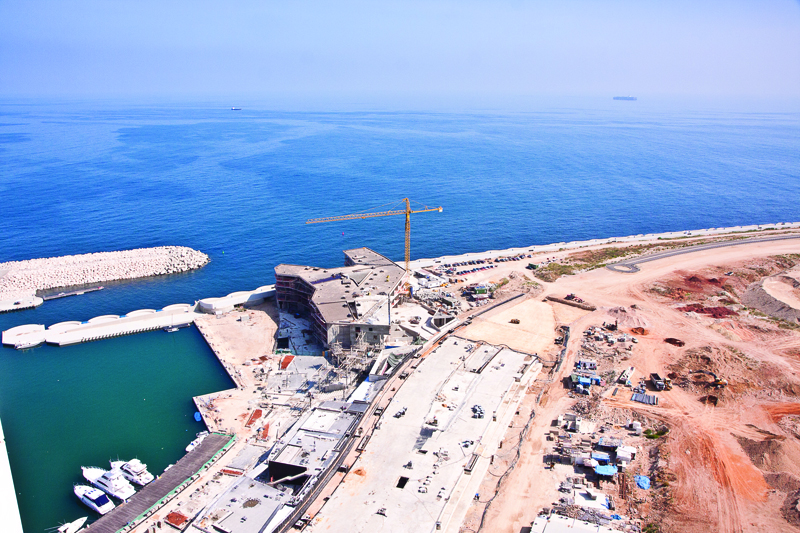
The Kempinski chain also has plans for two five-star outlets in Lebanon. Set to open in 2012, the Kempinski Hotel Beirut is a resort hotel located at what once was the famous Summerland Hotel. The hotel is in the final stages of construction and will have 151 rooms and 56 luxury apartments, as well as a marina with up to 60 berths. Between Aley and Bhamdoun, the German hotel chain is currently constructing Al Abadiyah Hills, which is set to open in 2013 featuring 74 rooms, 12 villas and 181 apartments.

Ending up, but slopes ahead

Tourism in Lebanon picked up slightly toward the end of 2011. The Eid Al Adha holiday in early November saw hotels and restaurants fill up across Beirut, while according to Achkar, meetings, incentives, conferences and exhibitions (MICE) tourism showed an increase. “It sounds ironic, but Lebanon in 2011 was one of the most stable countries in the region,” he said. “Beirut and Dubai proved popular destinations for business meetings and conferences. Let’s hope that trend will continue next year.”

That said, “The political turmoil in the region prevented many Arabs from choosing Lebanon as their final destination,” said the restaraunt owners’ syndicate’s Ariss. “2012 is going to be worse, as the causes of the crisis prevail and Syria will remain politically instable. In addition, the raise in wages, not only the minimum ones, will have disastrous consequences on the tourism industry. Companies have started lay-offs. Expansion plans have been halted. New investments are being postponed. Many restaurants in 2012 will shut down or change owners.”

“Political stability in the region, and especially Syria, will be essential for a full recovery of the Lebanese tourism sector in 2012,” said Achkar. “In addition, it does not help that Lebanon is still haunted by the negative image created by the international media, which seems to only report on negative events. This does not really affect Arab tourists and Lebanese expats, but it does make potential Western visitors think twice.”

With the aim of countering Lebanon’s negative image abroad and attracting more western tourists, the cash-strapped Ministry of Tourism in 2010 proposed to introduce a LL 5,000 airport tax to be used exclusively for promotional activities, yet the proposal never made it through parliament.

“If I look at the stands of neighboring countries, such as Syria, Jordan and Egypt, I honestly feel ashamed to participate at tourism fairs,” said Lebanon’s Minister of Tourism Fadi Abboud. “At such events we look like the poor cousin. Tourism represents 22 percent of our GDP and we should invest in it. Yet you cannot create an industry if you do not promote it.”

More visitors from Europe would surely help diminish Lebanon’s over-dependency on Arab tourism. “It would be great if Lebanon in the near future could attract more tourists from the US and Europe,” said Bou Dargham of the Four Seasons. “But how do you do that in the short term? Today, when you type in Beirut or Lebanon, Trip Advisor shows you in red letters: ‘Travel Alert: Safety and Security Concerns.’”

Following the kidnapping of seven Lithuanian cyclists in the Bekaa Valley and attacks on United Nations Interim Force in Lebanon (UNIFIL) troops, the British and French embassies warned their citizens to avoid or be cautious when traveling to the south or east of the country. Following alleged incursions by the Syrian army into Lebanon, the British embassy in October advised against “all but essential travel to within 5 kilometers of the Syrian border,” while it “continued to advise against all travel to Palestinian refugee camps and against all but essential travel to the Bekaa Valley and south of the Litani [River].”

The French Embassy furthermore warned against the danger of kidnapping in the Bekaa Valley, potential attacks of French UNIFIL troops in Saida and further south and called on travelers to avoid certain suburbs of Beirut and Tripoli. Seeing the events which occurred in Lebanon in 2011, such specific and carefully worded warnings do not seem unreasonable.

The same cannot be said about the travel advisory issued by the US State Department, as it urges “all US citizens to avoid all travel to Lebanon due to current safety and security concerns.” The statement edges on the hysterical, warning, among other things, that “public demonstrations occur frequently with little warning and have the potential to become violent” and “family or neighborhood disputes often escalate quickly and can lead to gunfire or other violence with little or no warning.”

This is almost ironic coming from a country enamored with firearms and that boasts an annual homicide rate twice as high as that of Lebanon. Issued on April 4, 2011, following the fall of the pro-American Hariri government and with negotiations over a new cabinet in full swing, some people claim the travel ban to be politically motivated. The US travel warning is particularly harmful, as the red alert on the popular site TripAdviser is directly linked to it.

“In 2011, we had hoped to attract an increasing number of Western expats living in the Gulf, yet the opposite happened,” said Achkar, who despite everything remained positive about things to come. “We’ve seen much worse. We’ve had the 2006 war, an 18-month blockade of downtown Beirut and months without a government or president. But we’ve always overcome. And we will overcome again.”

December 3, 2011 0 comments
0 FacebookTwitterPinterestEmail
Economics & Policy

Castles made of sand

by Executive Staff December 3, 2011
written by Executive Staff

When future generations of Lebanese look back on 2011, they may remember it as a year when the economy, having driven up the growth graph since the 2006 war, simply ran out of road at the top and headed off a cliff into recession.

How far the economy has fallen and how much further it may dive is a question that will have no certain answers anytime soon. As Executive went to print 2010’s national accounts — the primary method used to calculate the size and relative growth of an economy — had not yet been released by the government, much less those for three first quarters of 2011. 

“Every growth estimate is nothing more than a guestimate,” says Jad Chaaban, acting president of the Lebanese Economics Association. As such, in October the International Monetary Fund guesstimated that this year growth had fallen to 1.5 percent from 7.5 percent in 2010. What makes the outlook even more somber is that it was the second time this year the fund had revised growth downwards; previous to April the growth estimate was still hovering between 2.5 and 4 percent, depending on which international organization you chose to cite. By November the fund went even further.

“After four years of strong growth, Lebanon’s economy has lost momentum reflecting domestic political uncertainty and regional unrest,” said an IMF press release marking the end of their annual appraisal visit to Lebanon. “Latest indicators are pointing to some pick-up in activity, and the economy could grow at 1 to 2 percent in 2011, markedly below an average of 8 percent per year during 2007-10.”

Of course the government itself did no better in calculating growth. The previous finance minister’s budget proposal — which like all other budget proposals since 2004 have not made it past Parliament’s sticky gates — estimated growth at 5 percent.

“You are not walking into a certain environment… If the problem gets worse in Syria all of our exports will go down and we could even have the counter effect, with refugees coming into the country and a huge consumption problem,” said Chaaban. “With this uncertainty that is present today, you can’t just have one scenario. It’s more honest as an exercise to do different scenarios. I’ve never seen anyone give you a real plan for something with one scenario, unless they want to sell you the plan.”

This precipitous fall in economic activity was not only a byproduct of the country’s failing infrastructure or lack of official employment, inflation or economic policies. At the start of 2011 Lebanon got a new year’s shock as the cabinet collapsed over the issue of trying ‘false witnesses’ for misleading the Special Tribunal for Lebanon, set-up to investigate the assassination of former Prime Minster Rafiq Hariri and 22 others in a 2005 explosion. Since then, the issue has largely been ignored, but its repercussions are still being felt.
Almost immediately the readers of Lebanon’s economic crystal balls saw the dark clouds approaching. By the end of the year there was still little consensus over what the ultimate effect was. While the IMF posited a figure of 0.8 percent growth for the first six months of 2011, Finance Minister Mohamad Safadi joined the guessing game in October when he announced that the same period saw no growth and projected a 4 percent outlook for the second half.

“Neither the zero growth for the first half of the year nor the 4 percent for the second are precise or accurate,” says Elie Yachoui, dean of the School of Business Administration and Economics at Lebanon’s Notre Dame University, who agrees that all the indicators suggest that the gross domestic product (GDP) growth for this year will not exceed 2 percent. In an exclusive interview with Executive Safadi explained that the 4 percent projection was based on a “best-case scenario” playing out next year.

“This year [2011] clearly we wasted opportunities from the start, with changes taking place in the Arab world and the collapse of the  government,” said Nassib Ghobril, head of economic research and analysis at Byblos Bank. “If we had a government in place we could have been able to benefit and be on the radar, just like we did in 2008 and 2009 from the global financial crisis. All of this was before Syria. Once that started it affected confidence even more.”

Two months after the government collapsed the situation in Syria erupted, with widespread protests engulfing the nation, which constitutes Lebanon’s only open land border. The effects of the crisis on the economy were palpable, especially over the summer months when many tourists would usually arrive over land. Official figures show a 25 percent yearly contraction in visitors by the end of September — falling to 1.28 million compared to 2010’s year-on-year figure of 1.69 million. The turmoil in Syria was still ongoing as Executive went to print, a fact that Riad Salameh, governor of Banque du Liban (BDL, Lebanon’s central bank, finally admitted last month has hammered Lebanon’s economy.
“Since Lebanon’s economy is so closely intertwined with that of neighboring Syria, the unrest across the border has taken a huge toll on the Lebanese economy,” he said in a television interview in November.

As the terra firma shook under Lebanon’s economy, the structural indicators also gave in. For the first time in many years Lebanon’s balance of payments, a relative measure of money coming in and out of the economy, turned from a surplus to a deficit. A detailed breakdown had not been released by the time Executive went to press (something that used to happen during the days of the surplus) but consolidated figures show that by end-September the deficit had reached $302 million dollars, a far cry from the $186 million surplus posted in September 2010.

In the past the positive balance of payments was heralded as one of the shining beacons of Lebanon’s economic indicators because it overshadowed the balance of trade (the difference between the monetary value of exports and imports in an economy), which subjects Lebanon to a host of economic ailments. All throughout the year the balance of trade was setting record lows, and by the end of September 2011 had reached a five-year nadir of $11.18 billion — constituting a 10 percent increase in the trade deficit on 2010.

That is not withstanding the level of remittances entering the country, which, as Executive went to print, had not yet been released by BDL or the World Bank. Some 45 percent of households have at least one person abroad sending home money, according to research conducted by economist Robert Kasparian, who heads the compilation of Lebanon’s National Accounts.

Last year remittances reached a level of around $8.2 billion, although that figure includes some dubious additions such as payment of salaries from abroad.
“Our economy is more an external economy than an internal economy,” says Notre Dame’s Yachoui. “The remittances of Lebanese workers amount to $8 billion or $9 billion; it’s as if we were exporting such an amount. As long as the global economy is recovering I don’t expect any new crisis in terms of Lebanese employment aboard… unless a new international crisis erupts.” As Executive went to print, the Greek and Italian sovereign debt crises were looming apocalyptically over global markets. 

Pressure on the lira

As the rate of growth in the country’s economy nosedived, its currency has felt a downward drag, though, as has been the case since December 1997, the BDL maintained the exchange rate of the lira to the US dollar at 1507.5 through tapping its $30.6 billion war chest of foreign currency reserves. (By the end of September the total foreign assets of the BDL totaled some $32.2 billion, of which $16.2 billion was in gold.)

In the absence of an operational currency exchange market that could be used to value the Lebanese lira, the main indicator of currency pressure is the deposit dollarization rate, which rose during the first three quarters from 63.2 percent to 66.6 percent.

Adding to the weight on the lira and rattling the banking sector earlier this year was the debacle involving the United States Treasury Department and Lebanese Canadian Bank, when the treasury proposed banning US financial institutions from opening or maintaining certain accounts at the bank, in effect forbidding it from using the US dollar. At a time when government was at a standstill, this had reverberating effects on economic confidence due to the suggestion (still unproven) that the bank was working with Hezbollah — which the US has labeled as a terrorist organization — setting off speculation over possible banking sanctions. There are still widespread reports of investigations being carried out by the US treasury into a list of banks, although Lebanese authorities have refuted these. “We have no problems and no issues at all with the American treasury,” insisted Finance Minister Mohamad Safadi when questioned by Executive about his meetings with US officials.  

“The dollarization rate is still high but there is no panic or rush to the dollar,” said Ghobril. “There was obviously in the first half of the year, especially during the first few months, but now that is not the case; it’s a stable market. As long as there is no outflow from deposits the [currency] situation will remain stable.” Commercial bank deposits stood at $115.7 billion after the first nine months of 2011, a 6 percent growth year-to-date and a 9.4 percent growth relative to the first nine months of last year.

Feeling the inflation

While exports fell during the first three months of the year, they experienced a relative turn-around over the next two quarters and managed to stay in the black. However, imports have been rising; even in a period of assumed recession when consumption usually falls, the value of imports rose 9 percent year-on-year in the first three quarters.

While on the surface this figure may not seem too much of a worry, it has to be taken into account that Lebanese consumption of imports increased far less than the price they paid for those imports. Fuel prices averaged $113 per barrel in the first nine months of 2011, compared to $77 per barrel in the respective period of 2010, causing fuel imports — which constituted 18.3 percent of all imports by end-September — to rise by 5 percent in value. “Excluding this item, imports that have increased in value are mainly those that are highly affected by the volatility of international prices,” an October trade report issued by the finance ministry said.

Thus, the problem of import inflation is intensifying. Official figures, which are widely discredited by economists, put the third quarter year-on-year consumer price index (CPI), the major indicator of inflation, at 4.8 percent, while the governor of the central bank estimated it will hit 6 percent by year’s end on the back of rising commodity costs.

There is currently no concrete indication of how much this inflation is due to higher import prices and how much is homegrown. According to a World Bank report issued in May regarding 2010, “imported inflation in Lebanon has a strong impact on the CPI because imports amount to… 50 percent of domestic consumption.”

Still, Chaaban, whose organization is carrying out a study to quantify the sources of inflation, deems that the common estimate thrown around — that import inflation constitutes around 70 percent of inflation — is inaccurate. He estimates the figure somewhere between 50 and 60 percent because of the prevalence of what is commonly referred to as “the cartels.”

“If you look at the structure now — what we call the syndicate of this, or the syndicate of that — it’s basically cartels of this or cartels of that,” said Finance Minister Safadi.

At the crux of the matter is the long-standing issue of exclusive agencies, basically monopolies, enjoyed by importers who can sell a given brand in the country. This is compounded by a lack of legal controls on price fixing and other non-competitive practices such as import bans on certain sectors. Politicians, rich families or religious establishments, whose constituents are usually the same people wearing different hats, often own and control these companies.
“The 500 to 600 families that run the country need to admit to themselves that in order to keep the country running they must open up and partner with new companies and open up their capital,” said Chaaban.

A quick fix would be to pass and implement a comprehensive competition law, something that has been drafted and proposed for years but never made it through parliament. Given the make-up of the Lebanese economy and political circles that may not be such a surprise. “With regards to exclusive agents, you have companies that market thousands and thousands of items and the politicians have connections and interests with the oligarchs,” said Yachoui.
Another concern regarding inflationary pressures in the last quarter of the year was a demand put forth in October by the country’s main labor union to increase the minimum wage. The issue was debated widely in the press and in cabinet until the latter decided to impose an increase on the eve of a general strike. Rather embarrassingly for the cabinet, a later decision by the Shura council, Lebanon’s highest court, threw out the measure shortly afterward because it was deemed contrary to labor law. As Executive went to print negotiations between the labor minister and the unions were ongoing and it was not clear when and if a new minimum wage measure would be passed.

A tool to help possibly ease inflationary pressure would be to de-peg the currency from the US dollar and instead peg it to a basket of currencies of countries where Lebanon sources its imports, such as a mixture of the Chinese yuan, the euro and the dollar. This would allow the exchange rate to ease some of the pressure on prices. The country’s main import currency is the euro with Italy, France, Germany, the Netherlands and Spain constituting 28 percent of all imports from 2006 to Q3 2011, followed by China and the United States with 8 percent, respectively. However, such a move would go against the longstanding policy of the central bank to annul the local currency market in the interests of “currency stability.”

“The banking sector has resistance to venturing into complex schemes even if they would probably be beneficial for us as a country,” said Chaaban in relation to such a proposal.

Add or subtract value?

Another further upward pressure on prices is expected to come in the form of an increased value added tax (VAT), as proposed in the 2012 provisional budget. Yet the budget, as well as its associated revenues, is based on growth, which is anything but assured. Minister Safadi told Executive that all items, including VAT, where up for discussion as long as the end result did not increase the proposed deficit figure of $4.14 billion, an 11.4 percent increase on the 2011 budget, which never reached a vote in Parliament.

In theory, the constitution states that the budget needs to be passed by the end of January at the latest. But if it is not, at least according to minister Safadi, “it’s not a catastrophe.” Lebanon has not managed to propose and pass a budget since 2004 and this year looks no more certain, with a host of new taxes on the banking and real estate sectors set to be debated by many of the very same proprietors of these institutions in both cabinet and Parliament.

What is perhaps nearing catastrophe in Lebanon is the state of its infrastructure, with its insufficient water supply and decrepit transmission network, almost nonexistent wastewater treatment, daily power outages, crumbling roads and insubstantial public transportation system. To amend this, vital infrastructure projects such as power plants and water storage facilities, among others, need to be built. The problem is that, with a widening deficit and a debt-to-GDP ratio of some 140 percent (depending on whose GDP figure you use) financing these projects from the government coffers has become nearly impossible, even if a budget is passed. The electricity sector is projected to need some $6.5 billion in investment and water some $8 billion, just in capital expenditure, according to the Ministry of Energy and Water.

“Very simply, our treasury is no longer able to solve any problem related to any public service — that’s it,” says Yachoui. “We are left with only one solution which is a very ‘light privatization’ where we sign investment and management contracts in all the public service sectors with the private sector without selling any of our public services.”

And that is precisely what has been proposed through a draft public-private partnership law that has been through several drafts, with the reasons for its delayed passing unbeknownst to many, including the finance minister.

Gloom on the horizon

The economy looks set to suffer in the year ahead as harbingers of a precipitous slide have been calling out ever more vociferously. The Beirut Stock Exchange, for instance, lost around 20 percent of its value in the first nine and a half months of 2011. A new listing of the national carrier was put on hold indefinitely by the central bank, which owns the airline, and a new capital markets law passed this summer is still to be implemented.

Unemployment is ostensibly on the rise. Few give credence to the official numbers, which have not been updated since 2007, when the figure was put at 9.2 percent. But, according to a leaked presentation about an unfinished project being conducted by the World Bank, unemployment rates amongst men and women are 10 and 18 percent, respectively, which, when added to those working in the informal sector, make up “close to half the labor force.”

Among the few silver linings is an expected increase in telecom penetration due to broadband infrastructure upgrades. The World Bank estimates that every 10 percent increase in broadband penetration accelerates economic growth by 1.3 percent.

“Any analysis of this sector gives you a stand-alone impact: it gives you the potential but not the real growth after impact,” says Chaaban. “If there are more jobs and profits from this sector and then there is inflationary pressure the net effect is zero.”

The telecom sector cannot save the economy on its own, however, and it should be taken into account that the new infrastructure will be owned and operated by the government, and thus it could quash already limited private sector participation.

What’s more, as Executive went to print Prime Minister Najib Mikati had announced on a popular TV show that he would resign if funding for the special tribunal for Lebanon was not provided in some fashion by the end of the month.  If that occured it would result in the same scenario that caused the economy to plummet in 2011; the lack of a cabinet. This time, however, it will be more than just internal strains that the economy will have to bear.

“We are still subject to the problems in Syria and what happened in the first part of the year, from which we still haven’t recovered, so the outlook is tied to that,” says Ghobril. “As for the sources of growth, frankly, I can’t see them.”

December 3, 2011 0 comments
0 FacebookTwitterPinterestEmail
  • 1
  • …
  • 354
  • 355
  • 356
  • 357
  • 358
  • …
  • 686

Latest Cover

About us

Since its first edition emerged on the newsstands in 1999, Executive Magazine has been dedicated to providing its readers with the most up-to-date local and regional business news. Executive is a monthly business magazine that offers readers in-depth analyses on the Lebanese world of commerce, covering all the major sectors – from banking, finance, and insurance to technology, tourism, hospitality, media, and retail.

  • Donate
  • Our Purpose
  • Contact Us

Sign up for our newsletter

    • Facebook
    • Twitter
    • Instagram
    • Linkedin
    • Youtube
    Executive Magazine
    • ISSUES
      • Current Issue
      • Past issues
    • BUSINESS
    • ECONOMICS & POLICY
    • OPINION
    • SPECIAL REPORTS
    • EXECUTIVE TALKS
    • MOVEMENTS
      • Change the image
      • Cannes lions
      • Transparency & accountability
      • ECONOMIC ROADMAP
      • Say No to Corruption
      • The Lebanon media development initiative
      • LPSN Policy Asks
      • Advocating the preservation of deposits
    • JOIN US
      • Join our movement
      • Attend our events
      • Receive updates
      • Connect with us
    • DONATE