• Donate
  • Our Purpose
  • Contact Us
Executive Magazine
  • ISSUES
    • Current Issue
    • Past issues
  • BUSINESS
  • ECONOMICS & POLICY
  • OPINION
  • SPECIAL REPORTS
  • EXECUTIVE TALKS
  • MOVEMENTS
    • Change the image
    • Cannes lions
    • Transparency & accountability
    • ECONOMIC ROADMAP
    • Say No to Corruption
    • The Lebanon media development initiative
    • LPSN Policy Asks
    • Advocating the preservation of deposits
  • JOIN US
    • Join our movement
    • Attend our events
    • Receive updates
    • Connect with us
  • DONATE
Comment

Neither justice nor stability

by Sami Halabi August 3, 2011
written by Sami Halabi

In the past, other Arab countries have looked to Lebanon as a model of democracy and free expression in a region submerged in autocracy and monarchism. But the Arab Spring has put us Lebanese in awe of the feats we thought our brethren were incapable of achieving, and has highlighted the systemic flaws within what we once believed to be the most representative system of government in the Arab world. 

As much of the region’s citizenry fight to determine their political future, the matter of debate in the wake of the Special Tribunal for Lebanon’s (STL) indictment of four Hezbollah members is whether justice or stability is preferable in Lebanon. But instead of referring back to our own political reference books, we should be looking to those who are currently rewriting their history.

The latest round of protests in Egypt in July have come more than half a year since the pharaonic figure of Hosni Mubarak was ousted — plenty of time for any military council to hand power over to a civilian body that is already in place. The notion of genuine justice has become the mantra of the protestors, who want to see those who ordered and carried out killings during the uprising held to account. They are not concerned with the tired excuses that have helped to stunt the evolution of a truly representative Arab society and preserve a “stability” laced with corruption and inequality, and neither should the Lebanese.

The difference between the Egyptians and the Lebanese, however, is not only that the justice they seek follows a true overhaul of their political system, but also that they seek it on their own terms, not on those of foreign institutions. Egypt, and to a greater extent Tunisia — which has largely fallen out of the international media’s attention — have realized that revolution is a constant struggle and that they can rely only on themselves to direct its course. They understand that they must shatter the bedrock on which the previous system sat so comfortably, one institution at a time, before they can achieve what they initiated back in January.

Here in Lebanon, on the other hand, such a self-reliant fervor is not evident. Many seem to think that it is the international community that will deliver justice in Lebanon. But anyone who has taken even the most cursory look at our history and our current affairs knows that Lebanon is the playing field where conflicts and assassinations are carried out, as opposed to being resolved, in the game of nations.

A bona fide contribution to the country from the international community would have been to make good on one of the STL’s first promises: to focus on reforming the judiciary so that it could try its own cases. Perhaps if that had been a priority, six and a half years after the assassination of former Prime Minister Rafiq Hariri, Lebanon could have managed its own affairs rather than being swept up in the geopolitical wave of the tribunal.

As for those who propound stability over justice, the predication itself constitutes an insult to our collective intelligence and a means by which to point fingers and inflame sectarian conflict. By suggesting that stability will be harmed by the indictments because they pit Shia Hezbollah against the Sunni Future Movement automatically infers that the indictment amounts to a conviction in the minds of the latter, which it most certainly does not; many Sunnis are not about to swallow whole the STL pill given its grievous legal mishaps over the years. Trying to frame it as such only serves to add fuel to the fire of extremists, whose purpose is served by viewing every action or accusation by a sectarian party such as Hezbollah as representative of an entire sect, which again, it most certainly is not.

Thus the polemic that has emerged between justice and stability is just another testament to how susceptible we are to the pitfalls of sectarian rhetoric and the goading of international powers. We continually miss the point in the truth and stability equation: the two are inseparable. But if we allow our politicians to formulate their tired old narratives at a time when even the nations closest to us will not listen to the same old jazz, then perhaps we should expect to get exactly what we deserve: neither justice nor stability.

SAMI HALABI is deputy editor

at EXECUTIVE
 

August 3, 2011 0 comments
0 FacebookTwitterPinterestEmail
Economics & Policy

Forging steel from ash

by Zak Brophy August 3, 2011
written by Zak Brophy

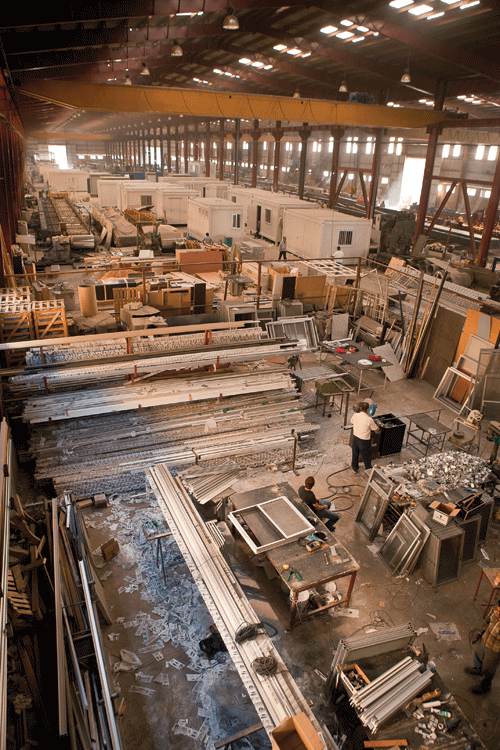
Toufic Dalal had spent 20 years building his firm into one of the largest steel manufacturers in the region, specializing in pre-engineered buildings and pre-fabricated houses. He had become a rare success story in Lebanon’s heavy industry sector.

Then on 23 July, 2006, Israeli fighter jets left his factory a smoldering wreck of ash and twisted metal.     

When Dalal heard his steel works factory in the Bekaa had been bombed he rushed straight to the site. Where he had stood the day before in a 22,000 square meter (sqm) factory full of heavy industrial equipment he found nothing but ruin. 

While most people would have been enraged, panic stricken or crushed, Dalal said without a hint of false modesty, “It bothered me some.”

“On the ground in the factory we had eight holes, 30 meters in diameter by 15 meters deep,” he said, calmly recounting the first scenes he saw. “So imagine what was left:  Nothing. All of the machinery was destroyed.”

The value of the damage came to a total of around $25million. 

At the bombed-out site, groups of employees had also gathered, many in tears. Unlike Dalal, they believed their livelihoods were ruined with the factory.

Surveying the damage, Dalal said he was struck by a simple wisdom that determined his next steps: “You know in this life it doesn’t matter if you have $20 or $100, or $20 million or $100 million. You come to a point where you are just playing with numbers.” 

Emboldened by this philosophy, it was clear to him that he had to rebuild. “I said to myself I want to start a new factory now as if I didn’t have anything before. It is much easier to build it now than when I did it 20 years ago. I have the money; I don’t have debt; I know the business; I have the experience, and I have a market.”

And build he did.

The next day he was on a United States Navy ferry to Cyprus from where he flew direct to Chicago. He immediately bought the machinery he needed to get back in operation and flew it to Lebanon. And so it was that within three days of being bombed that Dalal was rebuilding the foundations of his new factory.

Free from any debt burdens, he was able to make an initial investment in the range of $3 million dollars from his own savings. Once he was back up and running, the orders began to flood in, providing the finance for the full redevelopment of the factory; within three months he was back at pre-war production capacity.   

Fruits of war

Ironically, Dalal’s biggest client would emerge from the political settlement to the very same war that had leveled his facility. When a ceasefire was finally reached under the auspices of United Nations Resolution1701, the UN Interim Force in Lebanon’s (UNIFIL) troops in the south mushroomed from some 2,000 peacekeepers to nearly 13,000. “We ended up selling to UNIFIL in the south so many prefabs and so many buildings. We were earning between $3million and $5 million per year, and that actually compensated most of our losses,” he said.         

In no small part due to Dalal’s ingenuity, boldness and creativity, the bombing actually boosted the Dalal Steel business. The rapid turnaround from demolition to production won a lot of customer loyalty and trust, not to mention prestige.

“People liked to work with us, perhaps to help us out, or perhaps they felt more secure working with us, because even though our factory was bombed we were still there so they knew we could guarantee our work whatever happens,” he said, before adding with a wry smile, “It was like marketing for us. People know who Dalal is now.”

The plan was never just to return the company to where it had been before. With business thriving and a blank canvas to work with, Dalal built a far superior factory to take Dalal Steel Industries forward.  

It was expanded from 22,000 sqm to 32,000 sqm and it will soon be expanded to 50,000 sqm. Furthermore, the machinery has been upgraded and is now fully computerized with a much more efficient production system.

The economic crisis in America has graced Dalal with a golden opportunity to recapitalize his factory at discount rates. With many fabricator firms in the US going bankrupt, Dalal Steel is snapping up at auction virtually brand new top-of-the-line equipment “for peanuts”. Reflecting on life and work, he said, “It makes you feel happy that at least you have work while other people are closing down.”

Five years on and Dalal is boasting a substantially more successful business than the one that was leveled to the ground in the war. He said his assets are at least twice what they were in 2006, and his turnover is perhaps 10 times what it was before the war. What is more, he continues to be a significant employer in the Bekaa region, with his workforce having expanded from around 220 to approximately 350. Dalal said his team was “essential” to the resuscitation of the business in 2006.

The past five years have also made Dalal a rejuvenated captain at the helm of his new and improved vessel. “When I rebuilt my factory it gave me so much power, and I’m much more dedicated to the work and I… love it so much more than before,” he said.

In the drive to expand the company he has been developing new production lines while tapping into new markets and developing existing ones. On home turf he continues to win large contracts.

“Lebanon has been good until now,” said Dalal, before rolling off a list of contracts his company recently won, including an 84,000sqm shopping center in the Bekaa, 44,000 sqm of steel construction in a shopping center in Beirut and 600 prefab houses for the Lebanese army.

The US army used to be their principal client, but the scaling back of its presence in the Middle East means there is now less business coming from that corner of the world. Nonetheless, Iraq remains an important country for the company, with three large projects in Erbil currently underway. Dalal also anticipates good business developing in southern Iraq as investment in the oil industry picks up pace. It is with an eye on this market that he will be courting new clients at a trade fair in Basra in two months time. 

African prospects

However, the real growth area for Dalal Steel Industries lies to the south.

“Our replacement market is Africa now. We sell a lot of goods to Nigeria, to Angola, to Kinshasa,” said Dalal. The continent now comprises around half of the company’s business and they are months away frombuilding a new factory in Nigeria.

With sights set on these expanding horizons, Dalal’s children have joined him to play central roles in the firm. Three of his children have followed in their father’s footsteps and are now engineers, with his daughter running the engineering department in the office, one son running the big projects and operations in Africa, while another son is in his second year of studies in the US. Another daughter is a business graduate and takes care of the firm’s accounts. But he is quick to clarify, “You know I still get involved in everything.”

With the steel business going from strength to strength, the Dalal family are diversifying into the real estate game. After all, “It’s easy,” said Dalal. They have been buying land since 2004 and intend to start building a 24-story tower in Hamra in three months. The real estate projects are within a different company but one that is still very much a family affair.   

Looking back to 1987, a young Toufic Dalal decided to leave his job of four years with Proctor and Gamble because “an employee’s life was not the one for me.” He risked his lot to buy a machine and go solo before he even had a workshop or any land to use it in. 

Twenty years later, this audacious spirit served him well; after rebuilding his pulverized factory, in 2011 his entrepreneurial thirst remains unquenched. 

“In 10 years I suspect we shall be twice as big,” he concluded confidently.  


August 3, 2011 0 comments
0 FacebookTwitterPinterestEmail
Economics & Policy

Back in flavor

by Zak Brophy August 3, 2011
written by Zak Brophy

Liban Lait had established itself as a leading competitor in the Lebanese dairy industry by the time bombs began to rain down in 2006. Considering it had only been formed in 1997, and built its own factory in 1999, the company was brimming with confidence.  

But on July 17, 2006, two Israeli missiles demolished their processing plant in the Bekaa valley, throwing Liban Lait’s very existence into doubt. Five years later, the business has finally returned to capacity, and it is intent on fighting its way back onto the winners’ podium. 

Production Manager Houssam Zein-Eddine has been working at the Bekaa plant since day one. “I saw our dream underground. For all of us here, Liban Lait was like our baby. We had grown little by little and, once we were stable in the market and we had developed everything, it was bombed,” he said.

Along with many of the other staff, Houssam did not believe they would be able to rebuild the plant. Fatima Ghosn Dirany, head of human resources, said: “We were convinced that we would no longer be working for Liban Lait.” According to her, ex-general manager Michel Waked –— who passed away in August 2009 — helped the staff believe there was a future for the company. “He was a very strong man with a strong personality. A special one,” she said.

While touring the factory with staff four days after it was bombed he told them he intended to rebuild. “At first, we said ‘how can he be serious?’ It was a hard idea for us all to accept,” Dirany said. “He wanted to get started while the war was still going.”

Waked, and the rest of the board, did follow through on their decision to rebuild, but it eventually took them seven months to get back to a reduced level of production.

Zein-Eddine said all hands were on deck during this difficult period; “Managers, operators, everyone was working like a [laborer].We sorted through all the debris and got rid of everything that was completely destroyed and fixed what we could and when necessary imported from outside.”  

The shareholders made an initial investment in the range of $1 million to $2 million to get the plant to a level where it could produce fresh milk, Laban and Labneh, though at less than half its previous capacity. A plethora of product ranges, including flavored yoghurts, cheeses and deserts had to be dropped altogether.

Ultra Heat Treated (UHT) milk was a core product that could no longer be produced in the eviscerated factory. To maintain a presence in this market, Liban Lait imported its UHT from its franchise partner company in France, Candia. “It was important to keep a market share here but it was difficult to compete with high transport costs and high customs duties compared to imports from Arab countries,” said General Manager Youssef Massoud.

Time to rebuild

From early 2007 to January 2011, Liban Lait was operating on this reduced framework to keep a foothold in the market while working in parallel to build its new factory. “This allowed [us] to completely review the financial and technical aspects to make sure the job was done right. We did not stop completely and wait. That would have been a complete disaster,” said Massoud.

Around $25 million was invested to rebuild the whole factory, furnishing it with new and improved production lines. Having invested around $20 million in the original factory more than seven years earlier, there was initial uncertainty as to whether or not there would be the funds available to recapitalize the business. However, having proved that it could not return to production after the bombardment, nor could it service its existing debts, Liban Lait was eligible for a subsidized loan arrangement from Banque du Liban (BDL), Lebanon’s central bank, created specifically through a circular in 2007to assist businesses directly affected by the war. 

Under the agreement, the BDL effectively provided 60 percent of the replacement costs through the company’s commercial bank, which Liban Lait was exempt from having to repay. The way this worked was the bank was given soft loans from the BDL, which it then invested in treasury bonds, on which the interest accrued would cover their costs.

In a roundabout way it amounted to free money for Liban Lait. The remaining 40 percent was covered by their own sources, half by increased capital input from the shareholders and half from standard bank loans. 

The new plant manager, Abed Khoder, has overseen the transition to the new production lines, which has been underway since January2011. “We have improved productivity and quality with the new technologies… I can say operation costs will be around 40 percent less than what they were before.”

On the filling side, the plant has roughly the same capacity as it did before the war but as Khoder explained, the processing capacity has been considerably increased.

“Now our processing capacity is five times our production capacity. It is much easier to increase production capacity so this gives us room for expansion,” he said.

Liban Lait boasts of being the only large dairy processing plant in Lebanon that has its own milk source on tap. “Top quality milk as the first step is the most important thing and I am very confident in this,” said Massoud. On site next to the processing plant, the company has around 1,000 milking cows who tirelessly rotate on and off the milking machines three times a day, seven days a week. The farm, which was not struck in 2006, provides the plant with 25,000 liters of milk every day. 

Back in form

With the move to the new facilities, Liban Lait is finally re-entering the market for a whole range of dairy products, some of which it was producing before 2006 while others are completely new to the company. Earlier in the year a new milk range was launched including UHT and flavored milks and the first batches of new flavored yoghurts were leaving the factory as Executive went to press. Test runs on feta cheese have also been sampled and a new desert range will be launched in the coming months.


For each product there has been an extensive research and development process, which Khoder said costs on average around $200,000. “We do tests, retests and retest it again to be satisfied before we accept its launch into the market,” he added.

After four years, Liban Lait is now back in a position where it can compete in scale and range with the other major Lebanese dairy firms. “Many competitors have taken our place in the market. It is now our strategy to kick them out and get our place back again,” said Khoder.

But Massoud conceded that clawing back their market share, which he estimates to have declined by around 50 percent, will not be an easy task. Earlier in the year they ran a large advertising campaign for the new milk range and he said they will be “aggressively” marketing all the new products. But sparkling new facility aside, damage from the war continues to exact a toll. “It will be difficult to recapture the market share. This is the challenge. Of course nothing is a given.”  


August 3, 2011 0 comments
0 FacebookTwitterPinterestEmail
Economics & Policy

An uphill struggle

by James Reddick August 3, 2011
written by James Reddick

Having shut down operations when the Israeli bombing campaign began on July 13, 2006, Abbas Safieddine had the disconcerting experience three days later of seeing the smoldering ruins of his plastics factory outside Sour broadcast on France 24. Despite sitting on an isolated plot of land, far from any military, or even another civilian, establishment, PlastiMed’s facility was destroyed entirely by several direct hits; for days the plastic-fueled fire raged, while the site continued to billow smoke for weeks.

“That Sunday [July 16] was when they started bombing [manufacturers]; that was the ‘industry day’ when they hit all the factories for some reason,” Safieddine said. Theories have abounded as to the rationale behind the targeting of independent, apolitical businesses, with some accusing Israel of attempting to wipe out regional competitors. But in the case of PlastiMed, which manufactures and supplies to “filling companies” intravenous pouches for medical use, no such competition exists, neither from Lebanon’s southern neighbor, nor from anywhere else in the Middle East and North Africa region.

Today, the company operates administratively out of an office in Beirut‘s southern suburbs, while its factory is being rebuilt on the original site (after an attempt to buy land in Mount Lebanon fell through). It plans to reopen, with “a soft start” in the first quarter of 2012. But the difficulties encountered to get to this point, exactly five years later, demonstrate the immense challenges that faced all businesses affected by the war and the cumbersome process of procuring assistance from the Lebanese government. Initially, indications were good that the company would receive support from the Ministry of Industry. In early August 2006, he was  contacted by the ministry and by the Association of Lebanese Industrialists (ALI). “We had a few meetings with the minister at the time. They wanted acquisition of some data — anticipated losses, stuff like that,” he said. An appraisal of damage that excluded losses of stock came out to around $16 million, nearly four times the budget of the entire United Nations Industrial Development Organization relief program for affected industries and well beyond the means of Hezbollah’s cursory assistance for select businesses damaged in the war.

Diminished hope

“At the time, the association, as well as industrialists in general, were really hopeful. But it didn’t take long for the optimism to fade as most assistance was coming up for residential apartments. There was no mention of commercial assistance. So after two or three months we started to realize that nothing was going to happen,” Safieddine said. “The government really pulled out of this. Their excuse at the time was that there wasn’t enough money to go around to residential areas, much less to commercial. Plus, their argument is that the government has never assisted in commercial or industrial losses due to civil unrest or war or whatever.” Eventually, Safieddine got word that a proposal was in the works to implement a loan program through Banque du Liban, Lebanon’s central bank, though he says the process of appraising his losses, negotiating the loan and signing off on it has taken until this year to finalize. As with all of the central bank loans addressing industrial damage from the 2006 war, the conditions stipulate that 20 percent of the money for rebuilding must be put up by the factory owner, meaning that PlastiMed had to provide $3.2 million.

“These are big losses,” said Safieddine. “If it’s $1,000 you make the decision immediately. But you’re talking millions of dollars. The bank is very strict in making you conform to the 20 [percent] deal.”

Regaining trust

Even with the assistance (of which a total of $9.3 million will be forgiven), the company remains in a precarious position. Before the war, the operation was running 24 hours a day, with nearly 100 employees. When the factory finally reopens, the workforce will be at most 35 to 40 people, with as yet no intention of expanding. Repairing contracts with clients is one of the largest hurdles. When the factory was bombed, its entire supply was destroyed.

“We had two main customers here, and all of a sudden all their supplies were lost so they had to buy from Europe, because remember we have no competition regionally,” said Safieddine. “We had to assist our customers at least in a way to assure them that we have a warehouse somewhere in a neutral area of Beirut with a confirmed supply of their demand for six months or so. And we’re in the process of doing that.”

But regardless of these offerings to potential clients, building up a customer base is no small task.

“Our customers restart on an annual contract. So we sign off for the whole year,” he said. “If we miss, the customer has to wait another year. Then he may or may not sign with you. So in our case it takes time to acquire a customer. It’s difficult to lose a customer, but it’s hard to get one.”

But these are concerns for the future, when Safieddine and his staff can ditch their office in Ghobeiry and begin production once again.

“Our primary concern is to rebuild and launch,” he said. “After that, we’ll cross the other bridges when we get there.”


August 3, 2011 0 comments
0 FacebookTwitterPinterestEmail
Economics & Policy

Threadbare redress

by James Reddick August 3, 2011
written by James Reddick

When Ali Ismael, co-owner of Tricot Starlet Co., saw the wreckage of his clothing factory in Beirut’s southern suburbs, bombed just five days before the 33-day war ended, the shock literally sent him to the hospital with high blood pressure. “Everything I worked for my entire life just went to waste,” he said. “I did not inherit anything from my parents — neither my partner nor I. It was our entire life’s work and it was hard looking at it burn in front of my eyes.”

Little remained of the factory, located in a hard-hit area on Al Kassis Street next to what Ismael described as the “Hezbollah kitchen”. Initially, he considered this the final blow for the company; already, the textile industry was suffering in Lebanon, with cheaper competition from Asia and, contends Ismael, “mafias that can get in a whole container at the port for$15,000 without paying any customs.”

But his partner, Hussein Chehab, was unequivocal about the company reopening. “He was very brave and he directly decided to reopen again,” said Ali. “I wasn’t as brave but I supported him and his decisions.”

One of Tricot Starlet’s saving graces was a relatively immediate influx of money to help mitigate the $2 million of direct damage. First, he sold his two remaining warehouses for $415,000, which he used to buy a new facility in Hadath. Then his siblings and an American client with whom he used to work provided an undisclosed amount, while a Turkish supplier offered the company a generous $75,000 worth of credit. And lastly, Hezbollah provided $100,000 as compensation — not enough for a full restart — but sufficient to pay employees during the two months in which Tricot Starlet was out of commission before a new factory was opened in Hadath.

Left guessing

Notably absent in Ismael’s recounting of funding is the role of the Lebanese government. The United Nations Industrial Development Organization did provide $25,000 for four sewing machines, but Ismael has been unable to secure a central bank loan. Unlike many other factory owners Executive spoke with who were unwilling to mortgage their assets in order to receive a loan, Ismael is willing but has been left in limbo.

“The central bank sent some experts and auditors to appraise the damage,” he said. “I paid $12,000 to complete such procedures, but until now did not receive anything.”

Working through Bank of Beirut and Arab Countries (BBAC),Ismael said, the application was submitted to Banque du Liban, Lebanon’s central bank, and approved, but “has stopped there.”

Four years since the loan mechanism was created, and nearly three since the application deadline, Ismael no longer expects any assistance and is not sure of the problem. The central bank circular stipulates that a recipient must need the loan in order to continue operations, which for Ismael may not be the case. Still, nearly $2 million in damage is a hefty sum for a firm the size of his, with just 40 employees before the war, to have to pay.

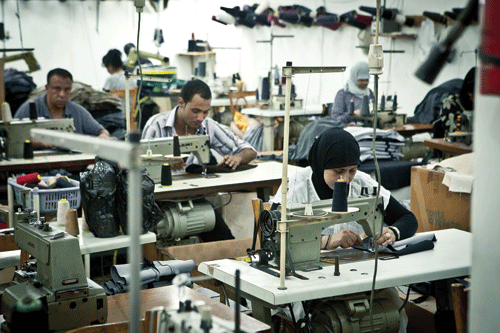
Nonetheless, the business continues with apparent efficiency. Men and women crouch over sewing machines, guiding the fabric as the needle chugs along the seams. Ismael designs the clothes, for women and for men, but is aware that in Lebanon the viability of plants like his is waning. “The cost of the thread is increasing and the sales prices are declining,” he said. “There is no possibility to grow in this industry; it is fading.”


August 3, 2011 0 comments
0 FacebookTwitterPinterestEmail
Economics & Policy

Beirut’s luxury kitchens

by Executive Staff July 26, 2011
written by Executive Staff

For an inside view of Lebanon’s top restaurants, check out the the luxury special report in the July edition of Executive Magazine, in stores now.

July 26, 2011 0 comments
0 FacebookTwitterPinterestEmail
Special Report

The coveted steps to perfection

by Executive Editors July 17, 2011
written by Executive Editors

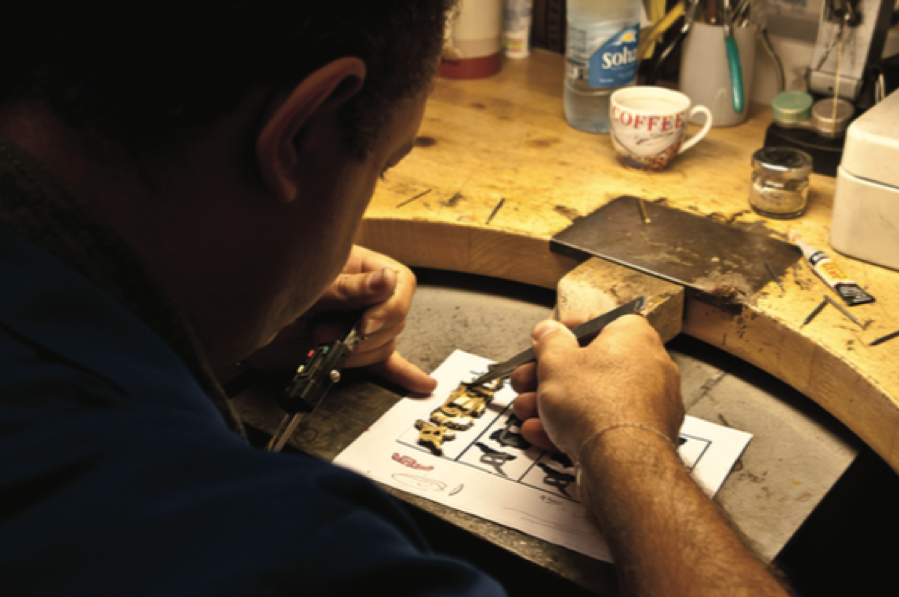
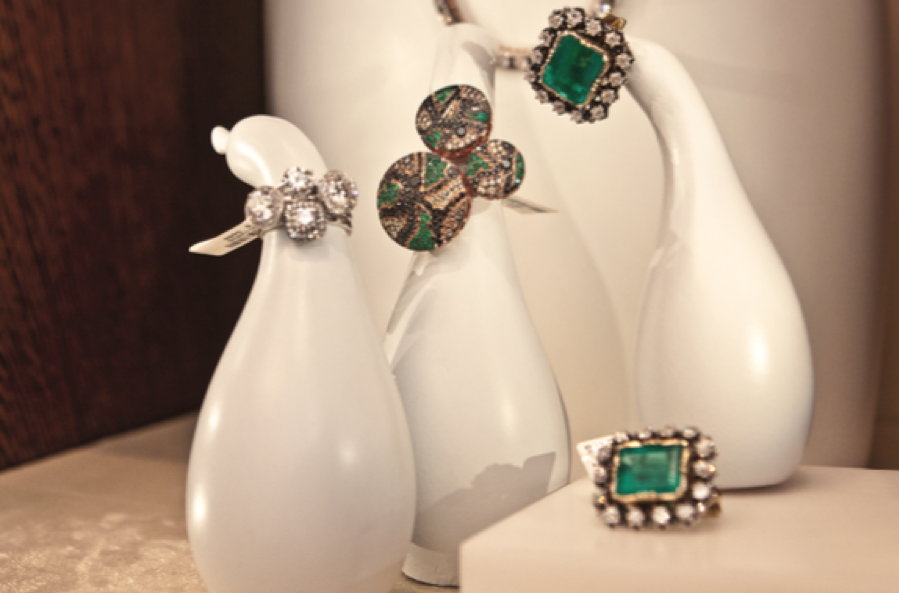
Underground, down a dark driveway and below a nondescript building in the back streets of the Beirut neighborhood, Tabaris, is a small, unmarked door. Behind this secret portal a bounty of diamonds, sapphires, rubies, gold, platinum, pearls and other precious gems lies in wait. Here, a treasure trove of wishes is carefully and painstakingly molded, filed and polished by the finest expert craftsmen into symbols of luxury and cherished personal items that will eventually adorn fingers, ears, necklines and wrists.

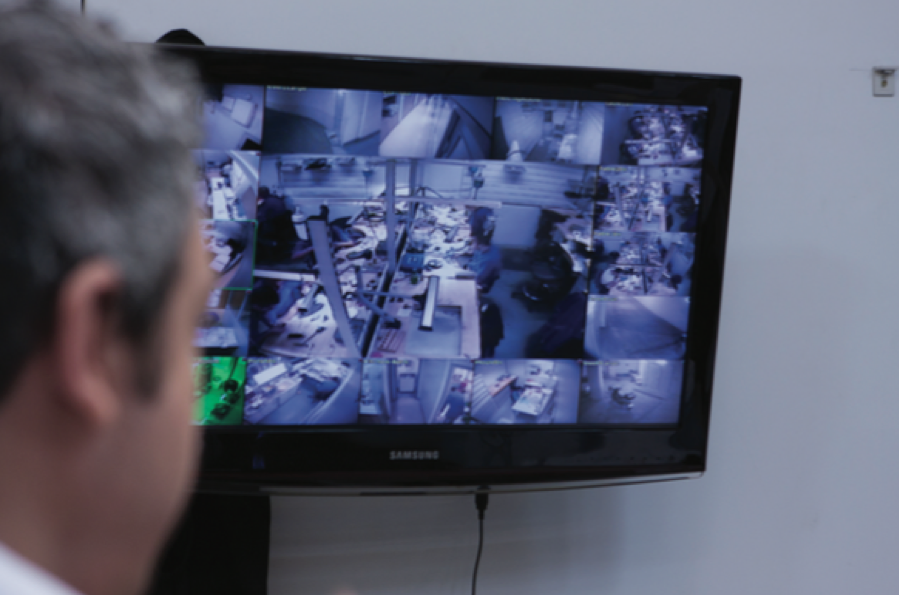
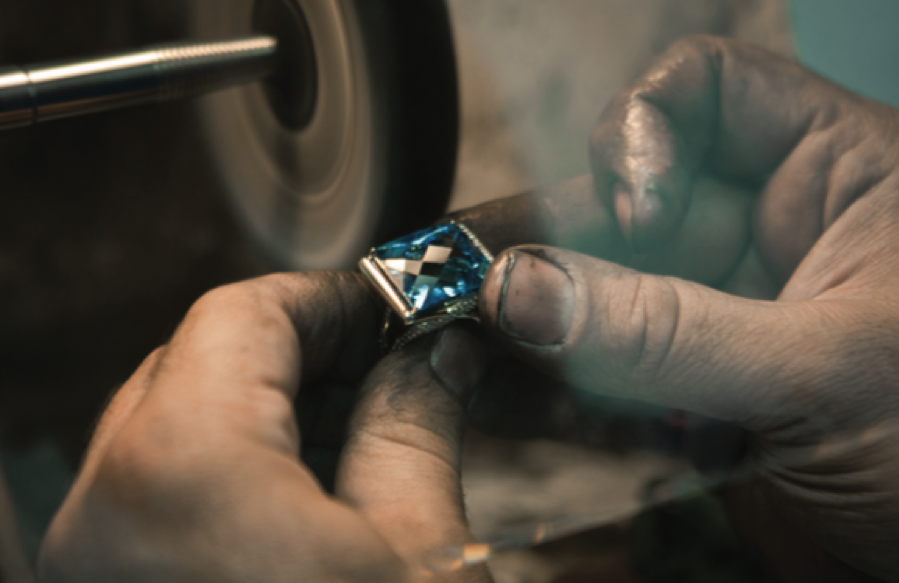
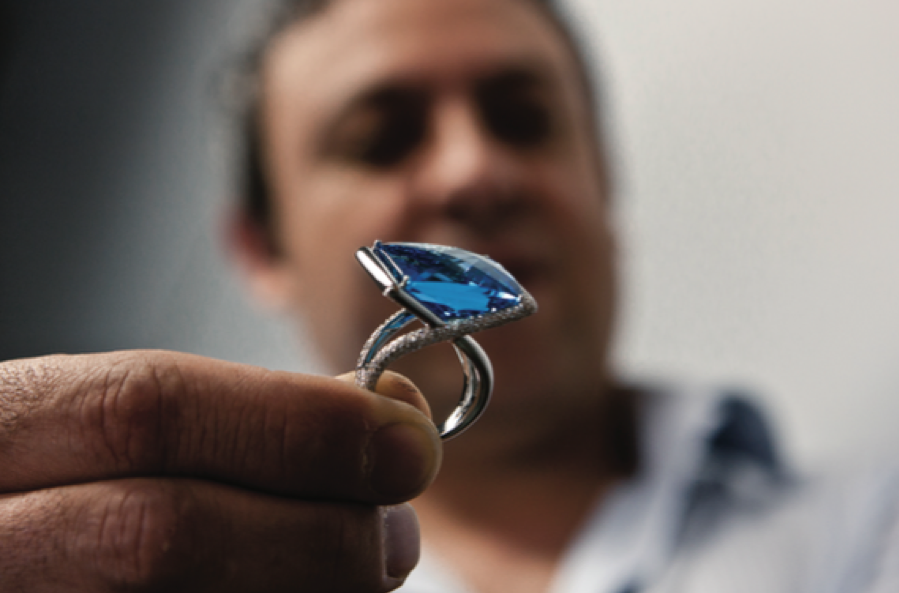
Before it ends up on the velvet pillows of the Mouzannar showroom to be gawked at and drooled over, the giant aquamarine and diamond-encrusted platinum ring passes through many hands. Under the watchful eyes of more than 20 security cameras [1], the jewellers use age-old techniques, with the help of some modern technology, to perform their transformation of raw materials into glorious ostentation.

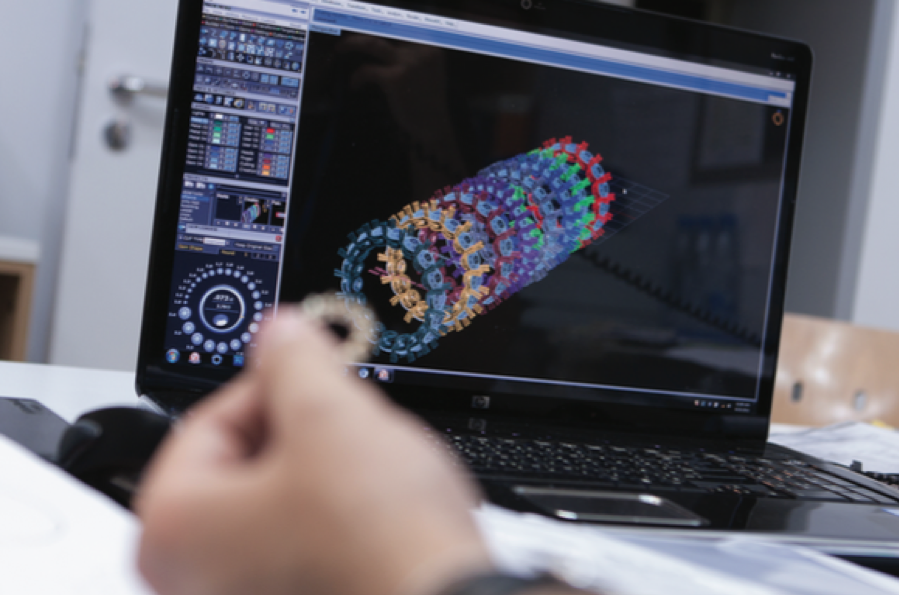
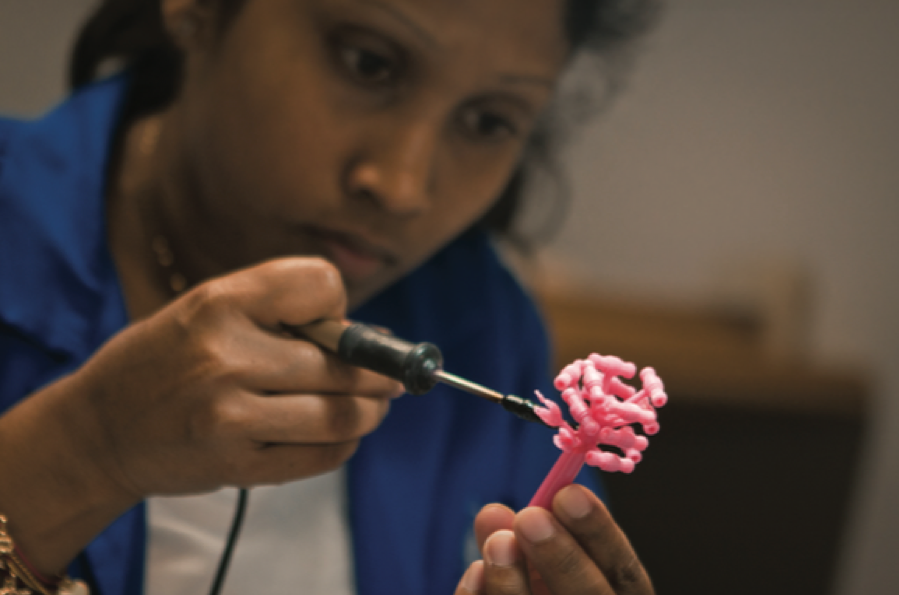
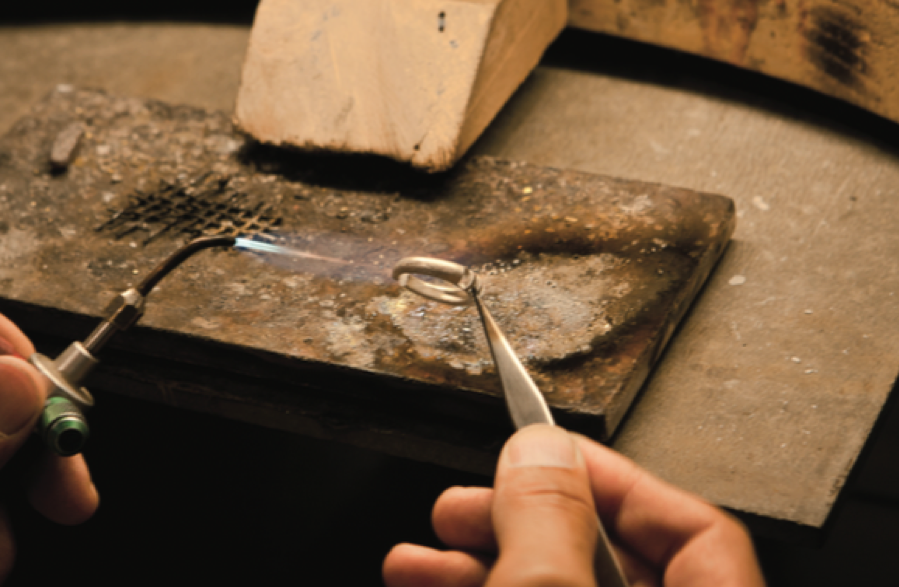
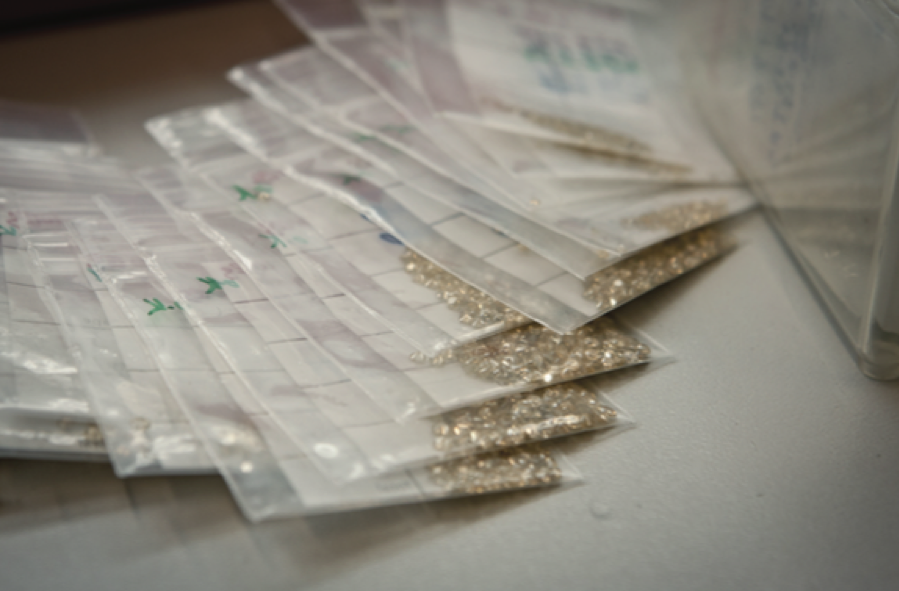
When the order for the ring comes in to the jeweller, the first step is selecting the stone. Then, using architectural software [2], the cast setting is digitally drawn in three dimensions. At this stage, the ring is moulded in wax [3], before the pure platinum is melted and poured into the setting. Emerging rough and unfinished [4,5], the ring is cleaned and weighed for value before being polished and filed; each tiny precious filing is collected on stainless steel trays for a later date. The giant piece of aquamarine, meanwhile, is weighed and examined in detail for quality, clarity and shape. The same treatment is given to the diamonds that will form the stone’s bed. Dozens of white diamonds pour from plastic zip-lock freezer bags [6] stored in rows in filing cabinets according to size and gem.

[2]
[3]
[4]
[5]
[6]

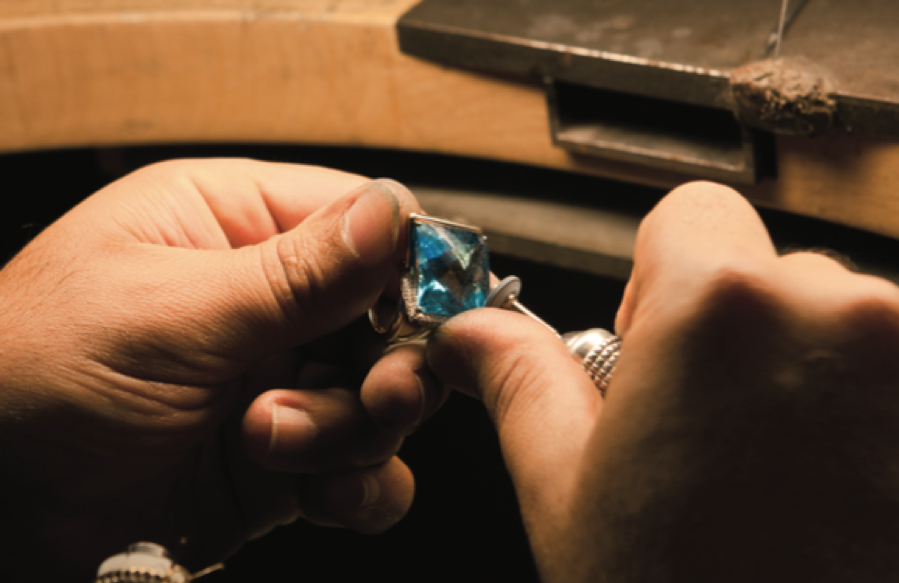
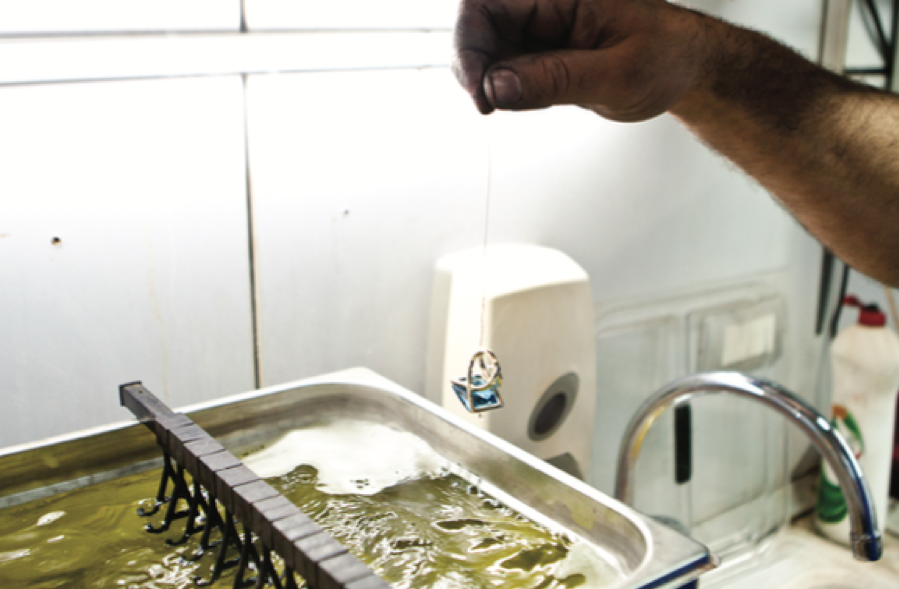
Once the gems are selected and prepared, they are ready to be set in the cast. The diamonds are laid out in tiny magnificent rows along the diameter, the aquamarine carefully fitted in its platinum jaw. Now, close to ready, the polishing [7,8] begins again — a process the jeweller explains will file away at least 10 percent of the original weight of the metal. At cleaning stage, the ring is plunged into a bucket of warm soapy water [9] using ordinary dishwashing liquid, then blasted with steam to remove any invisible scratches.

[7]
[8]
[9]

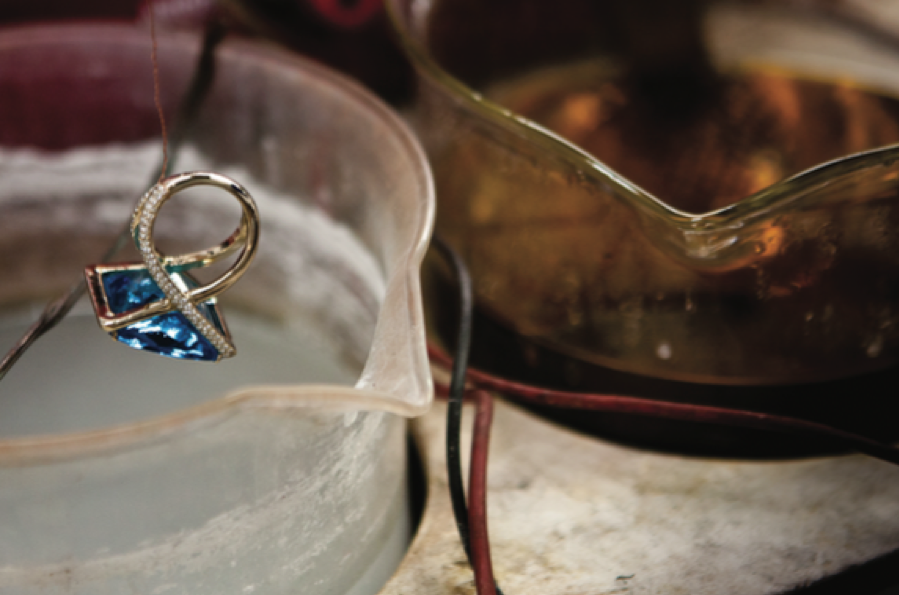
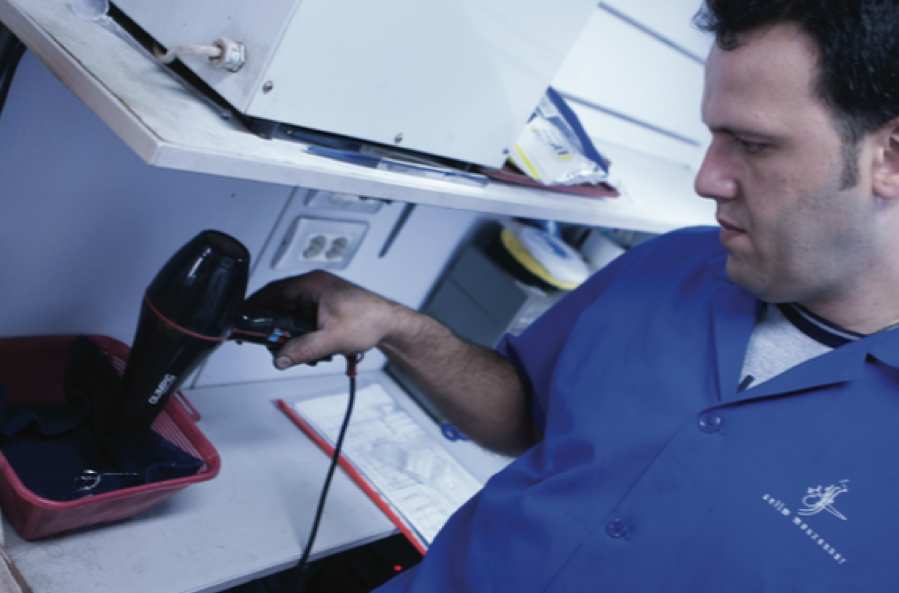
Finally the ring is submerged in salted water and exposed to an electric current to remove any lasting grease before getting a last bath and puff of steam. Still exhibiting golden tones, the ring is lastly dipped in rhodium [10], from which the metal emerges gleaming white. Dried with a hairdryer [11], the ring is ready to leave its humble home [12]. After a process that has taken three days, the ring is taken to the showroom for pricing and exhibition [13].

[10]
[11]
[12]
[13]
July 17, 2011 0 comments
0 FacebookTwitterPinterestEmail
Real estate

For your information

by Executive Editors July 17, 2011
written by Executive Editors

Dubai’s cedar shoreline

By the fourth quarter of this year, the island of “Lebanon” will be home to the first commercially operating project within The World, the 300-island man-made archipelago off the coast of Dubai developed by Nakheel. The island is fully owned by Indian entrepreneur Wakil Admed Azmi, who has spent approximately $16.3 million [AED 60 million] on the construction of a beach club and facilities, in addition to the initial cost of the island. Reza Sinnen, operations manager at the World Island Beach Club (which is being developed on the island), told the United Arab Emirates (UAE) daily Arabian Business in a June 15 article that another $2.17 million [AED 8 million] would have to be invested to complete the commercial resort, which includes a restaurant, lounge, entertainment venue and cabanas, with facilities that allow yachts of up to 80 feet to be docked. The resort aims to sell club memberships that cost up to AED 40,000 [$10,889] per year. Sinnen said problems with the delivery of water, electricity and on-island services mounted as Nakheel’s credit burdens grew, but that the owner cut construction costs by nearly 70 percent and managed the project himself in order to complete it on time. “We are about four months away. We are tying up with partners, yacht operators, travel agents, the Road and Transport Authority, Sealink…there is a lot to do,” Sinnen said. While 70 percent of the 300 islands are sold, according to Nakheel, none of the other owners have begun construction, except Kleindienst Group, which is developing resorts on the six islands it owns, which together are known as the Heart of Europe Project.

A greener prospect

A new environmental initiative that rates the green credentials of buildings in Lebanon was launched in June. The scheme was announced on the closing day of the 16th Project Lebanon, the international trade exhibition for construction and environmental technology that saw around 500 contractors and construction companies from 26 countries set up shop at Beirut International Exhibition and Leisure Center (BIEL) for the week. The ARZ Building Rating System is the first of its kind in the Middle East to classify the environmental performance of existing commercial buildings. The system takes into account Lebanon’s water and electricity shortages, and includes renovation conditions to reduce greenhouse gases. Building owners can invest between $100,000 and $4.9 million, based on building size and condition, to save between $35,000 and $890,000 in costs per year, according to Lebanese Council for Green Buildings President Samir Traboulsi.

From Damascus to Mayfair

A June 20 article in British daily The Telegraph reported that former Syrian Vice President Rifaat al-Assad bought a 10.3 million pound [$16 million] Mayfair townhouse in 2007 by signing a 110-year lease from the Grosvenor Estate, with funds paid by an offshore company based in the British Virgin Islands. Given the current unrest in Syria and the possibility of several Syrian officials facing international investigation, the properties could be confiscated in the event of a criminal investigation against Rifaat al-Assad for “crimes against humanity,” as he is blamed for ordering the massacre in the Syrian town of Hama in 1982 that killed tens of thousands. The article added that the 73-year-old uncle of current Syrian President Bashar al-Assad did not live in the residence until more than a year ago, but has been residing mostly in France and Spain. In 2008, Hafez al-Assad also bought a lease on the adjacent property, but Land Registry documents did not reveal the amount of the contract. In related news, Rami Makhlouf, the maternal cousin of the president, appeared in a rare televised appearance on state television on June 17 and pledged to relinquish all his real estate in Syria to the state and give up any business ventures that bring him personal gain, such as his stake in Syria’s monopolistic telecommunications company Syriatel.

Tourism takes the cake

Of the 35 business developments launched with the help of the Investment Development Authority of Lebanon (IDAL) between 2003 and 2010, tourism projects accounted for 79 percent ($860 million) of the $1.1 billion total mobilized investment. IDAL indicated that the bulk of tourism projects were the construction of luxury hotels and resorts, generating nearly 3,300 jobs over the same time period. The industrial sector was the second largest recipient of IDAL-supported investment between 2003 and 2010, receiving $131 million. IDAL mobilized investments accounted for some 4,760 new jobs over the seven-year period.

Solidere trumps 2010

Due to a surge in operating profits, Lebanese real estate firm Solidere was able to increase net profits by 7.8 percent in 2010 to reach $196.5 million, according to a June 15 statement by the firm. Sales of land plots and increasing revenues from rental units expanded Solidere’s operating profits to $272.2 million last year, a yearly increase of 16.5 percent. Based on its market capitalization of $3.1 billion at the end of 2010, the company was ranked 61st in Al Iktissad Wal Aamal magazine’s annual survey of the Top 100 publicly-traded Arab firms in the region, down from 45th place in the previous survey. As the largest property developer in Lebanon, its total assets are estimated to be worth around $10 billion today, while unsold property is valued at $7.5 billion.

Noor International’s dodgy dealings exposed

Beirut-based developer Noor International, founded by Mohammed Saleh, has not completed more than 5 percent of its residential projects sold off-plan, according to a June 1 article in Lebanese daily Al Akhbar.  It further claims that Saleh fled to Saudi Arabia in May after scamming investors of around $10 million. Noor International first gained notoriety (or infamy, depending on one’s perspective) in 2006 when Saleh sought to raise $1 billion from investors to build “Cedar Island”, a dredging and construction development that would have seen the creation of a 3.3-square-kilometer island off the Lebanese coast in the shape of a cedar tree. To the relief of many, this project was among the 95 percent of Noor’s development ideas never to see the light of day.

Gloom and dividends

Property transactions contracted 21.3 percent year-on-year by the end of April, while the value of the sales dipped 16 percent over the year, according to BLOM Bank. Further indicating a slow-down in construction activity this year, the major supply indicator, cement deliveries, fell 3.5 percent as of the end of April in comparison to the same time last year, according to the Order of Engineers of Beirut and Tripoli, and Byblos Bank. Holcim Liban, one of the major cement producers in Lebanon, will pay $30.25 million in dividends to shareholders starting June 27, at a dividend ratio (dividend payout as a ratio of 2010 net income) of 80.8 percent. Société Libanaise des Ciments Blancs, another major local producer, will also distribute dividends based on last year’s profits on the same day.

July 17, 2011 0 comments
0 FacebookTwitterPinterestEmail
Banking & Finance

Regional equity markets

by Executive Editors July 17, 2011
written by Executive Editors

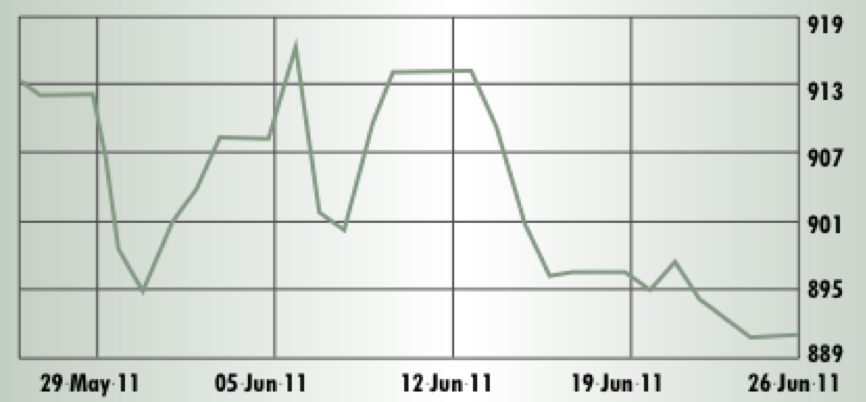
Beirut SE  

Current year high: 1,073.93    Current year low: 890.83

>  Review period:  Closed June 23 at 892.64 points       Period Change: -0.25%

Slumping Beirut stocks were not buoyed by the long-awaited emergence of a new, Mikati-led government. Instead, the market seesawed ahead of an anticipated political showdown during the upcoming parliamentary session and on uncertainty about unrest in Syria, leaving stocks down 8.2% in 2011 through June 23. Shares of Solidere hardly budged despite positive news of an 8% increase in 2010 net profits. Political bickering has driven the stock down 4.5% so far in 2011, though it is outperforming Bank Audi and BLOM Bank, which shed 15.6% and 10% respectively.

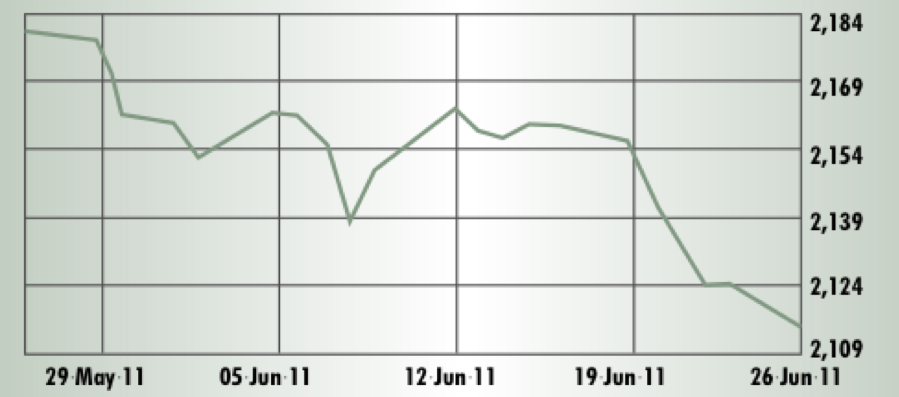
Amman SE  

Current year high: 2,477.99                Current year low: 2,113.46

> Review period: Closed June 23 at 2,122.97 points     Period Change: -1.7%

For Amman stock prices in June there seemed no end in sight for the slide that started at the onset of 2011. The market index has already given away 10.6% in 2011 through June 23 and stocks are yet to recover from the ‘Arab Spring’- driven declines earlier in the year. Continued political uncertainty, as well as unrest in neighboring Syria pose additional risks for all stocks.  However, the banking sector has generally shown considerable resilience with only a 4.7% decline year-to-date, including 1.4% in June.

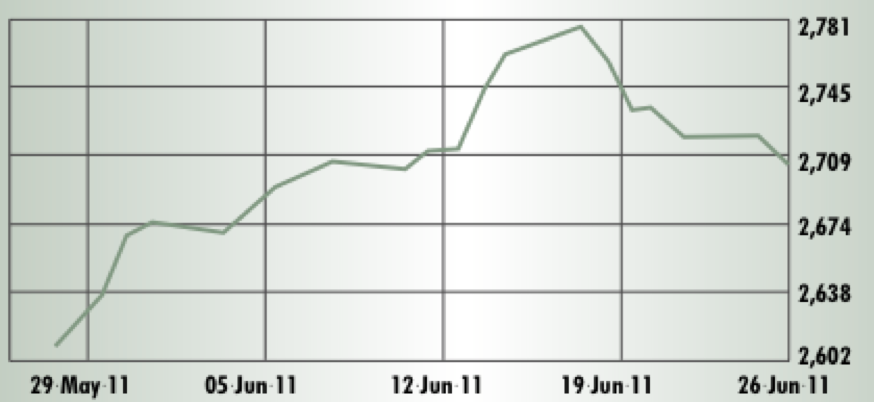
Abu Dhabi Exchange  

Current year high: 2,833.09                Current year low: 2,471.70

>  Review period: Closed June 23 at 2,716.72 points     Period Change: +2.94%

Stocks on the ADX roared in June to a new 2011 high of 2,775 points on investors’ high expectations ahead of a decision by global index provider MSCI to advance the UAE from “Frontier Markets” to “Emerging Markets” status. However, stocks weakened at the end of the review period when MSCI postponed the decision for six months. The ADX benchmark retained a flat record for the year through June 23 and posted solid gains for the month, as Etisalat leapt 7.8%. Year-to-date gains of 6.8% for banking stocks have been the market’s saving grace.

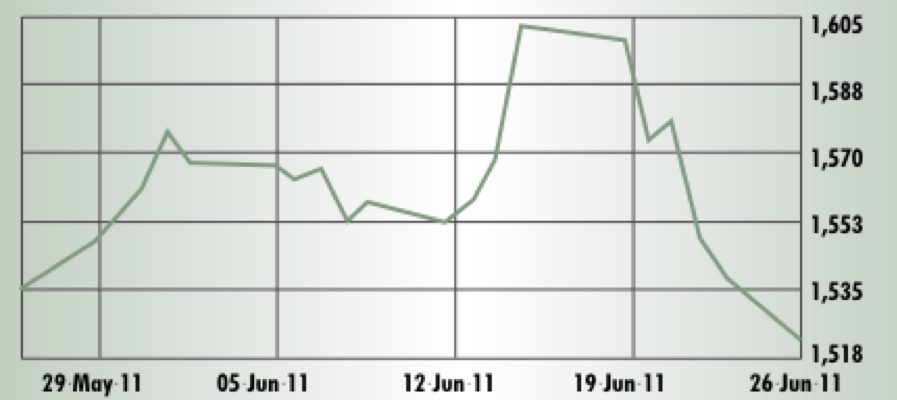
Dubai FM  

Current year high: 1,781.92                Current year low: 1,352.24

>  Review period: Closed June 23 at 1537.48 points     Period Change: -1.44%

Although the DFM index stumbled on MSCI’s decision to delay a possible upgrade to UAE’s bourses, stocks had little to lose. By June 23 the market was already down 5.7% in 2011 on expectations of further losses at real estate and construction companies and despite a year-to-date gain of 5.7% in banking stocks, with a nice top up of 2.4% in June. Market cap leader Emirates NBD booked a handsome gain of 48.6% during the first half of the year, while real estate behemoth Emaar Properties was down 13.2%, including 2.2% in June.

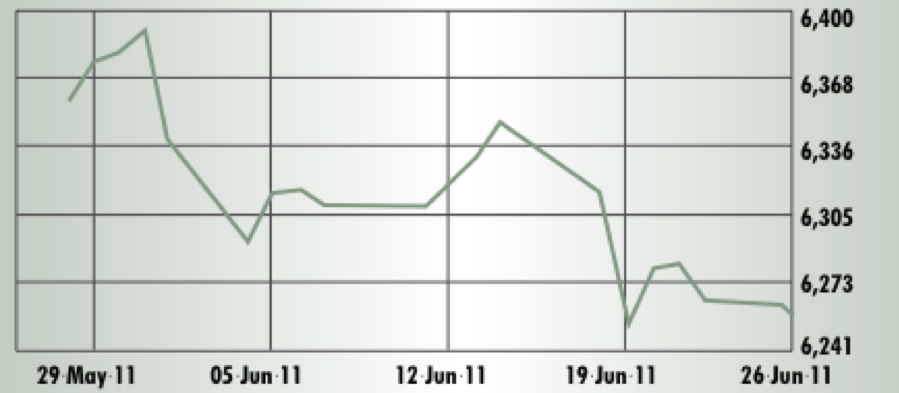
Kuwait SE  

Current year high: 7,129.30                Current year low: 6,134.60

>  Review period: Closed June 23 at 6,263.9 points     Period Change: -1.8%

Missing positive cues and dropping to thin volumes, Kuwaiti stocks slid further down the May slope at the onset of the summer low trading season. Kuwaitis go on vacation this year with almost 10% of their equity investments scrapped during the first six months. More ominously, the banking sector continued its steady decline, reinforced by Moody’s downgrade of National Bank of Kuwait’s credit ratings on Egypt exposure and real estate risks; the sector is 8% in the red for the year through June 23.

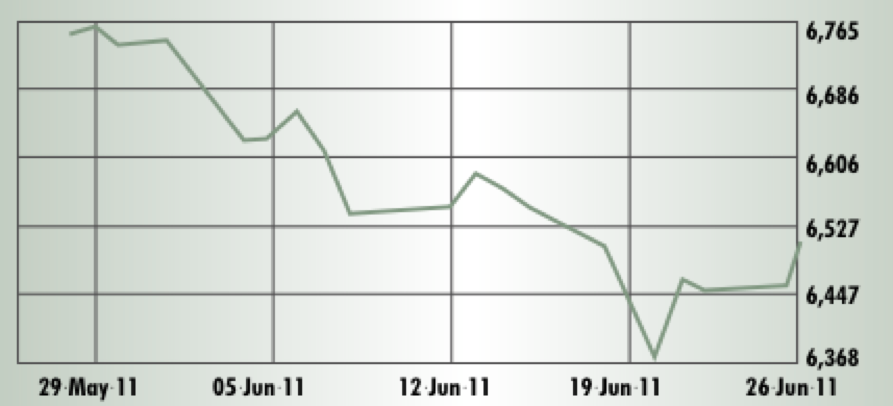
Saudi Arabia SE  

Current year high: 6,788.42                Current year low: 5,323.27

>  Review period: Closed June 22 at 6,449.49 points     Period Change: -4.26%

Tadawul’s stock activity was vibrant in June, backed by plentiful government loans and corporate Sukuks, including a massive 25-year $13.6 billion soft loan approved by the government for Saudi Electricity Company. However, real estate and banking stocks appeared to be off for an early stint of Red Sea vacationing, diving 8% and 4.9% respectively during our June review period. As a result, Tadawul’s year-to-date performance sank to -2.6% by June, ending Saudi’s earlier MENA exchange leadership.

Muscat SM  

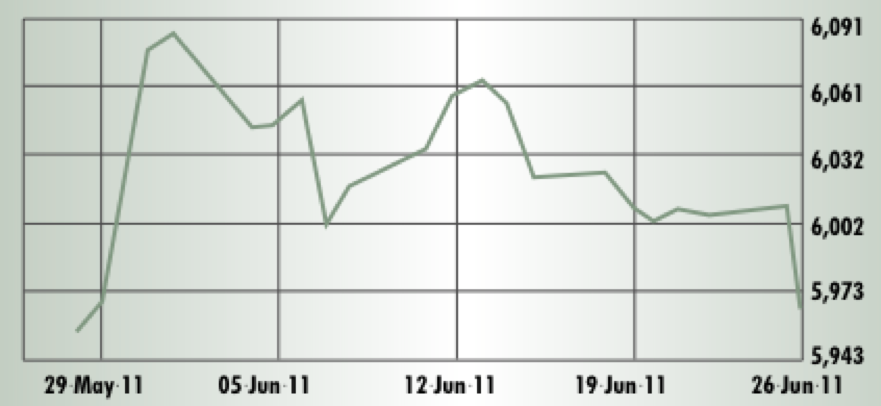
Current year high: 7,027.32                Current year low: 5,952.60

>  Review period: Closed June 23 at 6,003.82 points     Period Change: -0.07%

June’s mood swings are not unusual on the GCC’s smallest exchange. Following an optimistic Bank of America Merrill Lynch report, foreign investors flooded blue chip stocks hit by significant May declines. However, it appeared domestic investors were either not swayed or had defected to summer activities as the market gave back earlier gains and volumes thinned out. Investors may be saving up for the three IPOs scheduled for the fourth quarter, or are not hurrying into a market down 11.1% for the year and with few positive catalysts on the horizon.

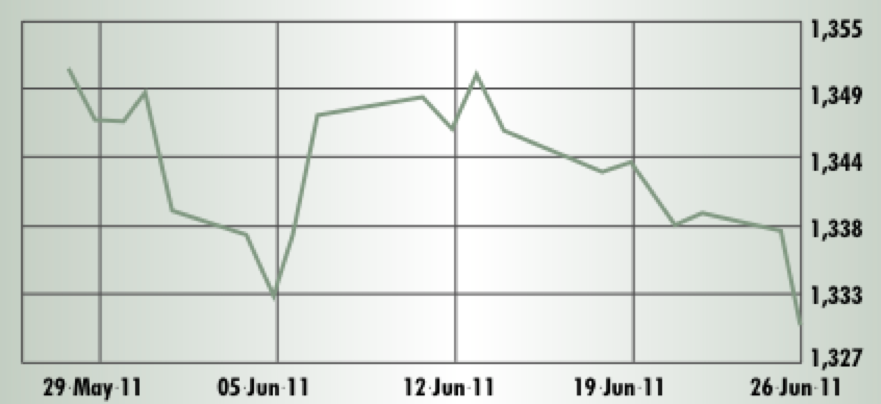
Bahrain Bourse  

Current year high: 1,475.10                Current year low: 1,330.03

>  Review period: Closed June 23 at 1,338.61 points     Period Change: -0.6%

As Bahraini courts were inking new life sentences for opposition members in June, the market index was inking a seven-year low, followed by a short-lived uptick. Despite continuing protests and the uncertain outlook for the upcoming national dialogue, the market has held up relatively well given the circumstances, falling 6.5% in 2011 through June 23. The key banking sector only gave up 3.7% during the first six months, with the market’s largest traded stock Ahli United Bank actually adding 1.4% year-to-date, compared to a 12.5% dive at Batelco.

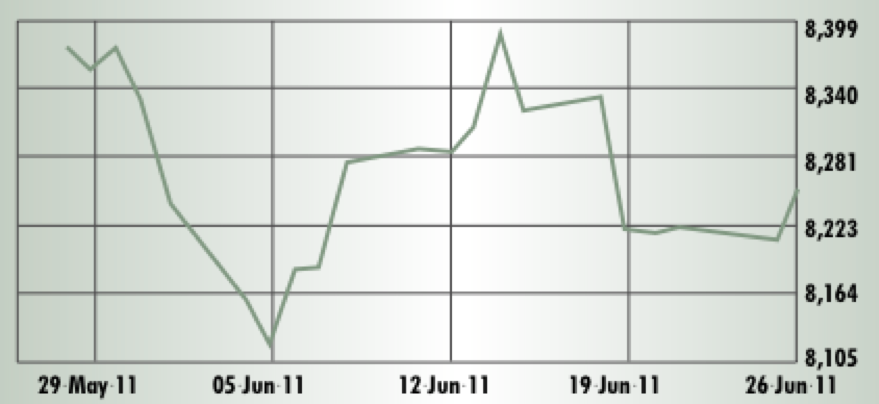
Qatar SE  

Current year high: 9,242.63                Current year low: 6,766.80

>  Review period: Closed June 23 at 8,214.35 points     Period Change: -1.92%

It is telling when Qatar’s central bank’s announcement that real GDP may grow 19% in 2011 does not move markets while MSCI’s decision to delay the decision on Qatar’s upgrade sparks a downturn. But this internationally focused exchange can still cheer foreign activities by Qatari companies, including Diar’s recently-approved multi-billion dollar Chelsea Barracks project in London. The market index on June 23 closed down 5.4% year-to-date, ironically one of the better showings among MENA exchanges.

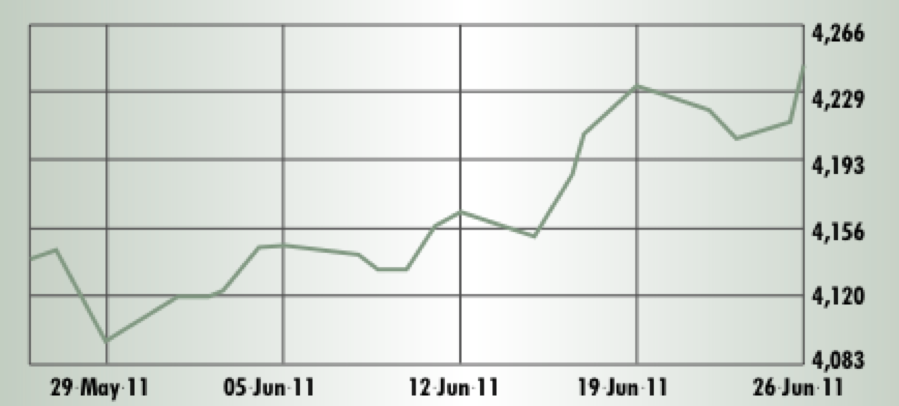
Tunis SE  

Current year high: 5,681.39                Current year low: 4,058.53

>  Review period: Closed June 23 at 4,254.12 points     Period Change: +3.23%

With Ben Ali sentenced in absentia for 35 years, the pre-crisis appeal of Tunisian stocks has returned. Business delegations from across the globe flocked into the country as political parties agreed to postpone elections until October. The market still has a long way to go before it recovers the 16.7% losses in 2011 through June 23, but the upward trend appears to be accelerating; the Tunindex registered the highest June return in the MENA region reviewed here. Meanwhile, Banque de Tunisie remained anchored, declining a relatively modest 5.3% during the first six months.

Casablanca SE  

Current year high: 13,397.47              Current year low: 11,499.64

Casablanca stocks witnessed a precipitous decline in June after the youth movement called for a boycott of the king’s July 1 reform referendum. The MENA region’s June laggard has compiled an 8% loss in 2011 through June 23, with market-cap billionaire Maroc Télécom hitting a multi-year low during the month. Banking stocks have tracked the market so far in 2011, with an 8.1% decline, while the largest bank by market cap, Attijariwafa Bank, shed 9.7% during the first six months.

Egypt SE  

Current year high: 7,210.00                Current year low: 4,878.00

>  Review period:  Closed June 23 at 5,479.74 points     Period Change: -0.79%

Since touching the year’s low in early May, EGX stocks have gained 12.3% through June 23, reflecting optimism for a recovery in tourism and real estate. Although the market is down 23.3% in 2011 to date, heavyweight Orascom Construction is only 4.5% in the red after post-Mubarak gains of 20%. Commercial International Bank and Telecom Egypt investors have not been as fortunate, with the two stocks losing 17.7% and 5% respectively since trading resumed in March.

July 17, 2011 0 comments
0 FacebookTwitterPinterestEmail
Special Report

Fady Chams

by Executive Editors July 11, 2011
written by Executive Editors

After starting out on the Cannes interior design circuit, Prospect Design International’s Managing Director, Fady Chams set up the second branch of the boutique design firm in Dubai in 2005. The firm’s work has been ogled by the eyes of the jet set, with a portfolio that includes the VIP Room in Saint Tropez, to world-famous Movida and Maddox in London, to the iconic art deco Sass Café in Monaco. Closer to home, Prospect left their mark on Beirut’s La Plage beach and Palais nightclub. Though the firm has worked on high-end projects from Casa Blanca to Kazakhstan, the Middle East’s highly hospitable climate remains the focus for their well-secured niche within the interior furnishings market.

  • How did you become a high-profile interior design company so quickly, designing interiors of exclusive high-end clubs and restaurants in Monaco, London, France, and the like?

My brother Sami, after having worked with Ralph Lauren Interiors and many other brands in the south of France, set up Prospect Design in Cannes in 1996. Several friends asked him to design restaurant interiors, which became very successful, and we became specialists in that domain of hospitality design. We were thinking to open Prospect Design in Beirut but security and investment-related factors didn’t allow us to do that.

  • Do you position yourself as designers in the luxury segment?

Not necessarily. We do high-end and we can provide a mid-end French classical Provence house, which is rich in natural materials, [such as] French antique wood, without having necessarily the highest technology and the expensive marble and so on.

  • Wasn’t Palais the biggest budget project in hospitality at the time?

No, not at all. To tell you, it was approximately half a million dollars, which is acceptable when you consider they already had the services, electrical, mechanical, air conditioning and so on. There is big competition in Beirut, especially for [design in] hospitality. Now, we have a lot of private clients for residences… and hope to design a boutique hotel but that is all related to the political and security situation.

  • When you compare the market for luxury hospitality design in Beirut with the regional market, do you see major differences?

In Beirut there are no limits compared to the rest of the Middle East. You can open a restaurant and club wherever you want and you are allowed to sell alcohol and open from very early until very late. In Dubai, [if you are a restaurant that sells alcohol] you have to be in a hotel, which affects our design.

  • What makes it so demanding to work on a luxury restaurant?

You cannot just design a very nice restaurant [based purely on aesthetics]. When it comes to operations you have a lot of problems with the lighting, the seating or the circulation around the tables. Also, going for a contemporary style or a classical style will definitely last much longer than something futuristic with a lot of LED lighting and changing colors.

  • Did the economic downturn impact your business?

Yes and no. Back in 2008, some clients started to freeze their spending. But we do not have a lot of overhead… Before the crisis in Dubai, we were approached by maybe 20 people a week; 90 percent of them were…wasting our time. Now, if we get approached by four clients, three of them are very serious and have the funds.

  • What was the most expensive project you ever worked on?

There were some private residences… that included an indoor swimming pool, a nightclub, a basement tennis court, you name it. In hospitality, it is a business with projections and a feasibility study and goals to meet. They don’t care if I put a gold-plated part in the ceiling or something that looks like a gold-plated part. But the private client would want gold-plated.

  • How did your strategy develop to combine luxury items with mid-range items in your designs of hospitality spaces?

It comes naturally since in most projects no one has an open budget; we are therefore quite skilled in mixing-and-matching a very expensive sofa with a less expensive table and a chandelier that is not a Swarovski one… to create a unique design. If you want a wall covering, I can find you five similar coverings at very different prices.

July 11, 2011 0 comments
0 FacebookTwitterPinterestEmail
  • 1
  • …
  • 369
  • 370
  • 371
  • 372
  • 373
  • …
  • 697

Latest Cover

About us

Since its first edition emerged on the newsstands in 1999, Executive Magazine has been dedicated to providing its readers with the most up-to-date local and regional business news. Executive is a monthly business magazine that offers readers in-depth analyses on the Lebanese world of commerce, covering all the major sectors – from banking, finance, and insurance to technology, tourism, hospitality, media, and retail.

  • Donate
  • Our Purpose
  • Contact Us

Sign up for our newsletter

    • Facebook
    • Twitter
    • Instagram
    • Linkedin
    • Youtube
    Executive Magazine
    • ISSUES
      • Current Issue
      • Past issues
    • BUSINESS
    • ECONOMICS & POLICY
    • OPINION
    • SPECIAL REPORTS
    • EXECUTIVE TALKS
    • MOVEMENTS
      • Change the image
      • Cannes lions
      • Transparency & accountability
      • ECONOMIC ROADMAP
      • Say No to Corruption
      • The Lebanon media development initiative
      • LPSN Policy Asks
      • Advocating the preservation of deposits
    • JOIN US
      • Join our movement
      • Attend our events
      • Receive updates
      • Connect with us
    • DONATE