• Donate
  • Our Purpose
  • Contact Us
Executive Magazine
  • ISSUES
    • Current Issue
    • Past issues
  • BUSINESS
  • ECONOMICS & POLICY
  • OPINION
  • SPECIAL REPORTS
  • EXECUTIVE TALKS
  • MOVEMENTS
    • Change the image
    • Cannes lions
    • Transparency & accountability
    • ECONOMIC ROADMAP
    • Say No to Corruption
    • The Lebanon media development initiative
    • LPSN Policy Asks
    • Advocating the preservation of deposits
  • JOIN US
    • Join our movement
    • Attend our events
    • Receive updates
    • Connect with us
  • DONATE
Comment

Saleh spurs unlikely unity

by Farea al-Muslimi June 3, 2011
written by Farea al-Muslimi

Millions of Yemenis went to the streets on May 22 in different provinces around the country to celebrate the anniversary of the 1990 national unification. The carnival atmosphere along 60th street in Sanaa differed from previous years; instead of photos of President Ali Abdullah Saleh, people paraded placards of the protesters killed since demonstrations began in February to demand the end of his three-decade reign.

National unity has experienced its fair share of stress since Yemen’s 1994 civil war, after which a victorious Saleh began to purge the army of southern officers through forced early retirements, at the same time deploying northern officers loyal to him through family and patronage networks to the south of the country.

Southerners blame Saleh’s regime for the endemic mismanagement and corruption associated with their oil; 80 percent of Yemen’s hydrocarbon wealth is in the south, accounting for the lion’s share of government revenues — facts which have helped fuel even greater resentment toward Saleh as southerners complain of a chronic lack of investment in basic infrastructure and development projects, and their exclusion from government employment.

The president had largely ignored such grievances until rebel movements began to call for secession and staged monthly protests in different southern provinces in 2004 and 2005. Clashes between the police and protesters have resulted in the death and injury of hundreds in the south over the last few years. Furthermore, seeing southern Sudan separate itself from the north in 2010 provided inspiration for southern Yemenis. Indeed, until recently an outright rebellion in the south seemed imminent. Before the anti-Saleh revolt spread to Sana’a it appeared that only Solomon’s wisdom could keep the north and south together, but since then the scene has changed dramatically across Yemen.

Engaging the south politically and economically has become apriority for the opposition movement in order to preserve the unity of the country. Residents of the southern city of Aden went out to protest in various squares in a display of solidarity for Yemenis attacked in Sana’a by security forces, and vice versa. Thus, a sense of unity between north and south is more prevalent than ever before; leaders of southern movements have announced that they no longer desire secession from the north, just a separation from Saleh’s regime. On May 22, Secretary General of the Southern Movement Abdullahal-Nakhibi, told the press, “The youth revolution made us rethink our calls for secession; our enemy was Saleh who abused the unification and excluded all partners.” A year before, such a statement would have been impossible.

But there is still a long way for Yemenis to go to create a stable and equitable state. The success of the opposition movement will highly depend on its ability to solve the southern issue, the biggest and most significant challenge Yemen has faced through the last two decades. The scene at the unification day parade in Sana’a, of a military officer who had sided with the demonstrators handing a Yemeni youth the nation’s flag, was a symbol of the transformation of Yemen from a military system to a civil one, but the images from the capital in the days that followed were less hopeful; by May 25 dozens had been killed in clashes between pro-government soldiers and tribal forces, particularly from the powerful pro-opposition Al Ahmar tribe. These battles raise questions about the stability of the opposition’s unity and whether or not it can hold under duress.

Transformation toward a parliamentary system has been the talk around Yemen, and the new constitution put together by the youth movement makes it clear that a decentralization of government is the basis for its implementation. But with Saleh continually reneging on the initiatives presented by the Gulf Cooperation Council to begin a transfer of power, the democratic momentum risks becoming bogged down in the mire of tribal warfare. On May 22, after a dramatic about-face by which the president at the very last moment abandoned an agreement to step down, he accused the opposition movement of “dragging us to a civil war”.

Saleh’s stubborn refusal to heed the demands of the demonstrators has accomplished in months what decades in power could not: the ideological unity of north and south. At the same time, if he does not step down soon, he may likely fulfill his own his prophecy.  

FAREA AL-MUSLIMI is a Yemeni activist and writer for Almasdar


June 3, 2011 0 comments
0 FacebookTwitterPinterestEmail
Comment

Ahmadinejad’s lost magic

by Gareth Smith June 3, 2011
written by Gareth Smith

Rumors of sorcery in the environs of Iranian President Mahmoud Ahmadinejad have reached such a high pitch that leading members of his entourage have had to deny them. Some Iranian media outlets even quoted the president as saying that those alleging “the influence of fortune-tellers and jinn on government were telling jokes.”

In fact, the matter is deadly serious. Ayatollah Mohammad Taqi Mesbah-Yazdi was quoted as being “more than 90 percent certain that he (Ahmadinejad) has been put under a spell… I do not know if it is hypnotism… or relations with yogis. But there is something wrong.”

Senior clerics have long disliked Ahmadinejad and see opportunity in his soured relations with Ayatollah Ali Khamenei, the supreme leader. Hence, a dispute with the leader over ministerial appointments has set off a wider spat. Khamenei in April reinstated Heydar Moslehi as the intelligence minister after Ahmadinejad had forced him to resign. While the president had little choice but to accept the directive, he subsequently refused to attend cabinet meetings for a week, then in May removed three ministers as part of a scheme to reorganize ministries. In assuming the sensitive oil ministry himself, Ahmadinejad further enraged his many critics and in a matter of days the Guardian Council — which can block legislation it deems unconstitutional — had overruled the president, deeming his move “illegal”.

Ahmadinejad came to the presidency in 2005 as an outsider to Iran’s political class after a skillful campaign that hamstrung his main rival, Akbar Hashemi Rafsanjani, who had strong support within the establishment. The new president had a popular touch rooted in his lowly father’s simple Quranic classes. Here was a man who talked to millions of Iranians in simple language and understood their beliefs and practices. Yet many aspects of popular religion in Iran are frowned on by senior clerics, whose standing is based on Islamic law and who disparage “superstition”.

When Ahmadinejad was elected, many wrong-footed analysts said he was a creature of the Revolutionary Guards (although his membership has never been established). But the discrete talk in Iran was of his religious beliefs, and particularly of his relationship with the 12th Imam. For Khamenei, the new president was a double-edged sword. On one side, he had won a landslide election victory pledging a return to the egalitarian values of the 1979 Islamic Revolution, in the process steamrolling two reformist candidates along with Rafsanjani. But on the other side, Ahmadinejad’s populism was unpredictable. His statements on Israel delighted the Persian, Arab and Muslim “street”, but they disturbed pragmatists in Tehran seeking a hardheaded calculation of national interest. His management of government also alienated a wide range of conservatives close to Khamenei.

By endorsing Ahmadinejad’s 2009 disputed election victory, Khamenei put more wind in the president’s sails. Buoyed by this support, Ahmadinejad and his close ally and relative by marriage, Esfandiar Rahim Mashaei, have tried to create a political bloc that might outlast the 2013 presidential election, when Ahmadinejad’s second term expires and he must stand down.

Senior clerics detest Mashaei, another figure of humble origins and one who has stressed Iranian nationalism even at the expense of Islam. Mashaei is at the root of tension between the president and leader; in 2009 Ahmadinejad was overruled by the supreme leader when he tried to appoint Mashaei as first vice-president. Instead he made Mashaei chief of staff, a post from which he recently stepped down, perhaps to prepare for parliamentary elections next year.

It was Mashaei’s tense relations with Heydar Moslehi that led to the April sacking of the intelligence minister and he has also been at the center of allegations that the Ahmadinejad camp has diverted oil revenue into election campaign coffers. At the brink before, Ahmadinejad has always pulled back from confronting Khamenei, and in a televised interview in mid-May he praised the leader as a just father, both to himself and the nation. Perhaps the president knows that, with or without the use of sorcery, this would be a confrontation he could not win.

Gareth Smyth has reported from around the Middle East for almost two decades and was formerly the Financial Times correspondent in Tehran


June 3, 2011 0 comments
0 FacebookTwitterPinterestEmail
Comment

A fall from grace

by Fabio Scacciavillani June 3, 2011
written by Fabio Scacciavillani


Dominique Strauss-Kahn, otherwise known as DSK, had flirted with the title of being the second most powerful man in the world after United States President Barack Obama in the aftermath of the 2008 Lehman Brothers demise. Such accolades will be scarce moving forward, however, with the now-former managing director of the International Monetary Fund arraigned on charges of rape in a New York court last month.

His supporters assert that his resignation is not an admission of guilt, but rather to shield the IMF from the fallout of the scandal while he clears his name from the ignominy, though his departure wil lstill have a profound impact on the organization.

After DSK took up the reins in 2007, the IMF had reverted to its heydays in the 1990s, an era when it played a critical role in managing the ‘de-sovietization’ of Eastern Europe and Central Asia, the reform wave in Latin America (despite the fiasco in Argentina) and the opening of capital markets —one of the pillars of what is nowadays called ‘globalization’.

By contrast the two predecessors of DSK are remembered most for their stolid management, their lack of vision and a dreary decade during which the IMF had been marginalized, demoralized and ignominiously downsized. But under DSK stewardship, the IMF confidently regained center stage in top policy circles and on finance markets. It engineered a rapid and effective response to the financial crisis, taking up monumental responsibilities when national governments were mostly scared or hapless to act. Billions of dollars were deployed over the main fronts opened by the freeze in credit markets worldwide to help central banks avoid a financial meltdown and economic collapse.

Nowhere was the IMF intervention more crucial than in the Eurozone. Despite stubborn denials by the European Union authorities and the European Central Bank (ECB) regarding member states’ need for IMF support —which in the view of haughty politicians in the ‘Old Continent’ was only intended for developing countries — Greece capitulated and negotiated a loan in exchange for austerity measures. DSK ensured that European public opinion, foremost in France, perceived that his institution and his personal involvement had saved Greece from a humiliating default. So with an eye to the primaries of the Socialist Party, which could have paved his way to the French Presidency, DSK used his role to strengthen his credentials as a competent economist and an effective decision maker. The successive IMF interventions in Ireland, and recently in Portugal, reinforced his standing; in fact before his arrest he was the frontrunner for the Elysée.

For the Greeks it was a stroke of luck to have at the helm of the IMF a figure with a keen interest in his future political career, and therefore a particular tendency to appease the left-leaning public opinion. The terms of the loans granted to Greece were relatively lax, hard questions were shoveled under the rug and the review of the progress to meet the targets of the stabilization plan lacked the steely determination displayed elsewhere. The plan was too lenient and in fact now Greece is asking for further support, which in any case is unlikely to prevent an eventual default, or a debt restructuring, as many politely call it.

Against this background the downfall of DSK came at a critical juncture. With Greece in need of further support, a benevolent attitude from the IMF was paramount in the strategy by the EU and the ECB to delay the hard choices on new governance in the currency union and reforms of the fiscal framework to share the burden of unsustainable sovereign debts in peripheral countries.

Worse for the Old Continent, emerging markets, primarily China, are less inclined to honor the unwritten agreement that the IMF managing director be European and the World Bank president an American. With their share of global GDP on par with that of developed economies, emerging markets feel they can field a candidate. If that were to happen, after the embarrassing epilogue of DSK’s tenure, the air on the Northern Mediterranean shores would be much chillier this summer.

FABIO SCACCIAVILLANI is chief economist at the Oman Investment Fund


June 3, 2011 0 comments
0 FacebookTwitterPinterestEmail
Comment

The great nuclear silence

by Peter Speetjens June 3, 2011
written by Peter Speetjens

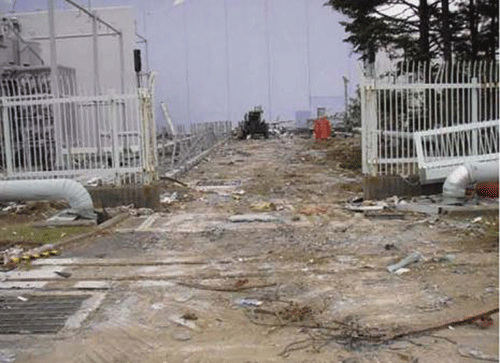
Obsessed with all things ‘now’ and ‘today’, the media are distinguished by a hopelessly short memory. Yesterday is ages ago, and anything that occurred last month might as well have happened in 1837, or not at all. When the news is no longer new the circus leaves town and a deep silence sets in. This is what happened after Japan’s March 11 earthquake and tsunami triggered a nuclear meltdown at Fukushima plant.

Following a fast and furious frenzy of media coverage, Fukushima’s fate and victims have disappeared from the radar, apart from on one day, May 20, when Masataka Shimizu resigned as President of the Tokyo Electric Power Company (Tepco), which owns the Fukushima plant, as it reported a net annual loss of $15 billion. Meanwhile, it remains to be seen how much Tepco will have to pay in compensation. Due to the radiation leaked into the atmosphere, some 50,000 families were forced to leave their homes, while more than 10 million liters of water contaminated with radioactive particles leaked into the sea. The financial and physical damage to human and marine life is hard to determine. The company itself has yet to issue an estimate, but analysts have indicated the total sum could amount to $125 billion. No wonder Tepco’s share price has fallen by 80 percent since March.

Meanwhile, the Japanese authorities have established a fund with which Tepco can compensate the victims. The company is obliged to pay back the government as soon as it returns to its profitable ways. Not known is what will happen were the firm to go bankrupt. Helped by a powerful lobby and PR machine, promoters of the nuclear option like to paint a safe and carefree picture of cheap, affordable energy. It’s true that, once up and running, nuclear power plants produce relatively cheap electricity. 

However, the cost of such unforeseen disasters as Chernobyl and Fukushima are not part of the calculations. Nor is a reliable estimate of the cost of nuclear decommissioning. The average lifespan of the world’s more than 450 nuclear plants is some 30 to 40 years, although many function well beyond their expiry date.  Once a nuclear plant is no longer safe to operate, it should be dismantled, while the site on which it stood should be decontaminated. Unfortunately, the nuclear industry has very little experience in decommissioning.

American nuclear power plants today reckon with an estimated decommissioning cost of some $325 million per reactor, and that is likely being optimistic. In France, the cost of decommissioning the relatively small Brennilis facility, which was only operational from 1967 till 1979, today amounts to some $650 million, no less than 20 times the amount initially estimated. Hence the reason why the big clean-up, like that of four other nuclear sites in France, has been postponed indefinitely. In Britain, the Nuclear Decommissioning Authority has altered its cost estimates several times and currently predicts a price tag of $100 billion for cleaning 19 nuclear sites.

While the Fukushima drama has triggered an intense debate over nuclear power in Europe, most Arab countries continue as if nothing has happened. Abu Dhabi remains determined to build four nuclear power plants on its shore, Riyadh recently signed a nuclear research agreement with China and Jordan is set to announce on June 30 the winning bid for building its first reactor. As none of these countries is particularly known for its free and critical media, the region’s nuclear future is largely determined in silence. There is one exception: Israel.

While the Israeli authorities recently shelved plans to invest in nuclear power generation, journalists, MPs and nuclear experts — for the first time ever — dared call for more openness regarding Israel’s, and the region’s, only nuclear facility at Dimona. They want to know if the ultra-secret, nearly-60-year-old military facility is still safe and where its waste is buried. And so they should: while the inland, desert facility is unlikely to be hit by a tsunami, it is situated only 30 kilometers south of the earthquake-prone Great African Rift.

But on the other hand, why worry? After all, the last big quake to hit the Galilee occurred in 1837, so long ago that it might as well have never really happened at all.

PETER SPEETJENS is a Beirut-based journalist


June 3, 2011 0 comments
0 FacebookTwitterPinterestEmail
Comment

Boon time for mercenaries

by Paul Cochrane June 3, 2011
written by Paul Cochrane

The wars in Afghanistan and Iraq are supposedly winding down, Osama Bin Laden is dead, and the so-called ‘Arab Spring’ is eroding the iron-fisted regimes that have for so long held sway over the Middle East and North Africa (MENA). For private military contractors (PMCs) — a polite name for professional mercenaries — such developments might be considered a harbinger of tough times. But business is better than ever in Iraq and Afghanistan, and the suppression of internal revolts throughout the MENA is presenting new opportunities for this multi-billion dollar industry.

Last month details emerged that the infamous founder of Blackwater, Erik Prince, was forming an 800-strong secret army for the United Arab Emirates, for a price tag of $529 million. Prince moved to the UAE after Blackwater, later renamed Xe Services, faced legal problems in the United States, notably in a case against four Blackwater operatives accused of killing 17 Iraqi civilians in Baghdad in 2007, which has recently been reopened.

Reflex Responses, Prince’s new venture in conjunction with a 51 percent Emirati stake, features South African and Latin American mercenaries, the latter brought into the UAE disguised as construction workers, according to the New York Times, hired to protect under-construction nuclear power plants and oil infrastructure from terrorist attacks, and to “put down internal revolts” and “unrest in crowded labor camps.”

What is curious is the UAE’s need for Prince’s firm, as the country already ranked 16th worldwide in 2010 for military expenditure, at $15.74 billion, or 7.3 percent of gross domestic product, according to the Stockholm International Peace Research Institute. If such a high cost for the conventional military cannot guarantee security, but a half billion dollar private force can, it puts into question the rationale for such a high defense budget. Furthermore, it sheds doubt on the UAE’s belief in the Gulf Cooperation Council — dominated by Saudi Arabia — to come to its aid to squash an uprising, as happened when GCC forces rolled into Bahrain this year.

The UAE is clearly worried about instability amid uprisings nearby and has taken a page out of other government manuals by resorting to guns for hire. In March, it was reported that up to 1,000 Pakistani troops had been recruited to serve in the Bahrain National Guard to put down the uprising, as local troops could not be relied upon. In Saudi Arabia, which recently signed a $60 billion arms deal with the US, Associated Press reported that a top secret project is underway with the US Central Command supervising and training a 35,000-strong Saudi force to protect oil infrastructure and, presumably, to crush any unrest. Reports also abound of Muammar al-Qadhafi using mercenaries in his ongoing war against the rebels in Libya.

Last year in Iraq, security was the second most common service provided by contractors to the US government, accounting for approximately 13,000 personnel, or 18 percent of all contractors, according to a recent report by the Congressional Research Service. But while US troop levels have dropped in Iraq since 2008, along with support service contracts as a result, PMCs actually increased by 39 percent, or 3,500 personnel, by the end of last year.

The US Department of Defense does not give a breakdown of contractor services in Afghanistan, but contracts have soared over the past five years, from $2 billion in 2005, to $11.8 billion for some 87,000 contractors in 2010. It appears as though demand for PMCs will remain high so long as governments carry out policies unpopular in the eyes of the public. After all, mercenaries are useful assets to perform tasks that might strain the loyalty of a country’s regular armed forces. Indeed, Reflex Responses will reportedly not hire Muslim mercenaries given that, in the words of Prince, “They could not be counted on to kill fellow Muslims.”

The regional spike in demand for mercenaries and private armies speaks volumes about the insecurities of the UAE and Saudi Arabia. More chillingly, it raises concerns about the destiny of the ‘Arab Spring’ when governments resort to such forces to quell revolt.

PAUL COCHRANE is the Middle East
correspondent for International News Services

June 3, 2011 0 comments
0 FacebookTwitterPinterestEmail
Economics & Policy

Executive Insight – Booz & Co.

by Ulrich Koegler & Ivan Jakovljevic June 3, 2011
written by Ulrich Koegler & Ivan Jakovljevic

ULRICH KÖGLER is a partner and IVAN JAKOVLJEVIC a senior associate at Booz & Company

In an age when email and digital social media dominate the present and future of communications, traditional postal systems are losing their role as the primary means of communication.

Yet, postal systems remain a vital way to reach people, even in the age of instant communication. What postal systems lack in speed they make up for in other benefits. They offer a way for citizens, especially those in rural areas, to better communicate with each other and their communities; a way for companies and merchants to reach their target audiences with direct mail, e-commerce deliveries and, perhaps most important to governments, a way to locate citizens in an emergency, get them essential services and documents and help them transfer money safely.

These benefits, while balanced among citizens, businesses and governments, nevertheless will not be available in emerging markets in general — and in the Middle East and North Africa (MENA) region in particular — without significant new investment and efforts by government leaders. Therefore it is critical for the benefits to be significant enough to justify investment and activity.

Because the region has only in recent decades witnessed stable population patterns common to Organization for Economic Cooperation and Development nations, postal systems in the MENA region are significantly smaller, less utilized and more costly than their counterparts in developed markets. Unfortunately, this has limited their potential and that of MENA countries to serve citizens, local and international businesses and governments.

Reaping the Benefits

There are numerous advantages to a strong postal system — one being the introduction of standardized addresses. An address system that makes the best possible use of modern Global Positioning Systems/geo-mapping technologies allows for both the unique identification of citizens as well as the ability to reach a destination in the shortest possible time. As such, an address system also offers important benefits for emergency responders, such as medical, police and fire services.

Meanwhile, governments seeking to interact more closely with their citizens can use postal addresses to locate and engage them regularly. When a government is able to reach its people it can efficiently deliver income support, information on public health and other essential services. This ability is vital to the success of many government services, especially in rural areas.

Those populations least likely to access government services in person or through electronic channels — the low income, sick, elderly or rural groups — are most in need of such access; therefore, a modern postal system is a valuable way to close any service gaps. Illustratively, the local post office is becoming a place where one can renew a driver’s license, pay utility bills, apply for various government documents or collect a pension check. 

A game plan for postal systems

Regional governments looking to further strengthen their postal systems have focused on four major areas for improvement: an address system to support national emergency and security services; data warehousing to provide governments and businesses access to essential socio-demographic information; a “last mile” delivery system to complement e-government services and e-commerce; and a system for postal money remittances to provide an inexpensive and traceable means to transfer money.

In addition to letting emergency responders — such as medical, police and fire services —  reach homes and businesses more easily, the unique identification of individuals through their mailing address can be part of a more comprehensive citizen and resident database that captures critical information. For instance, such a database might link addresses to medical history to allow ambulance attendants to respond more quickly and knowledgeably, note a history of domestic violence complaints that can prepare police for what they might face, or enable security forces to screen for potential security threats.


Last-mile delivery systems are another essential element in e-government and e-commerce services. For example, while e-government services can permit routine applications and renewals of key government licenses and documents, such as passports and birth certificates, citizens still need to take delivery. A postal system allows the government to ship those documents directly to people’s homes, rather than to make citizens stand in line in government offices that may be difficult to reach.

Globally leading postal operators have also deployed digital documents, such as secure letters, digital marketing and digital secure identification — a service that gives postal operators a strong footing to operate in the digital age.

Finally, postal systems can be a conduit for money transfers. Such use is not uncommon: in many markets, the post office is the primary place to conduct such transactions.

Moving more aggressively toward such a system would allow governments to track money transfers more efficiently, help security agencies tackle terrorism and reduce narcotics trafficking, money laundering and tax evasion. Postal remittances can be a more secure alternative to informal money transfer schemes (such as hawala), which have been linked to the financing used in the 9/11 terrorist attacks.

Other nations that have sought to improve national postal systems have developed some sophisticated capabilities. For example, Singapore introduced a postal address system that enables sequential sorting of mail items based on the shortest delivery route.

Many nations have developed postal banking systems that provide basic financial services to customers far from national banking centers. Development of all those service capabilities will require initial investments well beyond the capacity of national postal operators. Their current small scale and low revenue base will simply not allow for a comprehensive overhaul of postal infrastructure.

But due to the fact that these services have significant mid-term revenue potential, and the potential for a profound socio-economic impact, governments should take the lead in making sure that the MENA region has a full spectrum of opportunities for citizens to receive information and services.  

June 3, 2011 0 comments
0 FacebookTwitterPinterestEmail
Society

Gambling on a goddess

by Emma Cosgrove June 3, 2011
written by Emma Cosgrove

Claude Tahchy and his partner at Solicet, Tony Haswani, along with Mix FM radio station, are behind what has been touted as the event of the summer: Shakira’s first concert in Lebanon. Days before the over-$1million event, Executive sat down with the young producers to find out how an event of this magnitude comes together and what else is on the horizon, as they attempt to carve a place in the crowded and cut-throat field of event production in Lebanon.

How did Shakira’s first concert in Lebanon come together?

CT: It is not the issue of working with Shakira. The issue is how to build a portfolio and how to survive in Lebanon. We’ve been here for 16 years. I started at the company in 2001 as a volunteer and now I’m a partner. We’ve been trying to do big concerts but the problem is always the situation in Lebanon. But small events will lead you to big events. We’re not an international company, we’re a local one, and the issue is how to keep the company surviving in such a difficult market with such a situation; every two or three months you have a problem in Lebanon.  For Shakira, we did the contract 40 days ago [from May 20]. It was very fast. Usually for such an event you should plan four months ahead. But the issue is always the situation of the country.

What if something happens and you have to cancel the event?

CT: That is the main issue. If she cancels, we are taking this risk. We have insurance but still you have your credibility. If you stop the event you should refund the tickets and it’s another month of work. On a big project like this, all the efforts of this company are based on this event and every member of the company is working more than 12 hours a day on it… Up until today, everything is clear. And I think it is going to be huge.

Why hasn’t Shakira already come to Lebanon to perform?

CT: I will tell you how we proceed with Shakira’s management. [Tony Haswani] is based in Canada and we have another company there— a booking agency for artists. With Shakira, we’ve come to build a relationship with big agencies like Live Nation, Shakira’s management.  It’s all related to [public relations] and relationships. For five years, every producer in Lebanon was trying to bring Shakira. It’s not about money, it’s about our relationships. It’s not the issue that we paid a lot of money. We finalized the contract in 10 days. After 10 days we signed and we announced it. It was very fast because she is on tour.

How do you deal with the competition in production and event planning in Lebanon?

CT: It’s all related to the situation. If it’s not good everything will stop. In 2005 we were planning more than five events and then we had a problem and we stopped everything after [former Prime Minister Rafiq] Hariri’s death. After this point we were looking for long-term projects to allow us to survive; when you have big events it will be great and you’ll grow. After 2005, 2006, 2007, a lot of companies closed in Lebanon.

How do you determine an event’s ticket price?

TH: Shakira is a very big event in terms of cost and in terms of operation. We think about different things. First, we think about how many people we’re going to have. Accordingly, we set prices. And then we determine how we are going to position ourselves; do we want the same income with fewer people or do we really want the masses to come and enjoy? Then we lower our prices and make it affordable. Our pricing strategy was studied with our partner, Mix FM, and they have a lot of experience in this field. We are going to have more than 15,000 people at the concert.

What would the tickets cost if you were not trying to make any profit?

TH: I want to jump on this question because I may answer with ‘the same price’. Things that professionals in the industry understand but [those outside of it] don’t is that when you put on such an event, you don’t think about making a lot of money, you think about making a name out of it. You think that we should break even and we work very hard to break even.

If something happens and you have to cancel the event, will you refund the tickets?

TH: For sure.

This summer you are also bringing Crazy Horse de Paris to Casino du Liban – a controversial show. Are you at all worried about the perception here of this racy show?

CT: Crazy Horse de Paris is a signature event. They are celebrating their 60th anniversary and people are traveling to Paris just to attend this event.

TH: Everybody is hot about the idea and everybody is liking the show. First, it is a cabaret style show. If you go to Paris and you see it, the theater is small and it can accommodate 400 people so it is very niche. And the starting ticket is 8 euros [$11.25] and you just go there and do nothing and just see the show. In Lebanon we are doing it with a price of $100 with two drinks, $150 with two drinks and canapés and champagne and for the dinner it costs $200 or $250; they will have full dinner plus premium open drinks and a bottle of champagne.

Do the owners of the casino have any say over the entertainment inside?

TH: No. We are renting the casino and they are collaborating with us on a few things. But they are not financially [sharing the] risk with us. We brought the show.

Casino du Liban is indirectly owned, in part, by the central bank and Ministry of Finance, so is the government approving nudity?

TH: It is not nudity — this is sensual couture because if you know the show, you cannot really see nudity and even in Paris it’s not nudity; they are wearing strings that are painted. But it’s nudity together with visual effects and once you see the visual effects on the women’s bodies you are going to be lost in terms of what is the visual and what is the woman.

Are you getting any push-back or are you expecting protesting?

TH: So far we are seeing a lot of good reception for the show because Lebanon used to bring such shows in the ‘60s and ‘70s. But we’re Lebanese and we want to bring back what our parents have told us about. So why not bring it back? Why can’t Lebanon be what it used to be?


June 3, 2011 0 comments
0 FacebookTwitterPinterestEmail
Comment

A persistent political ice age

by Christoph Wilcke June 3, 2011
written by Christoph Wilcke

Entrenched Arab governments in Jordan, Algeria and even Syria and Yemen reacted to the Arab Spring with a mixture of political concessions and repression. Saudi Arabia, on the other hand, offered none of the former while intensifying its crackdown on dissent. The kingdom’s political ice-age continues despite changes elsewhere.

Saudi protesters haven’t demanded regime change; in February, three petitions signed by thousands called for modest reforms, such as a constitution, an elected parliament and an end to corruption. And a fourth group announced the formation of the kingdom’s first political party. In February, there were calls on the Internet for street protests on March 11,which proved a turning point. Authorities reacted by arresting most of the political party’s nine founders on February 16, and on March 4 detained Muhammadal-Wad’ani, who had called for the protests in an Internet video. On March 11, the authorities arrested Khalid al-Juhani, the sole Saudi to attempt to broach the heavy security presence in Riyadh that day to protest.

The real activity was not in Riyadh, but among the Shia in the eastern Province, who represent between 10 and 15 percent of the population. Since late February, small protests had taken place there to demand the release of longtime political prisoners, in particular nine Shia Saudis held without charge or trial since between 1996 and 1998. Saudi Shia have a history of demonstrating for political change and against state discrimination,and have suffered for it, with little to show for their troubles. But for most of the country’s non-Shia population, the idea of uniting in protest around a shared set of grievances is a new one. In recent decades, only small groups of intellectuals have dared to voice dissent publicly and they often paid a heavy price.

In early March, the Council of Senior Religious Clerics, the highest law-interpreting body, and the Interior Ministry reiterated the government’s ban on public protests. Through targeted arrests of leading dissidents and protest organizers, the authorities showed their intent to nip an incipient protest movement in the bud.

The Shia protesters, though few in number, were not so easily stifled, and their largely leaderless protests continued. The authorities arrested some Shia intellectuals, such as the writer Hussain al-Alaq, and a few dozen protesters on March 4 and 5, but released them shortly thereafter and did show restraint. At another Shia protest on March 11 in the eastern city of Qatif, however, witnesses described to Human Rights Watch how an undercover intelligence officer opened fire, wounding three protesters. The incident garnered international attention, leading to the expulsion of a Reuters correspondent who covered the event.

In the wake of March 11, Saudi authorities arrested scores of Shia who continued to protest for the release of political prisoners and recently detained protesters, and who were increasingly expressing solidarity with their Shia brethren in nearby Bahrain, after its government brutally suppressed pro-democracy protesters with the help of a Saudi-led intervention force. By March 29, the number of detained Saudi Shia stood at around 140, and that of recently detained non-Shia dissidents at around two dozen. Shia protests ceased after April 15 but the authorities continued to arrest those who still called for reform. On May 17, the secretary general of the Interior Ministry in Riyadh promised a delegation of Shia elders that the 180-plus Shia detainees from the Qatif area alone, including 17 children, would soon be released. Saudi authorities seem to have succeeded for now in preventing organized protests from taking hold. Early arrests of leading Sunni dissidents prevented a common popular platform for reform from emerging at a national level, and the roundups of large numbers of peaceful Shia protesters underscored the longstanding policy of zero-tolerance for any manner of organized protest. If the government releases the Shia detainees over the coming days it may assuage the anger that has fuelled their protests.

Saudi rulers have, for the time being, snuffed out any spark for reform, and the country remains in a state of generalized repression, quashing hopes for near-term improvements. But recent developments also show that calls for reform and activism on an individual or small group scale are continually growing. Saudi leaders would be foolish to think repression can be an indefinite and sustainable answer.

Christoph Wilcke is senior researcher for Saudi Arabia at Human Rights Watch

June 3, 2011 0 comments
0 FacebookTwitterPinterestEmail
Economics & Policy

Accident or arson?

by Paul Cochrane June 3, 2011
written by Paul Cochrane

Fire fighters wrestle with a blaze that destroyed 70 warehouses in Dubai
</p>
									            </div>
        </div>

		            <div class=

June 3, 2011 0 comments
0 FacebookTwitterPinterestEmail
Economics & Policy

Afghanistan’s heroin addiction

by Adam Pletts June 3, 2011
written by Adam Pletts

As the needle pierces Reza Etesamifard’s skin in central London, the heroin entering his blood stream is on the final stage of a journey that most likely originated in Afghanistan. The drug in his veins has traveled more than 6,000 kilometers across battlefields, mountain ranges, deserts, rivers and seas, changing hands dozens of times. Along the way it has crossed at least 10 borders, eluding customs and law enforcement agencies at every stage.

Only moments after Reza removes the syringe, the heroin starts to kick in and he begins to scratch his face irritably, a common symptom among heroin users. As chance would have it, Reza is a refugee from Iran, one of the many countries that the heroin he uses most likely passed through en route to Britain. Unlike the vast majority of the United Kingdom’s users, his path to addiction began by smoking opium when still in Iran.

Reza would be the first to attest to how addictive heroin is and confesses that he will do anything to get his next fix and avoid the withdrawal pains, which he describes as being like “ants crawling around your skeleton.”

Although the 10 British pounds [$16.20] that he pays for 0.2 grams of heroin on a daily basis may not seem like much, he is just one of more than 11 million heroin addicts across the world whose combined payments make the heroin trade a $55 billion industry. Though highly profitable to some, the trade is lethal to others, with the United Nations Office on Drugs and Crime (UNODC) estimating that as many as 100,000 people die from the use of Afghan opiates every year. Some one million people worldwide are involved in heroin trafficking alone, while as many as three million Afghans play some part in the cultivation of poppy plants that yield the raw opium from which heroin is made.

One of those poppy farmers is Wali Jon, who supplements subsistence farming with cash from poppy crops in order to help support his wife and four children. Wali is from south Helmand Province, which alone produces half of Afghanistan’s opium. If prices are similar to last year he expects to make about $250 from two acres of poppy (8,093 square meters), which he hopes will yield four kilograms (kg) of opium. Like many other farmers in the region he is fearful that the authorities will destroy his crop; when asked what he would do if they did, he to Executive, “If somebody takes away your water on a hot day, what do you do?”

Reza and Wali are both tied to opiates — one through addiction and the other through his livelihood — but the similarities end there. Reza spends roughly as much on heroin every fortnight as Wali hopes to make from his whole crop in a year, despite the fact that Wali will produce enough opium in that year to supply Reza with heroin for eight years (given that it takes seven kg of opium to produce one kg of heroin). In short, Reza pays for each hit approximately 200 times what Wali was paid to produce its raw ingredients (based on last year’s prices).

As with any commodity, prices go up and down at both ends but no matter how high they rise, the Afghan farmers only ever see a tiny proportion of the whole profit.


The many roads from Afghanistan

So how does Wali’s opium reach Reza as heroin? Who actually makes the profits and how did Afghanistan become the world’s leading heroin producer? Although the heroin trade is illegal, the answers lie in conventional economics that link supply to demand and more importantly, reward to risk.

Unlike most other illegal recreational drugs, which are by and large produced and consumed within the same region, the vast majority of opium production is restricted to only three areas on Earth: Afghanistan, Southeast Asia (mainly Myanmar) and Latin America (Mexico and Columbia). Since 2005, Afghanistan has controlled some 90 percent of the global total, at about 8,000 tons of raw opium per-year. It also accounts for 85 percent of the world’s heroin, most of which is processed here or in neighboring Pakistan and Iran. 

The net result of this concentration of production is a worldwide narcotics trafficking network emanating from Afghanistan, the likes of which can only be rivaled, in both the reach and value, by Colombian cocaine trafficking. Afghan production single-handedly supplies heroin to Western Europe and Russia, by far the world’s two biggest markets, which together make up 47 percent of global heroin demand, and although Myanmar and Latin America are the major suppliers for China and the United States, respectively, small proportions of Afghan heroin also feed these markets.

By the very nature of illicit drug trafficking there is no way of saying with certainty how heroin has been smuggled from one place to another. The routes are fluid and change frequently, with traffickers taking advantage of loopholes as they appear. There are, however, established flows that have been identified by law enforcement agencies and bodies such as the UNODC and the European Monitoring Center for Drugs and Drug Assistance (EMCDDA).

Essentially heroin and opium take one of three routes out of Afghanistan; either the “Northern Route” through central Asia and into Russia, the “Southern Route” through Pakistan, or the “Balkan Route” via Iran and then onwards through Turkey and the Balkans to Western Europe. Much of the drugs that transit through Pakistan subsequently also pass onto the Balkan Route.

The UNODC estimates that some 25 percent of all Afghan heroin (95 tons) leaves via the Northern Route, 40 percent (150 tons) via Pakistan and around 35 percent (130 tons) via Iran. From the combined Iranian and Pakistani routes around 37 percent of Afghanistan’s total heroin production continues onto Europe via the Balkan Route.

Global opium production

The vast majority of the 95 tons of heroin that leaves via the Northern Route is consumed within Russia, while the Southern Route’s supply satisfies Pakistan’s demand (19 tons) and that of other destinations, including Iran (35 tons), South East Asia (25 tons), Africa (20 tons) and the United Arab Emirates (11 tons), the

latter of which is almost exclusively for onward shipment, mostly to China and South Africa. Of the Balkan Route heroin, after accounting for seizures and consumption in the countries en route, some 88 tons make it tote high-value sales in Europe, where four countries alone are thought to account for more than half the market, namely the UK (19 tons), Italy (18tons), France (10 tons) and Germany (7 tons).

The Balkan Route carries the largest volume the greatest distance and to the highest value market. Heroin was smuggled along the Balkan Route well before Afghanistan became the chief producer, during the period when it originated from Pakistan and Burma.

Laurent Lamiel, an analyst at the EMCDDA, described the route as “the illegal version of the silk road.”

“Heroin was travelling on [the Balkan Route] even when the Iron Curtain was in place, which shows how strong this route is and how developed, protected and historical the networks are,” he said.


Control of the routes

“The thing that is very important to understand is that the big players on the Balkan Route are Turkish criminals and traffickers,” Lamiel explained. “[They] are able to concentrate a large amount of heroin produced in Afghanistan into their hands and act as wholesalers to the British market as well as other European markets.” The UK’s Serious Organized Crime Agency (SOCA) backs this assertion, believing that some 140 Turkish networks control the heroin supply to Europe.

That Turkish criminal groups have taken dominance over other criminal organizations along the route is hardly surprising, not only because the route traverses some 1,600 kilometers of Turkish territory but also because Turkey controls the Bosphorus Straits, the most direct access point to Europe from South Asia without having to pass north of the Caspian and Black Seas. Turkey also shares a long land border with Iran, where heroin can be bought at prices similar to those in Afghanistan, and there are extended communities of Turks in London and elsewhere in Europe, particularly Germany, who can facilitate connections and legitimize travel. In a similar way, Pakistani groups that smuggle direct from Pakistan to the UK, by air or sea, exploit their connections within the UK and their close proximity to the Afghan market, cutting out middlemen to maximize profits on a route where they can buy at around $3,000 per kg and sell at $30,000 per kg; that route only accounts for small volumes of traffic, however, at most some five tons between ships and flights from Pakistan to the UK or the Netherlands.

Although Turkish and Pakistani groups largely control the Balkan and direct air and sea routes, respectively, individuals and groups from many other countries are also involved, as the arrest figures for heroin traffickers attest. In the Netherlands, for example, which could be considered the end point of the Balkan Route and is a key hub for onwards shipment to various European countries including the UK, Dutch citizens account for 20 percent of arrests, followed by Nigerians (19 percent), Turkish (16 percent), British (5 percent), Brazilians (5 percent) and Americans (5 percent).

Similarly, at several points along the route ethnic groups that straddle national borders, or have large diaspora populations, facilitate trafficking, examples being Kurds along the Iran-Turkey border, Aziris along the Iran-Azerbaijan border across which a sub-route branches north from Iran into Russia or Europe, and Albanians who are particularly visible in the trade in Greece, Italy and Switzerland.

The economics of the trade

Even though Afghanistan has a near monopoly on global opium and heroin production, the economics of the trade conspire such that the country makes far from the lion’s share of revenues. At retail prices the total world opiate value is approximately $65 billion — $55 billion for heroin and$ 10 billion for opium. The market with the highest value, Western Europe, accounts for approximately $20 billion of the global total, followed by the Russian federation ($13 billion), China ($9 billion) and the US ($8 billion). At best Afghanistan makes a small fraction of the profits. In 2009 the combined total paid to Afghan farmers was an estimated $400 million. When opium trafficking and opium processing into heroin are factored in, the value of the opium/heroin industry to the Afghan economy was some $2.4 billion, which is roughly 3.5 percent of the global market value. Antonio Maria Costa, the executive director of the UNODC, quoted Afghan President Hamid Karzai as telling him: “We take 3 percent of the revenue and 100 percent of the blame.”

Nonetheless, to a poor country like Afghanistan this revenue is still substantial. To put it in context, recent projections for Afghan government expenditure this year estimate it at $4.5 billion, of which the government can only raise $1.9 billion itself, the remainder being provided by international donors. Afghan heroin revenues are one-seventh the size of the nation’s licit gross domestic product, which according to the International Monetary Fund was $16.6 billion in 2010, although even this figure is inflated by international donor money, with an estimated $5 billion in annual aid fuelling the economy.

In general, the further away from Afghanistan, the higher the potential profits from heroin. Along the Balkan route, the wholesale heroin price varies from just $2,400 per kg in Afghanistan, to $11,000 per kg at the approximate mid-point in Turkey, to $30,000 per kg in the UK (see map page 37). Part of the explanation for this is that, in broad terms, the route travels up two gradients: firstly from less developed to more developed countries, where higher prices can be charged, and secondly from an area of abundance to one of relative scarcity. There is also the fact that the further the heroin travels, the more hands it passes through and the more costs are incurred, which must be recouped in the eventual sale price.


Global heroin consumption

“Although the UK is the highest value market in Europe, with some of the highest street prices for heroin anywhere in the world, there is more money flowing into Afghanistan from opiates consumed in Iran than there is from the UK,” explained a SOCA financial specialist who requested only to be identified as ‘Richard’ due to the sensitive nature of his work. To understand this, one must break down the price and look at where the revenues from street sales go.

At approximately $30,000 per kg the UK’s wholesale heroin price is below the European average of $36,000 per kg. This perhaps reflects the fact that, barring Russia, the UK has the single highest consumption in Europe and the pull of the market pushes the price down even after factoring in the risk to dealers, which is considerable given that the UK makes among the highest number of seizures in Europe. However, the street value of about $ 80per gram is above the European weighted average of $77 per gram, so that UK dealers are in a privileged position of buying at lower-than-average prices and selling at above-average prices.

The majority of the street value stays in the UK, with criminals making $50,000 for every kg of heroin sales, albeit most of these sales at street level will be in very small quantities, typically of 0.2 grams. Most of the wholesale import price of the heroin has to be paid down the chain of traffickers to pay costs incurred on the way, with any significant profits being retained well before Afghanistan by the controlling criminal groups.

This model is widely applicable to the high-value European markets, meaning the largest revenues from heroin sales are retained within the countries of final sale, even if they may be distributed between large numbers of dealers. Richard makes the point that, “When you go back to the cultivators and the processors in Afghanistan the price has nothing to do with the destination market, so they’re getting as much for each jirib [approximately2, 000 square meters] of land that they’ve cultivated whether the opium is smoked in Pakistan or the UK.”

Like so many things in life it’s a question of who you know.

“In reality if [Afghan traders] could get [heroin] to the UK themselves they would,” Richard said. “They’re entrepreneurs to a degree, but they can only sell it to the people they know who will buy it from them and they tend to be across the first border in Iran or Pakistan.”

Mechanisms of trade in Afghanistan

It is widely understood that the majority of Afghan opium farmers make very modest profits and are simply trying to make a living. In fact, many are stuck in an economic trap not dissimilar to that of coffee plantation laborers in various parts of the world who, after working hard in the fields, only receive a fraction of the profits that up-market Western coffee shops reap. The difference is that poppy crops are illegal and there will likely never be a “fair heroin trade” campaign. To this end the UNODC, together with most organizations, do not generally consider that the line of criminality has been crossed until the opium or heroin reaches the hands of substantial traders. Nonetheless, Afghan farmers stand the risk of having their crops eradicated by the Afghan National Security Forces (ANSF) and are often suspected of having links with the Taliban who, although not necessarily in control of the opium trade, do facilitate and profit from it.

Often Afghan farmers have turned to opium as a last resort in areas where the government provides very few services or even basic security. In such places, the Taliban or other anti-government elements can be an attractive source of support, especially in relation to poppy cultivation. At a grass roots level they provide poppy seeds and small loans to farmers to prepare for the harvest, as well as organizing collection of the opium. It’s in the Taliban’s interest to do so because the farmers in turn pay a tax on their opium, known as ushr, direct to the Taliban, which is usually levied at 10 percent.

Further down the chain, the Taliban are more closely involved with traders and lab processors, who pay for protection, facilitation and, where necessary, logistical assistance in heroin processing, storage and packaging. They also charge a zakat tax on traders, generally set at 2.5percent. Wherever they can, the Taliban levy these taxes on all goods, but with illegal crops they generally take payment in kind, knowing they can get higher prices beyond Afghanistan’s borders. However, contrary to what is often portrayed, the model is more one of the Taliban taking advantage of pre-existing trade than their having direct control of it.

The Taliban are known to apply pressure on farmers to grow opium but their decisions to do so are affected by a broad range of factors. Although it is true that opium usually fetches higher prices than alternative cash crops, other practical considerations must be taken into account. In the first place, with other crops farmers would have to get their produce to market by their own means, which can be difficult given the state of infrastructure in Helmand, or indeed most locations in Afghanistan. Secondly, raw opium acts as a form of currency, which is particularly important in under-developed rural areas where no banking facilities exist.

Some sort of transferable savings are especially valued during times of war and uncertainty, as Jean Luc Lemahieu, the UNODC’s representative in Afghanistan, explained: “Many people have been displaced, but if they are able to take their raw opium with them and their opium seeds, they have an income which will stay good for 10 years. Try to do the same with pomegranates, which only keep well for three weeks, after which they’re rotten in your pockets.”

To give some idea of the increase in earnings that opium can bring to farmers, according to the UNODC the average income of non-opium growing farmers in 2006 was $2,370, while that of opium growing farmers was $5,055. That said, the reality on the ground in Helmand and other poppy producing locations changes radically from one place to another. According to Richard of SOCA, “It’s very much a moveable feast. Village by village, prices change [and] intentions change, as does the role of authority and whether the local tribal leader or key person is sympathetic to the government or the Taliban.”


Price fluctuations and their causes

This year the average raw opium price in Afghanistan is estimated to be much higher than last — some $280 per kg compared to just $80 per kg in 2010. A very small portion of this rise can be attributed to successful eradication, which reduces supply and hence pushes up prices. However, there are two much more significant factors in the price increase: the first being that widespread disease triggered a blight in the crops last yearend tightened supply, second and more importantly, is speculation.

“The military operations mean that a lot of farmers are very uncertain about their future prospects and so they start to stockpile opium because in times of war it’s one of the best commodities to have,” said Lemahieu, pointing out the similarities to the classic economic model of the ‘Dutch tulips’.

Essentially the opium farmers are asking the same questions that any Afghan observer asks: “Is the troop surge going to work?” The farmer, however, must think beyond this to ask: “If the surge does work, will I be able to plant opium in the future and should I stockpile some of what I have?”

As Lemahieu notes, “It’s Wall Street all over again — except in Helmand and Kandahar — and these are not high paid bonuses for bank executives, these are poor farmers thinking ahead and saying ‘in this uncertainty, I’m not selling. I want to sit on it and see what happens to the price’.” The recent price rises are substantial enough so as to have provided many farmers who had previously abandoned poppy crops with the extra incentive to renew cultivation. The UNODC estimates that of the 20 provinces (from a total of 34) in Afghanistan that were for all intents and purposes ‘opium free’ by 2010, thanks to eradication efforts, at least four will see renewed cultivation in 2011.

Generally speaking, as the volume of opium production has increased over the years, from just 1,000 tons in 1980 to a peak of 9,000 tons in 2007, prices have decreased, but previous large price fluctuations at the supply side are not unheard of. Following the Taliban’s ban on opium cultivation in early 2001 prices rose from less than $50 per kg in July 2000 to nearly $700 per kg in August 2001. The ban was strictly enforced, making it probably the quickest and most effective, albeit short lived, drugs eradication program in history. The Taliban partly put the ban in place to appease Western governments in the hope that they would recognize the regime, not then aware that the move would be rendered redundant by the events of September 2001, which led to Western military intervention, the removal of the Taliban regime and a resumption of opium production.

Although the supply side prices may be prone to fluctuations given shortages in production, this is no different from any other commodity. The farm gate price of opium, however, is so low compared to the eventual market prices of the heroin that these fluctuations have negligible effect on heroin markets in distant locations, where the bulk of the price is driven by high risks to the dealers, combined with covering the costs of transport. Furthermore, the local mid-level traders take up some of the slack in the market, as Lemahieu explained: “[They] act as a price cushion in between the demand and the production so that some of their inflated profits from the past have gone down over the last months because they are paying for the extra cost on the production side while higher prices are not really reflected in the consumer side.”

Afghan production of opium has become so high that if it were all converted into heroin it would outstrip global demand three times over. From what has become such a strong and steady supply, European prices have gradually dropped, with the average heroin wholesale price falling from $100,000 per kg in 1990 to just $36,000 per kg in 2011. It suits the wholesale suppliers — in other words the larger organizing criminal groups — to keep the prices steady.

“They’re no different to other commodity brokers, which is essentially what they are, in terms of the ways they absorb price fluctuations and try to manipulate the market and the supply,” said Steve Coates, deputy director of SOCA.

Becoming the sultan of smack

It is only since the early 1990s that Afghanistan became the world’s dominant opium and heroin supplier and, effectively, the current war in Afghanistan has only consolidated its position. There had always been some opium production in Afghanistan but it wasn’t until the Soviet war through the 1980s that it became a major supplier. Previously, Pakistan had been the world leader in opium and heroin production, but as the Afghan mujahedin who were fighting the Russians began to use opium to fund their resistance, Afghanistan’s annual production started to increase.

As weapons were smuggled into Afghanistan, largely by Pakistan’s Inter Services Intelligence (ISI) and partly funded by the American Central Intelligence Agency (CIA), opium would be brought back and refined to heroin in Pakistan. In the early 1990s Pakistan clamped down on its production, virtually ending Pakistani poppy cultivation, but elements within the ISI continued to turn a blind eye to Afghan opium traders using the preexisting routes and processing infrastructure within Pakistan.

Following the Soviet withdrawal in 1989, a fierce civil war was fought between different Afghan factions, all of whom used opium revenues to some extent to fund their war effort. The Taliban, who had conquered all butte furthest northern reaches of Afghanistan by 2001, were no different in their use of opium as fuel for war, a fact that continues to this day.

What has changed is that opium production has roughly doubled since 2005 and has become increasingly concentrated in Afghanistan’s embattled southern areas, while it was not until the last decade that the majority of heroin began to be processed inside Afghanistan.


An end in sight

The extent to which the Taliban profit from the opium and heroin trade is often misunderstood. Of the $2.4 billion value of the opiates trade that is retained in Afghanistan, the UNODC estimates the Taliban’s total share would be around $125 million, with other less conservative estimates suggesting it to be as high as $400 million. Even the higher figure gives the Taliban only a 0.6 percent share of the total revenue generated from foreign sales of Afghan opiates. As a portion of Afghanistan’s share of the global spoils, it is only 17 percent. Nonetheless, in a country where entry-level police salaries are less than $100 per month, this allows the Taliban to compete with, and often out pay, state security forces’ salaries.

Successfully ending the opium trade would cut off a significant source of insurgent funding, but eradication is a double-edged sword that can sometimes act to alienate Afghan farmers, pushing them closer to the insurgents. In the past this has led US forces to back away from tackling the drugs problem, which they haven’t considered part of their main mission. Thanks to a change of policy in recent years, a slow decline in cultivation is beginning to take place.

“The real change [regarding opium] came about two years ago when the US military decided to go after the drugs, which they had not been doing for nine years,” said journalist and Afghanistan expert Ahmed Rashid. “If [former US Secretary of Defense Donald] Rumsfeld had not had that policy for so many years there wouldn’t have been such an awful situation.”

This year was the first that the US marines had a permanent presence in Marjah, previously one of the centers of the opium trade in Helmand. Although the farmers had been warned that eradication would go ahead many still planted poppy. As the harvest period approached, government tractors began to plow up the fields with marines providing security. Usually the harvest is the last quiet period before the Taliban’s yearly spring offensive begins, but this year in Marjah hostilities got off to an early start. No sooner had the tractors been sent into the fields than the drivers found themselves under fire from angry locals, some of whom had just crossed the line from farmer to insurgent. In a classic Catch-22, the eradication that is necessary to end the insurgency has also fueled it.

Until stability returns to Afghanistan it will continue supplying the world with the deadly by-product of its wars. It is estimated that there are more than 10,000 deaths per year from heroin overdoses in NATO countries, more than four times the total number of NATO troops that have been killed in Afghanistan since hostilities began in 2001. As Rashid sees it, “You cannot eradicate drugs until the war comes to an end. That’s the bottom line. When that happens, you can talk about a nationwide policy but you can’t really effectively tackle the problem until the war is over.”

The problem, however, is not simply to defeat the insurgents but to extend the government’s reach throughout Afghanistan. In many parts of Southern Helmand the first real evidence that the farmers had seen of any government action was the eradication of their precious poppy crops, before alternatives were put in place or any significant services provided. As Wali Jon, the poppy farmer, insists, “If the government provided any services or alternatives, I wouldn’t grow poppy.”

That certainly doesn’t seem like a reality in the near future and in the distant streets of London Reza Etesamifard has little concern that supply will dry up. As he strolls comfortably around his adopted city he points out the many locations where it’s easy to score heroin, from Soho back alleys to upper class suburbs. 

“In every part of London there are dealers; it’s an epidemic and nobody is dealing with it,” he said. “Plenty of users hold onto a job — it’s only the ones who have lost everything that you notice.”

Reza is frank about his addiction; he knows he’s lost everything. Although young, bright and energetic, he is homeless, penniless and without a friend he can trust, willingly confiding that the addicts he spends his time with would put heroin before their friendship, no matter the cost. The only thing forming any structure to his life is the acquisition of his next pain-staving, euphoria-delivering fix.


The routes

Although the so-called “Golden Crescent” covers parts of Iran and Pakistan, virtually all of the opium production in this area now takes place in Afghanistan – half of it in Helmand Province alone, which by no coincidence is also the heartland of the Taliban insurgency. The “Golden Crescent” was named after the “Golden Triangle”, consisting of Burma, Laos and Thailand, which had previously been the largest opium producing area until the1970s, when it was overtaken by Pakistan and subsequently Afghanistan. Most heroin processing occurs inside Afghanistan, but there is also significant processing along the Pakistani border. Once processed, most of the heroin transits through Pakistan, Iran and Turkey in bulk, where seizures of hundreds of kilograms (kg) at a time are not uncommon. Beyond this point, shipments are usually broken into much smaller packages with the average size of European heroin seizures in the tens of kg.

It is worth noting that seizures in Pakistan, Iran and Turkey alone accounted for 62 percent of global seizures in 2008 and almost half the European seizures in the same year were made by just three countries, namely the United Kingdom (18 percent), Italy (14 percent) and Bulgaria (13percent). The combined volume of heroin estimated to enter Iran is some 140tons, of which 14 tons is consumed in country and 32 tons is seized, giving Iran the best interception record at some 22 percent of its overall flow, compared to 18 percent in Pakistan and 10 percent in Turkey. 

Iran’s seizure efforts are not surprising given the scale of its heroin problem, with more than 400,000 addicts. Taking into account Iran’s international isolation, common ground in the fight against drugs serves as one of the few political bridges left to the West. As Jean Luc Lamahieu, the United Nations Office on Drugs and Crime’s representative in Afghanistan, explained: “It’s an area of rapprochement. Starting with counter narcotics issues we have to get the confidence to discuss other issues of importance.” Although the map show flows away from Afghanistan, some of the organized crime groups operating the routes also send precursor chemicals required for heroin processing and other drugs in the opposite direction into Turkey and beyond. There are several salient points on the map, most notably the price of heroin in Bahrain, by far the highest at $240,000 perkg (wholesale and retail), which can be partly attributed to the fact that Bahrain is a small island with few users and a strict state security apparatus that still has the death penalty for heroin traffickers.

June 3, 2011 0 comments
0 FacebookTwitterPinterestEmail
  • 1
  • …
  • 376
  • 377
  • 378
  • 379
  • 380
  • …
  • 686

Latest Cover

About us

Since its first edition emerged on the newsstands in 1999, Executive Magazine has been dedicated to providing its readers with the most up-to-date local and regional business news. Executive is a monthly business magazine that offers readers in-depth analyses on the Lebanese world of commerce, covering all the major sectors – from banking, finance, and insurance to technology, tourism, hospitality, media, and retail.

  • Donate
  • Our Purpose
  • Contact Us

Sign up for our newsletter

    • Facebook
    • Twitter
    • Instagram
    • Linkedin
    • Youtube
    Executive Magazine
    • ISSUES
      • Current Issue
      • Past issues
    • BUSINESS
    • ECONOMICS & POLICY
    • OPINION
    • SPECIAL REPORTS
    • EXECUTIVE TALKS
    • MOVEMENTS
      • Change the image
      • Cannes lions
      • Transparency & accountability
      • ECONOMIC ROADMAP
      • Say No to Corruption
      • The Lebanon media development initiative
      • LPSN Policy Asks
      • Advocating the preservation of deposits
    • JOIN US
      • Join our movement
      • Attend our events
      • Receive updates
      • Connect with us
    • DONATE