• Donate
  • Our Purpose
  • Contact Us
Executive Magazine
  • ISSUES
    • Current Issue
    • Past issues
  • BUSINESS
  • ECONOMICS & POLICY
  • OPINION
  • SPECIAL REPORTS
  • EXECUTIVE TALKS
  • MOVEMENTS
    • Change the image
    • Cannes lions
    • Transparency & accountability
    • ECONOMIC ROADMAP
    • Say No to Corruption
    • The Lebanon media development initiative
    • LPSN Policy Asks
    • Advocating the preservation of deposits
  • JOIN US
    • Join our movement
    • Attend our events
    • Receive updates
    • Connect with us
  • DONATE
Banking & Finance

Regional equity markets

by Executive Editors May 28, 2011
written by Executive Editors

Beirut SE  

Current year high: 1,111.39    Current year low: 912.21

>  Review period: Closed April 25 at 924.62 points Period Change: -1.1%

With government formation stuck for a third month, the BSE failed to excite and the market finished the review period treading negative territory. Shares of actively-traded Bank Audi shed 3.7% and Byblos shares inched up 1% during the review period. Shares of market cap leader Solidere moved about as much as the Lebanese cabinet. Bank of Beirut reported a 1.38% YoY increase in Q1 2011 net profits to $20 million. For good news, the Lebanese central bank and Washington both denied rumors of US Treasury Department hunting more Lebanese banks for money laundering.

Amman SE  

Current year high: 2,575.47                Current year low: 2,149.11

> Review period: Closed April 26 at 2,202.38 points Period Change: 1.23%

After hitting a multi-year low in March, Jordanian stocks rebounded in early April as investors were lured by lower valuations and positive earnings news. Political unrest seemed to subside after King Abdullah promised reforms, but security and economic concerns rose as Syria shut its border and a pipeline carrying natural gas from Egypt through Israel was set sabotaged, costing Jordan $4 million a day. Amidst all the unsettling news from the neighborhood, Al Rajhi Cement Company issued a $120 million seven-year Sukuk, the first Jordanian firm to use Islamic finance for funding.

Abu Dhabi Exchange  

Current year high: 2,833.09                Current year low: 2,471.70

>  Review period: Closed April 26 at 2,689.3 points Period Change: 3.15%

Waves of strong economic growth and abundant liquidity continued to wash positively across ADX stocks. Although the ADX index closed the review period still down half a percent for the year to date, its April performance was second only to neighboring DFM. While National Bank of Abu Dhabi fell victim to higher provisioning, Abu Dhabi Islamic Bank and Abu Dhabi Commercial Bank posted strong results, driving the banking sector index up 6.4%. Real estate companies Aldar and Sorouh were among the most traded stocks, rising 3.3% and 10.6% respectively.

Dubai FM  

Current year high: 1,859.96                Current year low: 1,352.24

>  Review period: Closed April 26 at 1634.75 points Period Change: 5.06%

After a slight pause at the end of March, DFM index led MENA financial markets higher in April despite a brief gasp over disappointing first-quarter earnings by Emaar Properties, the market’s heavyweight. Positive results helped leading bank Emirates NBD finish our review period up 30% and support the benchmark index. Investors were optimistic about the possibility of the DFM finally winning emerging market status from MSCI. Being in the black and having Fridays off, the DFM crowd at the end of April was all primed to focus on Buckingham Palace and the royal wedding.

Kuwait SE  

Current year high: 7,309.70                Current year low: 6,134.60

>  Review period: Closed April 26 at 6,493.5 points Period Change: 3.14%

For Kuwait’s investor community, April was a month with a somber note due to the death of Nasser al-Kharafi, the Kuwaiti billionaire and chairman of Kharafi Group with significant interests in companies ranging from KFC franchisee Americana to NBK and telco Zain. Zain and NBK are the KSE’s two market cap leaders. The banking sector closed our review period up 6.14%, as NBK reported 6.2% higher Q1 2011 net profit, sending its shares up 8.8%.  

Saudi Arabia SE  

Current year high: 6,916.79                Current year low: 5,323.27

>  Review period: Closed April 25 at 6,684.7 points Period Change: 1.86%

Share prices of companies listed on Tadawul continued to steadily increase, although with slowing momentum. The usual suspect for driving the SSE action, as in the past 18 months, remains the petrochemical sector, which grew net profits by 51% in Q1 2011, according to a Jadwa report. Petrochem shares were up 4.9% during our review period, led by market heavyweight SABIC at 6.4%. However, earnings at non-petrochemical companies rose only 3.7%, according to Jadwa.

Muscat SM  

Current year high: 7,027.32                Current year low: 6,058.11

>  Review period: Closed April 26 at 6,327.49 points        Period Change: 2.6%

Trading activity was limited on Oman’s stock market in April but the benchmark index gave a bit of an Alpine performance in the review period, losing some gains from the first half of the month. First quarter results at Omani banks came in strong with BankMuscat and NBO, the country’s two largest banks, posting respective 13.5% and 17% YoY increases in net profits. Investor sentiment appeared still wobbly after the Sultanate’s roller coaster first quarter that saw several protests and strikes in various companies. However, investor moods appeared pacified by announcements of dividend distributions.

Bahrain Bourse  

Current year high: 1,591.94                Current year low: 1,361.19

>  Review period: Closed April 26 at 1,400.27 points                 Period Change: -1.71%

Bahrain stocks continued to suffer from the fallout of the ongoing protests, although foreign banks in the country have denied rumors that some are planning to relocate. The expulsion of an Iranian diplomat has further escalated Bahrain’s war of words with Iran whose testy reactions pose a bigger risk to regional stability than the UK press’s badmouthing of the Bahraini Royal Family. Investors took a breather from the distribution of $118.5 million in dividends by Al Baraka Bank Group. Bank share prices seesawed during the month, with NBB dropping 8.4% during the review period.

Qatar SE  

Current year high: 9,242.63                Current year low: 6,647.18

>  Review period: Closed April 26 at 8,441.91 points              Period Change: -0.17%

The Qatar Exchange desert market rally that started in early March wound down in mid-April, the benchmark index skidding into the red by the end of our review period. Despite strong economic growth expectations on a record budget and the bullish credit and stock ratings of Qatari banks, business optimism entered the second quarter of 2011 on a low note. While Qatar National Bank and Commercial Bank reported strong results, investor unease was fueled by below estimate profits at Qatar Islamic Bank and by layoffs at Barwa Real Estate, the biggest listed property developer in Qatar. 

Tunis SE  

Current year high: 5,681.39                Current year low: 4,058.53

>  Review period: Closed April 25 at 4,235.36 points              Period Change: -3.37%

Stocks listed on the Tunis stock exchange are still paying the price of freedom, although the second half of April witnessed an uptick in trading volumes and showed signs of a return of investor confidence. However, the uncertain political situation led Capital Intelligence, the global credit agency, to assign a negative outlook for Banque Internationale Arabe de Tunisie, which holds 10% of the sector’s assets. Going forward, stock exchange activity may remain subdued as the country gears up for the July elections and amid continued military operations in neighboring Libya.

Casablanca SE  

Current year high: 13,397.47              Current year low: 11,499.64

>  Review period: Closed April 26 at 12,017.17 points              Period Change: -1.29%

Limited trading activity on the Casablanca Stock Exchange was not reflective of the political mood in Morocco, which appears to have escaped the networking grasps of the North African uprisings. Following peaceful protests across the country, the Moroccan government quickly agreed to increase public sector payrolls and the minimum pension. While the royal family was invited to London for social obligations, its investment holding SNI talked its 2010 profits down.

Egypt SE  

Current year high: 7,500.56                Current year low: 4,951.00

>  Review period:  Closed April 26 at 4,996 points   Period Change: -8.57%

Stocks continued to slide on the Egyptian exchange as companies calculate how heavy the protests of the past few months will weigh on 2011 earnings. But as the high drama of February was being replaced by talk of a Mubarak court appearance, the Egyptian economy and the exchange are set to benefit from a prospective $1 billion Kuwait Investment Authority Fund for Egypt and from a potential $6 billion IMF loan. In addition, the country is looking to hike revenues by renegotiating foreign gas deals.

May 28, 2011 0 comments
0 FacebookTwitterPinterestEmail
Banking & Finance

Simon Cooper

by Executive Editors May 28, 2011
written by Executive Editors

Simon Cooper is deputy chairman at HSBC Bank Middle East and North Africa (MENA). He recently sat down with Executive to discuss the effect of the regional unrest on business and investment in the MENA region, as well as growth opportunities for the future.

  • With all the capital outflows, the foreign investments that have been stopped, the people who have been laid off, the expectation that unemployment will rise rather than fall, the lost tourism and the fact that the government is not spending yet, it seems it will take a lot for Egypt to not to fall into a very vicious circle. Banks in general and HSBC are exposed to a lot of risks there. There’s a risk of default from corporate clients and absolutely from individuals for the retail banking division. How are you going to manage this crisis?

I think you’ve got to step back here. First there was the physical crisis that hopefully has passed. We were able to manage that through being part of a regional network so we were able to immediately support what was taking place onshore in Egypt with our infrastructure offshore. We were the first bank to re-open in Egypt.

In terms of the credit risk, we saw a short-term blip in delinquency in February when people on the retail side were not paid because businesses weren’t open to issue payrolls. But we’ve seen that reversing in March.

We as a bank are at the higher end of the economic spectrum in our client base so we have a natural advantage in terms of segmentation of our customer base. When you look at the corporate side, the central bank of Egypt was very disciplined for many years in terms of making sure that foreign currency borrowing was mirrored by foreign currency earnings. So again the impact of foreign exchange has been largely self-hedged by the regulations over many years.

There’s certainly going to be a short term impact on tourism. Hotel occupancy is definitely lower this time this year than it would have been this time last year. I understand that people are starting to book again for October-November, which will be the next peak season for Egypt’s tourism industry. It’s too early to say whether that will be successful or not. It will be a very important barometer to see how many people do come back in.

There’s definitely a bump in the road; exactly how long that bump will last is too early to say. To my mind, it’s probably a year or two to get back on its historic trajectory but I don’t think it will take 10 years, after a sort of downward spiral from where we sit today. We now need the constitutional reform to be moved forward; we need the government to come into place and hopefully it will be a sustainable one.

  • You were one of the first to be in Iraq along with Standard Chartered, but in the end it wasn’t really operational. What’s your prospect for Iraq and why there?

I can’t take credit or blame; it was done before I was in the region. But talking to Lebanese customers, there’s a huge amount of interest in business opportunities in Iraq. A number of people distribute their products into Iraq – all told me that their only constraint was in getting enough product into the market, whose potential they believe is significant. I think if you look at foreign investment coming into Iraq we’ve done a lot in terms of some of our multinational clients looking to establish or grow their business [there]. It’s not going to suddenly take over the United States as a top-five economy in the world, but in terms of growth potential it’s significant. Physical security remains a high operating cost of having a branch network in Iraq. But the business potential I think is significant. We used to manage the business predominantly from Jordan, and we increasingly put more and more people into Iraq as security becomes much more stable.

  • Bahrain’s image as a financial hub has been tarnished recently. Is doing business there at the moment such a good idea?

There are clearly a number of companies that ran regional businesses from Bahrain that had to move their operations very quickly elsewhere. So clearly that is a memory that people will retain for some time and it will cause people to think twice when they are looking to really invest. So yes, there has been some damage to its brand. But we’re absolutely staying there. We’ve been through a number of wars in the region and turmoil — we’ve seen it all before. So we’re very much here to stay and to continue to invest more.

  • How would you assess potential for Syria and Libya?

In Syria we have a representative office. We applied for a branch license last year, which we didn’t get. In terms of Libya, there’s a tremendous opportunity in terms of the economy and to be part of the economic growth. But I don’t know what’s going to happen in terms of the current conflict; that has to resolve itself one way or another before you can form a view as to where the economy is going and how long it’s going to take to get there. But the potential is absolutely huge. In Syria, I’m sure the economics are strong; but from a banking perspective, as an international bank doing business in Syria, given the US sanctions and everything else, it is too difficult. 

  • Will the ‘Arab Spring’ provide new opportunities for the region?

Look at what’s been the reaction for a number of governments. There’s been an increase in infrastructure spending. There’s a renewed or heightened oil price. Both of those things are economic stimulants for much of this region, and that gives tremendous opportunities for employment, gives opportunities for bankers, for project financing. So, yes, I think there will definitely be some benefits coming from it.

Many of the countries’ infrastructure is not at as high levels as you would expect given these countries’ wealth. So as infrastructure investment comes in, it is a real sustainable investment and a real sustainable benefit to the economy. It’s not just the initial sort of cash injection; it’s what it does to enable businesses going forward.

  • Who benefited from the capital outflows within the MENA region?

There’s definitely a flow of capital around the region. While there’s been an FDI [foreign direct investment] outflow, some of it has come back into some of the other countries. The UAE [United Arab Emirates] has definitely benefited from some of the unrest that’s taken place around the region. It’s become a safe haven for some direct investors.

It’s also become a safe haven for tourists. Tourism numbers in the UAE have risen dramatically in the last few years…because perhaps people are more concerned than they were about holidaying in some of the other destinations they would have otherwise gone to.

May 28, 2011 0 comments
0 FacebookTwitterPinterestEmail
Banking & Finance

The warning shot has sounded

by Executive Editors May 28, 2011
written by Executive Editors

The United States government’s recent designation of Lebanese-Canadian Bank (LCB) as a “prime money laundering concern” crippled the bank, prompting a shotgun marriage merger that will effectively erase LCB from the country’s banking sector. The event has highlighted the shortcomings of the country’s anti-money laundering (AML) and counter-terrorist financing regime, and has been a wake-up call for Lebanese banks to both the ramifications of non-compliance and the long reach of the US Treasury’s Financial Crimes Enforcement Network (FinCEN). It is also almost certainly a warning that Lebanon will be hit where it hurts most if it plays politics against the interests of the world’s largest economy.

When asked about LCB’s merger with Société Générale Banque au Liban (SGBL), Lebanon’s alpha banks refused comment across the board — indeed the topic of money laundering in Lebanon is so sensitive that officials and experts from multiple local and international organizations interviewed for this report would speak only on condition of anonymity.

As rumors circulated that the United States Department of the Treasury could be eyeing three or four more banks over dirty money allegations, the sealed lips of Lebanon’s biggest banks have left important questions unanswered regarding preemptive risk measures, such as scrutinizing bank accounts and transactions, upgrading compliance measures and related software and avoiding high-risk individuals and politically exposed persons (PEPs). But their actions have spoken volumes.

As the first quarter of 2011 came to a close, financial investigative units in Lebanon received a deluge of suspicious transaction reports (STRs) — required notifications filed by banks to the Special Investigation Commission (SIC) within the Banque du Liban (BDL), Lebanon’s central bank — with many regarding transactions that were only faintly suspicious.

“We had an STR on a $300 cash transfer — banks are worried,” said one financial investigator.

Lebanon’s banking sector has long been praised for its conservative nature and its contributions toward stabilizing the country’s economy, but now it is in the limelight for all the wrong reasons. While the storm seems to have subsided, the LCB scandal may well blow the cover of other banks before it blows over. With suspicion of vast amounts of dirty money circulating in Lebanon, the many loopholes through which it enters and the foreign pressures to expose it, the scene is set for an LCB sequel.

Dirty money

LCB’s connections to Lebanese-Colombian drug lord Ayman Joumaa’s shady money transfers, risky liaisons and a mix of inconclusive accusations by the US Treasury helped bring LCB down nearly overnight. But Joumaa is likely far from the only Lebanese bank customer engaged in suspect drug trafficking and money laundering.

While the vast majority of the estimated 8 million Lebanese and their descendants living abroad have exported their mercantile sensibilities to contribute to the economies and societies where they now live — and do so within the legal parameters of those countries — this massive diaspora and its strong family and community ties has also aided in the formation of a number of international networks engaged in illicit business.

Lebanese expats have built large communities abroad, mainly in South America, but also in South and West Africa, Canada, Australia, the United States and Europe; among the small number of more shady expats, law enforcement agencies have documented patterns of organized involvement in black market dealings involving illegal narcotics, ‘blood diamonds’, car-theft mafias and the like.

According to the United Nations Office on Drugs and Crime, in the early 1990s Lebanon gradually transformed itself into a regional hub for cocaine and heroin trafficking. And drug busts over the last few years indicate that the business continues to boom, especially those networks working out of South America.

In October 2008, United States and Colombian investigators dismantled a cocaine-smuggling and money-laundering ring that had been working with a Colombian cartel and a paramilitary group to smuggle cocaine into the US, Europe and the Middle East. In the middle was Lebanese kingpin Chekry Harb, the liaison between South American cocaine traffickers and Middle Eastern “militants”. Some $23 million was seized and 170 arrests were made, while Harb’s drug ring was believed to be laundering millions more monthly through what is called the ‘Black Market Peso Exchange’ using Asian-based financial institutions

In mid-2010, a record drug bust was made at the Port of Beirut when 102 kilograms of pure South American cocaine, worth $10 million, arrived in Lebanon packed under a layer of lead inside machine cylinders. And in September 2010, Lebanese security forces uncovered another network that the Central Office for Drug Control (CODC) called “one of the most important, highly complex networks” smuggling drugs between South America and Lebanon. The CODC confiscated 50 kilograms of cocaine, worth $8 million, of the 255 kilograms that one Venezuelan and four Lebanese had confessed they had planned to smuggle.

Heading north, car theft rings in Canada have also found their way to Lebanon. According to the Insurance Bureau of Canada (IBC), Lebanon is among the top 10 destinations for stolen Canadian cars, by way of containerized vehicles that usually make their way through Genoa, Italy to Eastern Mediterranean ports, including Beirut. In February 2009, Hanna Tanios and Ayyad Tirani, two Lebanese residing in Canada, faced charges of fraudulent concealment and possession of stolen property, namely cars. The vehicles were being cut in half and shipped via the port of Montreal to Lebanon where they were reassembled or sold for parts.

And then there is the Ivory Coast, which fosters one of the most notorious industries that Lebanese expats have engaged in: ‘conflict’ or ‘blood’ diamonds. In 2009, the Kimberly Process Certification Scheme (KPCS), the international regulatory body specific to the trade, recognized the Lebanon-Guinea Axis as an emerging diamond laundering route. In almost three years, leading up to 2009, Guinea had reported a 600 percent increase in diamond production and went from providing zero to 85 percent of Lebanon’s diamond imports. Although attributed to the discovery of new mines within the country, Guinea’s production pump was also connected to conflict diamonds coming from the northern Ivory Coast. As 2008 came to an end, 73 percent of Guinea’s total diamond exports were heading to Lebanon.

Lebanon’s irregular trade statistics, mentioned in a 2009 report by the United States Geological Survey (USGS), also raised some eyebrows; though it has no diamond mines, in 2009 Lebanon somehow managed to export 386,000 carats more in gem-quality diamonds than it had imported, while recording a trade deficit on industrial diamonds, which are worth 10 percent of the value of their gem-quality cousins. According to Partnership Africa Canada’s “Diamonds and Human Security Annual Review 2009,” “some 250,000 more carats leave [Lebanon] as gem-quality diamonds than arrive — worth 36 times their import value.” The discrepancies in numbers led the KPCS to investigate possible tax evasion, with Lebanon accused of importing gem-quality diamonds from Guinea as industrial diamonds, as the latter are taxed at a lower rate relative to their value.

“There is a large spectrum of criminal activities that involve some Lebanese abroad. But smuggling coffee from Colombia or counterfeit products from China is overlooked in Lebanon, which begs the question, what is dirty money?” asked one economist at a global banking watchdog organization who was not authorized to speak to the press.

But, according to the “International Narcotics Control Strategy Report” (INCSR) published in March 2011 by the US Department of State, these small-time illicit businesses in Lebanon are not the primary sources of funds laundered through the formal banking system.

“Laundered criminal proceeds come primarily from organized crime [networks],” the report says, not from smaller black market dealers.

However, a 2009 mutual evaluation report carried out by the Middle East and North Africa Financial Action Task Force (MENA-FATF) — the regional arm of the global Financial Action Task Force, an organization dedicated to stemming money laundering and terrorism financing — noted that drug trafficking in Lebanon “is limited to 150 dealers, [with] the average value of the business of each ranging between $4 million to $5 million.” That means a possible $600 million to $750 million may be entering the Lebanese economy each year, and potentially through the banking system.

The loopholes

According to the World Bank, some $8.2 billion in remittances found its way back to Lebanon in 2010, and this, according to the INCS report, poses significant potential for money laundering and ‘terrorism’ financing (as classified by the US), given the involvement of Lebanese networks abroad in underground finance and trade-based money laundering.

But, according to the global banking expert, the ambiguity in classifying transfers makes it hard to spot the shady ones. “The numbers are seemingly transparent, but they are hardly indicative,” he says. For one, remittances are not categorized; there is no distinction between capital, income transfers and money that goes straight into households. The inability to sift through this money makes it difficult to spot potential abuses.

There is also the issue of ‘fiscal residence’; Many expats use the fact that their fiscal residence is not in Lebanon to avoid reporting the source of their funding, meaning the Lebanese government is unable to trace money back to its source.

However, when it comes to capturing financial flows, there are certain unimplemented mechanisms in Lebanon that would provide the opportunity for greater scrutiny and oversight.

While financial institutions’ reports are major indicators of these flows, there is a shortage of economic, business, household and investment surveys indicating how much one earns on a monthly or yearly basis and the nature of those earnings. These surveys can catch inconsistencies in numbers once compared to those of financial institutions.

“How can the Central Bank do cross-checking if there is nothing to cross-check with?” the banking expert asked. The National Statistics Office, the severely neglected data collection wing of the government, has been too poorly funded to conduct large-scale fieldwork that can produce reliable figures.

Additionally, inconsistent reporting and inadequate enforcement of tax declarations by individuals and companies makes assessing income levels and possible suspicious transactions harder to spot. The issue is further compounded by Lebanon being primarily a cash-based society with a minimal paper trail, whether for tax and income declarations or for the authorities to monitor for suspicious transactions.

The shortcomings of such oversight at the governmental and fiscal level have knock-on complications for compliance units at banks in carrying out customer due diligence, more commonly known as ‘know your customer’ (KYC), procedures, where compliance officers (COs) are required to know the customer’s background, their profession, income and business dealings.

For instance, KYC can involve unannounced visits to a business to confirm that the declared business is what it claims to be, and whether it is generating the amounts coming in and out of the client’s account, but such investigations are few and far between in Lebanon. Complicating matters are the often very personal relations at the branch level between banker and client, where clients see it as an intrusion for the bank to probe into a customer’s life.

“Banks here are wary, and although interested in curbing money laundering, they need to do more [to improve] compliance, training and implement policies,” said a source close to the BDL.

These efforts are being undermined, however, by the lack of authority COs have within the management structure of financial institutions.

“If you took a survey of banks’ compliance and asked about the independence of the CO vis-a-vis management, the powers they have, their background [and] professional experience, and their salaries compared to other officers in the bank, it would come up short,” the source said.

A CO at a major Lebanese bank considered the compliance departments’ lack of authority a major obstacle to curbing money laundering and protecting the bank.

“One of the weaknesses we have here is that Lebanese banks are family businesses, so they can do anything they want,” said the CO. “COs should work more closely with the SIC without going directly to the chairman of the bank… Compliance should have the veto over whether to take on a client; otherwise what’s the point if the CO can’t say no?”

Easily secret

One concern specific to cash flows is the shortage of cross-border checks. According to a FinCEN report, cross-border currency reporting in Lebanon is requested of those carrying into the country more than $10,000 in cash, but currently is not enforced by law. This creates a significant cash-smuggling vulnerability. The SIC is working to draft laws to mandate cross-border checks but for now it goes largely unregulated. There is also no oversight of the buying and selling in precious metals, with ounces and kilos of gold and silver able to be bought over the counter, in cash, without any identification or paperwork required.

Another issue, once a forte for Lebanese banks, is banking secrecy. “There have been concessions with regard to banking secrecy; when transfers are fishy, banks are required by [AML Law 32] to lift secrecy,” said one financial investigator. But the global banking expert noted that banking secrecy itself is not the issue.

“The problem is that [secrecy] comes as a free gift for all,” he explains. In Lebanon, there are no disincentives for hiding records. In Switzerland, on the other hand, there are two strings of depositors: those who have banking secrecy and those who do not. The latter pay progressive taxation on revenues of deposits based on brackets; as their deposits reach higher brackets, they pay higher taxes. The former, on the other hand, are automatically subject to the tax rate corresponding to the highest bracket.

“Basically, if you want banking secrecy you pay for it,” he said. This taxation system does not spare banks from money launderers, but it is a form of insurance for the banks.

Banking secrecy does not mean that there is no oversight, however, as the SIC can request that it be lifted in the case of suspicious accounts. Indeed, the SIC lifted bank secrecy on 23 cases in 2010, which were then passed on to the General Prosecutor.

Money launderers in Lebanon are also protected by a lack of investigative work into their past. Only once banks notice irregular patterns in transfers and flows do they file an STR, after which the individual is looked into; the US State Department’s narcotics report notes an over-reliance on STRs to initiate investigations rather than an emphasis on predicate offenses that could involve money laundering. Notably, last year there was an uptick in the reporting of suspicious transactions, with the SIC receiving 245 cases — 160 from local sources and 85 from foreign — up from 2009’s 202 cases, of which 127 were from local sources. Lebanese banks, however, have only recently upgraded their IT systems to include money laundering detection software, as well as subscribing to databases that list high and heightened risk individuals and entities.

With Ayman Joumaa’s network linked to exchange houses in Lebanon, it was the amount of funds allegedly able to flow through them that was of concern. Effectively the exchanges were acting as banks. “Exchanges shouldn’t do parallel banking,” said the CO. “Only recently did they start doing third party (transactions), and they shouldn’t. They should let banks handle wire transfers.”

There are 383 exchange companies in Lebanon, 13 percent of which fall under “category A”, enabling them to trade in higher denominations and to carry out electronic transfers. The SIC is aware of the risks posed by exchange dealers; nearly half of the 154 on-sight examinations carried out in 2010 focused on money dealers.

But additional threats continue to surface. New payment methods (NPM) are providing money launderers with additional means to do their work. In its 2010 “Money Laundering Using New Payment Methods” report, the FATF highlighted the particular dangers of prepaid cards. These plastic cards, which are provided both by banks and private operators, allow customers to bypass credit checks and other forms of financial scrutiny. Some can be used in multiple countries.

“These high limit prepaid cards are like a mobile, transferable, untraceable, anonymous bank account,” the banking expert said. They allow virtually anybody to place money on a card, with little to no background check, and to do with it as they please, including in some cases using it outside of the country, as well as allowing others to access it. The latest BDL figures show a 7.1 percent increase in the number of prepaid and charge cards in Lebanon since 2009.

Dangerous bedfellows

With Washington keen to crack down on banks dealing with designated terrorist organizations and countries under US and international sanctions, Lebanese banks are exposed — like LCB was — to risk when dealing in financial transactions with America’s enemies: notably Hezbollah, Iran and Syria.

With the US intent on freezing transactions that go via or into the US from such parties, Lebanese banks, subsidiaries and affiliates face hazards. For example, the state-owned Commercial Bank of Syria (CBS) is on the US blacklist, a potential concern for Lebanese banks dealing with CBS; risks also exist for Lebanese banks simply operating in Syria, as well as Lebanese interacting with Iranian banks, such as Saderat and Melli. Bank Saderat, which was blacklisted by the US Treasury for providing funds for Hezbollah and Hamas, has branches in Lebanon.

Such risk exposure is not to be taken lightly — LCB executives can surely attest to the potential repercussions. In the case of British bank LloydsTSB, it was fined $350 million by a New York court in 2009 for transferring funds in a manner that contravened US sanctions, on behalf of clients in Sudan and Iran, including for Bank Saderat.

“The US Treasury can do anything they want. We’re helpless here and need to be very careful. Everyday banks, even US banks, get fined,” said the CO. “The SIC should do the same and give fines,” he added.

The politics

Evidence from the investigation justifying LCB’s designation as a primary money laundering concern has yet to materialize, let alone justify the hasty arrangements made between BDL and the US treasury. “So far, we have not found the links they are talking about, whether about the bank itself or about Joumaa,” one investigator close to the case told Executive.

US reports on money laundering in Lebanon mostly focus on drug trafficking and conflict diamond trade involving Lebanese abroad, often heightening concerns on illicit proceeds financing terrorism. As far as the US government is concerned, any money wired to Hezbollah supporters in Lebanon falls under the umbrella of terrorism financing, as was the case when Lebanese kingpin Chekry Harb’s cocaine ring was believed to be bankrolling Hezbollah. So seems to be the case with nearly every exposed drug trafficking ring the Lebanese have been involved with.

This poses a dilemma for Lebanese banks, as Hezbollah, despite the controversy, is recognized as a legitimate political party and resistance force by the Lebanese government. The US has denied any political agenda in the decision to designate LCB. The fact that it was announced exactly one month following the dissolution of the cabinet and the appointment of Hezbollah-backed prime minister-designate Najib Miqati, however, is seen by many of those who spoke with Executive as a clear message to Lebanon.

Given the apparent vulnerabilities of Lebanese banks, and the paltry standard for evidence the US Treasury showed it required to bring the hammer down on LCB, should the US decide to scrutinize more of Lebanon’s banks in the months to come there would almost certainly be more institutional casualties.

On the other hand, according to the global banking expert, “If no other banks are targeted, it means that LCB’s was a warning. No more, no less.”

May 28, 2011 0 comments
0 FacebookTwitterPinterestEmail
Banking & Finance

For your information

by Executive Editors May 28, 2011
written by Executive Editors

ABL adjusts benchmark lending rates

The Association of Banks in Lebanon (ABL) has recommended an adjustment of local and foreign currency benchmark lending rates to its member banks. In a circular dated April 12, ABL urged Lebanese banks to lower the Beirut Reference Rate (BRR) on lending in Lebanese lira (LL) from 7.27 percent to 7.21 percent. At the same time, it recommended raising the BRR on US dollar (USD) lending to 4.79 percent from 4.72 percent. The BRR on USD lending replaced the London Interbank Offered rate (LIBOR) as the national reference rate for lending in foreign currency in 2009, after the ABL had judged the LIBOR to no longer reflect the cost of funding and lending in Lebanon. The new benchmarks were adopted on both USD and LL lending in March and May 2009, respectively. Both BRRs constitute the basis to calculate the Beirut Prime Lending rate. ABL’s latest recommendations are part of efforts by Banque du Liban, Lebanon’s central bank, and the association to stimulate lending in local currency. The proposed adjustments will be effective as of May 2011.

El Zein group acquires controlling stake in MedGulf

Lutfi El Zein (LFZ) Holding, the investment vehicle owned by the insurance sector personality of the same name, has acquired a 51 percent stake in Mediterranean and Gulf Insurance and Reinsurance Group (MedGulf Group) in a transaction valued at $400 million. El Zein, long-time chairman and chief executive officer of MedGulf Group and previous holder of a minor shareholding in the group, purchased the stake from Saudi Oger, the conglomerate owned by the family of Lebanese  caretaker Prime Minister Saad Hariri. The acquisition is the largest leveraged buy-out (LBO) in the Middle East since 2007 and the largest ever insurance LBO in the Middle East and North Africa region. A consortium of 16 banks arranged the deal, which includes a $175 million syndicated loan facility, part of a multi-tranche financing package. Lead arranger on the acquisition was Bank Audi; Deutsche Bank was the book runner. MedGulf Group, which is Lebanon based, is stakeholder in MedGulf Bahrain, which in turn owns 32 percent of MedGulf Saudi, a listed company.

Moody’s raises DP World debt to investment grade

Moody’s ratings agency raised the credit ratings of DP World, a leading global port operator and subsidiary of Dubai World, to investment grade with a stable outlook, citing the company’s rapid recovery in terms of operating performance in 2010 and into 2011. The upgrade to Ba1 from Baa3 includes DP World’s long-term foreign and domestic currency ratings, and the rating on its $1.5 billion Sukuk Islamic bond, due in 2017, with a total of $3.25 billion in debt affected. The positive rating action follows DP World’s late March announcement of 35 percent increase in 2010 net profits to $450 million, buoyed largely by strong volume growth in the second half of the year. According to Moody’s, the ratings are sustained by the company’s diversified global operations, expected growth in container traffic, as well as solid profitability and a strong liquidity profile.

Auction for Syria’s third mobile license postponed 

Syria has suspended plans to auction off the country’s third mobile license due to political tensions and changes in its government. Scheduled for April 17, the license auction could not proceed due to a change in the supervisory committee overseeing the auction after Syrian President Bashar al-Assad replaced his prime minister and cabinet and promised to introduce new electoral and media laws in response to popular revolts. By the time of the auction’s suspension, the number of bidders had already shrunk from five to two companies. In March, the United Arab Emirates’ mobile giant Etisalat pulled out of the bidding, stating disappointment with the stipulated 25 percent revenue share allocation to the Syrian government. Etisalat’s bid was estimated at $122 million. Also citing Syria’s revenue terms, potential bidders France Telecom and Turkcell quickly followed suit and dropped out. By early April, Qatar Telecom Company (Qtel) and Saudi Telecom Company (STC) were the only bidders left. At the time, both companies reconfirmed their bidding commitments. Following postponement of the auction, Qtel said it was still firmly interested in pursuing the license despite the delay.

Plastic payment

on the rise in LebanonFigures released by Banque du Liban (BDL), Lebanon’s central bank, for February 2011 show that payment cards are still gaining favor with Lebanese consumers. According to BDL, the number of payment cards in the country reached 1.69 million in February 2011, up by 7.3 percent from the same time last year. Of all plastic payment methods, credit cards experienced the highest year-on-year increase in February of 15.4 percent, now totaling 395,000, or around 23 percent of all issued cards. Prepaid and charge cards were up 9 percent from the year before, amounting to 10 percent of all payment cards. Debit cards still held 66 percent of the market — with 1.12 million in all — though they recorded just a 4.5 percent increase year-on-year. Point of sale purchases in February jumped 24 percent year-on-year.

Kafalat guarantees fall

Guarantees issued under the Lebanese Kafalat loan guarantee program dropped 23.21 percent year-on-year in first quarter of 2011. However, the average value per guarantee rose to $139,200, up 17.76 percent from an average of $118,200 a year earlier. The face value of guarantees issued in the first quarter of 2011 reached $41.9 million. Allocation of loans by sector saw the industrial sector in the lead with 39.87 percent of total guarantees. Loans to the agricultural sector, comprising 37.21 percent of total guarantees, took the biggest hit as they declined 41.97 percent from a year earlier. In contrast, tourism sector guarantees increased by a yearly 38.10 percent since end-March 2010, accounting for 19.27 percent of total guarantees. Geographic distribution of loans at the end of the first quarter showed that companies in Beirut and Mount Lebanon accounted for 50.5 percent of Kafalat loans. The Kafalat scheme has been noted internationally for its quality, including praise as best performing credit guarantee scheme in the Middle East and North Africa in a March 2011 report by the World Bank.

Lebanon’s life premiums up 15 percent in 2010

Total life insurance premiums in Lebanon increased 14.8 percent to $356.7 million in 2010, according to the annual insurance sector survey by Al Bayan magazine. The report said the 2010 growth was double the 7 percent increase achieved the previous year, adding that life insurance penetration in Lebanon stood at 0.9 percent of gross domestic product for 2010, at an insurance density of $89.2 per capita. Firms reporting higher life premiums vastly outnumbered losers as 27 out of 33 life providers posted gains, led by two firms claiming triple-digit gains. Market share concentration by Lebanon’s top five life insurers dropped by about five percentage points year-on-year to 59 percent in 2010, representing an aggregate value of life premiums of $210.3 million. Metlife ALICO ranked first in life premiums volume with $70.7 million, or 19 percent market share. The other companies in the top five for 2010 were Allianz SNA, Bancassurance, Arope and LIA with life premiums of $40.8 million, $37.5 million, $36.5 million and $24.8 million, respectively. Arabia Insurance reported the biggest growth, an 829 percent leap that propelled it from 15th to 7th place in one year. MedGulf saw the sharpest decline among the country’s top 10 insurers; its life premiums dropped 14.4 percent in 2010.

UAE IPOs rising, but slowly

In signs of life for Gulf Cooperation Council primary markets, three companies in April announced plans to sell shares through Initial Public Offerings (IPOs) in 2011. Between May 1 and May 11, United Arab Emirates’ Eshraq Properties will be offering 55 percent of the company in an IPO worth $220 million, the first IPO on a UAE exchange by a real estate developer since Dubai’s Deyaar in 2007. Funds raised are expected to finance Eshraq’s developments, including the $2 billion Marina Rise on Al Reem Island. After a dry spell of no public offerings in more than two years in the UAE, the Eshraq flotation will be the Abu Dhabi Exchange’s third IPO in 2011, following two insurance-related offerings in February and April. While financial observers judge the return of primary markets positively, international firms have warned recently that political risk could deter investors.  In the two other new IPO announcements, Saudi Integrated Telecommunication Company (ITC) received approval from the country’s Capital Market Authority to offer 35 percent of its shares between May 2 and 8 in a bid to raise $93 million. In Oman, electricity producer SMN Power Holding said it is planning a 35 percent offering on the Muscat Securities Market in 2011; further details on the offering’s size and timing were not available.

May 28, 2011 0 comments
0 FacebookTwitterPinterestEmail
Comment

Iraq emerging

by Riad Al-Khouri May 28, 2011
written by Riad Al-Khouri

Eight years after the American-led invasion of Iraq, the country’s business climate seems to finally be showing some substantive improvements. Granted, the essential quality for the country to re-emerge as a target for investors is physical safety and stability, and on that score the numbers at first sight don’t appear encouraging; the level of violence in Iraq in March more than doubled compared with February. According to statistics from official Iraqi sources, in March, 136 civilians and 111 Iraqi police and soldiers died in attacks across the country; in Baghdad alone, 79 civilians and 31 security personnel were killed: more than twice the previous month’s total. The current level of violence is, however, still far below what Iraq saw during the sectarian warfare peak of 2006-2007; and a suggestion as to why the violence grew recently is that relaxed security forces, over-confident that the situation is calm, are making their searches less vigilant. Hopefully, neither this nonchalance nor the violence will become a trend.

Despite the security slips in Iraq of late, in recent months there have been rising numbers of international organizations and foreign businesses heading for the country’s capital to set up shop. Among the former is the United Nations Development Program for Iraq — previously based in Amman — which is due to begin relocation to Baghdad this month. And the lifting of a travel ban to Iraq on officials of the Paris-based Organization of Economic Co-operation and Development (OECD) is a further indication of a potential ‘Baghdad Spring.’ In the private sector, interest in Iraq on the part of big multinational banks is also growing: at an OECD workshop on Iraqi infrastructure development, held in Jordan in March, the Hong Kong and Shanghai Banking Corporation (HSBC) Group, Citibank and J.P. Morgan showed a keen interest in doing more business in Iraq. HSBC is already in the country through a majority holding in a local bank, and Citi has also been focusing more on Baghdad in the past few months.

Whatever political contortions and security issues may arise in Iraq, more business is certainly coming to the country. For example, the OECD event looked at vast projects to be undertaken, including an Iraqi Ministry of Agriculture plan to set up market complexes for the storage and distribution of farm produce. The recent announcement of an Islamic Development Bank grant for a feasibility study indicates that the project is under serious consideration.

Agriculture in particular could be the country’s new center of business attention (after the always-present focus on oil). Recovery in Iraq generally has not been matched by a revival of agriculture, once a mainstay of the country’s rural economy. Government wholesaling through the country’s creaky public distribution system is now increasingly recognized as problematic and technology, human capital and machinery in the sector lag behind as well. The scope for Iraq’s food production is enormous, and a focus on this kind of business would provide attractive solutions to internal migration, among other key issues plaguing the country.

Though a full recovery is not going to happen automatically or overnight, indications are now positive for the first time in decades — and certainly since the US invasion of Iraq in 2003 — that an improved business climate in the country is beginning to attract interest in non-oil investment, which in turn will help businesses to prosper and reinforce a positive cycle. Physical security is of course crucial, so before rushing to book a flight to Baghdad (where planes no longer land in a “corkscrew” pattern dictated by security concerns) one must remember that this is still no Disney Land. However, the recent economic and political momentum means that the risks of doing business in Iraq are slowly being outweighed by the potentially enormous benefits. Investment climate tipping-points are difficult to spot and to analyze but Baghdad is now heading in the right direction.

Riad al Khouri is dean of the business school at the Lebanese French University in Erbil, Iraq, and a senior economist at the William Davidson Institute in the Ross School of Business of the University of Michigan, Ann Arbor

May 28, 2011 0 comments
0 FacebookTwitterPinterestEmail
Comment

The tale of two Ammans

by Peter Speetjens May 28, 2011
written by Peter Speetjens

Jordan is often said to be divided, both demographically and politically, between so-called “real” Jordanians and those of Palestinian descent. Yet that is hardly the only fault line lurking below the relative peace that has reigned over the Hashemite Kingdom in recent decades.

The capital, Amman, for example, is like an apple split into two unequal halves. West Amman is rich and spacious, dotted with grand villas complete with lavish lawns and pools. Here one finds French supermarket chains, luxury hotels and foreign embassies. Here live the diplomats, aid workers and just about every Jordanian who “made it”. Here when they eat, the choice is between sushi, steak or pizza.

East Amman, on the other hand, is a giant beehive of cheap concrete in desperate need of a lick of paint. Here live most of Amman’s 2.8 million people on a variety of bread and beans. The city’s east and west meet at the Husseini Mosque in downtown which, though not even 100 years old, is one of the oldest buildings in the young capital. The mosque was also the center of recent demonstrations that have attracted a few thousand people — and nearly as many policemen. Yet so far people have not taken the streets en masse.

“I have no time for politics. I have three kids to feed,” said a taxi driver, Ahmad. To do so, he works an average of 10 hours per day, 6 days a week. Every morning, he rents his yellow cab for JD 24 ($33.8) and buys petrol for around $22. On a good day he goes home with nearly $30 in profit, on a bad one with about $10. “You know the difference between Bahrain and Jordan?” he asked. “In Bahrain people have money but no freedom. In Jordan they have freedom but no money.” Still, as if to illustrate the limit of liberty à la Jordanienne, he insisted that his full name not be used.

Based on 2008 figures, the 2010 Jordan Poverty Report determined the national poverty level as below an income of $80 a month for an individual, and below an income of $5,473 annually for an average family of 5.7 members. The average annual family income in 2008 in Jordan was just $8,706. The report concluded that the number of people living in extreme poverty in 2008 increased by 0.3 percentage points to 13.3 percent, despite the fact that gross domestic product that year increased by no less than 7.6 percent, prompting economist Yusuf Mansur to conclude that “economic growth has nothing to do with poverty reduction.”

Purchasing power in the different spheres of spending becomes clear at a market in east Amman, where one Jordanian dinar (equal to $1.4) will buy four pairs of large underwear, six pairs of socks, 10 kiwis or 10 kitchen knives “made in China”; for the same amount in west Amman one can buy half a hamburger in an American fast food joint. The rift between east and west, rich and poor, is perhaps more profound than between “real” Jordanians and “Palestinian” Jordanians, given that these groups live on either side of the city’s socio-economic divide.

However, the divide between haves and have-nots is also linked between capital and country, said Nawaf Tell, head of the Center for Strategic Studies (CSS) at the Jordan University. A recent CSS study concluded that the tribal regions of Ma’an in the south and Mafraq in the north of Jordan are by far the country’s poorest. For people living there, west Amman is like another planet, with even poor east Amman a step up the social ladder. According to Tell, the government’s development policy and constant focus on Amman is only exacerbating the divisions; the provinces have seen hardly any development and the north and south threaten to become a “chain of ghost cities” as the poor continue to migrate to the capital city.

“Amman does not have the resources to absorb such growth,” he said. In this era of regional unrest, one can only wonder how long this increasingly lopsided tale of two Ammans can remain a stable one.

PETER SPEETJENS is a Beirut-based journalist

May 28, 2011 0 comments
0 FacebookTwitterPinterestEmail
Economics & Policy

Rendez-vous with the rebellion

by Sam Tarling May 26, 2011
written by Sam Tarling

A Free Syrian Army fighter rests in a hill-top hideout near the Syrian city of Idlib [Photo: Executive/Sam Tarling]
The men are short of rocket propelled grenades, a key weapon in the FSA's arsenal [Photo: Executive/Sam Tarling]
FSA soldiers observe heavy fighting on a neighboring hilltop [Photo: Executive/Sam Tarling]
A member of the Free Syrian Army looks on as heavy fighting erupts on a hillside during an attack by his unit in the mountains of Idlib [Photo: Executive/Sam Tarling]
An FSA lieutenant assembles a remote trigger which will detonate the improvised explosive devices seen here [Photo: Executive/Sam Tarling]
An FSA fighter collects his weapons before heading out on an attack [Photo: Executive/Sam Tarling]
High demand and short supply has pushed prices for ammunition and weapons sky-high [Photo: Executive/Sam Tarling]
FSA soldiers go to great lengths to re-supply their base without being spotted by the Syrian Army [Photo: Executive/Sam Tarling]
An FSA fighter surveys his home in the town of Chatouriea [Photo: Executive/Sam Tarling]
An FSA soldier rests at a base near the Turkish border. Turkey, along with America, has recently pledged 'non-lethal' support for the Syrian opposition [Photo: Executive/Sam Tarling]

From the northern Syrian province of Idlib, a moment in the uprising
May 26, 2011 0 comments
0 FacebookTwitterPinterestEmail
Comment

Arab spring warms a Kurdish winter

by Gareth Smith May 3, 2011
written by Gareth Smith

Iran’s Supreme Leader Ayatollah Ali Khamenei was quicker towel come the ‘Arab Spring’ than United States President Barack Obama. While publicly comparing the unrest to its own “Islamic Revolution,” Tehran was weighing how the demise of two friends of the US in Egypt and Tunisia, and unrest in Yemen and Bahrain, might affect its struggle for influence with the US and its allies. The Iranian authorities meanwhile nipped in the bud February’s attempt by the opposition Green Movement to return to the streets, while the economy was buoyed by rising oil prices that passed $100 a barrel for the first time since 2008, due to the events in Libya and fears of unrest in Saudi Arabia.

Iran’s fiscal outlook suddenly looked rosier, easing apprehension over contentious plans to phase out $100-billion in annual subsidies of everyday items, such as gasoline. Then came unrest in Syria, a challenge to both Tehran and Washington. The US had tried for two years to entice Damascus into a “peace process” with Israel, and to weaken its alliance with Iran, buying into the Syrian regime’s argument that it acts as a bulwark against militant Sunnism and al-Qaeda. For Iran, Syria is far more strategic, its sole long-standing ally in the Arab world whose loss would mark a major setback. Of course Tehran would miss its most practical link to Hezbollah in Lebanon; additionally, Syrian unrest, along with protests in northern Iraq, has brought the ‘Arab spring’ dangerously close to home.

The concern here for Tehran lies in Kurdistan. Iran’s seven million Kurds have never shown love for the Islamic Republic. A military onslaught was deemed necessary after the 1979 Revolution to bring them into line, and while the main Kurdish party, the Kurdistan Democratic Party of Iran, ended its armed presence in Iran in 1997, it has been outflanked by the Party for a Free Life in Iranian Kurdistan, an active and militant group linked to the Turkey-based Kurdistan Workers Party. The 1997 presidential ballot was also the last time Kurds engaged in any meaningful way with the national electoral process, turning out in massive numbers for Mohammad Khatami.

A little more than six years ago, Nawsherwan Mustapha, who has subsequently led Goran (‘change’), the main opposition group in Kurdish northern Iraq, told me that future opposition in Iranian Kurdistan would not be armed struggle but non-violent street protests. His words may prove to be prescient. In Kurdish Syria, Bashar al-Assad’s decision to grant citizenship to tens of thousands of Syrian Kurds — originally from Turkey — has not stemmed unrest in the northeast. Many Kurds have been inspired by the autonomy carved out by the Kurds in Iraq, rousing in them the idea that, sooner or later, they will be able to assert their own rights.

In Iran’s Kurdish region, Tehran has a large security presence and military posts dot the borders with Iraq and Turkey, but even so many Iranian Kurds travel back and forth to Iraq. This is more often to smuggle goods than attend political meetings, but it still spreads contagion.  Opinions differ on the fragility of the Iranian body politic. John Bolton, former United Nations ambassador for the United States and a colorful expounder of influential views in US foreign policy, recently presented an op-ed to the Wall Street Journal depicting Iran as a regional hegemon bending the region to its will.  This caricature suits many political interests — including those of the Israelis, of the Saudis in denying domestic unrest in Bahrain or Saudi Arabia itself, and of certain factions in Lebanon — but it flies in the face of the military disparity in the Persian Gulf. Even excluding Israel or the formidable Bahrain-based US fifth fleet, the Gulf Cooperation Council countries spent 16 times as much on arms as Iran did between 1988 and 2007, and Saudi Arabia alone has more combat planes and tanks.

True, President Mahmoud Ahmadinejad and some cohorts, still enthused by their surprise election victory in 2005, often portray Iran as a superpower. But wise counsel within the leadership knows well that Iran is hugely outgunned, that the Shia are greatly outnumbered in the Islamic world, and that the Islamic Republic has therefore a greater interest in stability than in conflict.

Hence the Iranian leadership’s muted response to the March 14 intervention of Saudi-led troops in Bahrain to quell Shia-led protests; hence its nerves over Syrian unrest. As summer approaches, the ‘Arab Spring’ blows an increasingly uncertain wind toward Tehran.

Gareth Smyth is a former correspondent for the Financial Times in Iran


May 3, 2011 0 comments
0 FacebookTwitterPinterestEmail
Economics & Policy

Executive Insight – The GCC expands

by Fabio Scacciavillani May 3, 2011
written by Fabio Scacciavillani

The ‘Arab Spring’ is yielding some unexpected and exotic political fruits. The proposal to accept Jordan and Morocco into the Gulf Cooperation Council is certainly among the most intriguing, and it was followed almost immediately by Palestine’s request to join.

GCC Secretary General Abdul Latif al-Zayani announced that the current six members (Saudi Arabia, Kuwait, United Arab Emirates, Qatar, Bahrain and Oman) would welcome Jordan and Morocco into the bloc, saying that meetings “to complete procedures” are to be initiated soon.

Given the swift response by an institution not known for the timeliness of its decision-making process, it is likely that there were earlier discussions on this matter at the highest level (although Kuwait, Oman and Qatar reportedly expressed reservations about the move, preferring a limited membership, like that of Iraq and Yemen, confined to cultural and sporting events).

Previously, Jordan had shown interest in joining the bloc, but its requests had been politely turned down. Yemen’s request for membership has stalled for years but the country, though currently embroiled in political unrest, hopes to join by 2016. On the other side of the region, Morocco has apparently been invited to join.

This development could mark the coming of age of an international forum with ambitions to be a sort of Arabian version of the European Union, but which has been marred by a weak institutional framework and erratic procedures. Created in 1981 as a bulwark against a perceived threat from Iran, the GCC’s original agreement was ambitious in scope and covered vital areas with the potential to reshape and modernize the economies of the Gulf, while fostering a common foreign and security policy in a region endemically at risk of destabilizing crises. These included:

  • Harmonizing regulations in economy, finance, trade, customs, tourism, legislation and administration
  • Promoting scientific and technical progress in industry, mining, agriculture, water and livestock
  • Establishing scientific research centers
  • Setting up joint ventures
  • Establishing a unified military presence (the Peninsula Shield Force)
  • Encouraging cooperation of the private sector
  • Strengthening ties between populations
  • Establishing a common currency by 2010

Within the GCC framework the six countries have undoubtedly made some progress, for example in creating a Customs Union, in freeing the movement of citizens (but not of foreign residents), in establishing a joint military force (which was deployed recently in Bahrain), in cross-border investments and capital movements and in a number of other minor fields.

However, there are two fundamental differences between the GCC and the European Union. First and foremost, the members of the EU have transferred national powers to EU institutions. The most visible, influential and famous of these is the European Central Bank, which exercises its monetary authority in full independence from any political interference, as enshrined in the Amsterdam Treaty.

In several additional key areas member states have devolvedtheir functions to the EU Commission or other supranational bodies:international trade, antitrust legislation, agriculture policy and visaregulation. The EU Commission issues directives through a  common legal charter, which can span virtuallyany field, to which all national legislation must adhere.

In case of controversy or lack of compliance with adirective, the European Court of Justice can rule to force national governments to conform to EU legal provisions. Often pieces of national legislation are struck down by the EU Courts, which in some cases can even overturn the verdicts of national Tribunals.

Furthermore, one of the main achievements of the EU, the single market, allows for goods and other services to be traded freely across the EU and removes customs and passport controls between most member countries. One can travel from the Arctic to the Mediterranean without encountering a single frontier post. In essence the EU is a super-state with institutions that exercise powers even against the will of national governments, an elected Parliament and a body of laws and principles (the so called acquis communautaire), which is valid for all citizens and all the 27 countries. More recently the EU has adopted a Constitutional Treaty that establishes the fundamental principles guiding its actions and the decision-making rules.

By contrast, so far the GCC has been mostly a permanent structure of regional diplomacy, facilitating the exchange of views at the highest level. The implementation of decisions made by the GCC is the responsibility of national governments, not of common, independent institutions. The only (limited) exception is the Monetary Council, which is the precursor of the Gulf Central Bank to be established when, or if, the GCC issues a common currency. This will be the first genuinely independent supranational institution in the Arab world. But the plans for the monetary union, which was supposed to go intoeffect at the beginning of 2010, are proceeding slowly, with two countries (Oman and the UAE) out of six having declared their intention not to join.

The accession of the Jordanian and Moroccan monarchies to the GCC could help inject new life into the integration project and would mark a historic step forward, so long as it is conducive to an institutional framework modeled on the EU, with a devolution of powers at GCC level.

A major goal could be the establishment of a true single market, styled on the EU, with completely free movement of capital, goods and labor, plus an antitrust authority with pervasive powers.

At present, border controls, trade barriers and protectionist measures among GCC members are still very much in place (even to transfer a used vehicle between two countries requires a dose of patience and money which could be put to better use). This hampers the development of industries and economic activity that could create the several million jobs needed to absorb an increasing youth population, which, as recent events clearly show, is ever more restless and impatient.

On the other hand, the proposed enlargement might turn out to be just a political card played on an increasingly shaky table. It could very well be that the GCC’s newfound hospitality is intended to raise the six nations’ profile in the region and is more of an internal security pact by which member states would intervene in the case of internal unrest. If this is the case, the GCC would merely gain a front row seat to events unfolding in Algeria and Syria (as it already has in Yemen).

But for the GCC to limit itself to merely preserving the political status quo of its member states would be a missed opportunity: United States President Obama delivered a major policy speech on the Middle East last month, which foreshadows an unprecedented involvement in the region outside the security arena, and a clear indication — underlined by the explicit mention of the pre-1967 borders between Israel and Palestine as a natural negotiation platform — that the wind has dramatically changed.

The enlargement of the GCC could either constitute a myopic move for preserving the status quo (and another form of diplomatic jostling) or the means to address the roots of the economic malaise in the region by following a cooperative approach along the lines of the EU. The next few months will tell.

Fabio Scancciavillani is chief economist at the Oman Investment Fund

May 3, 2011 0 comments
0 FacebookTwitterPinterestEmail
Comment

Press persevere in Yemen

by William Dubbs May 3, 2011
written by William Dubbs

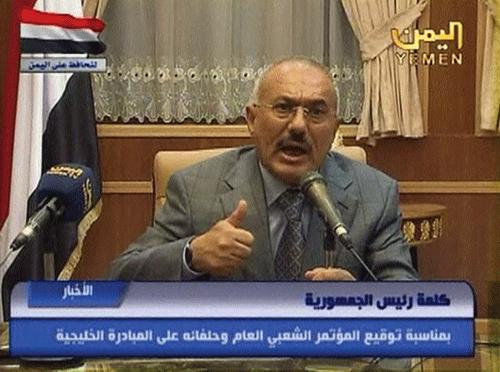
Tens of thousands of protestors throughout Yemen continued to demand the fall of President Ali Abdullah Saleh last month. This is a testament to the fact that the president and his ruling clique seem to have decisively failed in their draconian clampdown on the media, a clear bid to “monopolize the message.”

Throughout the last bloody three months, which have seen more than 120 peaceful protestors slaughtered by security forces and their gun-slinging loyalists, journalism has also been a major victim. Dozens of incidents of beating, kidnapping and censoring local and foreign media have run in parallel to the regime’s erratic bloodletting. The youth protest movement has been quick to notice that their cause desperately depends on conveying the behavior of President Saleh in its full horror, and have made obvious common cause with international outlets.

“Al Jazeera,” painted in bright white and broad calligraphic strokes, is emblazoned on the pavement of Yemen’s “Change Square” outside Sanaa University. Meanwhile, the government’s partisans have taken a full account of their detractors in the media, and predictably, they are not content to disagree civilly.

“We caught an Al Jazeera camera crew try to sneak up to ourprotest,” Saleh-supporter Nabeel Majid, said casually. Then, with a proud, deep laugh he proclaimed: “We beat them and sent them running!” A particularly memorable placard at the same gathering consisted of the Israeli flag, with the Star of David beside the Al Jazeera logo, a complement to the president’s assertion that unrest in his country was engineered in “the control room in TelAviv.”

After nearly 33 years of divide-and-rule politics and endemic corruption, Saleh’s power-hold is now in doubt; the regime is utterly incapable of countenancing the truth and will stop at no lengths to keep it away from a people gaining a new consciousness. First, the government deported Al Jazeera journalists, then plain-clothes thugs broke into the station’s downtown Sanaa offices and looted its camera equipment. Baffled by how the network kept managing to spirit correspondents into the country despite an official ban, security forces finally super-glued the door of their officeshut.

But the powers that be in Yemen will need more than super-glue to put their broken government back together again. A massacre on March 18th of more than 50 demonstrators, many of them just young boys, shocked the nation and led to a wave of official resignations from which the President is still reeling. Perhaps not a coincidence, the deportation of six foreign journalists, working for major outlets such as The Wall Street Journal and Time magazine, predated the atrocity by a matter of only a few days.

Poor Yemen, known in happier times as “Arabia Felix,” has never been a media darling.  Even in these heady days, the most revolutionary and hopeful in its millennia-old history of civilization, other current events in the Arab Spring, notably Libya and Syria, are stealing the headlines. And that’s just the way the president likes it. The media is something to be courted and coaxed, not welcomed and let free to do its work. Journalist visas, now non-existent, were granted with gusto by the government when Al Qaeda was the scoop and panicked western audiences promised dividends in military aid and development assistance.

The staff of CBS news documentary “60 Minutes” was even granted exclusive access to the president’s nephew, General Yahya Saleh, to discuss the much-exaggerated threat of terrorism. Now that the Central Security Forces, which Yahya commands, are busy shooting and tear-gassing protestors throughout Yemen, the General has suddenly become camera shy. Meanwhile, the many government news outlets are engaged in a race to the bottom. “Al Yemen” TV describes the perpetrators of March’s massacre as merely annoyed neighbors. “Nabanews” trumpets pictures of young men and veiled women together at protests as “proof” of shameful and impious “mixing” of the sexes.

A small group of international journalists, many of them poorly paid young freelancers, remain to document the struggle for the future of 24-million Yemenis to the outside world. But most promisingly, a whole generation has finally been inspired to unleash their creative potential and, for once, seize the means of defining their own identity. Countless young Yemenis now dedicate themselves to citizen journalism, blogging, and “facebooking” the progress of their movement, confident that the day the government can no longer dictate their lives is near.

William Dubbs is the pseudonym of a journalist based in Sanaa


May 3, 2011 0 comments
0 FacebookTwitterPinterestEmail
  • 1
  • …
  • 378
  • 379
  • 380
  • 381
  • 382
  • …
  • 686

Latest Cover

About us

Since its first edition emerged on the newsstands in 1999, Executive Magazine has been dedicated to providing its readers with the most up-to-date local and regional business news. Executive is a monthly business magazine that offers readers in-depth analyses on the Lebanese world of commerce, covering all the major sectors – from banking, finance, and insurance to technology, tourism, hospitality, media, and retail.

  • Donate
  • Our Purpose
  • Contact Us

Sign up for our newsletter

    • Facebook
    • Twitter
    • Instagram
    • Linkedin
    • Youtube
    Executive Magazine
    • ISSUES
      • Current Issue
      • Past issues
    • BUSINESS
    • ECONOMICS & POLICY
    • OPINION
    • SPECIAL REPORTS
    • EXECUTIVE TALKS
    • MOVEMENTS
      • Change the image
      • Cannes lions
      • Transparency & accountability
      • ECONOMIC ROADMAP
      • Say No to Corruption
      • The Lebanon media development initiative
      • LPSN Policy Asks
      • Advocating the preservation of deposits
    • JOIN US
      • Join our movement
      • Attend our events
      • Receive updates
      • Connect with us
    • DONATE