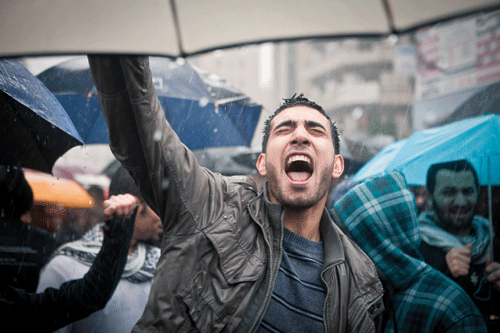
During the rain and overcast last month, one would have been forgiven for thinking the masses of Lebanese reciting slogans skyward about independence, resistance, justice, arms, tribunals, truth and stability had been duped into believing that their approach to social and political discourse would make the sun come out and the sky turn blue. Instead, however, many Lebanese would do well to regard each day that passes as an opportunity lost to the dreary sectarian bickering of our politicians — the same ones we fought so ardently to elect.
That we Lebanese have mixed up our priorities is nothing new but that does not make it any less relevant or painful to watch. Foreigners marvel at how we put up with governments and parties that have, literally, no stated socio-economic policies, but instead spout vague dogmatic principles that change with the tide. And yet still, we wait for the call from our zaim to cast a ballot or carry a placard. Thankfully, events in the region have put things in perspective. No longer can we claim to be the vanguard of freedom and democracy in the Middle East. Indeed, the Lebanese pale into the shadows of apathy behind the uprisings of our Arab brethren elsewhere demanding free societies that value equality over political patronage and sectarian entitlement.
Of course, there are those who will make the excuse that Hezbollah’s weapons are the problem, but it’s not the weapons themselves that prevented previous governments from forming a national labor strategy to absorb the 15,000 graduates each year — many of whom eventually leave the country — or prevented us from reforming our public sector to properly provide basic services such as electricity, water and telecommunications. Rather, it is the constant employment of these weapons in the politics of fear that has led us to this point. The situation will persist as long as the discourse remains in its present absolutist form: that arms should only be under the purview of the state or that the weapons — with their ambiguous size, location and uses — provide better security than a national army subject to regional and international pressures and commitments.
While both of these arguments hold some merit, neither honestly portrays the whole picture. What neither side is willing to admit is that there is a solution to the problem that they effectively evade.
Israel is not the only reason that Hezbollah’s weapons continue to exist outside of sovereign authority. The history of the south and its majority Shia inhabitants is wrapped with mistrust of the state due to decades of disregard from the central government in Beirut, dominated by the Sunni and Maronite powers. The divide is not only over arms, but also provision of public services; the sectarian overlords who hold influence over that provision have used it to underpin their politics of “fearing the other,” thus conscripting loyalty within their community and preserving the status quo.
But over the last two months cries for toppling the sectarian regime have risen in Lebanon, with thousands marching through the streets in protest last month. While expression of this secular vein is not in itself new, its current manifestation is within, and propelled by, a regional context demanding of substantive change rather than a cosmetic rearrangement of the existing power structure. Those who benefit from Lebanon’s current social construct know their power would be threatened if reforms toward a secular system gained momentum, and that in a society built on the principle of equality the emotive force of their sectarian sloganeering would be rendered mute. Even the issue of Hezbollah’s arms would be tempered, as the associated paranoia over them would lose its confessional dimension.
For this movement toward change to gain critical mass, it will need to convince the skeptics, many of whom also support the end of the sectarian system but are wary of any new movement being co-opted by either side of the current religious and political divide. There are many other factors that will also determine the movement’s success, but one thing needs to be recognized: now is an historic opportunity to wake the Lebanese consciousness, for us to stop baying like sheep for leaders who only perpetuate our problems and to cast them from their thrones as we march toward a solution together.
Sami Halabi is deputy editor of EXECUTIVE Magazine