• Donate
  • Our Purpose
  • Contact Us
Executive Magazine
  • ISSUES
    • Current Issue
    • Past issues
  • BUSINESS
  • ECONOMICS & POLICY
  • OPINION
  • SPECIAL REPORTS
  • EXECUTIVE TALKS
  • MOVEMENTS
    • Change the image
    • Cannes lions
    • Transparency & accountability
    • ECONOMIC ROADMAP
    • Say No to Corruption
    • The Lebanon media development initiative
    • LPSN Policy Asks
    • Advocating the preservation of deposits
  • JOIN US
    • Join our movement
    • Attend our events
    • Receive updates
    • Connect with us
  • DONATE
Comment

Banking the Holocaust

by Peter Speetjens December 3, 2010
written by Peter Speetjens


Victims turned into villains on November 9 when the United States Federal Bureau of Investigation (FBI) announced it had arrested 17 people accused of issuing false claims and documents to obtain pensions and hardship allowances from the Conference on Jewish Material Claims against Germany, better known as the Jewish Claims Conference (JCC).

There are strong suspicions the $42.5 million fraud case is only the tip of the iceberg. Especially in the last two decades, the JCC has come under fierce criticism for greed, mismanagement and a lack of transparency, even within Israel and the Jewish establishment. Founded in 1951, the JCC represents Jewish victims of Nazi persecution and their heirs in negotiating for compensation and restitution from the German government “to secure… a small measure of justice.”

To date, Germany has paid some $60 billion, which the JCC administered and distributed not only among victims and heirs, as was originally intended, but also among a long list of Jewish organizations that deal with Holocaust victim care, commemoration and education. Many of these organizations are represented on the JCC Board of Directors. Following the FBI statement, the JCC went into spin mode with adverts and interviews to portray itself as a victim, which was the language adopted by most media and even the US prosecutor.

Yet, six of the accused actually worked for the JCC, including Semen Domnitser, who since 1999 headed two of its funds. He was jailed, but immediately freed on $250,000 bail pending trial. The actual victim is of course the German taxpayer.  Writing in Israeli daily Haaretz, Anschel Pfeffer defined the JCC as “the richest, most powerful and least answerable old-boys’ network in the Jewish world” and feared the scandal was unlikely to be a case of “a few bad apples.”

According to a former JCC director, the organization has amassed more than $1 billion in liquid assets, while the Jewish Chronicle criticized the $437,811 salary one JCC official received in 2004. Isi Leibler, a former chairman of the World Jewish Congress, accused the JCC of incompetence and cover-ups and called for an independent review board. Likewise, the Movement for Quality Government, an Israeli anti-corruption platform, calls for the JCC to be placed under supervision. The JCC’s creative accounting methods seem to have started after the fall of the Berlin Wall, when the organization saw a whole new world of options and possibilities to seek compensation for Jewish victims and their heirs living in countries of the former Soviet Union. The $42.5 million fraud mainly deals with such cases.

One case in particular has created bad blood both within and outside the Jewish community. In 1990, when the new democratic government of East Germany introduced a law to restitute property nationalized by the former communist regime, the JCC — even before the reunification of East and West Germany — ensured that this included the restitution of Jewish-opened property sold after 1933 or confiscated by the Nazis. What’s more, the JCC became the legal successor to all Jewish property that went unclaimed by the end of 1992, whereby it had the privilege to file “broad claims” in which such minor details as the property’s actual location and the owners’ names could be filled in at a later stage. German weekly Der Spiegel reported that some 240,000 claims were filed in East Berlin alone. In some cases, there were 10 claims for one property and in nearly all cases the JCC was one of the claimants. According to the JCC, the “real estate” fund brought in some $2.3 billion. The JCC is currently negotiating with other Eastern European countries over a similar settlement. Finally, the JCC administers the $1.5 billion of the curious Swiss Banks Settlement account, which some people have called the biggest case of legal blackmail in the history of mankind.

While the $42.5 million scandal may have opened the lid for more investigations concerning the JCC, some more fundamental questions come to mind. For example, if a Jewish victim of Nazi persecution is entitled to claim property he was forced to sell before fleeing in 1938, should a gypsy or homosexual holocaust survivor not be able to do the same? And, last but not least, what does this all mean for a Palestinian farmer who lost everything in 1948?

PETER SPEETJENS

is a Beirut-based journalist

December 3, 2010 0 comments
0 FacebookTwitterPinterestEmail
Comment

A house of ineptitude

by Executive Staff December 3, 2010
written by Executive Staff


As the first decade of this century draws to a close, Lebanese public policy is face down in a stagnant swamp. Of more than 60 draft laws put before parliament since it was elected more than a year and a half ago, it has passed only two.

Despite this, headlines in 2010 heralded Lebanon’s renaissance, with storied statistics glorifying the banks and real estate developers for propping up the country’s soaring gross domestic product. But if times are so good, then why has it become so common to see people digging through trash bins for recyclables to sell? Why can so few wage-earning Beirutis afford a home in the city?  

It is because Lebanon’s economic growth has produced few new jobs and wealth accumulation has been limited to the already affluent, who also frequently happen to be members of parliament, ministers and their associated entourages with major stakes in banks and real estate companies. While a handful of MPs seem genuinely concerned for the nation’s welfare, most elected officials show little initiative to operate more than a semblance of a state — one functional enough for them to protect their interests, but not so functional as to provide the Lebanese with services independent of their patronage.

Even the exclusionary growth Lebanon has been experiencing is unsustainable, however, with global organizations — such as the International Monetary Fund — and prominent Lebanese economists sounding warnings. The intensity of wealth concentration in Lebanon is starving the wider free market of capital, while government deadlock on infrastructure reforms is hobbling our productive sectors: industry lacks reliable electricity, our archaic telecommunications network stunts the service sector and entrepreneurial innovation, while agriculture needs a clean, secure water supply. The sprinting GDP growth is slowing and without new investments in infrastructure to carry it, the economy will run out of road.  

A positive note over the past year is that an understanding seems to be building in government that something needs to be done; the Council of Ministers, Lebanon’s cabinet, approved an electricity reform plan and a blueprint to overhaul the water sector is in the works, as is a new fiber-optic network. On paper at least, these plans show promise.

The problem is the different branches of government are not performing their most basic functions: parliamentarians are not passing legislation and thus cabinet’s reform plans have not been made law; reams of legislation that was passed in years gone by remain unimplemented by the ministries, and the judiciary has been impotent in holding ministers to accountable for this.

The current excuse MPs, cabinet and the courts have for not doing their job is the confrontation between the government and the opposition over the United Nations’ Special Tribunal for Lebanon (STL), which has degraded political dialogue in the country to imbecilic chest thumping. The STL, however, for everything else it is, is also a scapegoat. The intransigence of Lebanon’s political and sectarian chiefs preceded the STL and will most likely survive its passing.

It is not the STL stopping the implementation of widely beneficial, desperately needed socio-economic reforms — our so-called leaders are doing that.


December 3, 2010 0 comments
0 FacebookTwitterPinterestEmail
Economics & Policy

Q&A with Raya Hassan

by Sami Halabi December 3, 2010
written by Sami Halabi


Raya Hassan is Lebanon’s finance minister. Saddled with a debt  around one-and-a-half times the size of the country’s economic output, a gaping deficit and a lack of infrastructure, she is tasked with making a method out of the madness. In an exclusive interview Hassan sat down with Executive to discuss everything from her ministry’s performance to the economic priorities of the government.

E  The ministry’s strategy to reduce the debt-to-GDP ratio appears to have been successful, but we only have potentially unreliable national accounts figures for 2008 to go on. As such, how can we accurately assess the progress made in the last two years, or even make projections?

For 2010 we brought an expert from INSEE [French National Institute for Statistics and Economic Studies] to help us project a growth rate for 2010. On the basis of the 2008 data we extrapolated, we can then determine what the 2010 GDP would be. We also use that same base for a projection for 2011 and 2012. Of course, the projections in terms of real growth rates are reviewed each year based on the projected activities in the economy. It is not based on real surveys for the economy but it is as close as we can get in the absence of work that is [now] being done by the Central Administration for Statistics (CAS).

E  For the first time you have projected a decrease in the amount of debt servicing, but the principal continues to grow. With telecom privatization being discounted for a few years to come and other Paris III reforms tied up in parliament, how will you reduce the principal on the debt now that our rate of borrowing is getting better?

In terms of reduction in the stock of debt, I don’t think there is any action in the foreseeable future… because as you said there are no plans for imminent privatization of the telecom sector [which would create capital with which to make repayments]. Of course [the stock of debt] is important, but for us I think what is more important is how to reduce the flow and ensure that the debt is not increasing at an increasing rate. That is why we look at growth as an anchor for controlling debt-to-GDP and at ensuring that we have a primary surplus in the budget in order to ensure that, at least, as the years progress we have a restriction on the increase of the debt stock in a sort of controlled manner. It’s the best we can do, as the primary surplus creates a cushion to any increase in the stock of debt.

E  But that primary surplus comes from the lack of infrastructure spending. We are going to have a problem with growth if we don’t catch up with infrastructure, so the primary surplus is not necessarily a blessing.

It’s a mixed blessing because even though the debt increase is going to be controlled, on the other side you are not going to have all the capital expenditures that would unleash the full potential of the Lebanese economy. The 8 percent growth rate that we project for 2010 is very good. However, in order to ensure the sustainability of this growth rate and to ensure that it is being translated developmentally on the ground, it is important for us to address the structural deficiencies in the economy. If the 2010 budget is ratified, all of these capital expenditures hopefully will be released and we will start to see some benefits coming out of it.

E  You have said that the current growth has not translated into jobs on the ground. Now that political tension is rising and there is a lag in policy making, have we lost this growth cycle?

There has not been as much job creation as we would have liked [and] I think the golden opportunity that we had in 2010 is now starting to fade away. What is good is that even with all the political upheavals we are still seeing some positive developments. I am a bit surprised frankly. However, 2010 would have been a golden opportunity to really capitalize on these positive developments and move forward in order to capture these good indicators and consolidate them. [The longer] this political environment persists, the less we will be able to do in the short term.

E  You seem to have abandoned a value-added tax (VAT) increase again for 2011 and are now saying you would re-examine exemptions. What is the current VAT strategy?

It’s not just [about] VAT. Our tax policy [aims to be] equitable, distributed and efficient. When I first took office this is what I [did] in terms of the assessment of the current tax structure. What we have concluded out of this study is that the tax policy is equitable, believe it or not, efficient and reflects the structure of the Lebanese economy. This economy is based on consumption and mostly on imports and not exports.

Now, if we are going to increase unproductive expenditures this is something that I will fight. But if the parliament approves and ratifies current expenditures that would put a dent on the primary surplus or the budget deficit then I will have no choice except to increase revenues.

E  By imposing new taxes?

New taxes, of course, because we are adamant that the budget deficit should be controlled and it should not increase, and we need to have a primary surplus, and we need to reduce the debt-to-GDP ratio. If there is going to be an uncontrollable increase in expenditures, the Ministry of Finance has no choice but to increase revenues. Growth will take care of some of it, but we have to look at other options.


E  You say that the tax structure reflects the Lebanese economy, but the economy is changing with real estate constituting an ever-greater proportion of GDP and the productive sector becoming less important. You have suggested an increase of 5 to 7 percent on the registration tax for properties over $500,000 and now say that you want a re-evaluation tax, but there are other real estate taxes that are much easier to apply.

I did suggest a tax on vacant real estate… because [vacant properties] are not taxed today. That is what I proposed in the 2010 budget but it was not approved within the parliamentary committee. For the 2011 budget I proposed a ‘quasi-capital gains tax’ [on real estate]. It’s not a capital gains tax per se because to be able to impose a capital gains tax you would have to have a complete database of the real value of real estate, and we don’t have that today. But in the absence of a complete valuation database, I am saying that we have to impose a 1 percent tax on revenue emanating from the sale of properties.

E  How much do you expect that to take in?

Some 200 to 300 billion [LL] ($133 million to $200 million). But this is not an optimal solution. What we are hoping to do is make this a transitory solution until either the valuation exercise is complete or we take a decision, and this will be discussed by the Council of Ministers. There is going to be a cut off point as of, say January 1, 2011, and afterwards we will capture the real value of the property, start to recognize any future transactions, and try to impose a capital gains tax.

E  Many of the MPs, if not most of them, have interests in real estate and some of the ministers as well. Is this the main problem with imposing real estate taxes?

[Sigh,] Look, we passed a 2 percent increase in the registration tax. There is [a possibility of] the tax on vacant property. There were going to be three tax measures that were going to be imposed on real estate. However, I think the concern was that in the advent of this slowdown in the economy, especially in the last two months, there is a fear that all three measures would really impact the real estate sector very hard. Whether we like it or not, the real estate sector is part of the growth pillar. I think this is where they are coming from. The fact that we passed at least one, and the fact that we are still going to discuss the 1 percent on revenue, I think would be fair for the time being.

E  In terms of salaries and related payments (the second largest expenditure item) the salary scale is not changing, the organizational structures proposed by the Office of the Minister of State for Administrative Reform (OMSAR) are not being implemented, the public bodies remain bloated bodies of patronage and the United Nations Development Programme (UNDP) is doing a lot of the work that the public sector should be doing…

Not a lot of the work; the policy work.

E  When does this stop and the transfer of capacity happen and we start cutting the edges?

I agree with you fully but the underlying factor is the political will to do it. This is not just up to the Ministry of Finance or OMSAR. We believe that the public sector could be much more productive. We think the public sector is bloated and needs to be reformed: the laws, the regulations and the capacities. However, that would mean that maybe we need to do some retrenchment in the numbers and need to look at the salary scales and look at training and this is a huge political decision. I think, and I discussed this with the Prime Minister, that the time is opportune to look at the salary scales and review them because the last time we reviewed them was more than 10 years ago. But, the review of the salary scale cannot be done independently…

E  It has to be changed along with the organizational structures of public administrations. But at the same time you are proposing to increase the number of security services significantly and this will mean more salaries and pensions. Frankly, the security services cannot fight Israel or fight battles in the streets. What is the point?

[Laughs] But, ok. You need them not just to maintain security within Lebanon but also you need them for traffic control, for ensuring the proper functioning of the state. For the army, we are trying, as much as we can, to get grants from abroad. This is a priority. Listen, if you don’t have security, you don’t have an economy.

E  But it is a political decision for them to come into Bourj Abi Haidar when there is a clash. This has nothing to do with if there are 20 or 100 troops.

But you are talking about the sovereignty of the state and the prestige of the state; you can’t have that if you don’t have a strong army and a strong internal security force that would allow you not to depend on non-Lebanese or non-official sources.

E You have already advanced the money for the fiber-optic broadband cables plan to the telecom industry to get the ball rolling. First of all, how much has been advanced and how did you do it without parliamentary approval?

It’s a treasury advance. And we are always attacked for treasury advances [by] the Ministry of Energy and the Ministry of Telecoms… We advanced the Ministry of Telecom around 100 billion [LL] [$66.7 million] to start the fiber-optic plan in the absence of a telecom sectoral plan. Now the fiber optics is a given and we have to do it, but how does this fall into an overall plan? We still don’t know.

This [issue] is the most detrimental in terms of the competitiveness of the Lebanese economy. We have been waiting now for more than a year, we have not even discussed any potential sectoral plan. Nothing. Not even a discussion. The TRA [Telecom Regulatory Authority] is crying. The whole economy is crying. This is where I think we are at our weakest. There should be something done very quickly. We could take years to come up with the perfect plan but that time is costing us huge amounts of economic growth. It’s going to be a huge detriment to the economy.

E  What is your forecast for 2011?

Well, that depends on what will happen in the next short period. If this political impasse persists then I think we are going to be seeing a tangible slowdown. In the last couple of months we have seen somewhat of a slowdown but this has been compensated by the very high growth we witnessed in the first six months of the year. If this persists then I’m going to be really concerned about the state of the economy in 2011.

December 3, 2010 0 comments
0 FacebookTwitterPinterestEmail
Finance

Executive insight – Standard Chartered

by Nicole Purin December 3, 2010
written by Nicole Purin


The Islamic finance market is currently undergoing structural transformation. Arguably, the most significant legislative development in 2010 for the industry was the publication of the Sharia-compliant Tahawwut (hedging) Master Agreement (TMA).

The TMA is the first standardized cross-jurisdictional document of its kind for privately negotiated Islamic hedging products. It has been developed by the International Swaps and Derivatives Association (ISDA), together with the International Islamic Financial Market (IIFM), under the approval of the IIFM Sharia Advisor Panel and in consultation with market participants (such as the Dubai International Financial Center authority and Standard Chartered Saadiq).

The completion of this document has been regarded as monumental for the Islamic hedging sector. The global crisis highlighted the importance of more robust risk management processes and standardization of Islamic hedging documentation in the context of Islamic derivatives. ISDA and IIFM worked closely with the Sharia scholar community to ensure that the structure and content of the document would meet approvals across the board; such consensus was finally secured after protracted negotiations.

The Tahawwut Master Agreement

The TMA is modeled on the 2002 ISDA Master Agreement which is used by market participants to document conventional derivative transactions, but unlike the conventional master agreement, the TMA is limited to Islamic hedging products such as profit rate and currency swaps.

The document complies with the requirements of Sharia Law and accordingly the form eliminates interest and stipulates that trades may not be entered for gambling purposes (but solely for the purposes of hedging). In addition, no settlement based on valuation or without tangible assets is allowed. It is essentially a framework agreement where Islamic structures such as murabahas (a sale and deferred payment arrangement used to provide trade or acquisition finance) and wa’ads (unilateral promises) are documented, which includes completed and future transactions. Fundamentally, the agreement creates the hedging mechanism by separating various legs of the underlying hedged transactions for the purposes of Sharia compliance.

Make or break

Industry participants have claimed that the TMA is a highly innovative document that achieves standardization without compromising on Islamic principles. Afaq Khan, chief executive officer of Standard Chartered Saadiq, stressed that the TMA will allow Islamic banks to offer end-to-end solutions to their customers and will allow better treasury-risk management tools for Islamic financial institutions to competitively manage market risks. However, to this date, the TMA remains untested in the market.

Firstly, it appears that in some Muslim countries market participants would rather conform to locally established hedging techniques. Secondly, from a technical perspective, the close-out netting mechanism — close-out netting allows parties to aggregate their exposures and reduce them down to a single payment following a default or other termination event by a counterparty — in the TMA faces practical limitations as it can only be enforced on counterparties in jurisdictions where netting is part of the national insolvency law, such as common-law based legal regimes.

Will change come in 2011?

Overall, in spite of all the industry’s efforts, it is unclear at this point in time whether the agreement will become widely used in the market. One must not forget that when the 2002 ISDA Master Agreement was launched, key market players were reluctant to use it and they preferred to rely on the 1992 form. Eventually, the 2002 version superseded the 1992 form.

Change is a perpetual characteristic in the current business environment and in spite of the Islamic industry’s adherence to existing practices, the benefits of market standardization outweigh any potential risks. In the spirit of standardization and innovation, the adoption of this document by market participants would be a positive development and there is a strong consensus in the market that 2011 might be the break-through year for the TMA.


December 3, 2010 0 comments
0 FacebookTwitterPinterestEmail
Economics & Policy

Executive insight Byblos Bank

by Nassib Ghobril December 3, 2010
written by Nassib Ghobril


Official figures put the average real growth rate of Lebanon’s economy at about 8.8 percent during the years 2008 to 2010, constituting one the highest average growth rates in the world over that period.

Indeed, only Qatar, Afghanistan, Timor-Leste, China and Ethiopia posted better growth rates than Lebanon during these three years. Further, Lebanon’s real gross domestic product growth rate averaged 9.2 percent in 2008 and 2009, almost identical to China’s 9.4 percent output for the same years. These figures put the performance of the Lebanese economy among the best globally, a remarkable achievement if one were to believe the official numbers. But high and sustained rates of economic growth require a number of factors, including a very competitive economy in most of its pillars. This year, and for the first time, the competitiveness of the Lebanese economy has been measured and benchmarked against the rest of the world.

The World Economic Forum ranked Lebanon in 92nd place among 139 countries on its Global Competitiveness Index for 2010-11. It also ranked Lebanon in 26th place among 32 upper-middle income countries and in 12th place among 15 Arab economies included in the survey. The index measures national competitiveness and highlights its micro and macroeconomic foundation. It measures a country’s and its enterprises’ ability to compete in global markets, based on the supporting institutions, infrastructure, economic policies and education and healthcare systems, the country’s capacity for innovation as well as the sophistication of domestic markets and local business practices.

Hamstrung by poor infrastructure

A closer look at the index ‘s detailed results shows that Lebanon does well on efficiency-enhancing indicators such as health and primary education, higher education and training, efficient markets, financial sector development and business sophistication, among others. But it is clear that the poor state of infrastructure is a major impediment to the competitiveness of the Lebanese economy.

Lebanon ranks in 123rd place among 139 countries for the quality of its infrastructure. In other words, Lebanon has a better infrastructure than just 22 percent of the countries surveyed. Lebanon falls immediately behind Mauritania, Mali and Lesotho, while ranking ahead of Paraguay, Cameroon and Cambodia. Mauritania and Mali are low-income economies and Lesotho is classified as a lower-middle-income economy.

Lebanon also has the worst infrastructure among the 15 Arab countries included in the index, as well as among countries of the same income level. The results indicate that Lebanon has the infrastructure of low-income countries, while its per-capita income is one of the highest among upper middle income economies.

However, the details show that it is not the entire infrastructure that is neglected, as Lebanon has the 36th best air transport infrastructure, the 55th best port infrastructure and the 71st best fixed telephones network in the world. So what is dragging the quality of infrastructure to the level of poor economies is primarily the low quality of electricity supply and mobile telecommunications, followed by the poor state of roads and railroads.

The quality of electricity supply is the single biggest infrastructural obstacle to the competitiveness of the Lebanese economy, as Lebanon ranks in 136th place on this category, classifying it as having the fourth worst electricity supply of the 139 countries surveyed.

The quality of mobile telecommunications does not fare much better, as Lebanon has the 16th lowest level of mobile phone subscription, reflecting the network’s limitations.

In parallel, a survey showed that a plurality of executives at Lebanese companies consider that the inadequate supply of infrastructure is the single biggest problem for doing business in Lebanon, as 18.5 percent of respondents put infrastructure bottlenecks as the most important obstacle for their work, ahead of government bureaucracy, political instability and corruption.

Making it all add up

So how can the Lebanese economy grow by an average of 9 percent annually and, at the same time, have vital components of its infrastructure in such a dismal situation? The more pertinent question would be: does Lebanon growing by an average of 9 percent annually mean the country does not have infrastructural impediments, or are infrastructural bottlenecks so significant as to raise questions about the reliability of the growth figures?

Benchmarking the scope of improvement for Lebanon shows that if the country achieves a maximum value on each of the categories in the infrastructure sub-indicator within the Upper Middle Income group to which it belongs, its rank would jump by 91 spots to 32nd place globally in the quality of its infrastructure. As such, Lebanon’s infrastructure would become comparable to that of Estonia, Israel, Thailand and Oman.

In turn, this would push the country’s overall competitiveness ranking to a level allowing the economy to effectively compete on a regional level and achieve its growth potential.

Studies by the International Monetary Fund and the World Bank indicate that improving the electricity supply would raise Lebanon’s real per capita GDP by 1 percent annually, while upgrading the broadband infrastructure would add as much as 1.4 percent annually in real per capita growth.

The electricity issue is being addressed through a comprehensive five-year restructuring plan, which has been approved by the cabinet with vast sums allocated in the 2010 budget for this purpose.

Also, the Cabinet’s Ministerial Statement called for upgrading the telecom infrastructure. These initiatives, even with political consensus, will require time to be completed but they would help alleviate key obstacles to economic growth.

If competitiveness is to truly be raised, along with upgrading Lebanon’s hard infrastructure, the country’s statistical infrastructure must also be upgraded in order to provide a more realistic and transparent picture of the actual growth and performance of the economy.

December 3, 2010 0 comments
0 FacebookTwitterPinterestEmail
Economics & Policy

Time of mixed fortunes

by Sami Halabi December 3, 2010
written by Sami Halabi


During the civil war, Beirut’s Commodore Hotel acted as a shelter for the various journalists and dignitaries who would brave the chaos to try and understand why this small but promising Mediterranean nation had fallen prey to the ravages of conflict.

Twenty years since the guns fell (relatively) silent, and with many a former warlord now a politician or member of cabinet, it was fitting last month that the Lebanese Economics Association (LEA) chose the same hotel to launch its own assault on how the powers that be are again squandering opportunity and endangering the country.

“It’s always about how they split the kaaki [traditional Arab bread],” said Elias Saba, two-time former Lebanese minister of finance, at the press conference. “When they [politicians] agree on that, all the bickering ends and it’s over.”

By the end of 2010, that kaaki had yet to be divvied up, and the cabinet had come to a complete standstill over the United Nations’ Special Tribunal for Lebanon. Not to be outdone, Parliament had yet to convene to pass a budget for the year, despite being constitutionally mandated to do so in October.

“When the Council of Ministers [Lebanon’s cabinet] gets postponed it turns out to be an achievement, instead of them fighting,” sighed Nassib Ghobril, head of economic research and analysis at Byblos Bank.

While Lebanon’s policy makers tussled over wider political issues, the economy was witnessing — on the surface at least — what many observers deem to be the end of Lebanon’s economic honeymoon. The current economic recovery cycle began its upward curve in 2006 when real growth hit a low of 0.6 percent. Since then, the economy has bounced back to register 7.5 percent real growth in 2007 and peak at 9.3 percent in 2008, a figure that only became apparent in April, 2010, when the 2008 National Accounts were released to the public.

Coincident indicator (An average of eight weighted economic indicators)

A lack of reliable data means that everything from that point onwards is more or less a blur. However, economists from the International Monetary Fund (IMF), the finance ministry and the Economist Intelligence Unit (EIU) all agree that growth has begun to slow and move into a trough, which will result in anywhere from 5 to 8 percent growth in 2010, and even less in 2011.

That means that even though growth is still high by global standards, the chance to take advantage of this opportunity has been missed, “as always, as usual,” said Jad Chaaban, acting president of the LEA, “because the politicians are bickering.”

The dearth of economic data notwithstanding, it has become apparent that the political tensions that have materialized in the second half of 2010 are hitting the country’s economic standing hard.

The coincident indicator, an average of eight weighted economic indicators published on a monthly basis by Banque du Liban (BDL), Lebanon’s central bank, shows that economic activity mushroomed during the first three months of the year, climbing 8.3 percent to reach 264.5 points in March and fell back to a still respectable 251.9 points in July.

Fears of instability, brought on by incidents such as clashes in Bourj Abi Haider (above), and the exchange of fire between Lebanese and Israeli forces on the border, threaten economic growth

In August it saw a sharp decline to 228.3 points, ostensibly a result of political tension rising after a cross-border firefight between the Lebanese and Israeli armies and clashes between the Shia Hezbollah and the Sunni Al Ahbash groups. Tacked on to this was the fact that Ramadan fell in August, resulting in hotel occupancy rates of just 43 percent at a time when they are usually full to the brim with Gulf tourists escaping the summer sizzle.

As Executive went to print, the indicator was resting at 229 points for the month of September, the same month Prime Minister Saad Hariri admitted that it was a mistake to have accused Syria of his father’s assassination and that “false witnesses” misled the investigation. The latter sparked an explosive row which put the cabinet’s policy agenda on the backburner.    

“Since July everything has shifted to politics and the tribunal and the president’s role has been limited to trying to assemble the Council of Ministers. So who is talking about other things at this stage?” said Ghobril.

Uneven growth

Whatever growth has been achieved has been unevenly distributed to limited segments of the economy, according to Eric Mottu, the IMF’s resident representative in Lebanon. He estimates that 4 to 5 percent of real economic growth came from retail trade and 2 percent stemmed from construction, leaving agriculture and industry with marginal to negative growth. This corresponds with his organization’s estimate of 8 percent growth in 2010.

As Lebanon’s economy has been dominated in recent years by services industries, productive sectors have more or less taken a backseat. According to Toufic Gaspard, economic consultant and former director of research at BDL, this historical phenomenon is lamentable, because even though in many developed countries industry now constitutes a small share of total gross domestic product, they developed high productivity within their manufacturing sectors in the past, before transitioning into services and other sectors.  

“No country in the world has developed without manufacturing, and it’s not because we like the smoke stacks, it’s because manufacturing creates jobs and is a driver of productivity,” said Gaspard. He added that the growth experienced from 2007 to 2010 was mostly the result of pent-up demand following the withdrawal of Syrian forces and was constrained to the real estate, construction and tourism sectors in the center of the country. “If we have the same [de-industrialized] structure we [will] produce the same performance. No matter how you look at it we are not doing well at all.”

Looking at the numbers, it’s no surprise that many are pointing to real estate as the main source of uneven growth across sectors. According to the General Directorate of Land Registry and Cadastre (GDLRC), the sector saw the value of property sales skyrocket by 60.6 percent during the first three quarters of 2010 to hit a record-breaking total value of $6.96 billion, some 20 percent of the EIU’s 2010 GDP estimate. 

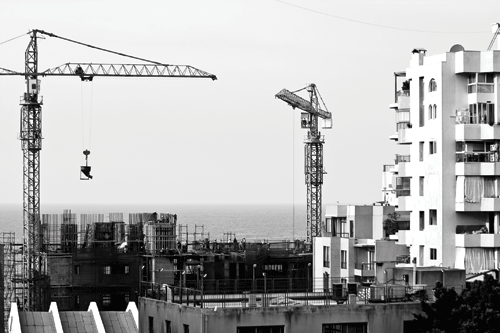
Record real estate profits and banks with more cash than they know what to do with mean little to Lebanon
</p>
									            </div>
        </div>

		            <div class=

December 3, 2010 0 comments
0 FacebookTwitterPinterestEmail
Finance

Executive Insight – GVCA

by Imad Ghandour December 1, 2010
written by Imad Ghandour


It is telling that the most exciting event in private equitythis year was the Celebration of Entrepreneurship event in Dubai — also knownas Wamda, the equivalent of the West’s eureka. It brought a much neededfreshness and vigor to a private equity industry that is in search ofexcitement and vision.

The private equity industry landscape has changeddramatically in the past two years as the mood has swung from celebration tohumility. Fundraising and deal-making activity shrunk in 2009 by as much as 85percent and did not recover, as many, including yours truly, hadprophesied. 

The number of funds that are active and investing has alsoshrunk to less than a dozen in the Gulf Cooperation Council from a peak of morethan 50, with many fund managers unwillingly switching from being deal makersto caretakers. Some funds have already closed down shop while others are facingup to the fact that, after their current ventures wrap up, there aren’t any tofollow.

Over the past four years, successful managers raced to raisebigger and bigger funds (as big as $4 billion) and few managers remainedfocused on the smaller opportunities, which constitute the mainstream of thecorporate landscape in the Arab world. Constrained by their current mandate,the remaining mammoth funds are now facing a new challenge: access to qualitydeal flow. These large funds are starving for new investment opportunities thatcan deliver the promised returns and are facing the grim scenarios of eitherreturning some of the cash raised to investors or investing in sub-pardeals.  

Funds raised in the MENA, by size

Going back to Wamda celebrations, the 2,000 delegates thatparticipated in the festive conference represent a renewed and revived core ofthe Gulf’s economic activity. Gone are the days when business in the region meantbetting on inflated real estate prices and skyrocketing stock markets. A muchmore sober mood of industrious entrepreneurship is setting in.

The number of people I know personally that are en-route tostarting their own businesses, despite the recessionary environment, isenormous. They come from all walks of life — from students to executives — andare setting up everywhere from Riyadh, to Jeddah, to Cairo, to Dubai, toBeirut, to Amman.

In the past 20 years working in the region, I have not seensuch a vibrant entrepreneurial environment as I do today. The benefits ofeconomic liberalization are starting to trickle in.

So what does that mean for private equity?

It means that there is a stellar increase in demand forequity funding, which is good news in principle, except that economicliberalization measures have not extended to privatizing large-scale stateenterprises. Instead they have given rise to a wave of grassrootsentrepreneurialism.

In other words, large private equity funds seeking to attract,say, a company like Gulf Air, are going to compete with each other over the fewopportunities of such scale that remain. On the other hand, smaller growthcapital funds focused on funding a company like Bateel — a successful regionalchain of date stores and cafés — will have ample opportunities from which tochoose.

Large funds are rigidly geared to do large deals; due to thehigh profile of the people they hire and the bandwidth of their fund managersit won’t be easy to switch their focus to smaller deals.

IMAD GHANDOUR is chairman of Gulf Venture Capital Assocation


December 1, 2010 0 comments
0 FacebookTwitterPinterestEmail
Finance

Sounding the alarm

by Emma Cosgrove December 1, 2010
written by Emma Cosgrove


Common sense is the currency of rational minds — in this respect Dubai may be short on change. On November 25, Dubai World, the wholly owned subsidiary of the Dubai government, announced that it would request a 6-month standstill on all payments and debt servicing of some $11 billion due to creditors in December — effectively giving notice that the further $49 billion the company has outstanding may also be beyond its means.

The announcement came after the markets closed for the four-day Eid al Adha holiday, during which time the company maintained complete silence while the news shook the financial world, prompting panicked investors to line up at the doors of Gulf markets to dump exposed portfolios when bourses reopened on November 30. As they waited in the Gulf, financial markets from London to Beijing shed share value in fear of their own exposure.

Dubai and Abu Dhabi markets dropped instantly at the opening bell, followed closely by other regional markets. The next day, Dubai World released a statement confirming it was in talks with United Arab Emirates banks to restructure $26 billion in debt. The company said restructuring could consist of “deleveraging options,” “asset sales,” and “formulation of restructuring proposals.”

“We would expect a decision to come out of [the discussions]  on what assets underlay the liabilities, and what the plan is for liquidizing those assets so that bondholders get some partial repayments,” said Raj Madha, director of equity research at EFG-Hermes.

Dubai has hedged its future on booming demand to fill some of the biggest malls in the world

As executives and Dubai authorities prioritize Dubai World’s obligations behind locked doors, the rest of the financial world can do nothing but wait and watch the markets.

The markets react

By the middle of November 2009, the financial world seemed optimistic — and with some justification. The Morgan Stanley Capital International (MSCI) index had recovered 48.9 percent of losses incurred during the downturn, while the MSCI Emerging Markets index had fared even better, recovering 58.13 percent. The MSCI Arabian Markets index — Gulf Cooperation Council, Egypt, Jordan, Morocco, Tunisia and Lebanon — also followed suit, albeit with a little less vigor, recovering 30.89 percent of their losses.

After the announcement that Dubai World could effectively not pay its debt on time, that recovery quickly went into regression. In just two days of trading the Dubai Financial Market (DFM) dropped 12.5 percent and the Abu Dhabi Stock Exchange fell by 11.6 percent. Dubai’s indices for real estate, as well as investment and finance, saw some of the worse losses, down 18.1 percent and 15.5 percent respectively.

Question marks hang over the prospects of Dubai
</p>
									            </div>
        </div>

		            <div class=

December 1, 2010 0 comments
0 FacebookTwitterPinterestEmail
Comment

2010: year of the food fight

by Executive Staff December 1, 2010
written by Executive Staff


</p>
									            </div>
        </div>

		            <div class=

December 1, 2010 0 comments
0 FacebookTwitterPinterestEmail
Finance

The vocabulary of the recovery – Recurring profitability

by Emma Cosgrove December 1, 2010
written by Emma Cosgrove

Recurring profitability

The repeated act of earning more than is spent.

“Banks have been hit by loan losses as well as investment losses due to the financial crisis. Recovering from the crisis effectively means returning to stable profitability,” said Moody analyst John Tofarides when asked what indicators are the most important to watch.

GCC Banking universe 2010 profit growth by region

Profitability is perhaps the most obvious indicator, but can also be the most misleading. Banks in the UAE, for example, saw a healthier first quarter of 2010 than second quarter, due mainly to an edict from the Central Bank to stop provisions for the first quarter. When a let up of bad loans did not materialize, they then had go into provisioning overdrive, which is why most saw smaller profits growth in the second quarter of 2010 than the first. Aggregate profits of the entire GCC banking sector declined 5 percent year-on-year at the end of June, and more tellingly, 10 percent quarter-on-quarter, according to Global Investment House, reversing the upward blip if the first three months of 2010.

UAE banks struggled the most in the second quarter and saw profitability shrink a dramatic 42 percent quarter-on-quarter. Omani banks, which saw profit drop 4 percent, were the other losers for the quarter. Banks in Saudi Arabia, Kuwait and Qatar averaged positive profit growths of 1 percent, 6 percent and 7 percent respectively, relative to the first quarter. Saudi Arabia and the UAE, however, were the only two countries with negative profits growth year-on-year.

Standard and Poor’s (S&P) predicts that profitability will be the last indicator to stabilize and return to a steady upward trajectory.

 So, recurring profitability is the sign that the financial fever has broken, the virus killed, and the GCC patient is back on the road to recovery.

Loan growth  

The percentage by which the total value of a bank’s loans changes over a certain period of time.

Healthy lending is the only way for banks to return to normal profitability. They can and are increasing their non-interest income through upping fees and offering more paid services, but if they are to fully recover, lending must resume.

Lending Growth, H1 2010 - GCC countries

But finding viable lending opportunities is challenging when personal as well as corporate finances are under such stress. Lending growth therefore can show not only the health of a bank, but also the health of the financial environment in which it operates. But the vacuum of viable lending is not the only hurdle. In crisis, banks become exceedingly cautious and reluctant to lend.

Steady lending growth will show not only an encouraging financial trend, but a behavioral shift as well, said Peter Baltussen, CEO of Dubai Commercial Bank. “Incremental loan growth will indicate whether banks are indeed willing to reverse their risk-averse approach of the previous years and start a positive credit cycle again, which will have a direct positive impact on the economy,” he said. 

In the first quarter of 2010, lending growth was varied throughout the region with most of the bad news coming from Saudi Arabia, the United Arab Emirates and Kuwait. However, though trends exist, lending practices vary more from bank-to-bank than from country-to-country. So this is an area where banks must be scrutinized individually rather than aggregated from each country (see chart). Though most of the region’s largest banks posted positive lending growth for the first half of 2010, many growth rates were quite low, leading regional experts to be very pessimistic in the their estimates of when lending will return to normal.

Sophia el-Boury, a UAE bank analyst at Shuaa Capital, said: “We’re not very optimistic in terms of lending growth. From now until the end of the year, banks will still be prudent and cautious to lend; the current operating environment is still changing.”

Bad loans

Loans that are not bringing income to the lending institution.

“Bad and doubtful debts and provisions reflect the credit worthiness of a bank’s customers and, sometimes, a region’s overall economy,” said Chief Executive Officer at United Arab Bank Paul Trowbridge of the GCC financial press’s new favorite phrase. “While reasons for potential non-payments can include disputes over supply, delivery or conditions of goods, they in general provide a clear indication on the appearance of financial stress within customer operations.”

According to S&P, non-performing loans have been steadily climbing since 2008, increasing across the GCC from 2.7 percent at the end of that year to 5.4 percent by the end of September 2009. S&P predicted in its February Banking Industry Report Card that NPLs would peak by mid 2010.

Qatar and Saudi Arabia have seen the lowest NPL ratios of all GCC countries. Qatar’s success in avoiding bad debt is no doubt due to the government’s swift action at the onset of the financial crisis, with the government buying up loans to the real estate sector from its banks and injecting capital into the system in October 2008. Kuwait is showing the most NPL struggles due to its banks’ predilection for local investment firms and real estate, which quickly became delinquent upon the onset of the crisis.


“Starting the second half of 2010 and assuming the economic recovery proceeds according to our expectations, we believe that asset quality for Gulf banks will likely bottom out before slowly improving,” stated the S&P report. NPLs are an important indicator not only because they demonstrate the general economic health of borrowers, but also because they forecast the continuing fortification against them, which is a major drag on profits.

Provisioning

The setting aside of funds to allow for existing or expected bad loans.

“The level of provisions has been the single biggest swing factor for regional banks in recent years,” said Dubai Commercial Bank’s Baltussen. Provisions in the GCC as a whole jumped nearly 5 percent year-on-year in the second quarter of 2010. Amid buzzing news of recovery at the beginning of the year, provisioning slowed across the board with the UAE Central Bank actually instructing its institutions to stop provisioning for their biggest threat, Dubai World.

Provisioning, H1 2010 - GCC countries

The instructions seem to have been quickly disregarded, however, as there was a 48 percent quarter-on-quarter increase in provisioning in the GCC in the three months to July 1, with nearly half of the quarter’s provisions taken by UAE banks. Saudi banks came in second regarding provisions, representing 23 percent of the quarter’s total.

Aggregate figures show provisioning by GCC banks peaked in the fourth quarter of 2008 when it became clear that the GCC would not be shielded from the crisis, and again in the fourth quarter of 2009, when the scandal and defaults of Saad Group and Algosaibi & Brothers had come into full effect and Dubai World had faltered. The second quarter of 2010 has seen the third most provisioning of any quarter since the crisis began, reaching nearly $2 billion.

A slowdown in provisioning will be perhaps the first sign of recovery for each country’s banking sector; an event that may be already occurring in Oman, as provisions there have returned to normal levels this quarter, according to Global Investment House.

December 1, 2010 0 comments
0 FacebookTwitterPinterestEmail
  • 1
  • …
  • 398
  • 399
  • 400
  • 401
  • 402
  • …
  • 685

Latest Cover

About us

Since its first edition emerged on the newsstands in 1999, Executive Magazine has been dedicated to providing its readers with the most up-to-date local and regional business news. Executive is a monthly business magazine that offers readers in-depth analyses on the Lebanese world of commerce, covering all the major sectors – from banking, finance, and insurance to technology, tourism, hospitality, media, and retail.

  • Donate
  • Our Purpose
  • Contact Us

Sign up for our newsletter

[contact-form-7 id=”27812″ title=”FooterSubscription”]

  • Facebook
  • Twitter
  • Instagram
  • Linkedin
  • Youtube
Executive Magazine
  • ISSUES
    • Current Issue
    • Past issues
  • BUSINESS
  • ECONOMICS & POLICY
  • OPINION
  • SPECIAL REPORTS
  • EXECUTIVE TALKS
  • MOVEMENTS
    • Change the image
    • Cannes lions
    • Transparency & accountability
    • ECONOMIC ROADMAP
    • Say No to Corruption
    • The Lebanon media development initiative
    • LPSN Policy Asks
    • Advocating the preservation of deposits
  • JOIN US
    • Join our movement
    • Attend our events
    • Receive updates
    • Connect with us
  • DONATE