• Donate
  • Our Purpose
  • Contact Us
Executive Magazine
  • ISSUES
    • Current Issue
    • Past issues
  • BUSINESS
  • ECONOMICS & POLICY
  • OPINION
  • SPECIAL REPORTS
  • EXECUTIVE TALKS
  • MOVEMENTS
    • Change the image
    • Cannes lions
    • Transparency & accountability
    • ECONOMIC ROADMAP
    • Say No to Corruption
    • The Lebanon media development initiative
    • LPSN Policy Asks
    • Advocating the preservation of deposits
  • JOIN US
    • Join our movement
    • Attend our events
    • Receive updates
    • Connect with us
  • DONATE
Finance

New year, new IPOs

by Executive Staff January 3, 2010
written by Executive Staff

In 2009, markets were battered by a seemingly never-ending series of financial crises — burst bubbles, financial meltdowns, soaring oil prices, credit crunches and falling home equity. These crises have weighted down the initial public offering market since 2008, and yet, the regional IPO pipeline is full — 150 companies have already announced IPO plans for 2010 and beyond.

Analysts say that with pent-up demand for equity, a large pipeline of deals and realistic sellers, there is every reason to believe that 2010 will be the beginning of an active and profitable period for IPOs.

According to available data, a number of regional companies plan to list this year, reopening a market that has been virtually shut even as investors lapped up billions of dollars worth of newly issued bonds across the Middle East and North Africa region.


While regional and global investors nurse their wounds over Dubai World’s debt problems, there are scores of opportunities if one looks beyond the immediate crisis. With many of Dubai’s state-owned entities restructuring and struggling to keep their finances in order, the government may look to offload some of these assets, say analysts.

“A number of government-linked companies, such as Dubai World and Nakheel, have generated spectacular growth for the emirate’s real estate, shipping, transport and financial sectors over the past two decades,” notes a Societe Generale report. “Now part of that constellation of companies could be broken up as Dubai struggles under its heavy debt load. In some cases, firms could be dismembered or partially privatized.”

Many Dubai Holding and Dubai World entities can be knocked into shape for a public offering — Dubai International Capital, Jumeirah Group, TECOM Investments, and Dubai Group from Dubai Holding are assets that many investors would love to have in their portfolio… if they believe in the long-term Dubai story, say analysts.

Similarly, partial privatization or offering Dubai World’s Jebel Ali Free Zone and Istithmar World to the public may help the Dubai government raise finances, trim costs and focus on governance and infrastructure.

Meanwhile, new IPO announcements that came out at the end of December include big names such as Bahrain’s Gulf International Bank, with plans to float some of its shares in 2011, and Afghan carrier, Safi Airways, which is planning to launch an IPO within the next three years and list the company on one of the UAE’s stock exchanges. Abu Dhabi-based Tasheed Holding, a food and beverages conglomerate, said that it plans to launch an IPO in 2012 without providing additional details.

In Saudi Arabia, the hottest IPO market in the region, the Capital Markets Authority, or CMA, said it approved initial public offerings for three Saudi firms early next year. The Saudi homegrown fast food chain Herfy Food Services will offer 8.1 million shares January 11 through 17.

Al Sorayai Trading and Industrial Group plans to sell 9 million shares between February 1 and 7, while travel agency Al Tayyar Travel Group will offer 24 million shares on February 22 through 28.

In North Africa, Egypt’s private equity fund, Citadel Capital, which manages a portfolio of $8.3 billion worth of investments across 12 countries, said it would offer 12.5 percent of its shares to raise fresh capital. The company, which will be listed on the Cairo Stock Exchange, has not yet provided a date for the IPO.

Libya, not well known for IPO announcements, is putting the final touches on plans to privatize two state-owned firms through an IPO scheduled for the first half of 2010 said Soliman Shehoumi, chairman of the Libyan Stock Exchange.

Shehoumi said that an Iron and Steel Company and National Commercial Bank are schedule to go public “in the near future,” but he did not specify how much of the companies will be offered to the public and how much the government is seeking to raise.

The National Commercial Bank was scheduled to launch an IPO for a 15 percent stake of the company’s share in 2008, however, the plan did not move forward with officials citing technical delays. Central Bank Governor Farhat Omar Bin Guidara said earlier this year that the government would sell a 15 percent stake in the bank, worth $40.5 million, in 2009.

Although no one can predict the future, analysts say conditions in the global IPO market in 2010 are set to noticeably improve, particularly in comparison with 2009. However, the real rebound is not expected until mid-2010.

The IPOs of 2009

Economic fluctuations in Palestine

Palestinian Securities Exchange (PSE) has approved IPOs and the listing of four Palestinian companies for early 2010, with an estimated total value of over $200 million, said PSE Chief Executive Officer Ahmad Aweidah in December.

Wataniya Mobile, with $180 million of capital, will offer 53 million shares in February 2010, while the Arab Palestinian Investment Company (APIC) is planning a capital increase by $12 million to $70 million through an IPO.

Amaar Real Estate Group, the Palestine Investment Fund’s real estate development arm, with $220 million of capital, is the third company to launch an IPO on PSE, Aweidah said.

Club Deportivo Palestino, the Palestinian community’s first division soccer team in Chile, plans to launch its IPO by issuing 2 million shares at a price of $1 per share, raising its capital by $2 million to $20 million.   

Palestino Club, the only western company to be listed on the PSE, is also planning to be listed on Santiago Stock Exchange in Chile. 

Aweidah also revealed that there are ongoing discussions with 15 family-owned companies to encourage and prepare them to list on the PSE.

“Despite being the newest stock market, the PSE is the most advanced one in the Arab countries on the technical level,” said Ahmad Aweidah.
January 3, 2010 0 comments
0 FacebookTwitterPinterestEmail
Finance

Recovery’s lazy V

by Sami Halabi January 3, 2010
written by Sami Halabi


The recession is over,” says Bill O’Neil, portfolio strategist at Merrill Lynch’s Chief Investment Office in London. That is the sentiment one gets when reading Merrill Lynch’s “Year Ahead 2010” report, authored by O’Neil. Speaking to Executive in Beirut as part of a whirlwind tour across the Middle East and North Africa region, O’Neil stressed that the global recovery would be “subpar” due to the nature of this recession, given that it was built around a banking crisis.

The nature of the recovery has been the topic of much contention during this current downturn.  Talk of the recovery curve being a “W”, “V”, “U” or “L” has been bantered about in economic literature, but with little consensus. As far as Merrill Lynch and O’Neil are concerned, the recovery will take the form of a “lazy V.”

Fear across the globe of a double dip, or “W-shaped” recovery, is unwarranted, according to O’Neil, given the particular elements he sees as carrying the world through 2010. The policy stimuli that typified late 2008 and 2009 will continue to fend off any unexpected dives, claims O’Neil, such as the one warded off in Dubai when Abu Dhabi stepped in and bailed-out the faltering emirate. This, coupled with close-to-zero interests rates, will allow the financial recovery to seep into the real economy thought 2010 — albeit producing lackluster results compared to previous economic upturns because of the “headwinds,” which will continue to affect the “speed limit of revival.”

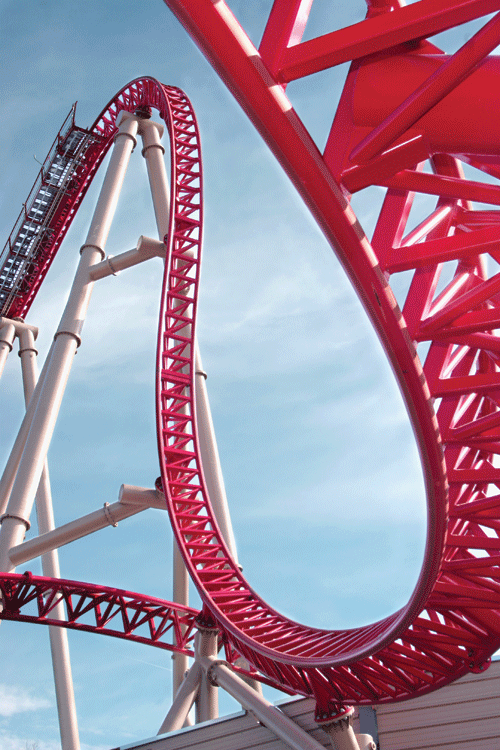
The roller coaster tapers off

What stands out from the Year Ahead 2010 report is the predictions. Merrill Lynch believes that the current rally of the euro against the dollar will recede in 2010, landing the euro at $1.38 by June, and falling to $1.28 by the end of the year. O’Neil claims that the dollar slump will reach its end as the “overvalued” euro readjusts, and “undervalued” emerging market currencies come under more pressure to de-peg from the dollar and come into their own.

According to the report, an average price of $85 per barrel of oil is foreseen “above the forward curve.” The long-term aspect is even more promising as “monetary stimulus chases too few oil barrels,” said the report. Rising oil prices will be, in particular, the result of what O’Neil sees as raising emerging market demand, which would on its own push the price of oil over $100 per barrel. “Western markets cannot tolerate a $100 barrel,” he quips.

Other commodities are also expected to do well in the medium term. Gold in particular is predicted to hit $1,500 per ounce as it is affected by three factors: credit risk, dollar weakness and the strength of commodities. O’Neil, however, “wouldn’t be surprised” to see gold consolidate in the near term at $1,000 per ounce if the dollar rises considerably. “Gold will still have a financial following in terms of the ETF [exchange traded funds] demand on the basis that it is a hedge against some sort of policy miscalculation or failure,” he says. 

While fears over Dubai defaulting have been allayed for the time being, O’Neil says the continued presence of large amounts of debt will have a detrimental effect on offshore capital confidence, which has been “shattered” by the recent Dubai World debt standstill fiasco.

“There is an inconsistency, unpredictability, and a lack of transparency that has produced an unpredictable set of events. Markets are going to insist on a substantial risk premium in that environment in terms of funding ventures,” says O’Neil in reference to Dubai. Much of Dubai’s financial future will continue to depend, he reckons, on the actions of Abu Dhabi and its sovereign wealth fund, which contains $500 billion to $600 billion, according to O’Neil.

“There is an inconsistency, unpredictability, and a lack of transparency that has produced an unpredictable set of events. Markets are going to insist on a substantial risk premium in that environment in terms of funding ventures,” he adds, in reference to Dubai. Therefore Merrill Lynch’s prediction of just 2 percent growth in the United Arab Emirates in 2010 seems to hold merit.

What has been a roller coaster year for the world and the region looks to become less harrowing in 2010, though O’Neil insists that the ride is not over. He does, however, single out one region as being more or less a rock in the storm: “Offshore of the Levant, there is nothing normal about the current situation.”

Editor’s note: The original article was edited on January 20, 2010 to reflect the accurate Euro to US Dollar projection.

January 3, 2010 0 comments
0 FacebookTwitterPinterestEmail
Real Estate

Danger underfoot

by Nada Nohra January 3, 2010
written by Nada Nohra


"Earth-shattering” events are relatively par for the course in Lebanon, with war, political upheaval and any number of social revolts rarely outside the realm of possibility at any given moment. The Lebanese, however, tend to focus on surface-level events to “rock” the nation, while few realize that below the ground they walk, an actual shattering of the earth is mounting.

“The possibility of a damaging earthquake happening in Lebanon is very high, and it is getting higher every day and every year,” said Ata Elias, assistant professor at the department of geology at the American University of Beirut (AUB), adding that the country could be hit with a quake reaching a magnitude of 7.5 on the Richter scale.

Lebanon stands on several major fault lines, which are cracks in the earth’s crust. Fault lines are at the boundaries between the earth’s tectonic plates and may range from less than a centimeter to several hundred kilometers in length. Tension can build along fault lines as the tectonic plates rub against each other, and if too much pressure builds the plates may shift, causing an earthquake.

The largest in Lebanon is the Yamouni fault that runs the length of the western Bekaa Valley, linking the Jordan Valley fault line to the Ghab Valley fault line in Northern Syria.

The Yamouni fault caused a major earthquake in 1202 A.D., and has a recurrence time of 800 to 1000 years, said Elias. Do the math, and you realize that the next major quake is set to hit between the years 2000 and 2200.

Lebanon’s many faults

The Yamouni is not the only fault putting Lebanon at risk, as there is another running along the coast — the Mount Lebanon fault — that is believed to have caused the catastrophic earthquake of 551 A.D., accompanied by a tsunami that hit the eastern Mediterranean and devastated the cities and towns along the coast. That earthquake is estimated to have had a magnitude of 7.5 on the Richter scale and caused 30,000 casualties in Beirut alone. The Mount Lebanon fault has a recurrence time of 1,500 to 1,700 years, which means another quake in the near future should not come as a surprise to anyone.

“We are now at a very singular moment in our geological history where we have two faults that might produce an earthquake,” said Elias.

Jordan, Syria and Palestine are also subject to seismic hazards and therefore any seismic activity that might be generated from these areas could affect Lebanon as well.

There are no means to know when exactly the major earthquake might occur, but that is not the sole issue since many smaller earthquakes are continuously taking place in Lebanon, such as the tremors witnessed in the south in February 2008, or the 5.3 magnitude earthquake that trembled Beirut in 1997.

The seismic hazard that Lebanon is subject to cannot be avoided, but the risk associated with the earthquake can be largely reduced by building safer structures and complying with seismic building codes.

Mohamed Hrajili, professor of civil engineering at AUB, said that it is very hard to calculate how many buildings in Beirut are built in compliance with seismic building codes, but gave an estimate of around only 20 percent. 

Hrajili added that the most vulnerable buildings are those between 8 and 15 stories high, due to the frequency with which the ground would shake as well as other technical factors that characterize earthquakes in Lebanon.

Even though the number of buildings resistant to earthquakes is very low, awareness on the issue started to rise in the early 1990’s when engineers started to adopt seismic building codes in their designs and a ministry decree was issued in that regard. Hence, many of the new buildings that were constructed after the Lebanese Civil War comply with some building code, whether American or European.

Heading off disaster

When the post-civil war reconstruction of Lebanon started, a team at AUB initiated a study identifying the seismic hazards that the country is subject to, and proposed a set of regulations for the construction and design of new buildings.

“We wrote a proposal to the directorate of urbanism saying that something should be done in this regard,” said Hrajili, who was involved in that study.

Lebanon was zoned under the 2B designation in the Uniform Building Code of the United States. In 1997 and 2005 respectively, decrees were issued and amended stating that new buildings should comply with the codes suggested in the decree or any other internationally recognized building code. Hrajili said the decree includes standards to meant to make buildings as safe as possible, and more importantly, to prevent them from collapsing.

“We can tolerate cracks in the buildings but we don’t want them to fall on peoples’ heads,” he said.

According to the decree, a report should be submitted to the order of engineers in that regard before obtaining a construction permit.

Although the decree was issued, the experts Executive spoke to said there is no strict supervision over the implementation of these codes.

“They ask for the file so they know the study is done, but they don’t have the means to check everything,” said Alexandre Richa, head of the department of construction and civil works at Apave, which runs technical oversight on construction sites to verify the solidity of structures and personal safety. Richa said there should be an implementation law that follows the decree, stating how inspection and control should be done.

Sami el-Khoury, director at the engineering company Rafic el-Khoury and Partners agreed with Richa, adding that even very experienced engineers might not be aware of the details that should be included in the structure, and that’s why a more thorough inspection should be carried out.

Cities at risk

In the event of an earthquake, high density areas are at higher risk, as buildings are closely lined up and will cause substantial damage and casualties if they collapse. These areas are in major cities like Beirut, Tripoli, Tyre, Jounieh and others. “I don’t worry about the Bekaa, for example, even though the fault passes there…the houses are remote and we can shelter these people more easily and save their lives,” said Hrajili. 

Another high-risk factor for Beirut and other coastal cities and communities is the possibility of a tsunami occurring, should the earthquake originate along the Mount Lebanon fault line. However, Elias said that tsunamis on the coastal line will not be higher than six to seven meters, thus mainly affecting the ports, the airport, and factories that lie in these areas.

Uncertain footing

Another worry experts point to is the fact that many districts and cities in Lebanon are built on sandy soil that has a high water content. If an earthquake takes place, soil liquefaction might occur and cause buildings and other structures to sink. Among the areas most at risk of this are the southern suburbs of Beirut, Bourj Hammoud, Tripoli and Damour. 

“There are measures that should be taken into account; in sandy areas you have to do a liquefaction analysis for the sand on which the structure is resting and that will give you an idea of how to reinforce the soil, so that you don’t have a sinking effect,” said Khoury.

Shoring up shaky infrastructure

Not only can new buildings be protected against earthquake hazards, but old structures can be reinforced to minimize the risks associated with tremors as well.

However, while holding new structures to building codes adds, on average, five percent to overall costs, reinforcing old buildings would be very costly, said Richa. “The cost may be equivalent to demolishing the building and rebuilding another one,” he said.

Still, there are some important structures that should be protected, as Hrajili explained, despite the high cost associated with it.

“Not every building should be repaired, but the most important ones like government owned buildings, hospitals, schools, ministries,” said Hrajili.

Better safe than sorry

Although architects and engineers in Lebanon have come a long way in terms of seismic awareness and building code implementation, there is still much to be done before Lebanon could be considered prepared for potential seismic hazards. 

“The government must create more awareness, like wearing seatbelts…now 80 percent of the people in Lebanon are wearing seatbelts because of the large [awareness] campaign,” said Khoury. He added that it is better to follow a certain methodology, because the cost of negligence is too high if an earthquake occurs and the country remains unprepared. 

Hrajili said the most important thing is to create stricter continuous supervision, in order to ensure that engineers actually comply with the building codes.


 “We only respect the code when there is an earthquake, for 1 to 2 years we pay attention and then afterwards we forget,” he added.

Building codes should be upgraded in accordance with geological and architectural studies.

“Codes should always be improved…take the example of the last earthquake that happened in L’Aquila, in Italy,” he added. On April 6 2009, an earthquake with a  magnitude of 5.8 on the Richter scale shook the city. More than 300 people were killed, more than 1,000 were injured and around 30,000 were left homeless.

Keep in mind that most structures in L’Aquila followed European building standards for protection against seismic hazards. The next earthquake in Lebanon will make painfully clear which of this country’s developers have been as scrupulous.


January 3, 2010 0 comments
0 FacebookTwitterPinterestEmail
Real Estate

A new nautical nucleus

by Nada Nohra January 3, 2010
written by Nada Nohra


As it stands at the moment, Beirut’s newest yacht club doesn’t look like much. The cement floors have yet to be covered, the luxury apartments have yet to be furnished and the gym equipment has yet to be installed — and yet still, the yachts of posh foreigners and locals are moored outside like the highest class of club hoppers queuing to get into a joint that is yet to open. 

This is the Beirut Waterfront Development, a $150 million project in the heart of the Beirut Marina, north of Saint Georges and facing the Marina Towers. Upon completion, the project will stand on 22,351 square meters of reclaimed land and offer 20,000 square meters of built up area divided into two plots.

The first plot will include the 14,000 square meter yacht club. Alongside the yacht club construction machines are currently working on the foundation of a 6,000 square meter structure that will host a mix of 14 restaurants and retail outlets. The rooftop of this structure will hold landscaped areas and swimming pools. An additional 22,000 square meters of underground space will be dedicated to parking and technical areas. 

The project will open in phases. Restaurants will be completed by November 2010 and tenants will have five to six months to settle in before the official opening takes place in spring 2011. A few months later, the yacht club and residences will follow. By the end of 2011, the whole waterfront project is scheduled to be complete.

The Beirut Waterfront Development faced several delays, ranging from security issues to the complexity of building the understructure. The assassination of former Prime Minister Rafiq Hariri caused a prolonged shutdown of the whole area and thus halted construction work.

Farouk Kamal, executive chairman of Stow Waterfront Development (Stow) and director at Beirut Waterfront Development (BWD), said that the costly underwater construction of the parking and technical areas required more time than expected.

“We originally needed two years to finish the underwater construction, but it dragged on and it took us three years,” he said.

Samer Bsat, assistant general manager at BWD also explained that the complicated architecture of the yacht club delayed licensing, which caused the project’s completion further postponement.

The joint venture

BWD, the developer behind the project, is a 50-50 joint venture between Solidere and Stow. The agreement was signed in 2004, where Solidere’s contribution was in kind, as it provided 22,351 square meters of reclaimed land for the development, matched by $31.6 million provided by Stow. The rest of the money for construction will be funded through equity and local banks.

Stow’s involvement started with the 26-story Marina Towers project, located at the waterfront and completed in 2007. Solidere provided Stow with a tunnel linking the tower directly to the Marina.

“We sort of became curious about what is happening there, so we started following up… and then we agreed on the terms,” said Stow’s Kamal.

A strategic approach

The American company Steven Holl Architects designed the project in collaboration with Lebanese architect Nabil Gholam, who produced the detailed design. The purpose of the waterfront project is to create a new “human anchor” for all Beirutis and an attractive destination on the Mediterranean Sea for sailors, said BWD in a press release.

Kamal said that the waterfront development aims to complement the downtown area and become an active social hub that would be considered as a ‘Lebanon brand’.

“We are very proud of what has been set up,” said Kamal.

To make it easier for pedestrians to access the development, a bridge will link the project to the hotel district that will soon host the Al Hayat Hotel and the Four Seasons, and which already includes the Beirut and Marina towers, as well as the Monroe and Ramada hotels.

The development will be semipublic, thus allowing anyone to access to the restaurants, the green areas and the marina, while the yacht club will be reserved exclusively for members.

Sky high prices

The yacht club is already 85 percent complete, explained BWD’s Bsat. Some 16,000 square meters will be dedicated to apartments — 54 fully furnished luxurious flats — with the balance allocated to the club area. According to Kamal, the architectural design of the club was done in such a way that all units will have equally exceptional views.

A selling price has not been set for the apartments.

“The strategic decision is to get as [high] as we can [in prices],” said Bsat. Therefore BWD will not start selling apartments before they are completed, since [the finished apartments] would attain higher prices. “It is easier to be convinced to buy an apartment when you see it rather than on a plan,” he added.Kamal said the price tag on the apartments will be completely dissociated from prices of other real estate developments in the area.

“We are not related to the market in general, this is a unique project and the prices we will achieve will not be related to the surroundings,” he added.

Owners will have the option to lease the apartments in their absence. The leasing will be managed by BWD and apartments will have a ‘5-plus’ star service.

Joining the yacht club will also be expensive, but the fees, like the apartment prices, have not been set yet. Fifty selected personalities will represent the founding members, while normal membership will be open to 800 individuals.

Restaurants and retail

Fourteen different restaurants and eight or nine retail outlets will be hosted in the marina development. BWD has not sealed the contract with any tenants yet, but has received 150 “serious applications,” according to the company.

BWD spent a substantial amount of time investigating the right mix of restaurants at the Marina.

“We wanted to be sure that whoever is going to open will stay there for a long time,” said Bsat. Kamal added that “If we get a good Japanese restaurant, we avoid having a competitor next door.”

The restaurants, located below the level of the road in front of development, will allow the sidewalk above to be extended from 3 to 20 meters, with the roofs of the restaurants landscaped so as to offer the public a park-like experience while admiring the sea view.

BWD will also manage the yacht club and restaurants.

Branding BWD

The design is done, construction has started and the project is progressing quickly. However, one question remains unanswered: what to name the development?

Kamal said that the company is thinking of calling the area ‘Zeitouni’ (‘The Olive’), which was the name of the hotel district which faced the BWD a long time ago. This old area was considered as the place to be, and the heart of Beirut where all the restaurants and leisure facilities existed. For authenticity, Kamal added that they might plant a 1,000-year-old olive tree in the marina.

January 3, 2010 0 comments
0 FacebookTwitterPinterestEmail
Real Estate

On sliding sands

by Nada Nohra January 3, 2010
written by Nada Nohra


With iconic projects that attracted international celebrities such as Donald Trump and David Beckham, the Dubai-based real estate developer Nakheel has always played an important role in fulfilling Dubai’s ambitious dreams.

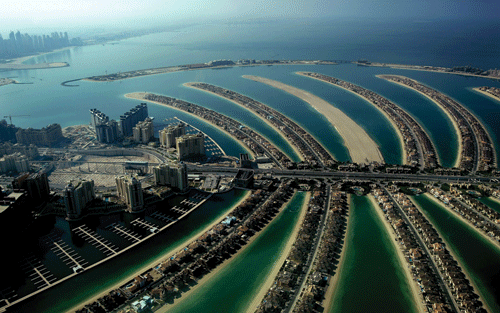
Its Palm trilogy — Palm Deira, Palm Jumeirah and Palm Jebel Ali — has become a firm feature on Dubai’s map and is now symbolic of the emirate, not to mention the developer’s other distinguished projects such as The World and Discovery Gardens.

Nakheel was established in 2001 as the real estate arm of the state-owned holding company Dubai World. Its operations include real estate development, management, sales and fund management. Until the last quarter of 2008, the company surpassed expectations; launches of large scale projects were coupled with sky-high profits due to land sales and continual hikes in property prices.

Nakheel’s biggest achievements in 2008 were finishing the land reclamation of The World, officially opening Palm Jumeirah to the public and being named ‘Developer of the Year’ at the Arabian Business Achievement Awards.

When the global financial crisis started to rain down on Dubai’s real estate market, investors began to shy away, demand plummeted and prices followed. Consequently, most real estate developers, including Nakheel, began to shelf new project launches and cut costs by decreasing staff and advertising expenditures. Nakheel, being one of the pioneers in the market, repeatedly made headline news and its cash flow problems became the bellwether of Dubai’s real estate market.

The beginning of bad news

In October 2008, the slide started precipitously. Shortly after the Cityscape property convention of that year, Nakheel announced delays on several of its flagship projects, including the Trump International Hotel and Tower in Palm Jumeirah and the Universe Island. Work continued on projects such as the Madinat Al Arab, Canal District and others. The project delays were aimed to “ensure that our model is aligned to meet the market demand,” said the company at the beginning of December 2008.

These announcements came as a surprise to many. Shortly before Cityscape 2008 started, Chris

O’Donnell, chief executive officer of Nakheel, claimed that the global credit crisis would not affect plans for the one kilometer high Nakheel Tower. He said at the time that funds for the scheme would come from a combination of “pre-sales of land in and around the tower, and then project funding.”

Since the delays were announced, Nakheel has not resumed construction on any of its deferred  projects, with Donald Trump Jr. remarking at Cityscape 2009 that work on the Trump hotel will not restart anytime soon.

Building contractors reported that all construction companies working on the Nakheel Waterfront development were asked to accord a 30 to 40 percent discount, The National wrote in May.

Cutting costs

In an attempt to cut costs as revenues started to fall short, Nakheel announced in November 2008 its first mass layoffs, sending pink slips to 500 employees — roughly 15 percent of its workforce.

“We have a responsibility to adjust our short term business plans to accommodate the current global environment,” said the company in a statement at that time.

Concurrently, realty operators such as Damac, Omniyat and Tameer Holding Investment began implementing large-scale redundancies.

In July 2009, Nakheel announced another 400 job cuts, meaning that in nine months the company shed a total of 1,400 employees, leaving it with some 1,600 on the payroll as of July 2009, according to Zawya. Immediately following Cityscape Dubai in October 2009, Nakheel cut an additional 500 personnel.

Cityscape 2009

As Cityscape Dubai 2009 was about to commence, news surfaced that both Nakheel and its biggest competitor, Emaar, were missing from the list of exhibitors. To save face and prevent further erosion of confidence in the real estate market, both companies declared at the last minute that they would participate. 

Despite being officially present, company representatives were noticeably absent from the Nakheel stand at Cityscape, with only a hostess or two offering visitors paper to write down requests or queries. The assumption was that Nakheel would answer these at some point.

Reporting losses

On the financial side, Nakheel reported that its revenues in the first half of 2009 fell 78.1 percent to $536 million, relative to the $2.5 billion it took in over the same period in 2008. “Dubai real estate was impacted and as a result Nakheel sales volumes and transaction activities remained low [sic],” said the company in a statement.

It also announced that its liabilities for the same period increased 7.2 percent to $20 billion, as the company had a loss of $3.64 billion due to a large write-down of asset value, mainly land, and due to projects that were put on hold. The statement added that Nakheel was continuously reviewing its operational and overhead expenditures in order to meet the market’s opportunities and challenges.

At the beginning of 2009, reports emerged that Nakheel was considering plans for an initial public offering (IPO) to raise $15 billion to offset its cash flow problems. Speaking to the press on several occasions, officials from Nakheel neither confirmed nor denied the reports, but said that an IPO might be one of the funding options the company would consider. “We’ve got different options and an IPO is one of the options — it doesn’t mean that an IPO is imminent,” O’Donnell told The National in December 2008. Since January 2009, no further announcements were made in that regard.

The maturing sukuk

During the growth years of the real estate market, Nakheel issued three sukuks (Islamic bonds), to help finance its projects. The first three-year sukuk was issued on

December 14, 2006, and had a total value of $3.5 billion.

The Islamic bond had a profit rate — in other words a Sharia-compliant interest rate — of 6.345 percent. Over the three years since, Nakheel paid half the profit (3.1725 percent per year), leaving the rest to be paid on maturity. The sukuk was backed with land and asset collateral more than twice its value.

In addition to the 2006 sukuk, Nakheel issued two other Islamic bonds; Nakheel Development 2 Limited, issued in January 2008 with the value of $750 million due in 2011, and Nakheel Development 3 limited, issued in May 2008, valued at some $980 million. These bonds were set to come due in 2010.

By the end of 2011, Nakheel is scheduled to repay more than $5 billion in debt. Several months before the $3.5 billion sukuk bond came to maturity, investors started to question whether the company would be able to pay its liability in the wake of the liquidity crunch it was facing. As the bill came due, analysts expected that the probability of default would be quite low, since Nakheel is a Dubai World subsidiary and would obtain government support when needed.

“The Untied Arab Emirates authorities are acutely aware of the amount of profile the Nakheel 2009 sukuk instrument has in the international capital markets,” Chavan Bhogaita, head of credit research at the National Bank of Abu Dhabi, told Bloomberg late in October 2009. “In our opinion, they fully intend to repay this bond.”


The bond bomb

On November 25, Dubai world unexpectedly announced that it was asking its creditors for a standstill on its $59 billion debt, and on December 1, it said that the restructuring to the Nakheel and Limitless liabilities would total $26 billion.

In the first week of December, it was reported that cash-strapped Nakheel received a $2.45 billion cash injection as part of the $10 billion government aid program for businesses, launched in February 2009.

In mid December, Dubai received another present from its oil-rich neighbor. Through Dubai’s financial support fund, Abu Dhabi pumped another $10 billion into the indebted emirate, of which $4.1 billion went towards meeting Nakheel’s first sukuk repayment. Dubai world will use the rest to repay its contractors and suppliers.

A spokesperson from the Dubai Department of Finance said that the $10 billion received from Abu Dhabi will be repaid as a 5-year bond with 4 percent annual profit.

“[Nakheel] will honor all obligations related to the 2009 Nakheel Development Limited sukuk using funds that will be provided by the Dubai Financial Support Fund. In accordance with the terms of the sukuk the repayment will occur within the next 14 days,” said Nakheel in an announcement published on the Nasdaq Dubai.

Although Nakheel’s first debt will be repaid, the rest of the Dubai World obligations will still be negotiated for restructuring. As a next step, Dubai World is in negotiations with representatives of more than 90 banks to discuss the remaining $22 billion debt.

Whether Nakheel repaid its debt or not had implications for the six ratings Moody’s has for Dubai, as the ratings company told Bloomberg the sukuk was a “litmus test” for the accredited companies — DIFC Investments LLC (the investment arm of the Dubai International Financial Center), Jebel Ali Free Zone, Dubai Electricity and Water Authority, Dubai Holding Commercial Operations Group LLC and Emaar Properties PJSC. 

The credit rating agency Standard and Poor’s has described December’s developments regarding Dubai World’s debt as “steps toward rebuilding confidence,” but said it was uncertain about the ability of the government to bailout other firms.

What’s next?

There is no doubt that the ride has been rough for Dubai’s flagship developer over the last 15 months, and whether Nakheel will once again re-launch its ambitious projects and re-hire a workforce on the previous scale remains to be seen.

The main concern at this moment is for the developer and its parent company to meet their debt obligations; a default risks opening Pandora’s box on the property market and on Dubai as a whole.

January 3, 2010 0 comments
0 FacebookTwitterPinterestEmail
Comment

Iraq’s amorphous politics

by Ranj Alaaldin January 2, 2010
written by Ranj Alaaldin

Iraq is set to hold parliamentary elections this March, after politicians in Baghdad overcame the squabbling and heated debates that had long delayed the controversial new election law. Iraqis will find themselves participating in a democratic process which, because of its incorporation of the open-list system (whereby people vote for individuals as opposed to parties), outmatches the elections of 2005, which adopted the closed-list system, and also outmatches the democratic standards of their regional neighbors.

The electoral process in Iraq will not be a smooth one. Violence, as ever, will decide the extent to which Iraqis will turn out to cast their votes. Recent security failures indicate that terrorists, suspected to be comprised of extremist Sunnis and jihadists, still remain at large. Their tactics have morphed to meet the challenges posed by a far more confident and assertive Iraqi security force, which can claim some credit for the overall reduction in violence; terrorists now re-group, re-equip and then, in time, strike at high value targets, such as the various ministries which suffered suicide attacks in recent months. In comparison to previous years, they strike at chance, as opposed to at will.

The terrorists’ main aim is to rekindle the ethno-sectarian violence of 2005 and 2006 that tainted Iraq in the aftermath of the United States-led invasion. But despite extremist strikes on Shiite civilian and government targets, there has yet to be reprisal attacks against Sunnis by the Shiite community, its clerical and political leaders.

Although large scale ethnic and sectarian violence is, save for certain parts of northern Iraq, a thing of the past, Iraqi politics as a whole has yet to garner the same fortunes. Politics in Iraq continue to be determined by ethnic and sectarian affiliations, and the Iraqi elections in March will exhibit this paralyzing feature of a country that continues to be a victim of its fascinatingly diverse, culturally and historically rich population.

But there is hope. Political scientists often highlight that division within majority identity groups is essential for stability in highly diverse societies. The Shiites, the majority group in Iraq, ran as a single bloc in the 2005 elections under the United Iraqi Alliance. This time, the alliance, running under the new banner of the Iraqi National Alliance (INA), does not include the current Iraqi premier Nouri al-Maliki and his Islamic Dawa Party.

The Islamic Dawa Party instead sought to form a secular and cross-sectarian alliance that builds on the group’s electoral success in the provincial elections last January. At the time, the development suggested a new chapter in Iraqi politics — one free from the shackles of ethno-sectarian loyalties. Yet, this never came to be. Maliki failed to bring any prominent Sunnis or Kurds onboard, leaving the premier vulnerable, but nevertheless comforted by the widely held belief that the INA still comprised mainly sectarian parties who performed poorly in last January’s provincial polls. Recent terror attacks will hurt Maliki, however, given that his key campaign platform was security.

Things also look more promising for the Sunnis. The Unity of Iraq Alliance (UIA) includes the major Sunni figure Ahmed Abu Risha, leader of the Anbar Awakening forces, who commands significant respect among the Sunni population. Elsewhere, the Iraqi National Movement (INM) is led by former premier Ayad Allawi (also a Shiite) and prominent Sunni figure Salih al-Mutlaq.

The major electoral battle will be in the Shiite south. In the January 2009 provincial polls, Maliki’s coalition achieved 28.6 percent of parliamentary seats, while the INA, made up of the Islamic Supreme Council of Iraq (ISCI), the Sadrists, former premier Ibrahim Jafari and the Fadhila party, achieved 28.2 percent. The contest this March will therefore be a hot one, with neither of the coalitions likely to win a majority. This will embolden the Kurdish parties, but also the UIA and INM, who will be lobbied to become coalition partners.

Further splits are likely after the elections. The INA, though currently united, is essentially an alliance of convenience — bedfellows who have conflicting ideological and political visions but who recognize they fare better united than divided against Maliki’s electoral credentials. The INA’s ISCI and Sadrists have a history of violent rivalry, and the INA is made up of numerous strong personalities who have ambitions to become premier (a likely sticking point in the aftermath of the elections).

The divisions are positive only in that they make parties more susceptible to compromise on some of the key outstanding disputes: the division of power and control over the country’s vast energy resources.

The ongoing territorial and constitutional disputes will certainly continue well beyond the elections. But this is not to suggest that Iraqi democracy will be reduced as a result. To the contrary, the new open-list system means that Iraqi politicians will be more accountable; it also reduces the significance of affiliations, sectarian or otherwise, since merit rather than background becomes the route to power.

 Cracks are starting to appear in the traditional political landscape of Iraq for the better of Iraqis as a whole, though the journey is still a painfully enduring one.

RANJ ALAALDIN is a scholar on Iraq and is published regularly in The Guardian

January 2, 2010 0 comments
0 FacebookTwitterPinterestEmail
Real Estate

Standing your ground

by Nada Nohra January 1, 2010
written by Nada Nohra

Dealing with the slowdown facing the United Arab Emirate real estate market was not easy for property developers in 2009. With project financing and mortgages less available as well as market sentiment at basement levels, both investors and end-users were reluctant to invest in a sector so heavily affected by the financial crisis.

“People were trying to keep their liquidity to themselves…so there was not that much interest in investing in real estate,” said Faisal Hasan, head of research at the Global Investment House, an investment company which manages real estate funds. With the preliminary fourth quarter and yearly numbers coming out, some developers managed to end the year in a relatively good financial position, while others suffered significant losses in profits and revenues.

“It was just a question of the degree of how negative those numbers were going to be,” said Zahed Chowdhury, institutional equity sales manager at Al Mal Capital, an investment bank with a large real estate portfolio.

Fourth Quarter Results

Emaar property was the best performing UAE developer in the fourth quarter, beating market expectations by recording a hefty rise in both profits and revenues. Aldar suffered substantial losses, while Sorouh and Union Properties, which both saw declines in net profits and revenues in the fourth quarter. Deyaar has not issued its last quarter numbers yet but said it had a 95 percent decrease in profit in 2009.  

UAE fourth quarter results (in $millions)

UAE full year results (in $millions)

Chowdhury said that comparing fourth quarter results, or even yearly results of real estate companies, is rather inaccurate and is not a valid indicator of the health of these businesses since their sales do not happen continuously, but depend on when projects finish and when delivery takes place.

“While you are building, there is no revenue, but when you build it and sell it there is ‘100 percent revenue’ and the day after you sold it there is ‘zero percent revenue,’” he said. Therefore, he noted, what should be looked at is whether the company has delivered what it announced on schedule. Moreover, analysts Executive spoke to said that revenues and profits, although the most popular numbers, are not enough to indicate whether the company is solid financially. It is also important to look at the balance sheet and the net debt-to-equity ratios of these companies. For example, both Aldar’s and Union Properties’ net debt-to-equity ratios are 115 percent, Emaar’s is more than 20 percent and Deyaar’s and Sorouh’s are negative (because of negative equity resulting from asset values falling below outstanding loan values), according to a fourth quarter report the HC Services and Investment’s brokerage arm.

“In Aldar’s case, [the debt] it is going to be a stress for the business while in Emaar’s it will not,” said Chowdhury. It will also affect the company’s ability to acquire financing.

“For example if Emaar wanted to raise money it would be able to because it doesn’t have that much debt on its balance sheet, and also it has rental properties and that can be used as underline collateral. But, in general, lenders are still very risk averse,” said Sana Kapadia, vice president of equity research at EFG Hermes.

Low financing slows the market

Since the financial crisis began and banks started to tighten loan requirements, both project and mortgage lending have been hard to obtain, which limited both demand for, and the supply of, new projects.  Charles Neil, chief executive officer of real estate firm Landmark Advisory, said that in the fourth quarter only about 14 percent of transactions executed by the company were financed by banks, while the rest was personal financing. 

“The commercial banks don’t seem to have much risk appetite for new lending in the property sector so they have been lending at very low loan-to-value ratios,” he said. The Dubai World debt crisis, which erupted in the last quarter of last year, also put more pressure on financing and affected companies’ fourth quarter results. “You can’t really exclude the Dubai World factor from fourth quarter of 2009,” said Saud Masud, head of research and senior analyst at the real estate department of UBS. “It put more pressure on financing, which also put more pressure on project activity, so it forced companies to either delay projects or to see more challenging adoptions in terms of demand.”

Emaar outperforms

In its preliminary results, Emaar announced a 94 percent increase in fourth quarter revenues and a net profit of $196 million compared to a loss of $662 million in 2008. Emaar’s net profit beat Credit Suisse estimates by 39 percent, but was in line with the Bloomberg consensus numbers. The increase in revenues and profits was driven by the delivery of 3,100 units in 2009, and the increase in income coming from malls and leisure businesses it owns.

“I think what is happening is that Emaar has done well because it didn’t need support like Aldar and Sorouh did, it had the financing already,” said Masud. He also added that Emaar was able to differentiate itself from the rest of the pack because other companies do not have a portfolio as mature as Emaar’s, in terms of reoccurring income and international projects. “To what extent it can continue to do that will be a question mark,” he added. 

As for the first quarter numbers, Chowdhury from Almal Capital said that Emaar’s financials should be strong with the delivery of Burj Khalifa, but will not maintain a robust growth in the second or third quarter since there will not be as many deliveries to be made.

“Emaar looks better for the simple reason that it sold most of the things that it was going to sell,” he said. “Aldar is still building most of the things that it is going to sell and while it is building them, [their prices] are falling.”

Aldar underperforms

Aldar also had some surprising results. Shafqat Malik, chief financial officer told Bloomberg in mid-February that the company had suffered, for the first time, a net loss of $153 million in the fourth quarter of last year, compared to a profit of $23 million in the same period of 2008. In a Bloomberg survey, analysts expected the company to record a profit of $111 million and a Credit Suisse estimate stood at $23 million. Aldar’s annual profit fell 71 percent year-on-year to $272 million, and revenues fell 60 percent to $539 million. Malik also told Gulf News that the decline was due to the absence of any land sales throughout the year, adding that there “were project write-offs of around $141 million in the fourth quarter alone, with the pre-opening costs of $46 million in our different Yas Island assets.”

The drop came as somewhat of a shock due to the relatively strong Abu Dhabi market in which it is based.

“Aldar couldn’t exceed expectations because people expected it could do some land sales, because the Abu Dhabi market was comparatively better than Dubai’s,” said Venkateshwaran Ramadoss, senior research analyst at real estate department of the Kuwaiti Financial Center  (Markaz).

Moreover, Chowdhury explained that Aldar is earlier in its lifecycle than Emaar and thus has a less developed business model.

“Aldar it is still at least another year or two away [from maturity],” he said. “So the crisis has caught Aldar too early in its life cycle, leaving its revenue and its income stream more volatile to the crash, compared to Emaar.” 

After announcing its financial results, Aldar also announced the sales of the Yas racetrack, the yacht club, as well as the infrastructure on Yas Island to the Abu Dhabi government for $2.5 billion. The sale was at book value and no profit was recorded. Credit Suisse reported that this sale would reduce the net debt-to-equity ratio from 115 percent to 71 percent.

“The sale of the track and certain associated amenities in itself is a positive step,” said EFG Hermes in a note. “As it would mean that some concerns over Aldar’s capital-intensive ventures are now eased.” In the first week of March, Moody’s downgraded Aldar’s rating to Ba1 from Baa2, the first step below investment grade with a negative outlook, along with six other government related UAE companies. Following the announcement, Abu Dhabi government reaffirmed in a press release its support for its state-owned entities and said “we obviously disagree with the reasoning involved in a number of Moody’s decisions.” Aldar was not available to comment.

Sorouh too young to fall

Sorouh Real Estate fared better than Aldar in the last quarter, and revenues were $119 million, 17 percent lower than the same period of 2008. The revenue was mainly driven by the sale of 643,000 square meters of land for developing the first phase of the Al Ghadeer project, built by Al Sdeirah Real Estate Investment, which is 30 percent owned by Sorouh. The company recognized $66 million in provisions in the last quarter as well as a $13 million loss from its 20 percent share in three associates: Aseel Finance, Green Emirates Properties, and Al Maabar International Investment LLC. The company’s net profit amounted to $7 million; down from $13 million in the same period of 2008.

“In 2009, we saw very few sales of property units, as we had not launched any new projects and had already pre-sold a number of units heading into construction phase,” said the company in an emailed statement.

Over the course of the year, the company managed to cut expenses by 41 percent to $63 million, recording $844 million in revenues and $135 million in net profit — 16 percent and 73 percent lower, respectively, than in 2008. Al Mal Capital’s Chowdhury said that Sorouh was further behind in its life cycle than Aldar, which has placed it in a better financial position and protected it from a substantial debt burden on its balance sheet.

Construction continues outside Dubai
</p>
									            </div>
        </div>

		            <div class=

January 1, 2010 0 comments
0 FacebookTwitterPinterestEmail
Economics & Policy

Making hay while the sun still shines

by Ahmed Moor January 1, 2010
written by Ahmed Moor


Oil and gas markets face a number of challenges to their continued development, with producers confronting three main issues: peak oil, alternative energy and/or nuclear power and the risk of geopolitical instability.

The United Arab Emirates is as affected by these issues as any other energy-exporting nation. Dubai is already experiencing the effects of peak oil, as its reserves dwindle to nearly insignificant levels. The country is pursuing nuclear and renewable energy to offset its consumption of fossil fuels. The UAE also relies heavily on the Strait of Hormuz for most of its export capabilities — leaving it vulnerable to the potential effects of war with Iran.

Peak Oil

Peak oil represents one key theoretical challenge to producers in the oil industry. The idea is that because global stores of oil are finite, the world will one day reach a point where it is extracting the maximum amount possible, and will thereafter confront a period of decline in oil output. While some analysts expect peak oil to occur around 2030, others expect it to occur sooner than that.  Analyst and author David Strahan expects the net global production to reach peak oil by 2020 at the latest. According to him, oil production is shrinking in 60 of the world’s 98 oil-producing countries. Indeed, he predicted in 2008 in a speech at the World Energy Summit in Abu Dhabi that the total oil output for non-Organization of Petroleum Exporting Countries (OPEC) states will reach its apex in 2010.

The United States Energy Information Administration (EIA) appears to agree on this point. According to a report it published, “the EIA projects the total non-OPEC supply of crude oil will grow by just over 1 million barrels per day [bpd] to an average 51.5 million bpd in 2010 — the largest year-over-year increase since 2002. The increase in total non-OPEC supply for the year is the result of higher production in the United States, Brazil, China, and Russia.” 

But after this bumper year, the EIA expects non-OPEC supply set to drop by 280,000 bpd in 2011  — the third time in the last 15 years that non-OPEC supplies have fallen year-over-year. Previous declines in 2005 and 2008 were primarily the result of supply disruptions in the Gulf of Mexico related to hurricanes.

There are other indicators that peak oil may be a serious concern in the coming decade. For instance, the 30 biggest oil companies upped their exploration budgets by 45 percent to more than $400 billion in 2006 alone. Yet, oil and gas reserves only grew by 2 percent despite the massive investment.

According to Kate Dourian, Middle East editor at Platts, yields from existing fields are dropping about 5 percent to 7 percent annually. At the same time, analysts predict that 30 to 40 million barrels of new daily capacity will be needed to meet global demand between now and 2030. That’s due to the fact that the capacity expansions currently underway in the Gulf don’t cover the difference. “There will be a supply shortage if people don’t invest now because of the long lead time” in exploration and delivery to market, she said. But because of the increased viability of alternative fuels, producers are reluctant to invest. “It’s difficult to ask producers to pour billions into the ground to keep it there,” she explained.

Alternative energy and nuclear power

A wide range of alternative energies are being brought to the market and there is some expectation that they will displace oil and gas market share globally, which today is generally estimated to be between 80 and 90 percent. According to the International Energy Agency, in 2005 nuclear generation provided 6.3 percent of the world’s total primary energy supply and its share of the market is likely to have climbed. Alternative fuels encompass a range of sources such as biodiesel, chemically-stored electricity, hydrogen, vegetable oil and biomass sources.

There are two main reasons for why governments and people around the world seek to become less dependent on fossil fuels. First, the consumption of oil and gas creates greenhouse gasses, which are heavily implicated in global warming and the destruction of ecosystems worldwide. Environmental degradation is arguably the direst threat confronting the world today. In the words of United Nations Secretary-General Ban Ki-Moon: “Business as usual cannot be tolerated, for it would condemn millions — no, billions — of children, women and men around the world to shrinking horizons and smaller futures.” 

Indeed, climate talks may be having a chilling effect on the amount of new investment oil and gas producers are making in increased production, even before any viable alternatives hit the market. Dourian explained that: “The producers are saying ‘Well hang on a second we don’t know how Kyoto is going to impact future demand; we don’t know how much is going to be displaced.’” The Kyoto protocol is an international agreement designed to combat climate change that expires in 2012. Efforts are underway to replace the agreement with similar or more robust international agreements.

Second, as economies in the developing world grow — most notably China and India — they will require ever larger amounts of energy. Energy from oil producing states is far from guaranteed in the long term, and renewable energy that can be produced within a country’s own borders is often preferable. Many governments regard energy security as a priority, and a heavy reliance on foreign governments exposes them to potentially destructive consequences.

The UAE is already making provisions for nuclear energy in response to increased domestic energy demand and to further capitalize on petroleum’s exportability. At present the country is in consultation with the International Atomic Energy Agency (IAEA) to create a nuclear program, and it accepted a $20 billion bid from a consortium of South Korean companies in December of 2009 to build four nuclear power plants for commercial use by 2020. This is in keeping with Dubai’s plans to produce 20 percent of its energy from renewable sources by 2030.

The UAE is a signatory to the Nuclear Non-Proliferation Treaty. It also signed and ratified an additional safeguards agreement with the IAEA in 2003. In 2008, the country appointed an ambassador to the IAEA.

Geopolitical disturbance

The Middle East and parts of Africa are some of the most politically volatile areas of the globe. They also contain the largest stores of fossil fuels, which means that global supply lines are threatened by every regional conflagration.

The Iran-Iraq war, the first Gulf war, the 1973 war, and ongoing strife in the Niger Delta all precipitated spikes in the price of oil and natural gas. Today, there is a real possibility that Western countries and/or Israel will attack Iran under the banner of quashing its nuclear capability. If that happens, the Iranians may retaliate by striking tankers and cutting supply routes through the all-important Strait of Hormuz, through which passes approximately 17 million barrels of crude oil per day. While many countries have energy reserves (America’s stockpile consists of about 700 million barrels of crude oil), they probably will not be enough to offset the adverse effects of a war with Iran. Such a conflict would thus likely lead to a ‘double-dip’ global recession. 

There are many challenges to the continued provision of steady oil and gas supplies to the world market. The industry is being forced to grapple with steadily shrinking supplies, adverse environmental effects which result from fossil fuel consumption and a high-risk supply area. While much can be done to mitigate these risks in the short and possibly medium term, these are likely long term, irreversible trends. In other words, the world will continue to move away from oil.

January 1, 2010 0 comments
0 FacebookTwitterPinterestEmail
Capitalist Culture

Arab Perestroika

by Michael Young December 17, 2009
written by Michael Young

In early November, the Western media was awash with material celebrating the 20th anniversary of the fall of the Berlin Wall. Not surprisingly, these echoes had turned into a hollow clang by the time they reached the Arab world. So, are Arabs really incapable of grand transformative change, particularly democratic change, and if so, why?

The question is both fair and beside the point. Everyone will provide a different answer; trying to nail down such a momentous query is unlikely to lead far, raising only more questions. Aligned against those, present company included, who believe that the region is capable of deep democratic change, there are those who will present “culturalist” arguments to the effect that Arab states don’t have the historical baggage required to set up democratic orders.

As their societies have always been autocratic, the argument goes, Arabs are therefore predisposed to autocracy. Others will go further to assert that Islam doesn’t inherently allow for democracy, even though no convincing evidence has ever been presented to justify such a sweeping conclusion.

 These opinions are terribly constricting and self-reinforcing. If a society is perceived as being incapable of opening up, of pursuing liberal outcomes, then there is no motivation from their governments, let alone foreign governments, to ever take popular preferences seriously. Yet as East Germany in 1989 showed, as did Lebanon in 2005 and Iran this year, even when presented with small openings, societies under tight control — whether domestic or foreign — will take steps toward emancipation, which, even momentarily, can fundamentally improve their situation.

 Unlike the former communist states of Eastern Europe, the Arab world is more complex when it comes to economics. By and large the region’s economies are under the control of the state, or its representatives. Even private sectors, where they exist and even thrive, can in many ways be undermined by rulers and the absence of independent judiciaries.

Yet economics and finance have also been rare areas in the region where regimes have left society some room to maneuver; in most places the notion of a private sector is encouraged, so long as leaders and their acolytes are reserved a cut of state profits and political realities remain unaffected.

But these hybrid economic systems have failed to create more liberal societies. An assumption of numerous Western projects directed at the Arab world has been that the loosening of economic controls might ultimately be mirrored by a loosening of political controls.

This was, for example, a pillar of the Barcelona process set up in the mid-1990s by the European Union. In reality, the link between economic and political openings has been tenuous at best, which is why the political expectations surrounding Barcelona have virtually dissolved, with the process focusing almost exclusively on economic reform.

In that case, what would it take for the Arab world to have its own Berlin Wall moment? Is such a thing even conceivable, particularly given that the region is not held together by a unified intimidating power similar to the Soviet Union’s, where a loosening of the straps at the center could ultimately bring the entire edifice down?

That the George W. Bush administration imagined Iraq’s liberation might be such an event raises hackles today, even if the impact of what happened there has yet to be fully grasped. Grand projects tend to die in the Middle East. Instead, the region seems only to breed stalemate and a sense that nothing will ever change.

But that may not be true. One could easily imagine, for example, that a sudden breakdown of Iran’s autocratic order, which is now devoid of any revolutionary ideological fervor, would send shockwaves through neighboring Arab states. Had post-Saddam Iraq succeeded more quickly (for it will likely emerge from its nightmare stronger), its democratic reverberations could have been more effective than they are; even now, the country’s emerging pluralism deeply worries its neighbors.

In a Middle East where the status quo has prevailed for so long, a sudden swell of change akin to the fall of the Berlin Wall may be more plausible than we think. Arab states will not become freer and more liberal through economic reform. And if change comes, states will not have the benefit of a democratic neighborhood, such as the European Union, to frame their future actions and integrate them into the safety of a liberal, capitalist and multilateral structure.

That’s why if, or when, the Arab wall falls, the consequences may be much direr than those found in Europe two decades ago. The wall may collapse on our heads.

Michael Young

December 17, 2009 0 comments
0 FacebookTwitterPinterestEmail
Luxury Retail

Faces of fashion

by Executive Staff December 17, 2009
written by Executive Staff

Toni Traboulsi Executive manager, Middle East Luxury Group

E  Rumors of money laundering activities have sometimes beenassociated with some prominent Lebanese luxury groups in Lebanon. Some retail clients have also complained about unfair return policies and voiced doubts as to the original quality of goods sold by some of the luxury sector’s mammoths. How, as a member of the luxury retail industry, do you perceive these serious accusations and do you believe they reflect on the Lebanese luxury sector as a whole?

I am aware of these accusations but I believe that this type of talk is common in Lebanon when an individual or a company becomes very successful. However I really cannot say for sure if there is any truth to such allegations, but given that our industry is a very sensitive one and our market an extremely sensitive one, such accusations are certainly detrimental to the image of the Lebanese luxury retail as a whole.

Regarding accusations of counterfeiting, I do not believe it is practiced by large groups as you mentioned, but certainly by some smaller retail stores, some of which openly display copies of famous brands and are located in the vicinity of the Lebanese parliament. There should definitely be more of a governmental effort to rein in such unlawful practices that harm the Lebanese luxury retail industry. As for complaints about the return policies and quality of service provided by some boutiques, I believe that brand policies differ from one market to another and especially in Lebanon, due to the mentality of some clients who tend to abuse the system. We at MELG take, however, very seriously any complaint regarding product defect and immediately replace any faulty item, if sold at one of our boutiques. We also involve the manufacturer every step of the way.

Christiane Boustany Business manager of the fashion division, Malia Group

“Lebanese designers have exported luxury to the world”

E  Do you believe that the financial crisis put an end to the luxury retail party in Lebanon? Or on the contrary, do you feel that Lebanon will be spared by the overall financial contraction?

I highly doubt the party is over for Lebanese retailers. And yes I do believe Lebanon still has major potential as a regional luxury shopping destination. One has to keep in mind that the country’s precarious political situation and permanent state of instability has reflected negatively on our growth and  left us lagging behind other luxury retail destinations for quite some time.

We’ve come a long way but we still have a lot to achieve. However, Lebanon’s position is unique in the Middle East; not only has it become an importer of luxury brands, it has been able, through a pool of talented Lebanese designers such as Elie Saab or Zuhair Murad, to export luxury to the world.

Grace Sehanoui Brand manager, E and E Group 

E  Do you believe that with the current economic crisis, there is more of a future for diffusion brands than for haute couture creations?

“Without haute couture there is no future for diffusion brands…the democratization of luxury will never be able to cross certain boundaries”

The world of luxury fashion will always be defined by haute couture. It is true that diffusion brands have today become part of a wider trend: the world’s luxury fashion houses are looking to grow through lower priced items dubbed as secondary brands. It is also interesting to note that some famous designers, such as Jimmy Choo, are entering the low cost retail market by creating special collections for other retailers, which are international companies like H&M. These diffusion lines, which have lower margins than luxury lines but higher volume, are growing in importance. But at the end of the day, many big fashion names rely on the visibility of their high-end brands and the glamour of their Paris, London or Milan défilés to bring in the numbers. While the strategy of some of the fashion powerhouses will be to expand in diffusion lines, because they can increase sales turnover, higher profit margins will remain in haute couture which, ultimately, help boost all other lines with the brand image they diffuse and the quality and creativity involved in their production process. Without haute couture there is no future for diffusion brands and I believe that the democratization of luxury will never be able to cross certain boundaries.

Izzat Traboulsi Managing director, Hugo Boss for the Middle East

“We need to preserve the exclusive character of downtown”

E  How, in your opinion, should Lebanese luxury retailers position themselves in order to differentiate Lebanon as a luxury retail destination from other international shopping capitals such as Dubai, Paris or London, and what can they do to capture a larger portion of the Arab clientele?

As luxury retailers we need to focus, develop and further promote our downtown area as a luxury shopping destination. Beirut’s downtown is comparable to New York’s Sachs Fifth Avenue area — which is delimited by the 40th and 50th street quadrant — or the select Paris Avenue Montaigne. We definitely need to preserve and promote the exclusive character of our downtown area by building a proper brand mix, while staying away from lower cost brands that might hurt the luxury image we would like to achieve. Ultimately, Lebanon is, today, providing shoppers with a beautiful open air space, a naturally handsome setting that features glamorous brand names. We have been able to create a high-end destination that other countries in the Gulf can’t really compete with. Even in countries like Syria, which actually have a downtown area, it is very difficult for them to offer a similar shopping experience due to the setup of their urban areas, lacking proper brand mix and where shoppers will encounter sandwich eateries sitting side by side to luxury stores. Besides a naturally beautiful setting, Lebanon also has the advantage of the savoir-faire and know-how of big retail groups that define the meaning of luxury in our country.

December 17, 2009 0 comments
0 FacebookTwitterPinterestEmail
  • 1
  • …
  • 434
  • 435
  • 436
  • 437
  • 438
  • …
  • 682

Latest Cover

About us

Since its first edition emerged on the newsstands in 1999, Executive Magazine has been dedicated to providing its readers with the most up-to-date local and regional business news. Executive is a monthly business magazine that offers readers in-depth analyses on the Lebanese world of commerce, covering all the major sectors – from banking, finance, and insurance to technology, tourism, hospitality, media, and retail.

  • Donate
  • Our Purpose
  • Contact Us

Sign up for our newsletter

    • Facebook
    • Twitter
    • Instagram
    • Linkedin
    • Youtube
    Executive Magazine
    • ISSUES
      • Current Issue
      • Past issues
    • BUSINESS
    • ECONOMICS & POLICY
    • OPINION
    • SPECIAL REPORTS
    • EXECUTIVE TALKS
    • MOVEMENTS
      • Change the image
      • Cannes lions
      • Transparency & accountability
      • ECONOMIC ROADMAP
      • Say No to Corruption
      • The Lebanon media development initiative
      • LPSN Policy Asks
      • Advocating the preservation of deposits
    • JOIN US
      • Join our movement
      • Attend our events
      • Receive updates
      • Connect with us
    • DONATE