• Donate
  • Our Purpose
  • Contact Us
Executive Magazine
  • ISSUES
    • Current Issue
    • Past issues
  • BUSINESS
  • ECONOMICS & POLICY
  • OPINION
  • SPECIAL REPORTS
  • EXECUTIVE TALKS
  • MOVEMENTS
    • Change the image
    • Cannes lions
    • Transparency & accountability
    • ECONOMIC ROADMAP
    • Say No to Corruption
    • The Lebanon media development initiative
    • LPSN Policy Asks
    • Advocating the preservation of deposits
  • JOIN US
    • Join our movement
    • Attend our events
    • Receive updates
    • Connect with us
  • DONATE
Feature

Stand and deliver: The state should answer to the people

by Rany Kassab, Zeina Loutfi & Ramsay G. Najjar January 16, 2010
written by Rany Kassab, Zeina Loutfi & Ramsay G. Najjar

After more than five months of a political stalemate and relentless bickering between opposing politicians, the first government headed by Prime Minister Saad Hariri was sworn in last December, receiving a record-breaking vote of confidence from parliamentarians and signaling, one would hope, the beginning of a new phase for Lebanon.

But the Lebanese have become increasingly cynical vis-à-vis any notion that a change in names will actually lead to a change in governance. They have grown skeptical that a new government would actually present a policy statement reflecting political, social, economic and cultural dimensions.

Even when governments did go as far as to establish a “viable” and “realistic” policy statement, they seldom went the extra mile in actually implementing its clauses, creating somewhat of a schizophrenia between rhetoric and reality on the ground.

Discussing the cabinet’s policy statement in our “consensual democracy” has become a formality and an end in itself. The cabinet’s policy statement, the core of a democratic government’s agenda and its raison d’être, has been all but drained of its substance and essence, becoming simply a hollow package and a distant fleeting memory of a pledge for a better future.

Accountability, thus, is what has been missing in our part of the world. It is the root of democracy, and only by raising the level of our political maturity in demanding accountability from our elected officials can we move to a state of near perfect balance, in which citizens have both rights and responsibilities.

According to the American author Michael Armstrong, “The ancient Romans had a tradition: whenever one of their engineers constructed an arch, as the capstone was hoisted into place, the engineer assumed accountability for his work in the most profound way possible: he stood under the arch.”

Granted, this might be taking things to the extreme, but extreme measures might be the only cure left to our ailing democracy if we are to move from a tradition of electing officials based on family ties, personal interests or sectarian allegiances, to one of electing officials based on their competence, track record and capacity to “walk the talk.”

Accountability is certainly not a new concept. It has been around ever since the days of Socrates and Plato in ancient Greece. It was also one of the key offshoots of the French Revolution which, in 1794, established accountability of the government through the establishment of the national archives and the citizen’s right of access to government documents. Accountability is also a key pillar of the corporate world, whereby executives and company board members are primarily liable and accountable to their shareholders, but also to their stakeholders, and where companies are answerable to their customers and are penalized in case their products and services are perceived as not offering their “promised” value.

Therefore, what we need to do in our part of the world is to try to change mentalities and entrench the concept of accountability. Communication plays a central role in that.

Achieving the desired level of political and social “awakening” requires constant efforts to educate the general public on the intricacies of true citizenship, with what it requires in terms of rights and responsibilities, being accountable and holding elected officials accountable. Academics have a role to play on that level by pushing for the infusion of curricula in schools and universities centered on civic responsibility.

Members of the civil society, meanwhile, can positively influence public opinion (through media campaigns, publications, rallies, press conferences, meetings, viral online communication, etc.) while serving as watchdogs, sanctioning the government in case it goes off-track and fails to abide by its promises.

The media, as the fourth estate, has a paramount role and duty to exercise as well, in both educating the general public and disseminating the right messages on the need for a new social contract, but first and foremost in acting as guardian of the public interest and as “auditor” of the activities of the government. In a country that still prides itself as being a beacon of free press in the region, Lebanese media has an even greater responsibility to “keep the government in check”, ensuring that it implements the policies based on which it had gained the confidence of the people’s representatives.

While it has yet to live up to people’s expectations, the new Hariri government set a precedent in Lebanese history, in establishing a “National Priorities” agenda encompassing a series of concrete time-bound steps to be taken as part of the government’s short, medium, and long-term plans to tackle issues affecting Lebanese the most in their everyday life.

These priorities, owned by the people, should delineate the government’s course of action and its focus going forward. Our role, now, is to hold the government accountable on its ability to implement the “National Priorities” agenda. Only when we have exercized our legitimate rights a citizens can we as Lebanese truly start to claim that our democracy is safe and sound.

Rany Kassab, Zeina Loutfi & Ramsay G. Najjar S2C

January 16, 2010 0 comments
0 FacebookTwitterPinterestEmail
Comment

No-hope-in-hagen

by Peter Speetjens January 3, 2010
written by Peter Speetjens


In the early hours of December 19, a giant balloon of hot air appeared over Copenhagen, as the United Nations Framework Convention on Climate Change came to an end. For two weeks the conference’s odd 15,000 participants had talked and talked and talked, yet were unable to reach an agreement. And thus the stage was set for “Our Savior” — United States President Barack Obama — on the very last day, to bang out a deal that utterly lacked in substance and ambition.

Tellingly, while most of the 115 world leaders had not even read the text, the White House was the first to announce that a historic agreement had been reached. Shortly after, Obama appeared on television to explain to his dear citizens that the US, China, Brazil, India and South Africa had agreed to limit global warming to less than 2 degrees Celsius. But he did not say how, and how could he? The initial aim, to reduce CO2 emissions by 2050 to 80 percent of 1990 levels, was abandoned and the current text contains not a single target for carbon cuts.

Lumumba Di-Aping, chief negotiator for the G77 group of 130 developing countries including the Middle East and North Africa region, did not mince his words.

“This deal…has the lowest level of ambition you can imagine,” he said. “It’s nothing short of climate change skepticism in action.”

Still, it is unlikely that many Americans will have sleepless nights over the impotence shown in Copenhagen. A recent US poll concluded that only 57 percent of Americans believe there is solid evidence that the earth is warming up, while only 36 percent believe human activity has something to do with it. These are quite stunning figures for a developed country.

One might argue that, faced with the fallout of the financial crisis, rising unemployment and the ongoing national healthcare debate, the average American has more urgent matters on his mind than the melting of the Arctic and starving polar bears. Yet, that does not tell the whole story.  The sad fact is that, ever since the first calls to curb CO2 emissions and tax the world’s main polluters, America’s leading industries have embarked on a campaign to question and downplay global warming. In an immediate response to the creation of the UN Intergovernmental Panel on Climate Change?(IPCC), which brings together 2,500 scientists from around the world, America’s leading trade associations in 1989 launched the Global Climate Coalition (GCC) with the aim to “reposition global warming as theory rather than fact,” by means of public relations and lobbying campaigns.

The GCC represented some 6 million US businesses, including all leading energy and automotive firms. Founded in 1991 by a handful of coal, electricity and fuel companies, the Information Council on the Environment had a similar aim. One of its slogans was: “Some say the earth is warming. Some also said the earth was flat.”

Both organizations have ceased to exist, yet similar campaigns continue. For example, the American Coalition for Clean Coal Electricity was founded by 48 mining, rail, power and manufacturing companies. For 2009 alone, it had a budget of $45 million to convince both politicians and the general public that coal is clean.

A third aspect in the battle for hearts and minds is to pay and promote scientists who doubt global warming. For example, a leaked 1998 action plan issued by the American Petroleum Institute announced a massive campaign to make climate change “a non-issue.”

In addition to advertisement campaigns and intense lobbying, the plan aimed “to recruit a cadre of scientists who share the industry’s views…and train them in PR so they can help convince journalists, politicians and the public that the risk of global warming is too uncertain to justify controls on greenhouse gases.”

In February 2007, The Guardian reported that the  American Enterprise Institute for Public Policy Research  had offered scientists and economists $10,000 “to undermine a major climate change report” issued by the IPCC. In promoting such views, capitalist America finds itself on an equal footing with Saudi Arabia. “Climate has been changing for thousands of years, but for natural and not human-induced reasons,” said Saudi Arabia’s lead negotiator, Mohammad al-Sabban, in the run up to Copenhagen. “Whatever the international community does to reduce greenhouse gas emissions will have no effect on the climate’s natural variability.” If the developed world were to introduce energy saving measures, then Riyadh would demand compensation for lost revenue. That is like the tobacco industry demanding compensation for promoting non-smoking policies, as one environmentalist pointed out.

The comparison between climate change deniers and the tobacco industry does not stop there. When scientists in the early 1970s started saying that smoking caused cancer, the industry hired an army of PR and advertisement firms to deny that claim, in much the same way as American industries have battled to undermine the notion of global warming. In a society ruled by the law of the market, everything is subject to negotiation, even the truth. Yet who today dares deny that smoking causes cancer?

PETER SPEETJENS is a Beirut-based journalist

January 3, 2010 0 comments
0 FacebookTwitterPinterestEmail
Comment

Mum’s the Saudi word for war

by Paul Cochrane January 3, 2010
written by Paul Cochrane

The veil of mystery that hangs over Saudi Arabia’s biggest military operation since the Gulf War in Yemen does not come as a surprise. When it comes to security issues the kingdom has a particularly poor record of letting us know what is going on, while trusting in censorship and petrodollars to make sure that whatever collective recollection remains is kept hushed up.

But such lack of transparency regarding how crises are handled by Saudi Arabia — the region’s most powerful country and its largest economy — belies how serious the situation is in the Arabian Peninsula and how events can get out of hand, often with long term ramifications. This has widespread security and economic concerns for the Gulf, given the peninsula’s geo-strategic importance as an energy provider. And the Gulf can ill afford more destabilization on the coattails of Dubai’s debt debacle.

Curiously, the cusp of 2010 signals a macabre 30th anniversary of a political-religious event whose ramifications are still felt in the current situation in Yemen, and beyond, due to Riyadh’s draconian management style. In late November 1979, the Great Mosque of Mecca was seized by hard-line Islamist gunmen bent on overthrowing the Saudi monarchy and introducing a new redeemer — the mahdi — on the day marking 1,400 years of Islam. No word was given to the outside world about the seizure for two days, yet the siege shook Saudi Arabia’s foundations for two long weeks, challenged the kingdom’s position as the guardian of the two holy cities of Islam, triggered a Shiite uprising in the east of the country, and unleashed forces that led to the rise of Al Qaeda.

Then, less than a month after the Saudis’ disastrous handling of the siege — amid botched attacks using artillery and armored vehicles that wrecked the Great Mosque while several hundred were killed — the Soviet Union invaded Afghanistan on December 24. This created the spark for a Machiavellian strategy, hit upon by the United States and Saudi Arabia, for the kingdom to export its “bad boys” — the hard-line Islamists — to take on the Soviets. And we all know where that led.

But back in late 1979 the truth was far from clear, as it is now in regard to Riyadh’s involvement in attempting to crush the Houthi rebellion in Yemen.

Blame for the siege was first leveled against the fledgling Islamic Republic of Iran, then labeled an American-Zionist plot to strike at the heart of Islam. Indeed, Washington had to beg Riyadh to say that the United States had nothing to do with it as US embassies came under attack across the Muslim world, with the embassy in Pakistan burned to the ground.

Some people today still believe the Iranians were behind the siege, as it has been so hushed up in the history books and documentation outright banned in Saudi Arabia. In fact, there is only one book on the subject, bar dissident Saudi literature: Yaroslav Trofimov’s “The Siege of Mecca.” This would be comparable to a modern history of the US not mentioning the 9/11 attacks. What is at risk now is a repeat of 1979, with no coherent story coming out of the Arabian Peninsula about what is happening, given all the propaganda at play.  Iran is being mentioned as one of the backers of the Houthis. This could well be true, yet Tehran denies this as vigorously as Riyadh denies it is operating in sovereign Yemeni territory and that the US is advising the Saudis and Yemenis. On top of this, for a deeper understanding of the current conflict, the fallout from 1979 needs to be understood.

The regular “terrorist” attacks that occur within Yemen have come from splinter groups of the Islamists sponsored in the 1980s by the Sanaa government, the US and Saudi Arabia to counter the Marxist south — just as in Afghanistan in the 1980s. These bankrolled Islamists, along with returnees from Afghanistan, were later used to fight the Houthis in the north, a policy that continues until today.

The Houthis, meanwhile, are fighting against this Islamist trend in the Yemeni establishment — so successfully nourished in the 1980s — and to oust President Ali Abdullah Saleh — who came to power in 1978 — rather than against the federal republic of Yemen per se. Saudi Arabia’s involvement is similar to Afghanistan, with the war on the Houthis another Saudi proxy war that is “not a war” — it has not officially been declared — despite reports of Saudi armed forces bombing within the borders of the kingdom and in Yemen itself, as well as the navy operating along the Yemeni coastline.

Given Saudi Arabia’s track record, pressure should be exerted on the kingdom to give a clearer indication of how all of this may play out. No one wants the kind of blowback that the world has endured the past 30 years for the sake of maintaining Riyadh’s veil of mystery.

PAUL COCHRANE is the Middle East correspondent for the International News Service


January 3, 2010 0 comments
0 FacebookTwitterPinterestEmail
Comment

Turkey’s chocolate box

by Peter Grimsditch January 3, 2010
written by Peter Grimsditch

The Turks must be feeling that Forrest Gump’s mum had it right. In recounting the ups and downs of life in the eponymous film, Forrest said his mother used to tell him, “Life was like a box of chocolates. You never know what you’re gonna get.” Of the many allegorically relevant events in recent weeks, two best illustrate Mrs Gump’s maxim: uproar over the banning by the Constitutional Court of the main pro-Kurdish political group, the Democratic Society Party (DTP), and an unlikely political gaffe in Spain by the national flag carrier Turkish Airlines.

The DTP was banned because of its alleged connections to the outlawed Kurdish Workers Party (PKK), which has been in violent confrontation with the Turkish army for more than two decades. Over the past year Prime Minister Recep Tayyip Erdogan has poured a lot of energy and money into trying to undercut support for the DTP in its constituency heartland, Turkey’s southeast, by offering to relax restrictions on use of the Kurdish language and other cultural assets.

His main aim of trying to win over voters in the municipal elections last March was thwarted when the locals decided to beware Turks bearing gifts and mostly rejected Erdogan’s candidates.

Conspiracy theorists, of whom there are many in Turkey, claim that somehow Erdogan influenced the court’s decision in the first place. This is unlikely. The court is a stronghold of hardline secularists who are opposed to Erdogan’s Islamic-leaning Justice and Development Party. If there were political as well as judicial aspects to the ruling, say the more sophisticated lovers of conspiracies, they were aimed at giving the impression Erdogan was to blame.

The embarrassment to Erdogan of the court’s decision was made more acute after a decision by the party’s members of Parliament to resign en masse, as well as by sporadic clashes between Kurds and police in both Istanbul and the southeast, in which several people died. So the prime minister is left in the strange position of publicly bemoaning the loss of a party he can’t stand because “it’s not good for democracy.”

The MPs’ resignations may further complicate life. They could continue under the banner of a friendly [and legal] group, the Peace and Democracy Party. However, elections to replace or re-elect them would provide an opportunity to embarrass Erdogan further, by showing how much his support has fallen since the AKP’s historic polling of nearly 47 percent of the electorate in 2007.

While the Kurds, the constitutional court and the prime minister were playing political games in one arena, Turkish Airlines (THY) scored an own goal at the opening of its new relationship with the Barcelona football club. The airline struck a three-year, $12.9 million deal with the Spanish league champions to become their official carrier.

Barcelona wants THY to fly the team for Champions League away matches next season as well as on commercial tours to Asia. A 777-300ER aircraft sports the team’s logo and has had its name changed to “Barcelona.”

However, the deal started off with a bumpy ride. The plane carrying the squad to Abu Dhabi for last month’s World Club Championship was refused permission by Spain’s aviation authority to make a direct flight. It was cleared to leave only for Istanbul after Spanish airline companies objected to a foreign airline flying between two countries, neither of which was its own. Despite a journey longer by two hours, Barcelona still beat the Mexican and Argentinean sides to carry off the cup.

Turkish Airlines’ cause was probably not helped by a sloppy attempt to ingratiate itself with the Catalan football club and its president, Joan Laporta. The director of THY’s office in Barcelona, Serdar Kulçur, flew with the team to Abu Dhabi and made a midair speech that ended with the Catalan phrase “Visca el Barca y visca Catalunya Lliure” (Long live Barcelona and long live free Catalonia). Laporta is a Catalan nationalist and backs independence from Spain. The Madrid government doesn’t share the view. Kulçur’s straying into local political sensitivities is not likely to help in solving THY’s mini-war over permissible flight plans and Barcelona could soon tire of having to make every journey via Istanbul.

It will also be interesting to see the reaction of Turkey’s passionate soccer fans if Barcelona play and beat one of the country’s teams after flying in from Spain on a THY plane. To paraphrase Mrs Gump, you never know what’s coming next.

PETER GRIMSDITCH is Executive’s correspondent in Istanbul

January 3, 2010 0 comments
0 FacebookTwitterPinterestEmail
Society

Automotive opulence

by Executive Staff January 3, 2010
written by Executive Staff


Cars, like people, come in all shapes and sizes. We find ourselves describing them in terms ordinarily reserved for humans: muscular, sophisticated, dependable, smart. Often personified by their own unique quirks and charms, metaphorically, at least, cars are a lot like those who drive them.

So what, then, is a supercar? Consider this analogy: there is man, and then there is Superman.

The man from Krypton is stronger, faster, smarter, and better-looking than his earthling cousins. He defies physics. He pushes the envelope in the realm of the possible. Even when he’s battling the forces of evil, his hair remains impeccably styled.

Compare an ordinary car to a supercar, and you see a similar contrast, with one additional feature: where Superman can fly with eagles, the soaring prices of supercars reach stratospheres all of their own.

Loss leader

The supercar market has traditionally been an exclusive niche, dominated by marques such as McLaren, Ferrari, Bentley and Bugatti. The supercar model cannot simply be viewed as a high-end product: in many cases, even the cars’ stratospheric price tags do not match the even higher costs of their design and manufacture. Companies never invest without expecting return. So what’s the selling power in an uneconomical but dead sexy set of wheels?

The simplest, most comprehensive answer is that supercars promote their brand. The supercar is all about image: it’s flashy, fast and hogs the public spotlight each time it breaks a new record for speed or handling. Manufacturers are even selective about who they sell to, since anyone driving a supercar will automatically lend their own star-power, if they have any, to the car’s image.

It might seem like a global economic crisis would be a good moment for the struggling auto industry to tone down its image, trade glitz and glamor for conservative spending, and shore itself up against the biggest shock to its system since the Great Depression.

If super wasn’t enough

Logic would suggest that as citizens are forced to tighten their budgets, they’d be looking for reliable cars at low costs, not a $1.5 million dreamboat.

In fact, the opposite has occurred. While the automotive industry tanks and big dealerships unload their wares on the public at dramatically lowered costs, the supercar industry is expanding. Not in terms of volume by brand, but in a widening of the niche itself. Dealers such as Nissan and Hyundai, who originally built their reputations on dependability and low cost, are now launching their own supercar prototypes, the Nissan GTR and the Hyundai Genesis Coupe, both priced in the hundreds of thousands of dollars.

Established supercar makers are finding their own ways to step up quality, coming out with models that take “super” to the next level: the Ferrari 430, for instance, already a supercar, was recently upgraded with the release of the 430 Scuderia, faster and more powerful than its progenitor. The Lamborghini LB 640 tells the same story.

We can speculate at length on why this may be. Perhaps the industry is fighting to retain consumer confidence, and see massive spending on unsellable products as a way to show that it has plenty of profits to throw around. Perhaps the world’s wealthiest, those who might actually be able to shell out for a Bentley, weren’t hit hard by the crisis, or aren’t willing to show it.

It is interesting to consider where the supercar market might go from here. A possibility is that the supercars of today, launched as prototypes to catch the media spotlight, will hit the roads as an affordable vehicle tomorrow. This was the case with the Chevy Cameo, initially launched as a custom model, but later mass produced for a larger market.

What can be certain is that, with new competition in the niche, we’re bound to see interesting developments in the future. If every major carmaker jumps on the supercar bandwagon, companies such as Bugatti and Ferrari will have no choice but to supersede their past achievements and take their products to a new level if they are to maintain their image as forerunners in automotive technology.

NADIM MEHANNA is an automotive engineer and has been a pioneer of motoring on Middle Eastern television since 1992 

January 3, 2010 0 comments
0 FacebookTwitterPinterestEmail
Finance

A spotlight on markets

by Annelle Sheline January 3, 2010
written by Annelle Sheline


Crises purify markets,” pronounced Fadi Khalaf, the recently appointed secretary general of the Union of Arab Stock Exchanges (UASE) in his opening remarks to the organization’s first public meeting in Cairo in early December. With stock market heads trying to bolster each other’s confidence that the worst was over, the global economic crisis had never sounded more silver-lined.

Eleven days after Dubai World, the government-owned holding company, delayed its debt repayments in November and caused a massive drop in stock prices around the globe, Rashed al-Baloushi, deputy executive officer at the Abu Dhabi Securities Exchange said the bourse was “very optimistic about the future of [its] [Emirati] markets.”

Despite such statements intended to minimize the impact of the Dubai  World crisis, the fact that most Arab governments retain majority shares in their markets remains a critical factor in these economies’ ability to mitigate future crises.

The near default of Nakheel — the main real estate development arm of Dubai World — whose The World and Palm Island developments now symbolize the emirate’s excess, aroused much debate at the conference, as did speculations that Abu Dhabi might or might not take responsibility for bailing out its ostentatious neighbor.

Abu Dhabi announced in mid-December that it would lend Dubai $10 billion to cover part of the debt, essentially paying in full the matured Islamic bond and stabilizing Dubai as a whole.

Despite the lack of clarity on what would constitute the largest government default since Argentina had to undergo debt restructuring in 2001, the delegates’ mood remained aggressively confident. Reassurances abounded that markets had recovered from the Dubai scare and no lasting repercussions were expected.

“The first reaction was an overreaction,” declared Andre Went, the chief executive officer of the Qatar Stock Exchange (QSE).

What do Middle Eastern markets need?

In his opening remarks, the UASE’s Khalaf floated objectives for the delegates to pursue. Possibilities included a financial supervisory body for the Arab states and the establishment of a pan-Arab clearinghouse. Subsequent panels addressed the impact of the global crisis on Arab markets, market projections for 2010, greater integration and tougher regulation.

As Arab markets grow more complex and offer more diversified products, from derivatives to futures, off-market trading has risen in profile. The Secretary General of the World Federation of Exchanges, Thomas Krantz, cautioned against the increasing number of over-the-counter transactions that are conducted outside the regulation of a market or clearing house. Such non-exchange trading, he warned, would dry up liquidity that Arab markets desperately need to assuage fluctuations and, in addition, destroy price transparency set by an open market.

Turn the spinning wheel faster

Similar to the affiliation established between the Dubai Exchange and NASDAQ in 2005, Went announced a partnership between the QSE and NYSE Euronext. He recommended other Arab markets to focus on international alliances in order to “get the spinning wheel turning faster” — in other words, increase market velocity and diversify the range of products available, add central counterparty settlement netting, and lower barriers to membership in order to attract more initial public offerings, described by Ahmed Aweidah, CEO of the Palestine Securities Exchange, as “the lifeblood of exchanges.”

Massimo Capuano, the deputy chief executive of the London Stock Exchange Group and the CEO of the Borsa Italiana, offered a somber note, warning that the deeper impacts of the credit crunch may not yet have been fully felt.

“The World Bank and Arab governments must decrease the impact of a shrinking fiscal space on individuals, and close the feedback loop between real economies and financial systems,” he said. “They must develop internal markets that are able to absorb the effects of external factors. This was a crisis of the banking sector, not the financial sector as a whole.”

He reminded the audience that the crisis came within a context of an Eastward economic power shift, and that responses to the crisis should reflect awareness that Western economic centers are in decline.

Technological integration

Problems preventing the evolution and growth of Arab markets largely boil down to a justifiable lack of confidence in the security of investments. Short of imposing widespread and potentially market distorting regulations, a standardized technological system that allows regional integration and inter-border trading would permit markets to grow and stabilize.

The Chairman of Misr for Clearing, Settlement and Central Depository, Mohammed Abdel Salam, criticized Arab markets and clearinghouses for their many weaknesses, such as late delivery of payments and securities, a lack of transparency and a scarcity of information.

He recommended the adoption of standardized practices across Arab markets, such as immediate suspension of trading for defaulting brokers, enforcement of the 2007 G30 reforms and reinforcement of registered ownership. He urged the assimilation of all Arab markets onto one shared software hub, similar to the eight central securities depositories in Europe and Turkey now connected on the Link Up Markets.

Abdel Salam advocated that Arab markets “link technically if not legally,” laughing that as Arabs it was useless to attempt legal integration.

Mohammed Rashid al-Ballaa, chairman of Mubasher, a brokerage firm and e-financial services provider, put forward his company as the solution for the “multiple problems preventing Arab markets from working together.”

After Ballaa spoke, technological integration became the conference buzzword, as more stringent measures, such as a pan-Arab regulatory body or clearinghouse, proved too daunting or undesirable. Many delegates expressed support for adopting either Mubasher or a comparable system to integrate Arab stock exchanges’ software.

Market projections

The need for change in Arab investor culture became apparent as the conference wore on, from the current pool of short-term retail investors to long-term institutional investors. Saleh Nasser, the CEO of the Egyptian Society of Technical Analysts charted market data, using the Egyptian bourse, to demonstrate that long-term investors would have significantly higher profits than speculators.

Julien Nebenzahl, a board member of the Federation of Technical Analysts, used other market data to demonstrate the cyclical nature of the markets, suggesting that the “inventory cycle” had begun 10 months ago, and that the world was now in a stage of “consolidation.” He forecasted a new rally in prices until the middle of 2010.

Privatize Arab markets

Nebenzahl’s presentation and a dour warning from Essa Kazim, the chief executive officer of the Dubai Financial Market, may be the two strongest messages to have come out of the conference.

Kazim spoke from experience when calling for demutualization, and that “only a privately owned market can be sufficiently attuned to trends to respond appropriately.”

With most Middle Eastern governments still owning the majority of market shares — excluding Palestine — his grim pronouncement was met with both nods and stony faces.

Almost appearing to admonish his colleague from Dubai, the Abu Dhabi Stock Exchange’s Baloushi stated, “I believe the [Dubai] crisis is exaggerated. The money involved is not a huge amount. We need to preserve the institutions that make the economy appealing. It is worse when people relate the matter to the government. This is not appropriate.”

Abu Dhabi’s decision to bail out Dubai reflects the global trend of government intervention on an unprecedented scale, perhaps intended to silence criticisms from those who call for private companies to take over from government control.

At the UASE conference, the one purely governmental representative did not appear. Egyptian Minister of Investment Mohammed Mohieldin missed his scheduled address.

 Whether this reflects the belief that the UASE remains a dormant and largely ineffective body, or acknowledgement that perhaps the time has come for Arab governments to step back and allow the markets to handle themselves, remains to be seen and will be largely determined by what level of integration the UASE manages to accomplish.


January 3, 2010 0 comments
0 FacebookTwitterPinterestEmail
Finance

After the hubris

by Annelle Sheline January 3, 2010
written by Annelle Sheline


At the Union of Arab Stock Exchanges (UASE) conference in Cairo last month, Executive spoke with leading figures from different bourses around the Arab world about the impact of the Dubai World debt crisis, as well as other pertinent issues and trends in regional financial markets. Here is a selection of their answers: 

E  Was Dubai World’s near default an isolated incident or a symptom of Dubai’s financial situation as a whole?

Ahmed Aweidah, chief executive officer of the Palestine Securities Exchange: The writing was on the wall for Dubai. Everyone knew that Dubai was built on the availability of cheap credit, so during the credit crunch it was obvious Dubai would have problems; but it won’t go bankrupt. Dubai is going through a needed correction. It still has the fundamentals — qualified people, excellent infrastructure, ports and trade — that will allow it to bounce back on a more modest scale, but no more of this ‘tallest skyscraper in the world’ business.

Huseyin Erkan, chairman of the Istanbul Stock Exchange and president of the Federation of Euro-Asian Stock Exchanges: [Dubai World] was not an isolated case. Dubai invested heavily in real estate and was heavily leveraged. Now Dubai World will undergo restructuring as the authorities examine its assets.

Andre Went, CEO of the Qatar Stock Exchange: We’d better hope it was an isolated incident.

Abdullah Almadhi, CEO of Rana Investment Co.: Dubai World’s near default was a result of dryness in the market. The ripple effect of Dubai on shallower markets is greater than it would have been on more liquid markets. With proper amounts of credit to pay back loans, this will be an isolated incident.

Rashed Al-Baloushi, deputy chief executive (DCE) of the Abu Dhabi Securities Exchange: The figures were surprising for the United Arab Emirates. Our growth, gross domestic product, clear strategy and clear vision are moving us toward constant improvement. I think Dubai World was isolated and I am a strong believer in the strength of the Middle East.

E  What will be the impact of Dubai World’s near default on the region in 2010?

Thomas Krantz, secretary general of the World Federation of Exchanges: I have no idea. Our only role as markets is to stay open, to assuage concerns. The last thing you ought to do is lock the door.

Erkan: Regardless, there is liquidity in the Middle East. Money stayed home and it has helped offset the effects of the crisis. [Mideast] markets were not as poorly affected; most of the effect was psychological.

Went:The impact on Qatar will be limited. The initial reaction was an overreaction; the market fell 8.3 percent, but recovered quickly and is again over 7,000 points. It is difficult to predict the regional impact of the Dubai crisis; it depends whether foreign investors view the Gulf Cooperation Council as an integrated region or as made up of individual countries.

Massimo Capuano, DCE of the London Stock Exchange Group and CEO of the Borsa Italiana: Devolution is important for general credibility. It is too early to tell if Dubai’s credibility as a whole is damaged, as we’re still waiting for the solution. Dubai remains the most important economy in the Gulf, so the other GCC countries will need to decide what they need to do.

Aweidah: Palestine benefitted from its isolation in both the financial crisis and the post Dubai World downturn. Our stability, low leverage [and] current [foreign direct investment] levels make us attractive to investors. In 2008, we only lost 16 percent. We were the best performers in 2008 and have recovered the most since. We’re up 13 percent now. Everyone said, ‘Oh god, this is a crisis.’ Palestine is in a permanent crisis; it’s nothing new for us.

E  Why is the UASE meeting now, a quarter century after it was first established?

Capuano: The UASE is seeking to establish a common ground among its members, so that it can achieve a harmonized evolution of its markets; this has happened in many regions. As in Europe, the markets were once fragmented; then with the implementation of the euro and the European Central Bank it began homogenizing. The Middle East benefits from having a common language in which to conduct business.

Almadhi: We need to make sure that regulators and market participants are in the same place. It is important to sit down face-to-face, to hear the different issues we face and the similarities of our situations, which can lead to unified policies in terms of regulation. If we met on a regular basis I think we’d see more positive results.

Ahmed Saleh al-Marhoun, director general of the Muscat Securities Market: It is not easy to get everyone to agree. But in a crisis, you have to talk together in order to solve it. The [UASE] has been in existence for over 20 years and recently appointed a full-time secretary general with the clear objective of implementing an agenda.

E  Is it time for a pan-Arab stock index?

Went:Making an index is easy. One already exists, in fact, the Morgan Stanley Capital International (MSCI) Index; pan-MENA, pan-GCC, take your pick. It’s just a matter of calculating. The next challenge is to develop a trade instrument, like futures or options. Exchange Traded Funds are the new tools used for investment purposes. I’m not sure if a pan-Arab index makes sense. Maybe a pan-GCC index would, because the GCC countries are comparable while the whole region remains so diverse.

Capuano: An index could be useful, as it would attract interest from institutional investors that the region currently lacks. When launching an index, you need liquidity and  a strong commitment from liquidity providers. It is worth trying.

Almadhi: No. We need a unified approach to indexing, however. We need to be careful that our markets are not vastly different.

 Krantz: It is too soon perhaps. When a market is getting started it tends to be nationally based, and then afterwards becomes inter-country. These markets need to establish liquidity — multiple pools of liquidity that are nationally based.

Erkan: An index is a good mechanism for institutions to follow markets, so a regional index would be a good idea.

E  Why are markets in the Middle East subject to such dramatic volatility?

Went:The economic cycle goes faster in the Middle East than elsewhere. It’s a consequence of a non-diversified investment base.

Capuano: [Because of] the small size of the exchanges. I believe in finding the right combination of pools of liquidity together with institutional investors; finance could contribute a lot to developing these economies. There is a lot of potential here.

Almadhi: Two things. The shallowness of the markets, the types of products traded… Second, industrial investors with large holdings in specific companies that don’t act on fundamentals, but hold their own positions and have their own approach to the market.

E  What characterizes the Arab investor?

Went:The Middle East has more retail investors than institutional investors. Once the economies move from frontier markets to developing markets, [according to the classification by MSCI] we’ll start seeing more institutional and long-term investors.

Capuano: It is important to address the issue of long-term versus short-term investors. However, encouraging a long-term investment mindset can be difficult. This is a role that technology could play, especially in reassuring investors through regulatory software. Also, a common set of rules could harmonize and stabilize Middle Eastern markets.

Almadhi: Most investors are retailers; they are sensitive to events. They’re short-term speculators. Speculation is healthy but not at such high levels. Add institutional investors, and you get long-term funds that don’t dry up in reaction to bad news. Getting long-term investors just takes putting together a road show and marketing it around the United States, Europe [and] the Middle East.

Al-Marhoun: We need to change the mindset of the Arab investor. The region has a lot of liquidity available for long-term investment. If we can convince funds to be invested in the region, investors would find that returns on investments are higher in the Middle East than in Asia.

E  When can Arab markets expect to wean themselves off the price of oil?

Almadhi: The non-oil GDP is growing sharply. We’re diversifying from oil through partnerships with third parties. Abu Dhabi is an example of this, though I can’t speak on their behalf.

Al-Marhoun: There is a clear need for diversification. But the end result won’t come before a year or two. Most Arab countries have begun to diversify. In Oman and in the UAE there is an emphasis on real estate.

January 3, 2010 0 comments
0 FacebookTwitterPinterestEmail
Finance

New year, new IPOs

by Executive Staff January 3, 2010
written by Executive Staff

In 2009, markets were battered by a seemingly never-ending series of financial crises — burst bubbles, financial meltdowns, soaring oil prices, credit crunches and falling home equity. These crises have weighted down the initial public offering market since 2008, and yet, the regional IPO pipeline is full — 150 companies have already announced IPO plans for 2010 and beyond.

Analysts say that with pent-up demand for equity, a large pipeline of deals and realistic sellers, there is every reason to believe that 2010 will be the beginning of an active and profitable period for IPOs.

According to available data, a number of regional companies plan to list this year, reopening a market that has been virtually shut even as investors lapped up billions of dollars worth of newly issued bonds across the Middle East and North Africa region.


While regional and global investors nurse their wounds over Dubai World’s debt problems, there are scores of opportunities if one looks beyond the immediate crisis. With many of Dubai’s state-owned entities restructuring and struggling to keep their finances in order, the government may look to offload some of these assets, say analysts.

“A number of government-linked companies, such as Dubai World and Nakheel, have generated spectacular growth for the emirate’s real estate, shipping, transport and financial sectors over the past two decades,” notes a Societe Generale report. “Now part of that constellation of companies could be broken up as Dubai struggles under its heavy debt load. In some cases, firms could be dismembered or partially privatized.”

Many Dubai Holding and Dubai World entities can be knocked into shape for a public offering — Dubai International Capital, Jumeirah Group, TECOM Investments, and Dubai Group from Dubai Holding are assets that many investors would love to have in their portfolio… if they believe in the long-term Dubai story, say analysts.

Similarly, partial privatization or offering Dubai World’s Jebel Ali Free Zone and Istithmar World to the public may help the Dubai government raise finances, trim costs and focus on governance and infrastructure.

Meanwhile, new IPO announcements that came out at the end of December include big names such as Bahrain’s Gulf International Bank, with plans to float some of its shares in 2011, and Afghan carrier, Safi Airways, which is planning to launch an IPO within the next three years and list the company on one of the UAE’s stock exchanges. Abu Dhabi-based Tasheed Holding, a food and beverages conglomerate, said that it plans to launch an IPO in 2012 without providing additional details.

In Saudi Arabia, the hottest IPO market in the region, the Capital Markets Authority, or CMA, said it approved initial public offerings for three Saudi firms early next year. The Saudi homegrown fast food chain Herfy Food Services will offer 8.1 million shares January 11 through 17.

Al Sorayai Trading and Industrial Group plans to sell 9 million shares between February 1 and 7, while travel agency Al Tayyar Travel Group will offer 24 million shares on February 22 through 28.

In North Africa, Egypt’s private equity fund, Citadel Capital, which manages a portfolio of $8.3 billion worth of investments across 12 countries, said it would offer 12.5 percent of its shares to raise fresh capital. The company, which will be listed on the Cairo Stock Exchange, has not yet provided a date for the IPO.

Libya, not well known for IPO announcements, is putting the final touches on plans to privatize two state-owned firms through an IPO scheduled for the first half of 2010 said Soliman Shehoumi, chairman of the Libyan Stock Exchange.

Shehoumi said that an Iron and Steel Company and National Commercial Bank are schedule to go public “in the near future,” but he did not specify how much of the companies will be offered to the public and how much the government is seeking to raise.

The National Commercial Bank was scheduled to launch an IPO for a 15 percent stake of the company’s share in 2008, however, the plan did not move forward with officials citing technical delays. Central Bank Governor Farhat Omar Bin Guidara said earlier this year that the government would sell a 15 percent stake in the bank, worth $40.5 million, in 2009.

Although no one can predict the future, analysts say conditions in the global IPO market in 2010 are set to noticeably improve, particularly in comparison with 2009. However, the real rebound is not expected until mid-2010.

The IPOs of 2009

Economic fluctuations in Palestine

Palestinian Securities Exchange (PSE) has approved IPOs and the listing of four Palestinian companies for early 2010, with an estimated total value of over $200 million, said PSE Chief Executive Officer Ahmad Aweidah in December.

Wataniya Mobile, with $180 million of capital, will offer 53 million shares in February 2010, while the Arab Palestinian Investment Company (APIC) is planning a capital increase by $12 million to $70 million through an IPO.

Amaar Real Estate Group, the Palestine Investment Fund’s real estate development arm, with $220 million of capital, is the third company to launch an IPO on PSE, Aweidah said.

Club Deportivo Palestino, the Palestinian community’s first division soccer team in Chile, plans to launch its IPO by issuing 2 million shares at a price of $1 per share, raising its capital by $2 million to $20 million.   

Palestino Club, the only western company to be listed on the PSE, is also planning to be listed on Santiago Stock Exchange in Chile. 

Aweidah also revealed that there are ongoing discussions with 15 family-owned companies to encourage and prepare them to list on the PSE.

“Despite being the newest stock market, the PSE is the most advanced one in the Arab countries on the technical level,” said Ahmad Aweidah.

January 3, 2010 0 comments
0 FacebookTwitterPinterestEmail
Finance

Recovery’s lazy V

by Sami Halabi January 3, 2010
written by Sami Halabi


The recession is over,” says Bill O’Neil, portfolio strategist at Merrill Lynch’s Chief Investment Office in London. That is the sentiment one gets when reading Merrill Lynch’s “Year Ahead 2010” report, authored by O’Neil. Speaking to Executive in Beirut as part of a whirlwind tour across the Middle East and North Africa region, O’Neil stressed that the global recovery would be “subpar” due to the nature of this recession, given that it was built around a banking crisis.

The nature of the recovery has been the topic of much contention during this current downturn.  Talk of the recovery curve being a “W”, “V”, “U” or “L” has been bantered about in economic literature, but with little consensus. As far as Merrill Lynch and O’Neil are concerned, the recovery will take the form of a “lazy V.”

Fear across the globe of a double dip, or “W-shaped” recovery, is unwarranted, according to O’Neil, given the particular elements he sees as carrying the world through 2010. The policy stimuli that typified late 2008 and 2009 will continue to fend off any unexpected dives, claims O’Neil, such as the one warded off in Dubai when Abu Dhabi stepped in and bailed-out the faltering emirate. This, coupled with close-to-zero interests rates, will allow the financial recovery to seep into the real economy thought 2010 — albeit producing lackluster results compared to previous economic upturns because of the “headwinds,” which will continue to affect the “speed limit of revival.”

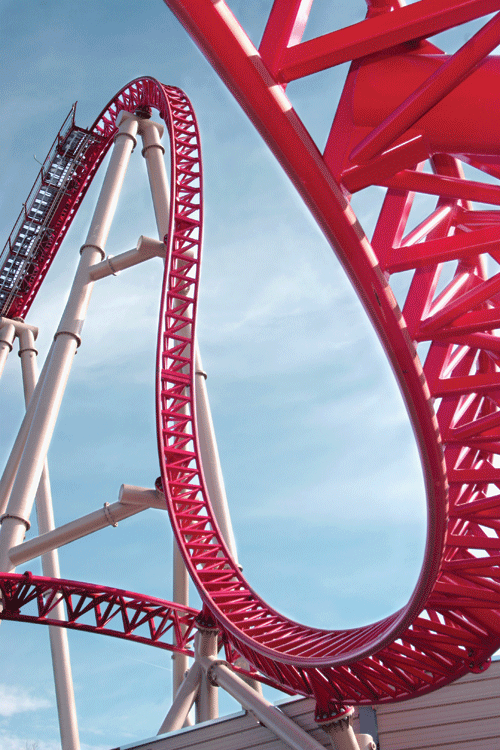
The roller coaster tapers off

What stands out from the Year Ahead 2010 report is the predictions. Merrill Lynch believes that the current rally of the euro against the dollar will recede in 2010, landing the euro at $1.38 by June, and falling to $1.28 by the end of the year. O’Neil claims that the dollar slump will reach its end as the “overvalued” euro readjusts, and “undervalued” emerging market currencies come under more pressure to de-peg from the dollar and come into their own.

According to the report, an average price of $85 per barrel of oil is foreseen “above the forward curve.” The long-term aspect is even more promising as “monetary stimulus chases too few oil barrels,” said the report. Rising oil prices will be, in particular, the result of what O’Neil sees as raising emerging market demand, which would on its own push the price of oil over $100 per barrel. “Western markets cannot tolerate a $100 barrel,” he quips.

Other commodities are also expected to do well in the medium term. Gold in particular is predicted to hit $1,500 per ounce as it is affected by three factors: credit risk, dollar weakness and the strength of commodities. O’Neil, however, “wouldn’t be surprised” to see gold consolidate in the near term at $1,000 per ounce if the dollar rises considerably. “Gold will still have a financial following in terms of the ETF [exchange traded funds] demand on the basis that it is a hedge against some sort of policy miscalculation or failure,” he says. 

While fears over Dubai defaulting have been allayed for the time being, O’Neil says the continued presence of large amounts of debt will have a detrimental effect on offshore capital confidence, which has been “shattered” by the recent Dubai World debt standstill fiasco.

“There is an inconsistency, unpredictability, and a lack of transparency that has produced an unpredictable set of events. Markets are going to insist on a substantial risk premium in that environment in terms of funding ventures,” says O’Neil in reference to Dubai. Much of Dubai’s financial future will continue to depend, he reckons, on the actions of Abu Dhabi and its sovereign wealth fund, which contains $500 billion to $600 billion, according to O’Neil.

“There is an inconsistency, unpredictability, and a lack of transparency that has produced an unpredictable set of events. Markets are going to insist on a substantial risk premium in that environment in terms of funding ventures,” he adds, in reference to Dubai. Therefore Merrill Lynch’s prediction of just 2 percent growth in the United Arab Emirates in 2010 seems to hold merit.

What has been a roller coaster year for the world and the region looks to become less harrowing in 2010, though O’Neil insists that the ride is not over. He does, however, single out one region as being more or less a rock in the storm: “Offshore of the Levant, there is nothing normal about the current situation.”

Editor’s note: The original article was edited on January 20, 2010 to reflect the accurate Euro to US Dollar projection.

January 3, 2010 0 comments
0 FacebookTwitterPinterestEmail
Real Estate

Danger underfoot

by Nada Nohra January 3, 2010
written by Nada Nohra


"Earth-shattering” events are relatively par for the course in Lebanon, with war, political upheaval and any number of social revolts rarely outside the realm of possibility at any given moment. The Lebanese, however, tend to focus on surface-level events to “rock” the nation, while few realize that below the ground they walk, an actual shattering of the earth is mounting.

“The possibility of a damaging earthquake happening in Lebanon is very high, and it is getting higher every day and every year,” said Ata Elias, assistant professor at the department of geology at the American University of Beirut (AUB), adding that the country could be hit with a quake reaching a magnitude of 7.5 on the Richter scale.

Lebanon stands on several major fault lines, which are cracks in the earth’s crust. Fault lines are at the boundaries between the earth’s tectonic plates and may range from less than a centimeter to several hundred kilometers in length. Tension can build along fault lines as the tectonic plates rub against each other, and if too much pressure builds the plates may shift, causing an earthquake.

The largest in Lebanon is the Yamouni fault that runs the length of the western Bekaa Valley, linking the Jordan Valley fault line to the Ghab Valley fault line in Northern Syria.

The Yamouni fault caused a major earthquake in 1202 A.D., and has a recurrence time of 800 to 1000 years, said Elias. Do the math, and you realize that the next major quake is set to hit between the years 2000 and 2200.

Lebanon’s many faults

The Yamouni is not the only fault putting Lebanon at risk, as there is another running along the coast — the Mount Lebanon fault — that is believed to have caused the catastrophic earthquake of 551 A.D., accompanied by a tsunami that hit the eastern Mediterranean and devastated the cities and towns along the coast. That earthquake is estimated to have had a magnitude of 7.5 on the Richter scale and caused 30,000 casualties in Beirut alone. The Mount Lebanon fault has a recurrence time of 1,500 to 1,700 years, which means another quake in the near future should not come as a surprise to anyone.

“We are now at a very singular moment in our geological history where we have two faults that might produce an earthquake,” said Elias.

Jordan, Syria and Palestine are also subject to seismic hazards and therefore any seismic activity that might be generated from these areas could affect Lebanon as well.

There are no means to know when exactly the major earthquake might occur, but that is not the sole issue since many smaller earthquakes are continuously taking place in Lebanon, such as the tremors witnessed in the south in February 2008, or the 5.3 magnitude earthquake that trembled Beirut in 1997.

The seismic hazard that Lebanon is subject to cannot be avoided, but the risk associated with the earthquake can be largely reduced by building safer structures and complying with seismic building codes.

Mohamed Hrajili, professor of civil engineering at AUB, said that it is very hard to calculate how many buildings in Beirut are built in compliance with seismic building codes, but gave an estimate of around only 20 percent. 

Hrajili added that the most vulnerable buildings are those between 8 and 15 stories high, due to the frequency with which the ground would shake as well as other technical factors that characterize earthquakes in Lebanon.

Even though the number of buildings resistant to earthquakes is very low, awareness on the issue started to rise in the early 1990’s when engineers started to adopt seismic building codes in their designs and a ministry decree was issued in that regard. Hence, many of the new buildings that were constructed after the Lebanese Civil War comply with some building code, whether American or European.

Heading off disaster

When the post-civil war reconstruction of Lebanon started, a team at AUB initiated a study identifying the seismic hazards that the country is subject to, and proposed a set of regulations for the construction and design of new buildings.

“We wrote a proposal to the directorate of urbanism saying that something should be done in this regard,” said Hrajili, who was involved in that study.

Lebanon was zoned under the 2B designation in the Uniform Building Code of the United States. In 1997 and 2005 respectively, decrees were issued and amended stating that new buildings should comply with the codes suggested in the decree or any other internationally recognized building code. Hrajili said the decree includes standards to meant to make buildings as safe as possible, and more importantly, to prevent them from collapsing.

“We can tolerate cracks in the buildings but we don’t want them to fall on peoples’ heads,” he said.

According to the decree, a report should be submitted to the order of engineers in that regard before obtaining a construction permit.

Although the decree was issued, the experts Executive spoke to said there is no strict supervision over the implementation of these codes.

“They ask for the file so they know the study is done, but they don’t have the means to check everything,” said Alexandre Richa, head of the department of construction and civil works at Apave, which runs technical oversight on construction sites to verify the solidity of structures and personal safety. Richa said there should be an implementation law that follows the decree, stating how inspection and control should be done.

Sami el-Khoury, director at the engineering company Rafic el-Khoury and Partners agreed with Richa, adding that even very experienced engineers might not be aware of the details that should be included in the structure, and that’s why a more thorough inspection should be carried out.

Cities at risk

In the event of an earthquake, high density areas are at higher risk, as buildings are closely lined up and will cause substantial damage and casualties if they collapse. These areas are in major cities like Beirut, Tripoli, Tyre, Jounieh and others. “I don’t worry about the Bekaa, for example, even though the fault passes there…the houses are remote and we can shelter these people more easily and save their lives,” said Hrajili. 

Another high-risk factor for Beirut and other coastal cities and communities is the possibility of a tsunami occurring, should the earthquake originate along the Mount Lebanon fault line. However, Elias said that tsunamis on the coastal line will not be higher than six to seven meters, thus mainly affecting the ports, the airport, and factories that lie in these areas.

Uncertain footing

Another worry experts point to is the fact that many districts and cities in Lebanon are built on sandy soil that has a high water content. If an earthquake takes place, soil liquefaction might occur and cause buildings and other structures to sink. Among the areas most at risk of this are the southern suburbs of Beirut, Bourj Hammoud, Tripoli and Damour. 

“There are measures that should be taken into account; in sandy areas you have to do a liquefaction analysis for the sand on which the structure is resting and that will give you an idea of how to reinforce the soil, so that you don’t have a sinking effect,” said Khoury.

Shoring up shaky infrastructure

Not only can new buildings be protected against earthquake hazards, but old structures can be reinforced to minimize the risks associated with tremors as well.

However, while holding new structures to building codes adds, on average, five percent to overall costs, reinforcing old buildings would be very costly, said Richa. “The cost may be equivalent to demolishing the building and rebuilding another one,” he said.

Still, there are some important structures that should be protected, as Hrajili explained, despite the high cost associated with it.

“Not every building should be repaired, but the most important ones like government owned buildings, hospitals, schools, ministries,” said Hrajili.

Better safe than sorry

Although architects and engineers in Lebanon have come a long way in terms of seismic awareness and building code implementation, there is still much to be done before Lebanon could be considered prepared for potential seismic hazards. 

“The government must create more awareness, like wearing seatbelts…now 80 percent of the people in Lebanon are wearing seatbelts because of the large [awareness] campaign,” said Khoury. He added that it is better to follow a certain methodology, because the cost of negligence is too high if an earthquake occurs and the country remains unprepared. 

Hrajili said the most important thing is to create stricter continuous supervision, in order to ensure that engineers actually comply with the building codes.


 “We only respect the code when there is an earthquake, for 1 to 2 years we pay attention and then afterwards we forget,” he added.

Building codes should be upgraded in accordance with geological and architectural studies.

“Codes should always be improved…take the example of the last earthquake that happened in L’Aquila, in Italy,” he added. On April 6 2009, an earthquake with a  magnitude of 5.8 on the Richter scale shook the city. More than 300 people were killed, more than 1,000 were injured and around 30,000 were left homeless.

Keep in mind that most structures in L’Aquila followed European building standards for protection against seismic hazards. The next earthquake in Lebanon will make painfully clear which of this country’s developers have been as scrupulous.


January 3, 2010 0 comments
0 FacebookTwitterPinterestEmail
  • 1
  • …
  • 433
  • 434
  • 435
  • 436
  • 437
  • …
  • 682

Latest Cover

About us

Since its first edition emerged on the newsstands in 1999, Executive Magazine has been dedicated to providing its readers with the most up-to-date local and regional business news. Executive is a monthly business magazine that offers readers in-depth analyses on the Lebanese world of commerce, covering all the major sectors – from banking, finance, and insurance to technology, tourism, hospitality, media, and retail.

  • Donate
  • Our Purpose
  • Contact Us

Sign up for our newsletter

    • Facebook
    • Twitter
    • Instagram
    • Linkedin
    • Youtube
    Executive Magazine
    • ISSUES
      • Current Issue
      • Past issues
    • BUSINESS
    • ECONOMICS & POLICY
    • OPINION
    • SPECIAL REPORTS
    • EXECUTIVE TALKS
    • MOVEMENTS
      • Change the image
      • Cannes lions
      • Transparency & accountability
      • ECONOMIC ROADMAP
      • Say No to Corruption
      • The Lebanon media development initiative
      • LPSN Policy Asks
      • Advocating the preservation of deposits
    • JOIN US
      • Join our movement
      • Attend our events
      • Receive updates
      • Connect with us
    • DONATE