• Donate
  • Our Purpose
  • Contact Us
Executive Magazine
  • ISSUES
    • Current Issue
    • Past issues
  • BUSINESS
  • ECONOMICS & POLICY
  • OPINION
  • SPECIAL REPORTS
  • EXECUTIVE TALKS
  • MOVEMENTS
    • Change the image
    • Cannes lions
    • Transparency & accountability
    • ECONOMIC ROADMAP
    • Say No to Corruption
    • The Lebanon media development initiative
    • LPSN Policy Asks
    • Advocating the preservation of deposits
  • JOIN US
    • Join our movement
    • Attend our events
    • Receive updates
    • Connect with us
  • DONATE
Feature

The Mediterranean Madoff

by Executive Staff October 2, 2009
written by Executive Staff

The quiet Southern Lebanese village of Maaroub has recently found itself at the center of attention following the recent arrest and indictment of its deputy-mayor and a prominent businessman hailing from the Shiite town.

Forty-nine-year-old business-mogul Salah Ezzedine, known by many for his piety and closeness to Hezbollah, is bankrupt and stands accused along with his alleged partner, Maaroub Deputy-Mayor Youssef Faour, of running a giant Ponzi scheme similar to that of American financier Bernard Madoff, who earlier this year was sentenced to 150 years in jail. As a result, the Lebanese press has dubbed Ezzedine “Lebanon’s Madoff.”

A Ponzi scheme is a fraudulent investment operation that promises investors high rates of return over a short period of time. The investments are then used to pay the return instead of actually being invested.

Exactly how much money invested with Ezzedine has gone missing remains a mystery. Some media reports estimate that he allegedly squandered more than $1 billion of investor money. According to sources close to the case,  the total amount invested with Ezzedine was at at least $500 million.

On September 12, the Lebanese financial prosecutor’s office charged Ezzedine and Faour with embezzlement, loan-sharking, distributing bad checks and breaching financial laws. They are currently in jail awaiting trial.

A wolf in sheep’s clothing

Ezzedine’s indictment has shocked residents of Maaroub. Many of them remember him as a kind and generous man who always stood up for the poor. He was considered a religious man who apparently gained fame among the Shiite community in the 1990s for organizing pilgrimages to Mecca. Indeed, one of Ezzedine’s businesses is his travel agency Bab el-Salam, which specializes in religious pilgrimages.

“He helped everyone, the poor, the sick, and people wanting to put their children in school that couldn’t afford it. Whatever the request was, he was there to help out. He was there to help immediately,” said Hussein Ezzedine, an employee at the town hall in Maaroub and distant relative of the business-mogul.

With the money he made, Ezzedine built new mosques in the town and made financial contributions to building the town hall.

A few years ago, Ezzedine funded a brand new soccer field for the village. Looking out from a tower above the field offers a view of the town, as well as Ezzedine’s luxurious villa estate that now stands empty. Locals point to two large and still unfinished houses next to Ezzedine’s mansion and said they belong to his partner, Faour.

Ezzedine was also known for his close ties to Hezbollah, which apparently earned him credibility among his investors, the majority of them being from the Shiite communities in Beirut and the South Lebanon. It is also believed that several Hezbollah officials lost money with Ezzedine. One of them is Hezbollah MP Hussein Haj Hassan, who filed a complaint against Ezzedine when his check from Ezzedine bounced. Although Hezbollah has clearly distanced itself from the alleged crooked moneyman, with Hezbollah leader Hassan Nasrallah denying the party had any official links to Ezzedine in a televised address, the story is still a major embarrassment to the organization. Nasrallah has acknowledged that some members of his party invested with Ezzedine, but that the total sum did not exceed $4 million.

Ezzedine was known for his close ties to Hezbollah, which earned him credibility among his investors

The smell of something fishy

Ezzedine’s business scheme, which incorporated tens of thousands of investors, offered quick returns of 40 to 50 percent from a range of apparently bogus investment projects such as petrol, African oil and titanium. Some of his investors even say they were offered annual returns of 60 to 80 percent.

Nassib Ghobril, head of economic research at Byblos Bank, says that while there have been several similar schemes in Lebanon over the past years, there have been none “on this scale.”

Commenting on the high returns promised by Ezzedine, Ghobril says this should have raised doubts in the minds of investors. Indeed, returns of up to 80 percent should have had alarm bells ringing in the heads of Ezzedine’s investors. That, however, did not happen.

“Anyone should be suspicious about these kinds of high returns,” says Ghobril. “But people still tend to believe these things. People don’t learn, not in Lebanon and not elsewhere in the world. The victims have a hard time believing it. They learned the hard way this time.”

Ezzedine headed a number of businesses, including the publishing house Dar Al Hadi, which specializes in children’s books, and a children’s TV station carrying the same name. Following Ezzedine’s arrest, the authorities seized the Dar Al Hadi offices, sealing the company’s glass doors with red tape.

Another one of Ezzedine’s company’s is a Beirut-based financial institution established in 2007 called Al Mustahmir, which specializes in money management.

Another business that has been linked to Ezzedine is the mysterious East Line Company. The Financial Times and Abu Dhabi’s The National reports say this might be one of the investment vehicles that Ezzedine used for his business operations. Last year, in June 2008, Gambian President Yahya Jammeh issued a statement saying that he had received a $4 million check for “royalties paid to the Gambian government by Salah Ezzedine of East Line Company for 10,000 tons of sand minerals exported from the Gambia.”

Unwary victims

With expected returns of 40 percent, a sizable portion of Maaroub’s 5,500 residents decided to try their luck with Ezzedine.

Hussein Ezzedine estimates that around 15 percent of the villagers invested money with the businessman at some level.

He mentions one man who started investing with Ezzedine back in 2000 and lost $1.4 million, while others invested between $100,000 and $250,000. Some of the lower-income investors lost $10,000.

Another investor, 29-year old car importer Ali Fneish, invested $120,000 with Ezzedine half a year ago. That money is now all gone.

A man in the nearby village of Toura identifying himself as N. Chour says he invested “more than $100,000” with Ezzedine earlier this year. He says he lost all the money he earned working in Africa for 15 years.

Chour says 60 percent of Toura residents invested money with Ezzedine. To collect investment capital, lower-income investors in some cases mortgaged their houses and sold off land.

Mohammed al-Duheini, mayor of Toura, told Agence France Presse that some 250 residents from his town invested money with Ezzedine.

“He managed to win the trust of the Shiites of South Lebanon and handled a lot of their money,” he told AFP. Chour speaks of how one person in the village was appointed to collect the money from investors and hand over the investments to Ezzedine and his associates as lump sums.  According to several Ezzedine investors, Faour allegedly had an office in Tyre and served as a point man for investors in the south. Ezzedine, meanwhile, is said to have had an office in Beirut’s southern suburbs.

Paperwork, including official receipts, appears to have been scarce with Ezzedine. In place of receipts, investors were given checks for the principle amount they had invested.

The great conspiracy theorists

In a peculiar twist, several of Ezzedine’s investors still defend him despite the fact that their money went up in smoke.

In Maaroub, investors and residents whom Executive talked to spoke of Israeli and American conspiracies as the cause of Ezzedine’s bankruptcy. Others believed the business mogul had taken a hard hit from the global financial crisis. They deny that Ezzedine, the “respected man” they entrusted their savings to, is a swindler.

But Chour says he has “doubts” about Ezzedine, especially following his and Faour’s recent indictment. So do other villagers, he says.

“Of course I have doubts. We don’t know what happened to him or where the money went. We have been asking this question and no one is giving us an answer — not the Lebanese state, nor any other person.”

Many investors still holding on to their checks from Ezzedine now await the outcome of the investigation for a solution. Reports have surfaced about investors in the Gulf losing large sums to Ezzedine. Yet, it is still widely believed that the majority of the victims of the alleged scam are Lebanese investors, many of whom have earned their money abroad and then returned home.

Amid growing fears in Lebanese financial circles, Central Bank Governor Riad Salameh told Bloomberg in September that Lebanon’s banks were not involved with Ezzedine.

“There is no exposure by the banks to it,” he said. “The investigation is ongoing. It has nothing to do with the finance or banking industry. He had his own investors, and it’s a private matter that’s outside of the banking industry.”
October 2, 2009 0 comments
0 FacebookTwitterPinterestEmail
Feature

Captain Hook incorporated

by Executive Staff October 2, 2009
written by Executive Staff

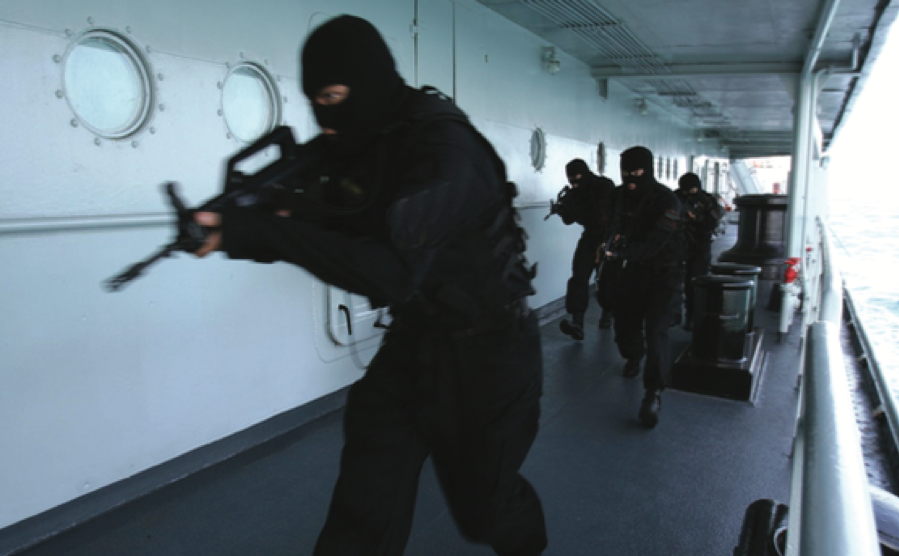
The financial cost of piracy off the Horn of Africa has surged over the past year as pirates have become increasingly audacious, better funded and equipped, and able to extend their reach in the high seas. A few years ago vessels were warned to keep 50 nautical miles off the Somali coast; now, pirates are boarding ships as far away as the Seychelles, some 1,500 kilometers off the coast of Africa. The area the European Union Naval Force (EUNAVFOR) patrols is some 9 million square kilometers, almost the territorial size of the United States of America.

Just as the range of pirate operations has increased, so has the ransoms being paid out, rising from $250,000 to an average of $1.25 million in 2008. The London-based International Maritime Bureau recorded 111 pirate attacks off the Horn of Africa last year, of which 42 were successful hijackings. In the first half of 2009 there have been 130 incidents.

The situation turned into what was internationally deemed a “crisis” last year, prompting the European Union to establish its first naval security mission consisting of 12 ships, while Russia, the US, China and India also sent warships to the Western Indian Ocean to protect their maritime vessels. In a rare show of international solidarity, the armada patrolling the Gulf of Aden is coordinating to curb the scourge of piracy.

But covering the cost of bases in Djibouti, Kenya, Bahrain (the US naval base), Dubai and elsewhere runs in the tens of millions. The operating cost of EUNAVFOR alone is $12 million a year, excluding the cost of naval vessels, aircraft and military personnel.

The cost to the shipping and insurance industries, however, is far higher. Last year, pirates collected around $30 million in ransoms. Cyrus Mody, manager of the International Maritime Bureau, said that figure doubles when the legal fees, negotiators, delivery of ransoms and associated costs were added. “The amount paid out is pretty much equal to what the ransom is,” he said.

The cost to insure ships transiting the Gulf of Aden is estimated at $20,000 per ship per voyage, excluding injury, liability, and ransom coverage. A year ago, the cost of the additional insurance premium was only $500, according to maritime newspaper Lloyd’s List. It is estimated that the increased cost of “war risk insurance premiums” for the 25,000 ships that ply these waters, which includes an estimated 11 percent of the world’s petroleum, could reach as much as $400 million.

Keeping to the designated shipping lanes in what EUNAVFOR calls “group transit” of several ships, and paying up if captured, would seem to be the only options for the world’s shippers. The alternative of avoiding the Gulf of Aden and the Suez Canal is simply too expensive and time consuming.

According to the US Department of Transportation, to re-route a tanker from Saudi Arabia to the USA via the Cape of Good Hope adds approximately 2,700 miles to the voyage and some $3.5 million annually. A routing from Europe to the Far East via the Cape, rather than through the Suez Canal, would incur an estimated additional $89 million annually, which includes $74.4 million in fuel and $14.6 million in charter expenses. In addition, the rerouting would increase transit times by about 5.7 days per ship.

Pirate dens

The heightened international naval presence off the Horn of Africa has had a direct impact on curbing piracy. “The number of attacks has not decreased but the number of successful attacks has gone down, primarily because of the naval presence,” said Mody.

EUNAVFOR’s specific mandate protects ships of the World Food Progamme. Commander John Harbour of the British Royal Navy and chief media spokesman for the European task force, said the rate of success was one ship hijacked for every three attempts, whereas a year later it is one in nine successful pirate attacks. “Every single day there is an attempt and every day we thwart that attempt. And even when there is not a direct attack, we see many skiffs with armed men,” said Harbour.

A knock-on effect, however, of the naval presence has been the ramping up of the ransoms demanded by the pirates and heightened investment in faster speed boats, mother ships to refuel and launch skiffs on the high seas, and better weaponry.

“When the navies united under an Aden task force, the pirates needed to be more audacious,” and demand higher ransoms, said Simon Davies, a former detective and special investigator with Britain’s Scotland Yard and a consultant on financial crime and piracy in East Africa. “That [ransom] pie graph is getting more and more cuts in it as the money is shared around. There is money for bigger engines and dhows to ply the sea carrying extra oil,” he added.

The pirates run what Mody called an “extremely business orientated” operation, similar to many organized crime syndicates around the world. Up to five major pirate groups operate from bases on the Somali coastline and are either self-funded or financed by external investors.

Employing watchers in commercial hubs like Dubai, the pirates are informed of when a ship leaves port and what cargo it is carrying, or information is easily garnered from reading the shipping news published in local newspapers. A crew of armed men on speed boats or on a mother ship then head out on the high seas to track down potential targets. If successful, the pirates capture a vessel and sail it to Somalia. There, said Davies, the pirate crew is replaced with another crew for negotiations to take place. The onus is then on the owner of the ship and insurance companies to cough up the ransom.

Due to the frequency of attacks, ship owners have set up insurance cartels, with many owners paying into a pool that will then pay out in the case of a hijacking. Then the separate insurers of a ship’s cargo, hull, and other forms of insurance get involved.

“If say a cargo of sugar costs $50,000, the insurer pays 10 percent of the ransom, the owner 15 percent, hull insurer 15 percent. If [they are] maybe $150,000 short, the cartel of ships pays up,” said Davies.

Then the drop off — usually in small denominations of US dollar bills — takes place. Back in 2005, Mody said money exchanged hands in either airport lounges or hotels in Dubai.

“A phone call was made and the vessel released. In 2008, the money was taken by security companies by boat to the captured vessel,” he said. “This has been taken a step further. To make it safer for delivery, the money is now being air dropped on the vessel or nearby. This is how the delivery has progressed, as, if you have a security person on-board, he will automatically become a threat to the pirates. And sailing in with the money from, say, Djibouti or Kenya, you need to hire a crew, and the crew knows there is $1 million on-board… The air drop has made it cheaper and safer.”

Getting rid of the loot

One spin-off from the piracy business has been a boom for sectors catering to the pirates, from arms dealers to boat outfitters, car dealers, and other enterprises. Businesses have also emerged that cater to the unwilling European visitors to Somalia.

“With Europeans captured, there is a burgeoning restaurant business [in Somalia] to cater to Western palates,” said Davies.

Mody said that living standards are going up due to “lavish spending by pirates, which is encouraging local industry to build up, and flashy new cars to be driven around because of the new money.”

While part of the loot is divvied out among the pirates, some is earmarked for investment in the next venture. But if the ransom money doesn’t stay in Somalia, where does it go? There have been claims that the money is laundered in Dubai — a claim the Emirate has vigorously denied — and via Beirut. Mody said much of the money gets siphoned into Kenyan real estate, where there has been a marked increase in Somalis buying properties in Nairobi. Davies said money may also be laundered or invested in Iran, Yemen and the UAE.

Indicative of the pirates’ business savvy, there has been minimal violence toward captured crew members.

“It is a business for them and any violence towards the crew will affect this business model,” said Mody. “If violence increased, this would change the dynamic, and that could be a turning point in how nations look at piracy. Keeping that in mind, having a link to terrorism is also not in the best of their interests. If a link is established, there would be a very serious clamp down by certain external interests.”

October 2, 2009 0 comments
0 FacebookTwitterPinterestEmail
Editorial

Time For Home Truths

by Yasser Akkaoui October 2, 2009
written by Yasser Akkaoui

I think it may be time for the Lebanese to face facts ­ — we are now in a state of civil war. Time and time again, when I have seen friends in recent weeks, there has been something of a familiar refrain: ‘the situation is bad, yes, but we are not there yet.’

It may not feel like a civil war from your office in Downtown Beirut, or Ashrafieh, or Hamra, but there has been more than the equivilant of a bomb per week in the first two months of 2014. Dozens have died as rival Lebanese (as well as Syrian and Palestinian) political groupings carry out tit-for-tat attacks and crackdowns. And those are just the successful ones. The security services have discovered a number of other explosive-rigged cars that sought to wreak havoc. If you don’t believe we are in a civil war, speak to the people of Dahiyeh, of Hermel, or of Akkar.

Our big savior, we were told, would be the new government. After a year of unnecessary infighting, our political classes have finally deemed it fit to form a Cabinet, run by Tammam Salam (seen on the cover). And what a Cabinet it is.

If Lebanon is run by 13 princes, then this government has given them all new jewels. Nabih Berri, speaker of Parliament and the wiliest fox out there, has managed to get his protégé Ali Hassan Khalil into the Ministry of Finance. Anyone hoping for new transparency with where our money goes is likely to be sorely disappointed. Likewise, Future Movement stalwarts Nouhad Machnouk and Ashraf Rifi — now interior and justice ministers respectively — have been tasked with tackling the now extremist groups whose predecessors they tacitly supported for so long. And almost every other appointment smacks of cronyism — our political classes looking out for themselves when their people are desperate.

Faced with a growing wave of radical groups, moderates of all hues have been shifted into the minority. They have come together to form a government, but done little to form a united front.

I hope to be proved wrong, I really do. I hope that this new government will want to open up, change policies and implement necessary reforms to both protect our little nation and help it grow again.  What is really needed to drag the country back from the brink, away from extremism, is a new deal for the Lebanese — the kind that gives people a stake in their society. For that reason, we have again produced in these pages a series of meaningful, practical policy proposals for the government, inviting the insights of leading thinkers from all fields. If any of these new ministers wants to prove me wrong, let him or her not attack us, but prove to us their honesty through actions. Let them come and discuss the necessary reforms to move the country forward.

But I will not be getting my hopes up. And in the meantime, Executive will continue calling out our politicians’ dishonesty, corruption and nepotism — even during a civil war.

October 2, 2009 0 comments
0 FacebookTwitterPinterestEmail
Feature

Lebanon’s Cannabis Commerce

by Executive Staff October 2, 2009
written by Executive Staff

General Michel Shakkour’s office, on the third floor of the Hbeish police station in Beirut, is lined with plaques and framed certificates from police departments around the world. The head of the Internal Security Force’s (ISF) General Crime Directory, Shakkour is responsible for combating narcotics, as well as prostitution and gambling. But for the past three years, Shakkour’s fight against illicit substances has largely been undermined when it comes to destroying the source of Lebanon’s narcotics production: the cannabis and poppy fields in the northern Bekaa valley.

Starting in 2006, the war with Israel and subsequent internal strife prevented the security forces from destroying the hashish crops at harvest time in early September. The next year Shakkour’s men tried again. But without the help of the army, which had been diverted to fight Fatah al Islam extremists, ISF forces came under fire from the farmers, who come from large, well-armed local families.

“This is why you have to show power through the army, because the army has tanks, planes and helicopters — they have everything,” Shakkour says.

This year has been different. Since a deal was brokered between the warring opposition and pro-government factions in Doha in May 2008, the country has witnessed a period of relative stability, allowing the security forces to focus on issues other than keeping the peace.

The ISF and Lebanese Army have reportedly succeeded in eradicating the majority of Lebanon’s illicit crops this year, as well as cracking down on some of the most notorious families in the drug trade. In late May, members of the Jaafar clan ambushed an army jeep in the Bekaa, killing four Lebanese Army soldiers and wounding a further 11. The attack was revenge for the death of a senior member of the clan, Ali Abbas Jaafar, who had 172 outstanding arrest warrants against him when he was killed by soldiers at a checkpoint near Baalbek.

In response, the army launched an offensive in the Bekaa, employing special forces and armored vehicles, setting up additional checkpoints, arresting close to 100 suspects and confiscating 1,500 kilos of drugs, weapons, military equipment and counterfeit money.

According to Shakkour, the farmers keep a close eye on political developments in Lebanon in order to anticipate how much attention drug eradication will receive from security forces and their government patrons.

“They find out sometimes that they can [complete] their plantation and then get their production. So this is why they are gambling. The last three years, no eradication — so they win. This year, they lost.”

ISF seizures of illicit substances in Lebanon 

Source: Internal Security Force’s General Crime Division

Yammouneh

During the years of the civil war, cannabis grew everywhere along the Baalbek-Hermel highway. Today the strip is barren, with little growing in the fields that line the road. Gypsies have made homes of plywood and sheets in the windswept plains where the fields once stood; scrap metal yards and junk car lots occasionally make way for men selling sacks of potatoes on the side of the road.

Turning off the highway, a winding poorly-paved road up the foot of Mount Lebanon leads to the village of Yammouneh. Nestled in a valley, the village is markedly more lush than its surroundings and has an estimated population of 4,000 to 5,000, though these days, many people live and work outside the village and abroad because of the dismal economic situation in the area.

Seventy-five percent of Yammouneh’s remaining residents depend on hashish, an extract of the cannabis plant, for their livelihoods, a local drug dealer, Mansour*, explains. According to Al Hayat, in 2007 this little village produced some 5,000 of the 70,000 hashish-cultivated dunams (1 dunam = 1,000 square meters) in the Bekaa region.

But this year, the Lebanese Army and the ISF came in and bulldozed all the fields just before the scheduled harvest.

“Why do they wait until the harvest to destroy our crops instead of doing it in June?” Mansour posits.

“Out of revenge, to punish the farmers?”

“Why do they wait until the harvest to destroy our crops instead of doing it in June?”

Grows like weeds

During the long lawless years of the civil war, Lebanon became a major producer and exporter of hashish, and to a lesser extent, heroin and other opiates. At its peak in 1988, Lebanon’s narcotics market was making an estimated $1.5 billion, according to Newsweek.

After the civil war ended in 1990, the United States pressured the Syrian government, whose troops were occupying Lebanon at the time, to crack down on the cultivation of illicit crops with the help of Lebanese authorities. Production continued, however, with several politicians known to be taking a cut of the profits.

From 1992 onwards, farmer’s crops were destroyed annually during harvest time, and farmers eventually turned to alternative crops — agricultural produce and livestock provided by the United Nations Development Program (UNDP) and United States Agency for International Development. The Lebanese government also opened a sugar factory in the area to spur employment.

The problem was that the Holstein cows donated by the US government cost more in upkeep than they provided in income, and the alternative crops failed to turn a profit. The Lebanese government shut down the factory after two years and the farmers, unable to make a living, returned to cultivating their hashish crops.

While Lebanon has been removed from the US list of major narcotics producing countries, it was still the largest producer of cannabis resin in West-Asia in 2007, according to the UN Office on Drugs and Crime. This year’s crop eradication cost upwards of $200,000, with 1,000 army soldiers deployed in a show of force, in addition to the I.S.F. officers. Tractors were rented from villagers at a $100 per day to raze the crops, and additionally, manual laborers were paid to uproot any remaining plants.

“This year, a political decision was taken,” Shakkour says, alluding to an agreement between Hezbollah, which has clout in the area, and the security forces. He explains that the entire process of eradication took some three weeks and “approximately 15,000 hectares” were destroyed, which he believes constitutes “90 to 95 percent” of cannabis crops.

The help of some of the local residents was also essential to the success of the operation, Shakkour claims.

“We have a lot of informants in the areas,” he says. “Every day we get a call from one of my informants. As soon as we get this information, we go straight to the field and eradicate it.”

While Shakkour says his troops met little resistance this year because of the army’s overwhelming presence, not everything went according to plan.

“[On] the third day we were in the Bouday area, one of the tractors passed over a hand grenade. The way they put it was very smart. They got it from films,” says Shakkour.

The farmers had attached a trip wire to a grenade inside of a glass cup. “When the truck passed over, it broke. We were lucky that this bomb was under the truck. If it [exploded] under a soldier, it would cut his leg or he might die. This was the only incident that happened this year. Thank God.”

This year’s crop eradication cost upwards of $200,000, with 1,000 army soldiers deployed in a show of, force

From seed to harvest

“In the best areas,” says Mansour pointing to the fields on his left, “a farmer yields about 10 kilograms (kg) of hashish per dunam of cultivated land.” In most areas, a dunam will yield an average of 4 kg of hashish. Cannabis is planted between February and April, and requires no irrigation.

The cultivation of one kilo of hashish costs the farmer about $200. This includes the wages for migrant workers who plant, weed and separate the male and female cannabis — only, the female plants are potent —  as well as rental costs of tractors and trucks to carry the crops from the plain to the storage rooms where they are left to dry. The farmer then processes the cannabis with a mechanized grinder made by and purchased from the village blacksmith.

“You only need a new one [grinder] every ten years,” says Mansour, commenting on the fact that the blacksmith makes little money from the area’s cannabis cultivation.

Finally, farmers extract the most potent powder through a large sieve. The congealed powder is then packaged and sold to the drug dealer for $300 to $400 per kilo. The farmer makes about $100 to $200 from every kilo he sells to the local dealer, and about $400 to $800 per average cultivated dunam.

Outside dealers then come to the Bekaa to buy hashish from the local dealers, who sell in bulk, starting at a minimum of 100 grams (g). One kilogram of hashish wholesale will cost approximately $1,000. In Beirut, the street value of 20g is approximately $50. Thus, dealers can make about $1,500 profit from one kilogram of hashish purchased in the Bekaa.

The export market

In Europe, a kilogram of Lebanese hashish sells wholesale for $4,400 to $5,900. Dealers, according to Mansour, come from all over including Spain, Egypt, Jordan, Saudi Arabia and Holland to survey the crop and negotiate the price. The dealers either ship or transport hashish by land to Europe.

“If I send 500 kg to Holland by truck, it will sell for about 1.5 to 2 million euros ($2.2 million to $2.93 million) there,” says Mansour. The dealer buys that amount of hash from the farmers for $150,000 to $200,000. He pays a truck driver $15,000 to drive the truck to Holland, and ends up keeping the rest.

“One ton of hash in Holland will sell for 3 million euros ($4.4 million). 2.5 million euros ($3.66 million) of that goes to the dealers,” Mansour claims. “In a good year, a dealer can sell 5 tons of hash and make seven to eight million dollars abroad,” taking into account expenses like labor, bribes, confiscated shipments and security.

“I used to be a dealer in Holland, Turkey and Bulgaria,” he say. From 1989 to 1997, Mansour claims he trafficked drugs with a partner who was “a policeman for Interpol.”

So who becomes a drug dealer and who remains a farmer in the village?

“People with contacts outside Lebanon become drug dealers,” says Mansour.

Shakkour says that hash can also easily be flown to Cyprus.

“The cost of smuggling is nothing — you can take it on the plane. 10 kg is [worth] 30,000 euros ($43,974). The dealer can send people with a handbag,” he says. “If he pays the ass [sic] — the guy who is taking the stuff — if he gives him $5,000, he will be very happy.”

If the estimated 20,000 hectares that were cultivated this year had been harvested and trafficked to Europe, 1 million kilos of hashish would have flooded the market, worth an estimated 3 billion euros ($4.4 billion). But when supply is up, prices go down, so even in years when the hashish plants were harvested without intervention from the security forces, dealers would often avoid selling off their entire stash.

“They didn’t plant a lot this year, because they have a lot in storage,” Shakkour says.

“In a good year, a dealer can sell 5 tons of hash and make seven to eight million dollars abroad”

A pretty penny for nose candy

Mansour also explains how cocaine is brought from South America to Lebanon for local sale. He says that on the street in Brazil cocaine sells for around $2 per gram.

“So for 5 kg, you’ll pay about $10,000 in Brazil. It will fit in the handbag you are carrying now,” he says. “In Brazil at the airport, you pay a bribe of $1,000 per kilo. So that’s $5,000 for 5 kg. [Upon arrival] in Lebanon, you pay $5,000 at the airport as a bribe. I’d pay you $30,000 to do that and I make a few hundred thousand dollars when I sell it here for $100 to $110 [per gram].”

Cocaine, however, is almost never sold pure to the end consumer.  Fahed*, a Lebanese man who dealt drugs in Europe before fleeing German authorities, says he normally cuts the cocaine he buys with lactose powder, at between a one-to-one to a one-to-three ratio.

Nationality of people arrested for drug offenses in Lebanon

Source: Internal Security Force’s General Crime Division

The only game in town

There are few overt signs of loyalty to political parties in Yammouneh or even much of a political presence — there are close to none of the portraits of religious and political leaders or party flags that usually adorn homes and public spaces around the country.

Ahmed* is 21 years old and works as an assistant to Mansour. He also runs a one-man drug business — growing his own small plot of hashish, but also weeding, harvesting, processing, packaging and selling his stash across the country.

Asked how much money he earns. “A lot!” he boasts, adding, “This year was excellent, because supplies are down… I sell about 2 to 3 kilos a year… all over the country. In Beirut, I make the most money. I sell a gram for $2 there.” Ahmed grosses about $6,000 per year or $500 a month, not including the cost of gasoline for his moped. In addition, he delivers drugs for other dealers. Compared to his parents, who grow apples, Ahmed earns a good living. “My father hates what I do,” he says. “But what else is there?”

“In Brazil at the airport, you pay a bribe of $1,000 per kilo. So that’s $5,000 for 5 kg. [Upon arrival] in Lebanon, you pay $5,000 at the airport as a bribe”

Learning from UNDP’s failures

So far, no alternative crops have succeeded in earning the farmers a livable wage.

“We can grow some apples,” Mansour says, “but only one harvest in five years is any good, because of the cold.”

He adds that the merchants who purchase the apples often shortchange the farmers on even the pittance the apples sell for.

“The farmers pay more [to plant and harvest] than they get back with apples,” he says.

UNDP alternative crop programs were ceased in the late 1990s, and pledged international donations never materialized. According to a Newsweek article in 2001, donors gave only $16.7 million of the $300 million the UN says it needed to develop Bekaa agriculture. But Western officials accused the UN of wasting the money it did receive through mismanagement and corruption.

“We succeed in the eradication only by force,” says Shakkour. “But we didn’t succeed to combat the idea. This is why the next year, or any year, if they [the farmers] will find that the situation in the country is not good, they will go back to planting [hashish]. The only solution is to get rid of the idea from their minds. And to get rid of the idea, you have to show them [other] projects, [other] alternatives.

Edgard Chehab, the current UNDP Energy and Environment Program manager, admits that the agency made major mistakes in the past.

“They [the UNDP’s earlier initiative] did not identify alternative crops that farmers were used to,” he says. “The crops needed lots of water, maintenance and investment, which made the project unsuccessful. They didn’t look at the marketing for farmers before.”

Prices of heroin, cocaine and cannabis resin in various years (in $)

Source: UNODC, INCSR, government sources

Harnessing cannabis’ potential

Chehab thinks he might have found a solution for Lebanon’s illicit crop farmers. In cooperation with the Beirut-based private investment firm Phystone, the UNDP is introducing pilot projects in the Bekaa for hashish farmers to grow industrial hemp — the non-intoxicating cousin of cannabis.

“The farmers are used to hashish and industrial hemp is very similar,” says Chehab. “It doesn’t need water and the Bekaa is dry. No fertilizer is necessary. ”

Hemp oil, which is rich in Omega 3 and Omega 6, can be extracted from the plants, and is a popular dietary supplement in Europe and the US to reduce cholesterol and the likelihood of heart attacks. In addition, the oil is used in cosmetics, and the fibers can be used as a combustible to heat homes, or to make rope and textiles.

Cultivation will begin in March 2010, in Deir El Ahmar, Baalbek and Hermel, according to Chehab. For the first year, they will cultivate only 500 dunams. By 2011 it will increase, he says.

“The UNDP will make sure that this is a joint venture between small farmers — who are guaranteed a lump sum — and that in addition, part of the profit will go to the farmers so they can stop thinking about hashish.”

Safi Harb, the chief executive officer of Phystone, says that the hemp seeds have already been purchased. He says his company identified the sector because they are interested in agro-industries, and to fill the void left by the Lebanese government and its seemingly non-existent infrastructure.

“This is a private equity project. We will have to convince the farmers that it can work by buying all the crops from them,” during the pilot phase. “Once we have enough supplies and raw material, we plan to set up a factory in Lebanon for hemp oil,” as well as for hemp-based cosmetics and by-products, and eventually a textile industry. Harb says he is ready to invest with the farmers and that they will not be exploited.

“We’ll buy all their products… at pre-agreed rates,” he says.

Harb acknowledges that they have yet to see how many kilos of seeds will be harvested per hectare. Phystone and the UNDP will guarantee the farmers a net profit of $150 to $160 per dunam, and farmers can plant and harvest two cycles per year, because each cycle lasts only 3 months.

“With industrial hemp, their profit will be cut by half — but its legal and sustainable,” Chehab says. “It is better than tomatoes, but not as good as hashish.”

Phystone plans to increase their project’s reach to a maximum of 5,000 to 7,000 hectares of industrial hemp. But while the project seemingly has all the elements of a successful venture, Harb admits that this depends on the farmers.

“This is the only plant that you can use everything with… Lebanon has the perfect climate and conditions — sunshine, the soil and seasons,” he says. Each phase of the project requires capital investment, though, and enough raw materials.

“The profits,” he says, “depend on the volume [produced].” With the pilot projects, Phystone will not be losing money. “We would not enter if the return on investments is below 20 percent over a three to four year period,” he says confidently. “The return on equity is higher.”

Harb plans to invite the farmers to be involved in the agro-industrial sector and also says he will offer the farmers shares. Chehab says the UNDP will ensure that the farmers are not exploited.

But not everyone has a sunny view of this newest venture.

“What are they doing — experimenting with us?” Mansour asks skeptically. “We will grow hashish until something works. We want a valid alternative, or next year, we will protect the hashish plants with our blood.”

Shakkour also expressed skepticism over the program, noting that the UNDP has not coordinated properly with the ISF. This recently led to the confiscation of hemp seeds which were being imported into the country, as the authorities confused them with their illicit counterparts.

The legalization question

The other program the UNDP has looked into in recent years is the legalization of cannabis.

“We were asked by the previous minister of agriculture in 2007 to study the possibilities for the legalization of hashish for medical purposes,” says Chehab.

The UNDP concluded, however, that hashish couldn’t be legalized because it has not proven useful for medical reasons. “It’s only useful for patients with HIV and cancer, against vomiting and loss of appetite. But it’s not yet proven to be a medicine,” say Chehab. The UNDP also concluded however that opium, which is used to make codeine, could be legalized.

“But the UN has very strict guidelines for this: Lebanon does not fulfill the minimum requirements in terms of stability, etcetera,” Chehab says.

While it seems like the private sector and the UNDP are the only ones concerned with a long-term solution to Lebanon’s cannabis problem, Shakkour thinks that the solutions for Bekaa farmers should not come from the outside, but rather from the Lebanese government. On this, the drug enforcement chief and Mansour, the drug dealer, agree.

“The government has done nothing but make promises,” says Mansour. “They have to understand, there is no life for us after hashish.”

*Editor’s note: Names have been changed to protect anonymity.

The legalization debate around the world

In 2005, 500 economists, including the prominent conservative Milton Friedman, published an open letter to the US President and Congress advocating the legalization of marijuana.

“Replacing [cannabis] prohibition with a system of taxation and regulation would save $7.7 billion per year in… expenditures on prohibition enforcement and would produce tax revenues of at least $2.4 billion annually if marijuana were taxed like most consumer goods,” stated the letter. “If… [cannabis] were taxed similarly to alcohol or tobacco, it might generate as much as $6.2 billion annually.”

Additionally, economists argued that the state would put drug traffickers and dealers out of business if the drug market were regulated.

Some European countries, Canada and recently Mexico, have taken the step of decriminalizing cannabis possession, meaning that personal use and — in some cases — cultivation of small amounts will not incur criminal penalties. This separates governments’ soft drugs policy from their hard drug policy, though drug trafficking is still illegal. 

Holland decriminalized cannabis possession and consumption in 1994 and did not witness an associated increase in drug abuse as a result — crime rates actually dropped. According to a 1995 report by the European Monitoring Centre for Drugs and Drug Addiction, the Dutch have the lowest drug addiction rates in Europe. The US, in contrast, which has severe penalties for drug possession, has a much higher rate of drug abuse, and incarceration rates for drug-offenders are higher than for any another crime, including murder. On the state-level alone, the US spends more than $6 billion per year to incarcerate drug offenders.

Drug producer countries, like Columbia, have recently started to consider decriminalization or legalization as a way of combating drug mafias and reducing drug-related violence. Currently the 1961 United Nations Single Convention on Narcotic Drugs and related UN agencies are opposed to member states legalizing illicit drugs, which is largely a reflection of the US’ position.

October 2, 2009 0 comments
0 FacebookTwitterPinterestEmail
Feature

Kicking the habit

by Executive Staff October 2, 2009
written by Executive Staff

Skoun, founded in 2003, is Lebanon’s first and only out-patient facility offering prevention and treatment for drug users. Located in Achrafieh, the center offers voluntary counseling for addicts, group therapy and drug replacement therapy. The overwhelming majority of patients who seek Skoun’s help are addicted to heroin and between the ages of 22 and 30 years old, although patients range from age 16 to 50. With a budget of $600,000 to $800,000 per year, Skoun treated 172 drug users in 2008 through funds it received from grants and private donations.

The idea for Skoun came about because of a “lack of services in Lebanon,” says Skoun’s director, Nadya Mikdashi. Other drug rehabilitation facilities in Lebanon include the in-patient rehabilitation center called Oum al Nour, while several  hospitals have detox programs.

Skoun’s approach is different, as they seek to treat people on an ongoing basis while they are living their daily lives, so that they can tackle “other life issues, not just addiction issues,” Mikdashi says. This approach isn’t new; in the West, 70 percent of addiction care is out-patient. Skoun views addiction as treatable and a specialty of mental health.

Amin has been a patient at Skoun for one year to treat his heroin addiction. He says he spent only a short period of time in another facility, which he claims “seemed to work under the presumption [that] you have messed up on your own. From now on, we tell you what to do, what to think, who to see and even what to say.”

“Skoun is different,” he says. “You take responsibility for your feelings and emotions, confront them, and accept what makes you happy as much as what brings you down.”

Amin has slipped up and used heroin a few times, as most addicts do according to Mikdashi. But Amin says that “it’s important to know why it happens, and how to prevent it in the future. So to say if you lapse again, you are kicked out, like some facilities do, is dooming people to failure.”

Every week, Skoun administers Amin a controlled dose of buprenorphine, an opiate replacement, and also samples his urine to ensure his overall health. Over the past year, Amin has been gainfully employed as a journalist and writer.

Mikdashi says that she has seen a steady rise in substance abuse and addiction in the last several years, including party drugs, such as ecstasy or amphetamines.

There are no reliable figures on how many people abuse substances in Lebanon, although estimates range between 10,000 and 15,000 users. Mikdashi says that some users come to the center for addiction to hashish.

“The nature of the drug is different [from opiates or harder narcotics],” Mikdashi says. “But the psychology of addiction is the same,” even if hashish is not as debilitating. In addition, patients also come to Skoun for alcoholism — what Mikdashi calls the “unspoken drug. There’s not enough of an understanding of what alcoholism is.”

Education

Mikdashi thinks that attitudes towards drugs are changing, that people are better informed, and that there is less stigma surrounding addiction. She says the main problem is drug education in schools has not been specific, and teenagers only get told that “drugs are bad, drugs will kill you.”

Another issue is that this approach doesn’t take into account the prevalence of drug experimentation and that no distinction is made between heroin and hashish use, for example. So if a young person tries hashish or sees other people using it, and sees that it is not killing them or ruining their lives, they dismiss what they learned about drugs in general. “We try to explain to young people, because experimentation is a reality, that there are differences between substances,” says Mikdashi, so that they understand the danger of addiction.

Lebanon’s Internal Security Forces (ISF) General Crime division arrests drug users as well as dealers. While a law passed in 1998 states that drug addiction should be treated as an illness rather than a criminal offense, the law has not yet been implemented.

“According to the law, if I arrest an addict here, I should send him to the committee for drugs. In this committee there will be a judge and a doctor, and they will decide if this person will go to the hospital, to treatment or to jail,” says General Michel Shakkour, the director of the ISF’s General Crime division. “They should send him to a certain rehabilitation center and a detox center that is free and belongs to the government. But we don’t have this yet. It hasn’t been established. So you can’t use this system.”

Instead, drug users often end up in prison, even more often than drug dealers. Every year, about 1,000 to 1,300 drug users are imprisoned, compared with 400 to 500 dealers.

“When I arrest people, I send them to the judge. And the judge sends them to prison,” Shakkour explains.

Because of the absence of a free, government-run facility, usually only families who can afford rehab succeed in getting their loved ones released.

“The family or the parents come to the judge, and ask to take their kids to the treatment center,” says Shakkour. “They sign a paper in front of the judge, and he releases them.”

Laws less implemented

Mikdashi says that the problem with the 1998 law is not only that it can’t be implemented, but that it only decriminalized addiction and not usage. She points out that there also needs to be a clear division between addicts who will deal to support their habits and drug traffickers.

But penalties for small-time dealers, or facilitators, are usually the same as major traffickers — up to 5 years in prison, and many of the large-scale dealers remain at large because they can bribe their way out of getting caught.

“If he’s a user, he’s a user. If he’s taking one cigarette or two cigarettes, heroin or hashish, it’s all the same [sentence],” says Shakkour.

But is it wise to have the same policies towards users of soft and hard drugs?

“From my point of view, yes,” Shakkour says. “From my experience, all the drug users of hashish… go for harder drugs.”

He believes the majority of the Lebanese population, especially teenagers, will try hashish. However, the World Health Organization has stated emphatically that “the theory that marijuana use by adolescents leads to heroin use is the least likely of all hypotheses.”

Skoun has recently completed a two-year series of workshops, sponsored by the European Union, to sensitize judges, investigators and policemen to addiction and how to deal respectfully with addicts. In cooperation with Shakkour, 1,200 new police recruits have received “sensitivity training.”

“Recovery is not just about dropping drugs or addiction, it’s about having a satisfying life and healthy relationships,” Mikdashi concludes.

Drug regulations in the Middle East and North Africa

The majority of countries in the region – Algeria, Bahrain, Egypt, Iran, Iraq, Jordan, Kuwait, Libya, Oman, Qatar, Saudi Arabia, Sudan, Syria, the UAE and Yemen—currently have statutory provisions for executing drug-related offenders. In addition to narcotics-related prosecutions, Iran, Libya, Saudi Arabia, Sudan, Kuwait and Yemen also punish consumption and possession of alcohol.

Syrian and Iranian laws treat addiction as a medical problem. Syria prescribes treatment at state-operated rehabilitation facilities for drug addicts who surrender to the police. Iran has instituted opium alternative programs for addicts since the 1960s, but has also executed tens of thousands on narcotics charges in the last decade. The death sentence can be handed down for possession of more than 30 grams of heroin or 5 kilograms of opium; lesser drug offenses are punished with imprisonment, fines or lashes.

While the UAE has reportedly not carried out the death penalty for drug offenses, its laws are considered some of the most draconian — and confusing. Possession of painkillers and certain over-the-counter cold and flu medication can result in a mandatory four year prison sentence. A Swiss national is currently serving a 4 year prison term after three poppy seeds from a bread roll were found on his clothes at Dubai airport. A Briton was arrested in Dubai for carrying Melatonin jet-lag tablets, which are sold over the counter in the US — as well as in Dubai.

Syrian drug policy authorizes capital punishment for narcotics manufacturing, trafficking, or sales. In 2008, at least four Syrian nationals, two Turks and one Lebanese citizen were sentenced to death for trafficking heroin and cocaine. In Algeria three men were sentenced to death in 2008 for trafficking some 600 kilograms of marijuana.

In 2007, Morocco reportedly arrested 18,734 Moroccans and 255 foreigners for drug-related offenses. Moroccan law provides a maximum prison sentence of 30 years for drug offenses, as well as fines ranging from $20,000 to $80,000. Ten to 15 year prison terms are the typical sentence for major drug traffickers convicted in Morocco.

October 2, 2009 0 comments
0 FacebookTwitterPinterestEmail
Banking

Lebanese banks expanding regional reach

by Saad Azhari October 2, 2009
written by Saad Azhari

There are perhaps two defining features of the Lebanese banking system in the last six years. The first, more recent feature, is its emergence as a safe haven amid the global financial crisis that has enabled Lebanese banks to benefit from capital inflows seeking safer and better returns, increasing assets relative to last year by 17 percent to more than $105 billion. The second, relatively more distant feature, is the expansion of Lebanese banks into regional and neighboring countries. Currently, there are 11 Lebanese banks with more than 220 foreign banking units spread over a large swath of countries in the Middle East, Africa and Europe.

Lebanese banks’ overseas presence is unsurprising. The major banks have always had a presence in Europe — primarily France, Switzerland, Belgium and the United Kingdom — to serve Lebanese and Arab expatriates in niche services, like private banking and trade finance, but that has not developed strategically enough to become an important part of their revenues and balance sheet. What is eye-catching is their recent move into Arab and regional markets. But even this should not be unexpected — Lebanese banks have always known how to handle foreign competition, having operated in an open financial system since the country’s inception and competed successfully in their domestic market against much larger and stronger foreign banks. In addition, the war years and their aftermath taught bank management how to operate, and even excel, under conditions of risk and uncertainty. Regional countries also share with Lebanon a common language, culture and a rich network of relationships that make the replication of banking services tried and perfected at home easy to replicate abroad.

The spurs of expansion

More specifically, we can look at the foreign expansion of Lebanese banks in terms of push and pull factors. On the push side, factors relate to the increasing saturation of Lebanon’s domestic market — currently containing 53 banks, nine of them foreign — and banks’ consequent strategy of reducing dependence on a comparatively small and highly competitive market. Also important is the banks’ desire to spread risk, diversify revenue sources and marshal liquidity away from further exposure to Lebanese treasury bills and Eurobonds. On the pull side, factors that stand out are the reforms that have opened up the banking sector to foreign competition in countries like Syria, Algeria and Saudi Arabia, as well as the expected growth potential of regional banking markets and economies.

But if regional expansion was to be expected as the next natural step for the major Lebanese banks, it was not without its challenges. The strategy was not uniform; each expansion had a focus and a form of its own, depending on the characteristics of the target market. Diversifying into the “virgin” and un-rated markets of Syria, Iraq, Algeria and Sudan is different than diversifying into the more developed markets of Egypt and Jordan, and even more so regarding the sophisticated Gulf Cooperation Council markets. This requires the spread of specialized and diversified product services: focusing more on retail and small business in the Levant and Arab African countries, and more on corporate, private and investment services in the GCC. A related challenge is that the form and focus a bank takes overseas depends on the country’s regulations and licensing rules. A case in point is BLOM Bank’s experience in Egypt and Saudi Arabia. Not granted a license to operate in Egypt, BLOM  acquired an existing bank in 2005, which proved very successful, having grown under BLOM Bank Egypt from eight to 24 branches, earning more than $20 million in profits in 2008. In Saudi Arabia, BLOM had to establish in 2009 an investment bank, BLOMINVEST S.A., since only the Capital Market Authority gives licenses for investment banks.

The major Lebanese banks’ foreign expansion and geographical diversification of revenues have been very fruitful. They can now safely depend on 25 to 30 percent of their accounts originating in foreign and regional markets — in terms of either assets, deposits, capital or income. This is no easy feat, since in most cases expanding banks under-perform in foreign operations due to the absence of “home-field advantage.” Success outside has also been facilitated by the central bank allowing the Lebanese banks to book loans domestically on foreign exposures, something that can be especially productive now since banks can extend more foreign loans from their rich and expanding domestic deposit base. Also helpful is the increase in business emanating from enhanced Arab economic integration, not only as it relates to expatriates and remittances flows but, also to intra-Arab trade and capital flows (more than $70 million for the former and $34 billion of foreign direct investment for the latter). In turn, success will strengthen the position of the expanding banks in their home market, enabling them to better withstand the competition and the lower intermediation margins. If success sees these banks have more than 50 percent of their consolidated revenue and balance sheet emanating from outside, then they can have their ratings exceed the Lebanese sovereign ceiling of ‘B’.

Lastly, what next for the major Lebanese banks’ regional expansion? They are now consolidating existing foreign expansions and widening the coverage and the quality of their product services. They are also waiting to move into other Arab countries, especially those in the Gulf that are yet to open their financial system to foreign and Arab investors.

Saad Azhari is chairman and general manager of BLOM Bank

October 2, 2009 0 comments
0 FacebookTwitterPinterestEmail
Banking

Money matters BLOMINVEST Bank

by Executive Staff October 2, 2009
written by Executive Staff

Regional stock market indices

Regional currency rates

Saudi Arabia’s $2 billion power charger

The board of Saudi Electricity Co.(SEC), the largest company in the Gulf by market value, announced a $2.04 billion grant in new power generation and transmission projects. To date, some $21.3 billion have been allocated to power generation projects across the kingdom. The new project will increase the power generation capacity by 13,000 megawatts. Of the latter, 50 percent will be operational within the next three years in order to meet the increased demand of the expanding population and industrial growth. The company stated that its active subscriber base in 2008 reached 5.41 million and the total capacity generated was 34,958 megawatts, 6.1 percent higher than 2007. This project comes as an addition to the $37.9 billion spent since the company’s establishment in 2000, with $22.45 billion worth of projects currently under development all over the kingdom.

Iraq to launch major investment projects

The Basra Investment Commission offered eight licenses for investment projects after approving their economic and technical viability. The projects vary from trade, industry, housing, agriculture and tourism sectors and are worth a total of $520 million. In other Iraqi news, the Kurdistan Regional Government (KRJ) has allocated $200 million for service projects in the Darbandikhan district. A supreme committee has been set up to carry out these projects, which include residential buildings, schools, and a nursery.  Seven international companies are to submit bids for the construction of the $3 billion Baghdad subway project in January 2010.

Jordan’s remittances drop 3.7 percent in 2009

Jordan’s remittances dropped 3.7 percent in the first seven months of 2009, to $2.1 billion from $2.2 billion over the same period last year, according to the Central Bank of Jordan. This decline in remittance from expatriates was mainly attributed to the global financial crisis, which affected labor conditions in the Gulf countries, the main employer of Jordanian expatriates. According to the department of statistics, 600,000 Jordanians work abroad, of whom 260,000 are in Saudi Arabia, 250,000 in the United Arab Emirates, 42,000 in Kuwait and 27,000 in Qatar. In addition, many Jordanians in the Gulf agreed on work contracts with lower salaries than what they used to earn, thereby reducing their ability to transfer money home. Moreover, economic experts believe that many Jordanians who work abroad prefer to save their money in foreign banks, benefiting from higher interest rates than in Jordan. It is worth noting that remittances represent nearly 20 percent of the country’s Gross Domestic Product.

October 2, 2009 0 comments
0 FacebookTwitterPinterestEmail
Banking

Samih Saadeh (Q&A)

by Executive Staff October 2, 2009
written by Executive Staff

Samih Saadeh is general manager of Lebanon’s 18th largest bank, Banque BEMO, and has been with the bank since 2003. He started working in the banking industry in 1978 and has been a senior executive at American Express Bank-Beirut, Bank of Beirut and ABN AMRO Bank.

Bank BEMO has total assets of $1.05 billion, and if the bank’s Syrian affiliate is included, some $3 billion. In the first half of 2009, the bank’s total assets grew by 15.6 percent.  Executive sat down with Saadeh to talk about his bank’s success and gain insight into the role smaller banks play in Lebanon today.

E As a medium sized “beta” bank, how does your strategy differ from an alpha bank? What are the top priorities on your agenda?

This is a board decision, it’s the oversight of the bank. We compare our private banking to Bank Audi Saradar sometimes, yes, [but] on a smaller case though, because they have larger capital and client base. Certainly when you have a universal bank you have a larger client base, which allows you to make more money and to be more exposed.

What we’re trying to do on a smaller scale is have a boutique bank, instead of having a universal bank. I respect everybody’s strategy, I probably agree with other’s strategy sometimes — because it’s faster to make money and grow — and you come to BEMO and you see it’s very little and a bit slower.

If you want to be a private bank in this country, you really have to have political stability. If people want to believe in putting money with you, you don’t have to rely on the locals. I hope one day the political stability arrives, but this is one of the missing links in the chain to complete the services of Lebanon as a financial center. All of the potential that Lebanon has is not prospering because of the political instability. People want to trust this bank in 10 or 20 years, and this is what we are betting on. We want to build this; we want to complete this closed chain in Lebanon.

E Now, how to survive? Bank Audi, for example, has built a lot of things around their vision and one of them is private banking.

Corporate banking and retail banking need a lot of capital. You need to either open capital or get other investors. Private banking, in reality, doesn’t need a lot of capital. It needs a lot of know-how, conservatism and trust.

E What kind of customers do you cater to?

We as BEMO have a different strategy than Lebanese banks. We don’t want to play volume. We would like to grow, certainly, but if you want to grow you have to have large capital and to possibly go into retail banking. You also have to have a strategic vision for the bank, which allows you to be like any other bank. In Beirut, we’re very specialized. Our motto is ‘corporate and private banking.’ We don’t do retail banking — we do to an extent though.

Recently we started to buy some Lebanese government sovereign paper. If you want to collect deposits and you don’t put it in a sovereign bank, you have to lend it. You are bound by ratios as well, on how much you lend. There is a limitation to how large we can grow in volume. So we always look at how much we can grow in fee income, not how much we can grow in volume. Even if I get a large deposit today, I lose a lot of money. Either you put it in the government, outside, or with the central bank. Even if the central bank pays for you half a point — you lose a lot of money.

Originally Lebanese banks collected deposits — they lent around 50 percent and placed with the government and the central bank up to 55 percent. We, on the contrary, have 25 percent with the central bank, and with the government we have 3 percent to 5 percent, not more. This is why growth is a limitation to us. If you compare us to the rest, we are a beta bank in volume, but our strategy forbids us from being an alpha bank, even if we wanted to.

E How has the bank’s strategy changed since the global financial crisis struck and now after?

Banque BEMO has always had the strategy to grow to be a private bank whereby we would be acting as a financial advisor for every high net worth individual throughout their life — no matter what stage they are in. If you want to act as a financial advisor, you need to build the reputation. Building this reputation takes decades actually. We’re building on the heritage the Obegi family has, for the last 50 years. Now we have another decade to work on, to earn this trust from the people. Also, we use a business model of relationships. That means every client has his own financial advisor or relationship manager.

When the financial crisis came — and this is an approach to private banking — people stopped dealing and we make a lot of money on people making deals. So part of our income was hurt… Now, it’s catching up, thank God, the trust is starting to be rebuilt. People are getting into the market.

On the corporate side, we didn’t suffer at all. We had a certain amount of money lent, and we had lent it. In percentage, we are the highest lent bank to corporates in the country. We are lending around 45 percent of our total assets to corporates. We don’t go into the government too much.

Private banking income was a little bit on a standstill. We hope that it will catch up again.

We didn’t change our strategy, it stayed the same… we just weren’t aggressive in pursuing it in the last year. But the board decided that strategically this is what they want. They want to stay as a private, corporate bank.

E Since the financial crisis, how has your advice to your clients changed? What are the most common investments you tell them to make?

Frankly it’s not easy to let them come back. Everybody lost, depending on the extent of the loss — nobody can claim they didn’t lose… If they bought their portfolios five, 10 years ago or two years ago they probably didn’t lose — the starting point is most important [factor]. We are inviting them to come back because the markets are starting to pick up, there’s a lot of opportunity. But, be prudent at least. You have the safe investments, if you go into medical and commodities. There are aggressive and risky investments like financials. Depends on your profile. We always split our client base into categories.

E Recently, the International Monetary Fund said Lebanon’s economy could grow much faster than their previous projection of 4 percent. But, the IMF emphasized that the top priority for Lebanese banks should be dealing with the public debt. What is your take on this?

This is quite a thorny issue. Who is right? Imagine if the banks didn’t give money; what would have happened? Also, imagine that we didn’t have this flagship of the economy — the banking sector — nobody would have heard of it. The economy is built on the financial sector. Certainly, the financial sector is benefitting from lending to the government, but it’s also to the benefit of all stakeholders. We were saved from the financial crisis because our debt was local. Lebanese banks cannot stop financing the government; it’s in their interest now.

For me, the public debt is the least thing we should worry about. If we spent the same time talking about the debt on increasing productivity, the GDP of the country would soar. Recently, Lebanon’s GDP increased to $33 billion; it could be $50 billion! This year we have a growth of 6 percent, when everyone else around the world is suffering negative growth. Imagine if there was political stability; the growth could be far higher.

Debt is not a problem as long as you generate productivity!

October 2, 2009 0 comments
0 FacebookTwitterPinterestEmail
Banking

A defaulting horizon

by Executive Staff October 2, 2009
written by Executive Staff

As property prices in Dubai continue to plummet and defaults in retail loans increase, many banks are retrenching the size of their loan books. Meanwhile, mortgages remain pricey due to the relatively high interest rates in the United Arab Emirates.

According to UAE Central Bank figures, the emirates’ 52 banks (24 domestic institutions and 28 foreign) provided approximately $23.14 billion in mortgage loans during 2007 and most of 2008. DUBAIFocus, an information hub by REIDIN.com in partnership with Dubai’s Real Estate Regulatory Authority (RERA) and the Dubai Land Department, said that compared to the last year, mortgage lending in Dubai fell 77 percent in the second quarter of 2009 from $9.58 billion to $2.17 billion.

DUBAIFocus reported that the value of issued mortgages in Dubai exceeded $2.17 billion during the second quarter. In the first three months of this year, mortgages reached $1.9 billion — an increase of 14 percent from the first quarter to the second. DUBAIFocus reported that 39 registered banks in the UAE filed 1,365 mortgages in Dubai alone during the second quarter of 2009.

Abu Dhabi Commercial Bank (ADCB), the UAE’s fifth largest bank by market capitalization, issued mortgages worth $506.67 million in the second quarter through 91 transactions, said DUBAIFocus. Dubai Islamic Bank (DIB) extended $497.55 million worth of mortgages from 151 transactions in the same three- month period.

In August, Ahmet Kayhan, CEO of REIDIN.com, told Business Intelligence Middle East that the correction in the Dubai property sector is altering the mortgage scene.

“At present, the UAE is witnessing a downward correction in loan-to-value ratios as the market dynamics continue to shift, thereby making the Dubai property market more accommodating to buyers and end-users,” Kayhan said.

“With more banks offering competitive lending ratios… it is no surprise that Dubai’s mortgage market has amounted to such staggering value despite the slowdown,” he added, noting a positive trend in the mortgage market.

“Mortgages originated between mid-2007 and 2008 are expected to be in negative equity”

A road still rocky

Due to improved liquidity conditions in recent months, the narrowing gap of loan-to-deposit ratios in the UAE banking sector have allowed banks to start reconsidering issuing loans, but with extreme caution. In a special comment issued in September, Moody’s Investors Service noted the obstacles Dubai banks face with mortgages.

“Mortgages remain a challenge, especially the vintages from 2007 and beyond. The property market has declined to [second quarter of] 2007 levels during the crisis, and we estimate a further decline to [fourth quarter of] 2006 levels.” At this point, Moody’s says average property prices have gone down by 40 to 50 percent in Dubai, and by 25 to 35 percent in Abu Dhabi. “That said, mortgages originated between mid-2007 and 2008 are expected to be in negative equity and naturally prone to default.”

Moody’s went on to say that it expects default rates to reach “around 20 percent for those mortgages, as [loans-to-value] have increased due to competition over the past two years (above 80 percent). However, for the whole mortgage pool, we expect a [probability of default] of around 12 percent and a [loss given default] of 50 percent.”

Overall, Moody’s believes that mortgages make up 5 to 7 percent of the combined loan book of banks. However, the cost of mortgages are still inflated, “and banks’ mortgage pricing remains aggressive, charging interest on their internally defined ‘cost of funds’ plus margin approach.”

The two largest mortgage lenders in the UAE, Amlak and Tamweel, have substantially trimmed down their lending since the fourth quarter of last year. Moody’s noted that the two lenders “are subject to a yet-to-be-specified government bail-out plan. For [the aforementioned] reasons… property prices will stabilize at an attractive and affordable level.” Moody’s also expects “a general deterioration in commercial and retail loans” in the near future.

Stress-testing assumptions for Dubai

Source: Moody’s Global Banking.

Individual credit recommendations

Sources: Companies, SCB Global Research

Loans go small-time

On a personal level, obtaining loans from local banks in the UAE is not that difficult, but the issue is the size of the loan. Charles Neil, CEO of Landmark Advisory, a division of Landmark Properties in Dubai, said that it is easier to obtain a mortgage for an apartment in Dubai versus a villa that can cost up to $1.1 million.

“You have to put in 30, maybe 40 percent of the value of the villa. So [the banks] are making it hard. You are seeing mortgages for the small amounts, but for the big amounts, no,” he said.

Neil explained that with Amlak and Tamweel out of the lending game, retail banks are playing a much bigger role.

“Amlak and Tamweel stopped lending altogether because they don’t have the money to lend. They are not in the market. So, [lending] is left to the commercial banks. Some have been a bit more active, [such as] the Islamic banks. But the problem is interest rates.”

In order for the property and lending market to pick up, analysts are lobbying for a lower Emirates Interbank Offered Rate (EIBOR). Yet, since its peak of 4.8 percent in November of last year, the EIBOR has recently tumbled to around 2 percent.

“The mortgage market revival is important for the property market to bounce back. Better and cheaper mortgages is surely key here,” a senior economist for MENA global markets at Standard Chartered Bank in Dubai told The National newspaper last month.

Raj Madha, director of equity research at EFG-Hermes in Dubai, believes that EIBOR and mortgage rates are related concepts.

“The mortgage rates will fall once perceived risk falls; and the perceived risk will fall when the property prices are on an increasing trend and once we know that the economy is stable in Dubai. I think it goes the other way around — once you know there is stability and growth in Dubai, you’ll see property trends going in the right direction,” said Madha.

Right now, “the main area [of concern] is unsecured lending, and then mortgages are likely to become an issue later on, just because people with mortgages take longer before they start defaulting. They look for more resources they can take out before they start defaulting… But we’re still expecting some problems on the mortgage side.”

As for Dubai banks’ lending behavior since the financial crisis, Madha noted a significant cutback.

“I would say that, really across the board, there’s been a retrenchment, but then selectively the banks are increasing lending at the moment,” he said.

Dubai’s banks have witnessed significantly less growth than their Abu Dhabi brethren

Abu Dhabi leads the way

Banks in Dubai have witnessed significantly less growth, especially when compared to their brethren in Abu Dhabi.

“The National Bank of Abu Dhabi grew very strongly in the second quarter… some of the other Abu Dhabi banks are also beginning to register some growth, like Abu Dhabi Commercial Bank, Abu Dhabi Investment Bank, First Gulf Bank — all positive,” added Madha. This growth is largely due to the Abu Dhabi government’s Tier 1 capital injection into its top banks earlier this year, which sustained the liquidity conditions of these banks.

But Dubai banks haven’t had an easy ride, noted Madha. “In Dubai, we’ve seen significantly less growth. Typically, Dubai Islamic Bank is cutting back on its main product — which is lending to the real estate sector. Emirates NBD and Commercial Bank of Dubai have been a little bit more cautious about turning the taps on again,” he said. 

On September 1, the Central Bank of the UAE (CBUAE) declared its plans to lower the interest rate on the liquidity support facilities given to the banks by the government. This move was aimed at reigniting bank lending throughout the Emirates.

Still, despite the CBUAE’s efforts, most banks have remained reluctant to boost lending. This is not surprising, as banks in Dubai should lend cautiously due to the high probability of customer default.

A recent report assembled by Investment Boutique and presented by Better Homes said mortgages will continue to face difficulties in the UAE, noting that: “Although activity has picked up in recent weeks, mortgage financing will continue to be tight as local banks still need to find cost-effective sources of funding to cover their current asset-to-liability gaps and to foster more lending.”

October 2, 2009 0 comments
0 FacebookTwitterPinterestEmail
Banking

A bank that grows from strength to strength

by Marwan Salem & Raya Freyha October 2, 2009
written by Marwan Salem & Raya Freyha

In a recently released report FFA Private Bank has initiated coverage on BLOM Bank, with a buy recommendation and a fair value estimate of $91.6 per share, implying a price to book ratio (P/B) 2009 of 1.41 and a price to earning ratio (P/E) 2009 of 7.40.

The report pinpoints that BLOM Bank has pursued an organic growth strategy, abstaining from the wave of consolidations witnessed by the Lebanese banking sector from the mid-1990s onwards. Thus BLOM has grown organically and gradually to become a major player in the Lebanese banking sector, where it operated a network of 56 branches nationally in 2008. Domestically, the bank is the largest commercial bank in terms of net profits; as for all other major ranking criteria, it is worth noting that BLOM occupies the second position in terms of loans, deposits, assets and shareholders’ equity.

Furthermore, the report stressed the bank’s business diversification. In this regard, it is noted that BLOM has launched new segments and products as the scope of the bank has been expanded from traditional commercial and retail banking to private and investment banking, asset management, brokerage as well as insurance and Islamic banking.

Beyond its historical presence in Europe, covering France, England, Romania, Switzerland and Cyprus, BLOM’s regional expansion has been a major part of the institution’s strategy. The bank provides exposure to several Middle Eastern countries, namely Egypt, Jordan and Syria, offering potential for serious growth. Additionally, BLOM has expanded its presence in the Gulf from two branches in the UAE, to recently receiving licenses to operate in Qatar for commercial and private banking activities and in Saudi Arabia for investment banking.

As for the group’s strategy, it is noted that BLOM is currently building its corporate strategy around two pillars, which revolve around maintaining a leading position domestically and further strengthening its presence overseas to reach a balanced breakdown of earnings between Lebanon and its affiliates abroad. While the first strategic objective is to be attained by pursuing organic growth, preserving a high level of cost efficiency and consolidating its universal bank profile, the second one revolves around further expanding its branch network and scope of service in its existing countries of operation and continuing to look for expansion opportunities in countries with satisfactory risk profiles.

BLOM has demonstrated a robust performance in the last few years, more specifically in 2008 and during the first half of 2009, proving its resilience to the global financial downturn. Last year, the bank managed to expand its deposit base and loan portfolio by 9.85 percent and 25.3 percent, respectively, and its net profit by 22.9 percent, moving the bank’s earnings to $252 million in 2008 and consolidating its leading position in profitability among its domestic peers. Loans and advances grew by 3.6 percent during the first half of 2009, while total deposits expanded by 10.5 percent over the same period. Net profit of $138.3 million was declared for the first half of the year indicating a 5.8 percent year-on-year increase in the bottom line results.

The analysis and forecasts discuss that, on the whole, BLOM is set to significantly grow in size and in profitability. The analysis performed is based on the fact that BLOM will maintain a sustained level of growth in its balance sheet, as witnessed by a compound annual growth rate (CAGR) standing at a respective 12 percent and 13.29 percent for customer deposits and loans. Over the projection period, the growth will be underpinned by the regional expansion and a probable revival of the economic environment which, in turn, would lead to a surge in demand from the private sector. However, it is noted that deposit growth might be adversely affected by an anticipated upturn in international rates as pressures on the London interbank offered rate (Libor) eases.

As for the bank’s liquidity levels, they will remain ample as mirrored by the loans-deposits-ratio standing at 23.1 percent for 2008, and slightly increasing to 24.5 percent by the end of the projection period, spanning  five years.

BLOM Bank’s loans-to-deposits ratio

BLOM boasts a high level of cost-efficiency, with a cost-to-income ratio standing at 42.9 percent in 2009, which is one of the lowest in the industry. Looking ahead, the ratio is expected to slightly increase in 2009 as a result of an aggressive regional strategy revolving around the development of the Saudi and Qatari entities, as well as the deployment of additional branches in existing countries of operations. From 2010 onwards, the ratio is expected to gradually decrease to reach 40.85 percent by the end of the projection period due to the fact that growth in revenues will surpass growth in costs.

BLOM Bank’s cost-to-income ratio

Source: FFA Private Bank

Triggered by a solid growth in its balance sheet and supported by a strict cost containment strategy, as well as an increasing contribution of regional entities to the group’s earnings, the analysis indicates that the bank’s bottom line growth is expected to remain strong, as reflected by a CAGR of 13.5 percent over the forecast period. In addition, the analysis pinpoints that higher interest spreads resulting from easing pressures on Libor will likely contribute to a surge in earnings.

BLOM Bank’s net income and growth rates

Source: FFA Private Bank

BLOM Bank boasted return on average assets (ROAA) and return on economic equity (ROEE) of 1.40 percent and 17.9 percent, respectively, in 2008. These return ratios should move towards 1.51 percent and 18.5 percent, respectively, by 2013.

Finally, it is worth mentioning that the forecasts assume that the bank is expected to maintain an adequate level of capitalization, while, as a result of a rapid surge in the loan portfolio, BLOM Bank will likely face a slight deterioration of its asset quality indicators.

Marwan Salem is head of research & advisory and Raya Freyha is a financial analyst at FFA Private Bank

October 2, 2009 0 comments
0 FacebookTwitterPinterestEmail
  • 1
  • …
  • 447
  • 448
  • 449
  • 450
  • 451
  • …
  • 685

Latest Cover

About us

Since its first edition emerged on the newsstands in 1999, Executive Magazine has been dedicated to providing its readers with the most up-to-date local and regional business news. Executive is a monthly business magazine that offers readers in-depth analyses on the Lebanese world of commerce, covering all the major sectors – from banking, finance, and insurance to technology, tourism, hospitality, media, and retail.

  • Donate
  • Our Purpose
  • Contact Us

Sign up for our newsletter

[contact-form-7 id=”27812″ title=”FooterSubscription”]

  • Facebook
  • Twitter
  • Instagram
  • Linkedin
  • Youtube
Executive Magazine
  • ISSUES
    • Current Issue
    • Past issues
  • BUSINESS
  • ECONOMICS & POLICY
  • OPINION
  • SPECIAL REPORTS
  • EXECUTIVE TALKS
  • MOVEMENTS
    • Change the image
    • Cannes lions
    • Transparency & accountability
    • ECONOMIC ROADMAP
    • Say No to Corruption
    • The Lebanon media development initiative
    • LPSN Policy Asks
    • Advocating the preservation of deposits
  • JOIN US
    • Join our movement
    • Attend our events
    • Receive updates
    • Connect with us
  • DONATE