• Donate
  • Our Purpose
  • Contact Us
Executive Magazine
  • ISSUES
    • Current Issue
    • Past issues
  • BUSINESS
  • ECONOMICS & POLICY
  • OPINION
  • SPECIAL REPORTS
  • EXECUTIVE TALKS
  • MOVEMENTS
    • Change the image
    • Cannes lions
    • Transparency & accountability
    • ECONOMIC ROADMAP
    • Say No to Corruption
    • The Lebanon media development initiative
    • LPSN Policy Asks
    • Advocating the preservation of deposits
  • JOIN US
    • Join our movement
    • Attend our events
    • Receive updates
    • Connect with us
  • DONATE
Levant

Come, marry and be civil

by Executive Staff August 28, 2009
written by Executive Staff

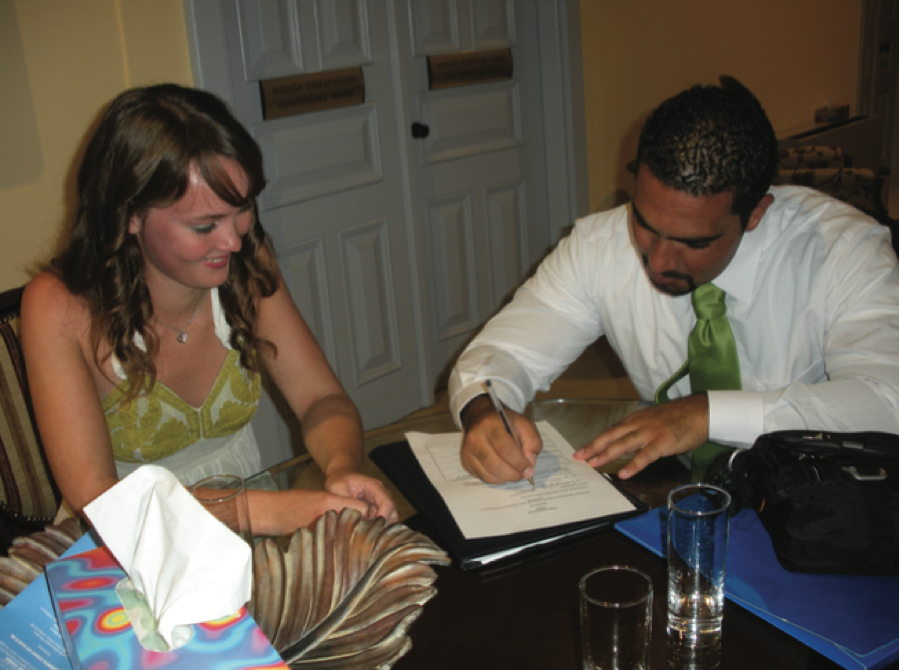
Firas Yazbeck and Naomi Arends arrived to the municipality building in Larnaca, Cyprus on a Monday morning. In just a few minutes, the Lebanese-Dutch couple had filled out their marriage documents as they waited in the queue to take their vows. In the waiting room, a promotional video of Larnaca — and all the activities visitors can do in one day — played on a TV.

Like many Middle Eastern couples, including those from Lebanon, Yazbeck and his new bride chose to marry in Cyprus, and spend their 10-day honeymoon on the island as well. Marriage in Cyprus is simple, it’s easy, and it’s one way to get around Middle Eastern marriage laws that don’t allow people from different religions to marry.

“It’s so close to Lebanon,” notes Yazbeck, a 27-year-old Maronite Christian. “It’s a good place for a civil marriage and a vacation.”

Still, he hopes his home country will allow civil marriage, which he thinks would be good opportunity for reconciliation between Lebanon’s different religious communities.

That sticky sectarianism

As modern and western-leaning as Lebanon is, the country does not allow civil marriage. For years, activists have advocated for the introduction of civil marriage in the Middle East, particularly Lebanon.

Last February saw a number of small victories for advocates of civil marriage in the region. In Lebanon, Interior Minister Ziad Baroud signed an order allowing citizens to remove their religious affiliation from government papers. Around the same time, activists held an inter-faith group marriage on Valentine’s Day. On Facebook, members of various Lebanese pro-civil marriage groups total more than 20,000 — compared with 13 on the social networking site that is against it.

But major obstacles still remain before the Lebanese are willing to legalize civil marriage. The act is no easy feat in a nation where the legal foundation is based on sectarianism. In 1997, the late President Elias Hrawi suggested implementing civil marriage in Lebanon, but was met with opposition from both Muslim and Christian leaders. For now, Lebanese who do wish to have civil ceremonies can do so outside the country and then register their marriage in Lebanon, which the state then recognizes as a legal marriage.

It takes around a half hour to make the short flight to Cyprus from Beirut, marginally longer from Damascus, and marriage is big business. Ever since the British mandate in 1923, the small island has been performing civil marriage ceremonies for locals and foreigners alike. Until the 1980s, citizens of the United Kingdom comprised the majority of marriage tourists to Cyprus. But over the past 30 years, most of the couples getting married in Cyprus have come from the Middle East.

Eager to capitalize on the pre-existing demand for civil marriage services, over the past several years travel agencies, embassies and municipalities in Lebanon and Cyprus have been coordinating to offer couples tourism and marriage packages, including everything from plane tickets and hotel rooms, to marriage paperwork and ceremony arrangements.

Hrach Kalsahakian, sales and marketing manager at the Cyprus Tourism Organization, says the Cypriot wedding business sector is only growing.

According to the Cypriot embassy in Beirut, there were 400 Lebanese couples who wed in Cyprus in 2007, compared with 278 in 2000.

“This sector is expected to grow because more and more people are discovering this side of the island and, on the other hand, more professional and sophisticated companies are providing wedding services,” he says. “The growth however is gradual and not excessive.”

Could other countries in the region, seeing Cyprus’ success in the marriage and tourism business, try to emulate the island country’s example? Not likely, believes Kalsahakian. He says, “Civil marriage is generally allowed wherever the role of state and religion is separate. This is difficult to achieve in most Middle Eastern countries and it is not expected to become a reality in the near future.”

Marry away but celebrate at home

Marwa Rizk Jaber, CEO of Beirut-based travel agency U Travel Middle East, whose Cyprus package tours include five to 10 couples traveling to marry every year, doesn’t see any economic loss to Lebanon due to many of its citizens having to go to Cyprus to get married.

“If someone is planning to do a big wedding in Lebanon, he will do a civil marriage in Cyprus and then do a big wedding in Lebanon,” she said. “It would be good to allow it in Lebanon, for the simple reason  that Lebanon has always been an open country although it’s based on religious confessions.”

Rola Badran, a Shiite Muslim, and Rami Khattar, a Druze, got married in December 2008 in a civil ceremony in Paphos, Cyprus, because their different faiths meant they couldn’t have such a ceremony in their home country of Lebanon.

“Civil marriage should be legislated in Lebanon as soon as possible,” says Badran. “It’s a unique country where Muslims, Christians, Druze and a variety of religions live all together and share their social, economical and political affairs. Civil marriage will give freedom to the young citizens and even older ones to unite under one umbrella.”

Some people believe that lobbying by Lebanese citizens and civil society groups will put pressure on the country’s politicians to change some of the sectarian laws, including the legalization of civil marriage.

“The idea is to have enough citizens who will remove their religions from their ID cards. This creates enough citizens not registered with any courts,” says Paul Salem, director of the Carnegie Middle East Center in Beirut. That way, he says, “the government doesn’t have a legal way to link people to religious communities. If you have 20,000 people, then there’s enough pressure on parliament. That’s one of the approaches to force the issue of civil marriage.”

Wedding packages to Cyprus:

There are a variety of wedding travel packages to Cyprus. Some include just the basics, while others handle every detail down to the champagne and the confetti.

  • U Travel, an agency based in Beirut, offers basic packages starting at $300 per person, depending on airfare and hotel category.
  • Nadia Travel in Beirut has a two-day package for $1,900 that includes transportation, hotel stay, marriage and document fees and administration.
  • The Beirut-based Aeolos offers packages for $1,800, which include transportation to Cyprus, hotel, all travel, marriage and visa fees.
  • Skarvelis Weddings in Cyprus offers some of the most comprehensive wedding packages. All include wedding documentation administration and a wedding coordinator, a decorated Mercedes, flowers, a wedding cake and champagne. The packages start at $1,200. Their most high-end package, for $5,400, includes 44 photos, Rolls Royce for the bride, white Mercedes for the groom, floral arrangements, hair and make-up for the bride and spa treatment. The packages all include a planning and coordination fee of $567 but not the town hall fees – these are an additional $400.

Alternatively, if couples do not want a package they can just pay the $600 planning and coordination fee and the $400 town hall fee and then choose additional extra items such as a cake, flowers, etc.

August 28, 2009 0 comments
0 FacebookTwitterPinterestEmail
Lebanon

For your information

by Executive Staff August 28, 2009
written by Executive Staff

Undervalued real estate

According to a Bank Audi real estate report published in July, property prices in Lebanon posted a moderate decline of 10 to 15 percent since the global recession hit the region. In the first five months of this year, sales transactions posted a mild drop of 6.7 percent year-on-year. In the same period, construction permits rose 4.3 percent.

The report says the resilience of the Lebanese real estate market compared to the region goes back to the strong demand drivers and ‘stringent’ regulations related to lending in the banking sector — both eliminated the possibility of a real estate bubble.

The report says despite the high prices of residential properties, especially in Beirut, the market remains undervalued on the regional and global levels. Beirut’s residential market is still cheaper than its MENA counterparts. The price of a 120 square meter high-end apartment is, on average, $2,229 per square meter, while the regional average is $2,682, according to the report.

The office market is also undervalued, says the report, noting Beirut’s central district ranks 33rd out of 57 office hubs in the world in terms of occupancy. In 2008, office prices in Beirut averaged $585 per square meter; the MENA average was $874, and the world average $793.

Economic growth up

In June, the International Monetary Fund published its periodic report on Lebanon’s economic outlook, upgrading its previous 2009 forecast for gross domestic product growth from 3 percent to 4 percent, with the potential to increase as long as domestic, political and security conditions remain positive.

The report said the global financial crisis’ impact on Lebanon has been “muted,” for various reasons. Inflows of commercial bank deposits, “which are the main financing source for the large government deficit, have remained strong,” the report said.  US dollar deposits have decreased, aided by stable security conditions and the significant interest rate disparity between deposits in Lebanese lira and the US dollar. The IMF also said there has been no pressure on the lira-dollar peg, and that the Lebanese Central Bank has quickly accumulated international reserves.

Lebanon’s banks have “had virtually no direct impact from the global financial crisis, given [their] limited exposure to failed foreign financial institutions or wholesale funding markets.” Lebanese banks continue to be highly liquid and capitalized. Unlike their regional brethren, the country’s domestic banks have not needed emergency liquidity injections or any form of public bailouts.

“Cyclical indicators point to a soft landing of the Lebanese economy in spite of the global financial crisis and recession. Economic activity has continued to expand robustly through the first quarter of 2009,” the report said. The IMF says that although merchandise exports have declined due to lower external demand, they only account for a small amount of the economy, and therefore have not significantly impacted the overall GDP. On the upside, construction activity is performing well, as are the tourism and financial services sectors.

BSE dives

After the Lebanese elections, the performance of Lebanon’s seven listed stocks slightly improved. But in the beginning of July, the Beirut Stock Exchange (BSE) dropped 6.1 percent, the market’s largest drop since its $5 billion crash in November 2008. The week of July 6 to 10 witnessed a weekly decrease of the entire BSE by 6.1 percent, which brought the market back to levels prior to the re-election of Parliamentary Speaker Nabih Berri. Real estate giant Solidere, largest stock by market capitalization, led the drop.

Due to a massive sell-off by an unknown shareholder on July 9 and 10, Solidere’s market value was slashed by 15 percent overnight. Some economists attributed the drop to the lack of progress on the formation of a government.  Moreover, a downturn in global stock markets and the dividend distribution of Solidere could also have played a role in the company’s share-price drop.

On July 9, buyers and sellers took advantage of the $3 gap between Solidere’s global depositary receipt (GDR) and its domestically-listed shares. The decline of around 8 percent in the company’s GDR value in London was most likely due to hedge fund selling, analysts said.

Nassib Ghobril, head of the economic research and analysis department at Byblos Bank, says politics are the main driver behind BSE volatility. “Solidere has always been a representative of political sentiment in the country,” he said. “After [Saad] Hariri became the [prime minister-designate], it jumped. The movement in the stock market does not represent the underlying performance of the listed companies on the BSE, unfortunately.”

August 28, 2009 0 comments
0 FacebookTwitterPinterestEmail
Banking & Finance

For your information

by Executive Staff August 28, 2009
written by Executive Staff

GCC private equity and M&As

The United Arab Emirates have taken the top spot in terms of private equity (PE) deals in the Middle East during the first half of 2009, according to Bureau van Dijk Electronic Publishing (BvDEP), a research firm. The UAE led the pack with a total of seven PE deals. Jordan and Kuwait registered only two deals each in the same period. The report found that in the first half of 2009 the region’s deal flow decreased 79 percent in terms of value, to $314 million, and decreased 41 percent in volume, to 13 deals, compared to the second half of 2008.

The report also highlighted the continued fall in the number of mergers and acquisitions (M&As) in line with the global trend. M&A activity declined 70 percent to $6.24 billion from a total of $21.03 billion in the second half of 2008. The volume of M&As also fell in the first six months of 2009, but performed better than the last 6 months of 2008, with a total of 122. The UAE again topped the tables in terms of M&As with a total of 36 deals.

The accuracy of the findings are marred, however, by the sector’s lack of transparency in the region. The total value of the deals closed by some of the region’s biggest players, such as Abraaj Capital, were not made public.

Saad/Algosaibi scandal

The saga of Saudi conglomerates Ahmad Hamad Algosaibi & Brothers co. (AHAB) and Saad Group has created one of the worst multi-billion dollar regional default crises since the global financial turmoil struck last year.

Saad Group, a $30 billion empire built by powerful Saudi businessman Maan al-Sanea, began showing signs of distress in June, after the Saudi Central Bank (SAMA) froze the personal accounts of Sanea and his family members. This unusual action by the central bank caused quite a stir throughout the Saudi banking sector, leaving many question marks in its tracks. Saad Group issued a statement saying, “Recent events, specifically affecting the Bahraini banking sector, have led to a short-term liquidity squeeze affecting Saad Group companies in the Middle East.”

“We are continuously striving to mitigate the effects of the limited squeeze and are also planning for an orderly restructuring of the debt of affected companies in cooperation with our counterparties and international advisers,” the company added.

As of June 27, Bloomberg reported AHAB owed $9.2 billion to more than 100 banks across the region, and less than two weeks later, AHAB filed a lawsuit against Sanea for $10 billion. AHAB is suing Sanea for fraud, insisting he embezzled money through his position at one of AHAB’s subsidiaries, Money Exchange, to ransack the company using inflated short-term foreign transactions. AHAB is apparently owned by al-Sanea’s wife’s family, making this a very complicated family matter.

Standard & Poor’s rating agency said that 30 banks rated by the credit ratings agency have significant — but manageable — exposure to the two troubled corporations. EFG-Hermes investment bank reported Abu Dhabi Commercial bank alone could easily have more than $500 million exposure to the companies. Fitch Ratings also said Mashreqbank’s exposure was severe, but manageable.

Regional pessimism

MasterCard Worldwide’s consumer confidence survey showed a drop in consumer confidence in six countries in the Middle East and North Africa. The 100 point index uses 50 points as a baseline to determine whether a sample is optimistic or pessimistic.

Kuwait registered the largest drop, from an optimistic 96.6 points to a pessimistic 49 points from the previous period. Egypt was the most pessimistic with a score of 32.3 points, while the most optimistic was Qatar at 71.4 points. The survey noted an increase in people saving for “precautionary purposes,” and also showed that people in the Gulf countries will be “saving more,” as opposed to Egypt and Lebanon, who will be “saving less.”

“This is the first time the Middle East as a whole has come in below 50,” said Shaun Rashid, the head of MasterCard Worldwide’s business in Egypt and Levant, who presented the results. “The last time we conducted this survey it was in November of last year and the [crisis] was not as widely understood by the consumers. This time around… when we got their responses they were responses that were in light of the global economic crisis.”

The results were compiled from a survey conducted between March and April in which 400 people in Saudi Arabia, Lebanon, Kuwait, United Arab Emirates, Qatar and 600 people in Egypt were asked questions about their consumption habits. All participants were either debit or credit card holders from the ages of 18 to 64.

August 28, 2009 0 comments
0 FacebookTwitterPinterestEmail
Comment

Iraq’s unfulfilled harvest

by Riad Al-Khouri August 28, 2009
written by Riad Al-Khouri

One of the (many) economic paradoxes in Iraq today is the existence of considerable poverty in a country that was once, and could still become, among the most prosperous in the region. Practically the only Arab state rich in both oil and water, Iraq’s de-development in the last few decades means that today many of its inhabitants are poor and malnourished. Though pockets of stability exist where life is less harsh (including, for example, Kurdistan) the overall situation in Iraq remains precarious and general economic conditions are tough.

The country witnessed a dramatic decline of living standards since the war with Iran (1980-8), which cost Iraq $450 billion (much of it in weapons) and the lives of 800,000 of its citizens. After the first Gulf war in 1991, annual per capita gross domestic product was at a mere $250, on par with the poorest countries in the region. That “recovered” to $600 in 2002, but fell to $400 in 2003 after the United States invaded. Since then, Iraq’s economy has been growing, but the country still has far to go to achieve prosperity, with unemployment at more than 25 percent. By contrast, income per inhabitant in the 1970s was several thousand dollars, and the percentage of those out of work was in the low single digits.

This precarious economic situation has brought about practical problems, including in the area of nutrition, with roughly 4 million Iraqis, or 15 percent of the population, being food-insecure today. The average daily calorie intake per person has dropped to about 2,000, compared to an acceptable level of around 2,400.

This is especially ironic in a country like Iraq, which before and during the oil era saw significant agricultural activity, with agriculture currently employing more than a quarter of the labor force, though contributing only 6 percent to the economy. Iraq’s major crops are wheat and barley, but for these as in others, productivity has been steadily declining over the last couple of decades. Cereal yield today is estimated at around 900 kilograms per hectare compared, for example, to neighboring Iran’s 2,300.

The reasons for this malaise are many. First, Iraq’s lack of fundamental prerequisites for market interaction, like secure property rights and freedom of movement, are poor. Second, even when these basic factors are assured, as in the Kurdish region, inadequate transport and storage means crops cannot be brought to market in a timely or otherwise efficient manner. For example, an agricultural official I talked to recently in Sulaymaniyah, near Kurdistan’s mountains, complained that the abundant grape crop of the surrounding hilly regions went to waste due to inadequate roads and cooling facilities. Third, the physical capital stock of Iraqi agriculture consists mainly of outdated Soviet-era machines that break down often and for which spare parts are rare. Finally, drought and frequent sandstorms over the past few years have worsened things.

Iraq cannot easily rescue its agricultural sector under present conditions. Yet, conflict apart, agriculture in many countries around the region is suffering. Though Iraq and other states in the region may not have been what the Group of Eight countries had in mind at their recent summit in Italy, they have approved $20 billion in aid over three years to help poor farmers in developing states grow and sell more food. The initiative aims to cut the number of malnourished people globally by helping local farmers produce more. The investment program would help farmers get seeds and fertilizer, and engage in effective marketing. Not unlike their counterparts in Iraq, these farmers have the potential to become prosperous, while solving the problems of hunger of those around them.

The recent statements by the G-8 on nutrition signal an encouraging shift of policy toward helping the poor and hungry to produce their own food. Aid for agriculture is falling globally, relative to support for other sectors: the proportion of development aid destined for agriculture in poor countries has fallen to about 4 percent today from 17 percent in the 1970s. Given the severity of the problem, $20 billion is a drop in the ocean, but at least the G-8’s latest pledge sounds more concrete a commitment than past aid declarations that went unmet.

Hopefully this money will materialize: much of it was pledged at the Rome Food Summit in June of last year, but in reality only a fraction has been disbursed. Regardless, agriculture is assuming more importance in the global agenda; hopefully this will also be the case over the next few years of Iraq’s development.

Riad Al Khouri is Senior Associate Consultant at the William Davidson Institute of the University of Michigan in Ann Arbor, and Dean of the Business School at the Lebanese French University in Erbil

August 28, 2009 0 comments
0 FacebookTwitterPinterestEmail
Editorial

Remember the past to make a better future

by Yasser Akkaoui August 28, 2009
written by Yasser Akkaoui

Former Lebanese Prime Minister and veteran Tripoli MP, Amin al-Hafez, who died last month at the age of 83, will be remembered for the integrity and sense of duty he showed during a period of Lebanese history that would have destroyed lesser men. He came from a generation that believed in putting the interests of the state above all else.

It is worth taking time to reflect on the values espoused by Hafez and the distinguished generation from which he emerged. He was in many ways a moral compass and an example of national selflessness.

Today, as our politicians are trying to form a new cabinet, they would do well to remember his example as they abandon their electoral promises and rush to secure the most lucrative portfolios to further consolidate power, rather than work for the good of the nation.

Hafez is survived by his son Ramzi, a journalist and the publisher of Lebanon Opportunities, a magazine that seeks to put forward Lebanese expertise and know-how.

Some of that resourcefulness would bode well for the Lebanese working in the GCC, as it seems complacency is begining to take hold there.

The Gulf is an area where the Lebanese have traditionally succeeded through a combination of hard work, relevant skill-sets and good relations with their fellow Arabs. For example, the media in the GCC has long been dominated by the Lebanese. Today however, the Lebanese lead in this industry is in danger of being overtaken by hungrier international media groups.

Faced with these sorts of challenges, the Lebanese public and private sectors across all industries must jettison their ‘short-termism’ and culture of self-interest and make genuine plans for the medium and long terms. The world appears to be gearing up to move out of a recession just as Lebanon appears to be once again hunkering down for some regional drama.

A nation with its finger on the regional pulse is out of step with global trends.

August 28, 2009 0 comments
0 FacebookTwitterPinterestEmail
Special SectionYoung Arab Leaders

Sheikh Sultan al-Qassemi (Q&A)

by Executive Staff August 28, 2009
written by Executive Staff

Sheikh Sultan al-Qassemi, chairman of the Young Arab Leaders – United Arab Emirates office, is a successful businessman, professor and financial columnist. He spoke with Executive about how his country, with a relatively small population, came to have one of the largest YAL memberships.

E What are your ambitions for YAL in the UAE?

I see YAL as a vehicle or platform that has tremendous potential. Sometimes, youth as individuals may have great ideas and potential, but lack the confidence or ability to launch something on their own. As a platform, YAL is able to act as a support system for these youth.

We are living in troubled and challenging times, so I feel that in a broader sense, YAL is able to promote better understanding by virtue of its separate country offices located around the region, and the frequent meetings of its members from the different country offices.

E What are some of the challenges that ambitious youth in the Emirates face?

First, there is the challenge of support and guidance. Some of the youth are very ambitious and talented. However, without proper guidance and support, many are not able to fulfill their ambitions, due to not being given the right set of skills, not being shown the right education path, or not getting the chance to meet the right people to get their ideas off the ground.

Another key area where I believe that a lot can still be done is in education. Some youth in the region do not have access to quality education, which can be due to various socio-economic factors. Family income levels, the high cost of education, and even simply not knowing where to look for a good education, all make for a challenging environment for those without the means.

There are many talented Arab youth, and we need to ensure that they get all the opportunities available to maximize their potential.

E Can you describe one or two specific initiatives that YAL-UAE is undertaking?

In our efforts to promote entrepreneurship among Arab youth, YAL-UAE, together with the Arab Business Angels Network, have held a number of entrepreneur-investor match-making events, such as the Arab Business Challenge. This allows entrepreneurial ventures to share their ideas and to connect with investors, who may be on the lookout for businesses to invest in.

Another one of our initiatives is the Arab American Business Fellowship. Through this, young Arabs are sent to the United States, and their young American counterparts come to us, where each spends a period of time learning, not only about business but at the same time learning about the cultures of the respective regions. This aids in breaking down many of the misconceptions both regions may have about each other.

E Are there any specific successes that you can point to?

The YAL-UAE Country Office has one of the largest memberships. This is a great achievement to me because it indicates that there is belief in what YAL stands for. YAL-UAE has been able to capitalize on this by inviting youth from universities and large corporations to personally meet and learn from the established business leaders that form the core of our members.

August 28, 2009 0 comments
0 FacebookTwitterPinterestEmail
Financial Indicators

Regional equity markets

by Executive Staff August 4, 2009
written by Executive Staff

Beirut SE  (one month)

Current Year High: 1,550.53  Current Year Low: 705.56

The Beirut Stock Exchange (BSE) was highly correlated to global and regional trends in the month of July, in addition to uncertainty related to the formation of a new cabinet. The MSCI Lebanon had dropped 6% in line with the global equity sell-off and falling oil prices in the first two weeks of July. However, political stability and news showing the economy will post strong growth numbers in 2009 drove the market back to 1056.99 points, down only 0.34% as of July 22. Positive economic news contributed to the recovery, including strong tourist and capital inflow numbers despite several minor incidents in South Lebanon. Banque Bemo’s shares were the worst performers, down 4.26%, followed by the country’s giant real estate company Solidere, whose A shares managed to recover from an 11% drop to a milder 2.33% decline. BLOM Bank’s shares topped the performance list, up 2.78%, followed by Byblos Bank with a 2.17% return. Despite the relatively tame performance of equities on the BSE in July, the market continues to lead the MENA region performance on a year-to-date basis with an appreciation of almost 31%.

Amman SE  (one month)

Current Year High: 4,702.43  Current Year Low: 2,482.46

The Amman Stock Exchange (ASE) posted the worst performance among the 12 countries under review, falling 5.51% to 2584.47 points through July 23. The index even hit a five-year low of 2,482.46 points on July 13. All market sectors dropped significantly, led by insurance and banking stocks which fell 9.59% and 6.60% respectively, while the industrial sector led the market with a drop of 3.74%. Jordan Clothing Company led stock performance with a 36.61% increase, followed by Jordan Central at 36.59%, whereas Arab Life and Accident Insurance Company fell 37.02% and Al Tajamouat for Catering and Housing Company lost 36.12%. The total value of real estate transactions dropped 38% year-over-year in the first six months of 2009 and the government’s budget deficit widened from $705 million to $759 million over the same period. On the other hand, the country’s tourism revenues grew  3% through the end of May, and the number of construction permits posted a 32.1% year-over-year gain in the first five months. The country’s trade deficit also narrowed by 32.2% through the end of June as a result of lower crude oil imports.

Abu Dhabi SM  (one month)

Current Year High: 5,005.17  Current Year Low: 2,136.64

The Abu Dhabi Stock Exchange (ADX) index rose 3.03% to 2,711.17 points as of July 23. Like other GCC markets, the ADX index hit a bottom in mid-July, driven by drops in oil prices, uncertainty around second quarter earnings, and the undetermined level of exposure of UAE banks to Saad Group and Al Ghosaibi. On the positive side, the market index has been steadily trending upwards since hitting the bottom in early November, and July was no exception especially that consumer and banking stocks continued to lead the market, rising 6.56% and 6.42%, respectively. On the other hand, the worst performing sectors were insurance (-6.23%), real estate (-5.58%), and construction (-5.21%). The market’s leading stock was the food industry’s Agthia (22.79%), followed by several banking stocks including National Bank of Abu Dhabi (14.80%) and First Gulf Bank (14.23%). Aabar Investments acquired a 4% equity stake in Tesla Motors from Daimler, and Abu Dhabi National Energy Company announced plans to spend $1.5 billion on acquisitions in the next 9 months.

Dubai FM  (one month)

Current Year High: 5,422.31  Current Year Low: 1,433.14

Almost nine months after the peak of the global equity sell-off, the Dubai Financial Market (DFM) has hardly recovered. The market index dropped another 1.83% in the month through July 23, to 1,751.76 points, still at December 2008 levels. Emaar Properties announcement in late June to merge with several of its competitors mostly drew a negative response. Moody’s downgraded the company’s credit rating and placed it on review for possible further downgrade, driving down the company’s shares 7.91% and the whole Real Estate sector 5.85% to become the worst performing sector of the month. The best performing sectors were Transportation (9.06%) and Utilities (5.81%) coupled with strong performance by Aramex (23.97%) and Kuwait Finance and Investment Company (14.91%). On the other hand, Arab Insurance Group (-15.56%), Shuaa Capital (-12.79%), and Emirates NBD (-11.68%) were among the worst five performers in July. During the month, the UAE Central Bank called for a meeting with commercial banks to assess potential problems to exposure to Saad Group and Al Ghosaibi.

Kuwait SE  (one month)

Current Year High: 14,997.20            Current Year Low: 6,391.50

Like most GCC stock markets, the Kuwait Stock Exchange (KSE) had a tough first half of July on the back of declining oil prices, but the recovery in oil prices and global equity markets was not enough to save the KSE from a 5.02% decline to 7,675 points as of July 22. Earnings in Kuwait were dismal as Mazaya Holding, Al Ahli Bank, and the National Bank of Kuwait reported second quarter declines in profits of 63%, 77.1%, and 32%, respectively. All sectors in Kuwait posted negative returns in July, but the real estate sector was the worst performer, dropping 7.93% through July 22, followed by the industrial and investment sectors which lost over 6.81% and 6.25%, respectively. Only the index of stocks on the parallel market rose 10.44% through July 20, but insurance, the best performing sector, lost 1.89% followed by services which dropped 2.28%. Al Maiden Clinic for Oral Health Services was the leading performer, up 100% over the review period, followed by Osoul Investment Company (35.09%) and Osoul (42.11%). The worst performance was delivered by Gulfinvest International (-43.94%).

Saudi Arabia SE  (one month)

Current Year High: 9,022.31  Current Year Low: 4,130.01

The Saudi Stock Exchange (TASI) index ended the review period up 1.32% at 5,670.42 points as of July 22, on solid earnings from the banking sector and recovery in oil prices from early July lows. The month had started with a continuation of the drop in equity prices from the June peak of 6094.91 as exposure to credit-troubled Saad Group and Al Gosaibi, and uncertainty surrounding second quarter earnings results cast a dark shadow on investor sentiment. However, by the third trading week, Saudi banks had reported solid growth in second quarter profits which reached almost $1.73 billion. The banking sector benefited strongly from quarterly results, rising 2.35% through July 22, but was still outperformed by the hotel and tourism sector which advanced 6.37%, followed by the industrial and telecom & IT sectors which rose 4.08% and 2.76%, respectively. On the other hand, the insurance sector had the worst performance, dropping 4.93% through July 21. Petrochemicals had a roller coaster month after China announced that it began an anti-dumping investigation into methanol imported from Saudi Arabia.

Muscat SM  (one month)

Current Year High: 11.178.58            Current Year Low: 4,223.63

The rebound of stocks in the second half of July drove the Muscat Securities Market (MSM) index up 3.49% to 5,808.07 points through July 23. All three market sector were in the green, with the banking sector leading the way, up 1.54%, followed by services and industrial at 1.38% and 0.51%, respectively. Market sentiment was generally positive as the government said it plans to boost its oil output by 20,000 barrels per day by the end of 2009. The best performing stocks were Gulf International Chemicals (12.58%), Oman United Insurance Company (12.5%), and Oman Cables Industry (12.07%). On the other hand, Al Hassan Engineering Company, Oman Chlorine, and Gulf Investment Services Company posted the worst performance, dropping 14.38%, 13.88%, and 12.33%, respectively. In corporate news, Standard and Poor’s downgraded United Insurance Company’s long-term credit rating, and HSBC’s MENA Infrastructure Fund acquired 32.8% of United Power Company for $26.5 million. Furthermore, Bank Muscat reported a 4.5% rise in its first half net profits to $157 million.

Bahrain SE  (one month)

Current Year High: 2,811.25  Current Year Low: 1,483.52

The Bahrain Stock Exchange (BSE) index posted the worst monthly performance among GCC markets and the second worst in our review of the MENA region, dropping 5.50% to 1,494.63 points as of July 23. The Bahraini market never actually recovered from the fall 2008 global equity sell-off, hitting a five year bottom of 1,483.52 points on July 21. The investment and banking sectors caused the biggest drag on the market, falling 7.49% and 5.96%, respectively, during our review period, while investors shifted to the defensive healthcare sector, the only sector in the green, which rose 1.77% over the same period. Only six out of 28 stocks rose in July, led by Banader Hotels Company (7.58%) and Esterad Investment Company (3.87%). Leading the decliners were Albaraka Banking Group (-23.91%), Bahrain Islamic Bank (-17.05%), and Ithmaar Bank (-15.69%). Bahrain Islamic Bank had announced a second quarter loss driven mainly by provisions. Bahrain Telecommunications Company said it was proceeding in its purchase of a 49% ownership stake in India’s telecom operator S Tel.

Doha SM  (one month)

Current Year High: 11,758.06            Current Year Low: 4,230.19

After a sharp decline in the second week of July, the Qatar Exchange Index stabilized and rebounded to end our review period through July 23, down only 0.82% to 6,438.30 points. The rebound came on the heels of strong earnings from the country’s largest banks, propped up by the government’s purchase of real estate investments and local equities to free up bank capital for lending. Earnings propelled the banking sector to the top with a 1.51% return during the review period, ahead of the industrial sector which returned 0.91% also on strong earnings announcements. The services sector which shed 7.81% despite a mid-month rebound. The best performing stock of the month was United Development Company (22.04%), followed by Qatar Electricity and Water Company (8.68%). Several large banks were also among the best performing stocks, including Doha Bank (4.6%) and Qatar Islamic Bank (4.97%). Real estate and investment companies were the month’s laggards, led by Ezdan Real Estate Company (-21.48%) and Dlala Brokerage and Investment Holding (-17.58%).

Tunis SE  (one month)

Current Year High: 3,677.46  Current Year Low: 2,836.64

After a long rally that started in December 2008 that drove Tunisian equities up 30% to a peak on July 1, the Tunisia Stock Exchange Index (Tunindex) let out some steam, falling 1.43% to 3,623.96 points on July 23. Leading the turnaround were Automobile Reseau Tunisien et Services (-15.01%), Société Tunisienne des Industries de Pneumatique (-14.16%), and Société Tunisienne d’Assurances et de Réassurances (-13.67%). The best performing stocks were Société Tunisienne d’Entreprises de Télécommunication (21.53%), followed by Société Nouvelle Maison de la Ville de Tunis (16.61%), and Société Magasin Général (12.94%). The market lacked significant catalysts during the month, but some positive announcements were made. The Tunisian parliament passed a law that would allow early retirement for public employees in order to help employ up to 7,000 young university graduates.

Casablanca SE  (one month)

Current Year High: 14,463.40            Current Year Low: 9,405.86

Like most MENA markets, the Casablanca Stock Exchange (CSE) index started the month of July by dropping significantly in the midst of another global wave of equity selling and pessimistic views of the world economy. However, unlike most MENA exchanges, the CSE index never rebounded. The drop continued through July 22, to reach -5.51% with the index standing at 10,949.81 points. The country continues to suffer from the fallout in tourism activity, the decline in exports, as well as the drop in revenues from remittances as a result of the decline in economic activity in Europe. As a result, the hotels and leisure sector remains the worst performing stock in 2009, down 10.59%, followed by construction and building materials (-10.04%). The best performing sectors so far in 2009 are transport (52.38%) and mining (51.9%). The leading stock was Société des Brasseries du Maroc (16.5%), followed by Involys (10.83%). On the other hand, the worst performing stocks were Microdata (-14.22%) and Aluminum de Maroc (12.69%).

Egypt CASE (one month)

Current Year High: 9.533.54  Current Year Low: 3,389.31

The Cairo and Alexandria Stock Exchange (CASE) posted the best performance in the MENA region under review through July 22, rising 4.3% to 5,947.89 points. The market was lush with positive economic news during the month, including an announcement by the Minister of Investment that the country’s GDP growth in 2009/10 will reach 4.5%, down only slightly from 4.7% the previous year. Real estate stocks led the late month rally, with top performers including Egyptian Real Estate Group (168.37%) and Zahraa ElMaadi Company for Investment and Urbanization (74.92%). The real estate sector was boosted by the government’s decision to extend the export ban on cement until October 2010 to stabilize local cement prices. The worst performing stocks were Al Watany Bank of Egypt (-23.46%) and El Shams Housing and Development Company (-16.31%). In corporate news, private equity firm Actis signed an agreement worth $244 million to acquire a 9.33% stake in the Commercial International Bank.

August 4, 2009 0 comments
0 FacebookTwitterPinterestEmail
Lebanon

Art – Creativity’s capital

by Executive Staff August 3, 2009
written by Executive Staff

Beirut explodes every now and then, often with tragic consequences. This past year, though, Lebanon witnessed a different and welcome kind of explosion: that of its contemporary arts scene. The opening of the Beirut Art Center, along with several smaller galleries such as The Running Horse – Contemporary Art Space and the Maqam Art Gallery, signals the development of Lebanon’s historically vibrant art market into a regional cultural center different from, but no less important than, the commerce-heavy hub of the United Arab Emirates.

“It’s a completely different new market here,” said Joy Mardini, the manager at Naila Kunigk’s Espace Kettaneh Kunigk, the Beirut sister gallery of Munich’s Galerie Tanit. “It’s booming, in parallel with Dubai, Abu Dhabi, and Qatar,” Mardini said, referencing the major arts institutions and fairs that have opened, or are planning to open, in the Gulf.

The international auction house Christie’s opened a salesroom in Dubai in 2006, kicking off with an inaugural sale in May of that year. The opening was significant because it was the first auction in the Middle East of international and contemporary art in Christie’s history, and the first time the auction house featured a modern and contemporary Arab and Iranian art section. The auction pulled in over $2.2 million, and subsequent auctions set records for artists including the Lebanese painter Paul Guiragossian, whose “Le Grand Marché” sold for $230,500 in October 2008, a world auction record for him. In March of this year, rival auction house Sotheby’s held its first Middle East auction at its new Doha office.

Art Dubai, a fair that now features 70 galleries, more than a quarter of which are based in the Middle East, launched in March 2006. The Sharjah Biennial also held its ninth edition in March, and several museums including a Louvre and a Guggenheim are scheduled to open in the region within the next decade.

Although the recently constructed infrastructure in the Gulf has had ripple effects in Lebanon, local Lebanese art brokers distinguish between the bubble that, by most accounts, has burst in the Gulf, and Lebanon’s steadily evolving art market.

Creativity’s costs
Natalie Khoury, director of the Beirut branch of Hamburg’s Galerie Sfeir-Semler for the past four years, said this is reflected in retail prices, which have grown at an even pace, in contrast to some of the record-setting prices achieved at recent auctions in the Gulf.

“[Now]they’re almost the same, and have been growing with the reputation of the artists,” she said in reference to Beirut’s prices vis-à-vis the Gulf. “We never had speculation like with the Iranians. The Lebanese artists established their careers very slowly and in a very balanced way.”

“Prices have increased, but not drastically. The prices have evolved with the careers of the artists,” she said.

Fadi Mogabgab, of the Fadi Mogabgab Gallery in Gemmayze, has been selling art in Lebanon for over 15 years, first alongside his sister Alice Mogabgab’s namesake gallery, and later on his own. He attributes the relative stability of the market to the distinct nature of his mostly local clientele.

“Because here in Lebanon we have culture and taste, people are very demanding,” he explained. “They are not necessarily following the trends of the big auction houses.”

Lebanese artist and collector Elias Maamari agrees.

“Today anyone with two pennies to rub together is buying and calling themselves an art collector. As soon as you have more paintings than walls, you’re a collector,” he noted.

Maamari, who trained as an architect, has also entered the art market through the other side of the looking glass, as an artist. His first publicly displayed piece, a cold cathode and rusting steel sculpture called “You are here for now,” was shown at the Scope Art Fair during Art Basel this year in Switzerland. It was priced at $78,290, but price, he said, can and should be irrelevant.

“You can buy art for $5,” said Maamari. “And sometimes that’s the most interesting stuff.”
More interesting to note, he said, is the relationship between the financial industry and the art market.

“They’re in bed together. They have to be. Look at the people collecting art today. The big collectors in Turkey, Russia — they’re a very small minority of individuals, and they’re the wealthy captains of industry, as they were historically,” Maamari said, citing the Frick Collection, which is housed in a museum in New York.

In Lebanon, though, there is an emerging group of young collectors, who, along with major Western arts institutions, are prying the market wide open.

Khoury of Sfeir-Semler gallery sells pieces to museums such as the Museum of Modern Art in New York, and the Hamburger Bahnhof in Berlin. As far as private collectors are concerned, she said most of them live outside Lebanon, but are Lebanese. While corporate collections are still not a major factor in their business, they are reaching new regional buyers through fairs like Art Dubai.

The art appeal
A 29-year-old New York-based Palestinian-American collector who often purchases art from Sfeir-Semler gallery on her trips to Lebanon told Executive that despite the frenzy in the Gulf, she has observed the prices of her favorite Lebanese artists, such as Walid Raad, remaining fairly reasonable.

“You’ve seen maybe a 20 percent increase in value over the past few years,” she said. “It’s not like it’s doubled in value. There have been fluctuations in Dubai, excitement and hope, but none of those galleries represent the famous Lebanese artists.”

Saleh Barakat, who says his Agial Gallery in Hamra was the first to open in Beirut after the civil war, remembers that when he started, “Only old rich people and relatively established collectors came to this gallery.”

“Now it’s much younger people [who are buying],” he said. “I think it has to do with the evolution of the economy; with the e-economy, and telecoms, these industries make young people richer.”

“The market evolves, collectors evolve, and I am evolving,” he continued. In addition to promoting young, emerging artists at Agial, his newest project, Maqam Art Gallery, is exclusively focused on Lebanese modern art. It opened in early 2009 with a show of Lebanese landscape paintings.

“The international light is only on contemporary art” from the region, said Barakat. “They are completely neglecting Lebanese modern art.”
Jim Quilty, a journalist for The Daily Star who has covered the regional art scene for the last decade, says the art market is a “fickle thing.”

“It’s about trends, what’s new, what’s sexy,” he said. “People become aware of an artist or two artists that hail from a certain region, and PR takes over, and it becomes ‘a thing.’ Artists can be working unrecognized for years and years, and then the PR people take over and decide that something exists.”

Local flourish
Although it may be a passing fad, the international appetite for Middle Eastern art, as manifested by shows like the Saatchi Gallery’s “Unveiled” in London, is nonetheless encouraging local arts initiatives to flourish.

Sandra Dagher, a co-founder along with artist Lamia Joreige of the Beirut Art Center, a non-profit gallery that opened this year in the city’s Karantina district, acknowledges the link between her institution and the commercial galleries that operate nearby.

“Even though the space is totally non-commercial, it’s an advantage for artists to make exhibitions in a center like this, and could raise their prices,” Dagher said. Dagher, who ran the avant-garde gallery Espace SD from 2000 until 2007, found the non-profit model more workable for her vision of promoting contemporary art.

“I realized that to be able to help with production of less commercial art, I didn’t want to depend on commercial issues,” she said. “When you want to be sustainable and dependable, you shouldn’t be a private company.”

The center is funded by private individual donations, a few corporate sponsors, and organizations like the Prince Claus Fund of the Netherlands. A bookshop and café produce additional revenue, and as Dagher said, the massive, airy space is also available to rent for events.

Her disappointment with the commercialism of the Lebanese art market was echoed by some gallerists, who complain that it is often difficult to sell some of the newer media, such as installations and video, in the local market.

Twenty-three-year-old Lea Sednaoui, who opened the Running Horse gallery in Karantina, said that often buyers are reluctant to spend big on an unknown name.

“They need to know what they’re buying,” she said. Nonetheless, she has had relative success with her two first shows, one of the Swedish painter Sigrid Glöerselt, and another of Lebanese photographer Karim Joreige. Joreige’s show was already more than halfway sold out as Executive went to print.

Sfeir-Semler’s Khoury agreed that pedigree plays a role, citing one popular conceptual artist whose work is part of major museum collections.
“A lot of people are asking about established Lebanese artists, i.e. Walid Raad. We sell a lot of Walid Raad. When people want to buy contemporary art from Middle East, he’s one of the artists they want to buy.”

She also cited medium as a factor, which in an era of large-scale installation and video work, may be problematic.

“Generally, videos are really hard to sell,” Khoury said. “It’s much easier to sell photography and painting.”

Barakat agrees that the big names are the easiest to sell, but this phenomenon is normal.
“Of course in every part of the world you have super stars and less established artists. Here it’s [conceptual artist] Walid Raad, [painter] Nabil Nahas, [painter] Ayman Baalbecki,” he says. The works of the latter two are both available through his galleries.

Fadi Mogabgab, though, insists that Lebanese have an open mind when it comes to art.
“I have sold things here I couldn’t sell to the French public,” he said. “Here they are more curious. They want something artistic, not just to match the carpets.”

As Elias Maamari points out, art has “a lot to do with money and very little to do with good taste… Money is the universal currency and good taste is very subjective.”

August 3, 2009 0 comments
0 FacebookTwitterPinterestEmail
Lebanon

Rest & recreation – The beach life

by Executive Staff August 3, 2009
written by Executive Staff

It’s an obvious business proposition: buy beach front property, wait for the sun to come out, and charge $20 a day for entry. And from mid-July through September, as long as there is heat to beat, Lebanon’s beach clubs are packed with tanned, oily bodies frying themselves to golden perfection.

As competition for customers intensifies, beach club owners are offering new, innovative incentives and programs to lure clients to their particular strip of sand. Furthermore, some are adding facilities to make their clubs year-round destinations, maximizing profit on some of Lebanon’s most expensive beach front property.

Club Senses in Kaslik sits near the coastal highway, 20 minutes from Beirut, drawing customers from the capital and nearby towns who want a quick escape from the urban heat. It’s a massive black building, with several floors of gym equipment, 40 exercise classes per week, an indoor pool with panoramic view and a large spa. While there is no beach access, it has two swimming pools, one of them for children. Last year, the pools were only for members of the gym, who pay a monthly ($165), quarterly ($462), half-yearly ($890) or yearly ($1,788) membership fee to use the equipment and take classes.

This year, the club’s management opened up the pool area for non-members. Although open for only a year, according to Shyrine Yaghi, Communication Manager at Club Senses, the laid-back, somewhat New Age feel proved extremely popular, especially with local Lebanese.

“Tourists are more likely to go to touristic cities,” she said. “But at Club Senses, it’s more like a resort. We’re not promoting it as the city of Kaslik. Last year we had a good experience with the beach club, so this year we’ve developed more space and a certain strategy to contain the 600 to 700 people who come on the weekends.”

In Byblos, Eddé Sands, one of Lebanon’s favorite beach resorts, is upping the ante, faced with increasing competition from places like Club Senses. In addition to their tropical outdoor spa, Eddé Sands opened an Ayurvedic spa this past year, the first of its kind in the country. Two Indian doctors trained in Ayurveda, an Indian science of healing, offer treatments, massages and consultations for specific ailments.

Eddé Sands is also looking to capitalize on the exclusivity angle, offering for the first time a silver “Presidential” tier membership, which for $1,430 comes with a host of benefits, such as free massages, free meals for two at all of the resort’s dining outlets, and a 15 percent discount at the spas. The regular purple ($411) and gold ($847) memberships are also now offered for families, rather than just individuals. And instead of one entrance for everyone, Eddé Sands also split the experience in two, with a VIP entrance that goes directly to the cabanas, bungalows and circular VIP pool, and a separate entrance for families and day-pass beach goers.

Like Club Senses, Eddé Sands is looking to make the resort a year-round destination. The memberships, which used to be valid until the end of September, are now valid through the end of the year. A massive new ballroom, over 700 square meters and seating up to 640 people, will host weddings and parties all year long. The resort’s traditional Lebanese restaurant, Layal al-Zaman, was the scene of New Year’s and Valentine’s Day parties last year, and can be kept open for winter dining.

Then there’s the beach club that’s opening this winter. Hotel Byblos-sur-Mer, owned by Alexy Karim, is set to re-open around Christmas this year, so he can catch some holiday tourists or Lebanese on a trip back home who are looking to spend a few days by the sea and explore Byblos’ old town. Located at the edge of the port and built in 1964, it ironically had its heyday during the civil war years, when many Beirut residents left for the relative peace of Byblos. But then the capital came back to life, with its new downtown and fancy hotels, and Byblos was, as Karim puts it, “forgotten.” He is looking to bring the hotel back to its former glory minus, of course, the circumstances that made it so popular.

Karim is also the owner of Dar l’Azrak, a seafood restaurant perched on a cliff in the town of Amchit, south of Batroun. With seven years in the seasonal food and beverage industry, he is keen to move onto a project with a slightly longer window of opportunity.

“We work all year just to make these three months,” he says, referring to the high summer season. Karim shudders to think of the summer of 2006, and calls 2008, when Lebanon’s government was pieced together just a month before the season began, “sort of a miracle.”

The four-story hotel will have 22 suites, eight rooms and a massive rooftop presidential suite with a 400 square meter terrace. Room rates will begin at around $200 for a 30 square meter deluxe room, and will climb into the thousands for the 160 square meter presidential suite. With high-speed Internet and two conference rooms, as well as a small spa on the third floor, Karim hopes to make it a corporate destination during the low season.

“There are two hard months, February and March. We have a low season like everyone else, when we will focus on corporate things, seminars,” he says. “But after February and March, you have Easter, and then springtime comes,” at which point he expects business to take off.

For summer 2010, he’s planning a beach club and pool just across the road from the hotel. Comprising 2,000 square meters, the U-shaped outdoor area sits just adjacent to the port. A finger of land that juts into the Mediterranean will house a seafood restaurant, also called Dar l’Azrak, and the rest of the little strip of coast will have a lounge pool, deck and snack bar.

“I’d rather give my guests nice clean water to swim in the sea than focus on a big pool,” says Karim, referring to a plan to pipe the hotel’s wastewater back into the municipal system for treatment, rather than letting it run into the sea. At the other side of the U is a raised wooden deck; this area will turn into a bar and lounge once the sun sets.

“It’s not wild like Eddé Sands, more of a chill out place, with jazz, blues, Cuban music. You can moor your boat and come spend the day, and then continue your evening after dinner at the lounge,” he explained. Guests will also be able to catch music from the Byblos Festival, whose stage is on the other side of the port.

“We’re targeting not teenagers but executives. Young executives,” said Karim, who is in his late 40s, “like me.”

The phased opening will help him iron out any kinks in what is his largest project to date, while not missing any of the seasons.

“I could have opened the beach this year,” he said, “but the hotel would not be done. I like to fix one thing at a time.”

“When you open it, that’s the hardest thing,” Karim continued. “It takes you two or three years to adapt, upgrading everything yourself. This way, we can fix any problems during the low season stages.”

August 3, 2009 0 comments
0 FacebookTwitterPinterestEmail
Lebanon

Telecom – Dialed with good intentions

by Executive Staff August 3, 2009
written by Executive Staff

Lebanon’s telecommunications industry has seen some progress in the last year, mainly due to efforts aimed at reforming the sector. One of the most positive developments is that Law 431 has actually begun to be applied. The law, in theory, lays out a roadmap for how the telecommunications sector should be reformed by giving it a corporate style structure, the goal of which is to prepare the sector for possible privatization.

Law 431 also created an entity responsible for carrying out and overseeing the reforms, called the Telecom Regulatory Authority (TRA). Recently the TRA’s mandate has put it in conflict with the Ministry of Telecommunications, with both sides struggling to assert their authority over the regulation of the telecom industry. It doesn’t help that the ministry and the authority appear to be backed by parties from opposing sides of the country’s political divide.

The conflict came to a head earlier this year when the TRA made two decisions that the ministry perceived as overstepping its mandate.

Simply called “Decision Number 1,” the TRA ordered that all mobile numbers for MTC start with the prefix “71” and all numbers for Alfa would start with “72.” The point of the decision was to shed light on the actual cost of calls between networks, since it’s more expensive to call an Alfa number from an MTC Touch phone, or vice versa, than to call a number on the same network.

“Decision Number 1 gives transparency to the end-users and makes it easier to know whether they are calling a subscriber who is on the same network or on a different network, because there is a difference in terms of tariffs,” said Kamal Shehadi, chairman of the TRA.

Also included in “Decision Number 1” was a TRA order to issue one million mobile numbers to each of the two mobile network operators. The decision went directly against the ministry’s policy of approving and handing out numbers for MTC and Alfa in batches of 100,000, thus giving the ministry control over the amount of mobile numbers in the market and keeping the operators on a tight leash. The Ministry of Telecommunications contested both parts of “Decision Number 1” on grounds that the TRA was overstepping its authority, and Alfa went ahead and started issuing 71 numbers. The Ministry of Telecommunication and Alfa declined to comment for this article.

The dispute was brought before Lebanon’s highest court, the Shura council, and in mid-July the court issued a ruling backing the TRA decision. The court said that under Law 431 the TRA was within its legal mandate to issue “Decision Number 1.”

The allocation of the numbers is part of the implementation of a “National Numbering Plan (NNP).” The numbering plan would, in theory, allow for better management of the mobile networks, and is part of the planned reforms of the sector. But the numbering plan’s budget comes from government coffers, and is called the “numbering fee.”

The second decision made by the Shura council was to suspend the implementation of the numbering fee that would be paid to the TRA to implement the national numbering plan. In May, the current care-taker Telecommunications Minister Gebran Bassil issued a policy paper for the plan, where he envisioned the TRA to be “guided to work on an NNP,” thus outlining his support for the plan but not allocating the task to the TRA.

If Bassil’s policy paper is anything to go by it seems that these decisions won’t be the last points of contention between the minister  and the TRA. The section of the paper that deals with the TRA uses language that asserts the ministry’s authority over the TRA. The paper then states that the “TRA is bound to fulfill all its duties and responsibilities under the minister’s supervision, following all ‘general rules for the Regulation of Telecommunications Services in Lebanon’ set out by the minister.”

While all this may seem like the TRA and the ministry are in a state of perpetual tug-of-war, Shehadi insists that this is not the case.

“This is not a turf war,” he said. “The TRA’s position is based on its desire to have a full partnership between the TRA and the Ministry of Telecommunications… based on the law and the respect of the TRA’s independence.”

Liban Telecom
Liban Telecom is intended to be a government-owned body with a corporate framework that eventually replaces the telecommunications ministry. According to Bassil’s policy paper, when launched, 40 percent of Liban Telecom shares will be offered to the Lebanese public (33 percent minimum) through an initial public offering in the Beirut Stock Exchange.

“The delay in establishing Liban Telecom is creating a delay for the overall package of reforms that is called for in law 431,” Shehadi said.

For this to happen, however, a new cabinet will first have to ratify the decision — and this cabinet has yet to be formed.

August 3, 2009 0 comments
0 FacebookTwitterPinterestEmail
  • 1
  • …
  • 454
  • 455
  • 456
  • 457
  • 458
  • …
  • 685

Latest Cover

About us

Since its first edition emerged on the newsstands in 1999, Executive Magazine has been dedicated to providing its readers with the most up-to-date local and regional business news. Executive is a monthly business magazine that offers readers in-depth analyses on the Lebanese world of commerce, covering all the major sectors – from banking, finance, and insurance to technology, tourism, hospitality, media, and retail.

  • Donate
  • Our Purpose
  • Contact Us

Sign up for our newsletter

[contact-form-7 id=”27812″ title=”FooterSubscription”]

  • Facebook
  • Twitter
  • Instagram
  • Linkedin
  • Youtube
Executive Magazine
  • ISSUES
    • Current Issue
    • Past issues
  • BUSINESS
  • ECONOMICS & POLICY
  • OPINION
  • SPECIAL REPORTS
  • EXECUTIVE TALKS
  • MOVEMENTS
    • Change the image
    • Cannes lions
    • Transparency & accountability
    • ECONOMIC ROADMAP
    • Say No to Corruption
    • The Lebanon media development initiative
    • LPSN Policy Asks
    • Advocating the preservation of deposits
  • JOIN US
    • Join our movement
    • Attend our events
    • Receive updates
    • Connect with us
  • DONATE