• Donate
  • Our Purpose
  • Contact Us
Executive Magazine
  • ISSUES
    • Current Issue
    • Past issues
  • BUSINESS
  • ECONOMICS & POLICY
  • OPINION
  • SPECIAL REPORTS
  • EXECUTIVE TALKS
  • MOVEMENTS
    • Change the image
    • Cannes lions
    • Transparency & accountability
    • ECONOMIC ROADMAP
    • Say No to Corruption
    • The Lebanon media development initiative
    • LPSN Policy Asks
    • Advocating the preservation of deposits
  • JOIN US
    • Join our movement
    • Attend our events
    • Receive updates
    • Connect with us
  • DONATE
Lebanon

Airlines – Delta landing

by Executive Staff June 3, 2009
written by Executive Staff

American owned airlines have been prohibited from flying to Lebanon since 1985, when kidnappings and hijackings were more common than tourists at Beirut International Airport.

But now Delta will become the latest American owned airline to open an office in Beirut, joining United Airlines and American Airlines. Jimmy Eichelgruen, Delta’s director of sales for the Middle East and Africa, explained the new Beirut office is part of Delta’s global expansion. 
“Delta was predominately a domestic airline and it has only been in the past four years that it has grown to [have a 50-50 split between] domestic and international flights,” he said. “The expansion of Delta has been phenomenal. Only two years ago the airline did not fly to the Middle East at all.”
Delta currently flies direct to Dubai, Kuwait, Cairo, Amman, Istanbul and Tel Aviv. Delta has 37 weekly flights to the Middle East, which is more than the other American airlines combined. This has meant that Delta has been in a prime position to profit in one of the fastest growing regions for aviation.
As to whether the new Delta office might suggest that the ban on US carriers flying to Lebanon will be lifted, Eichelgruen would not say.
“At the present time, US carriers are prohibited by the US government from flying to Lebanon,” he said. 
During the Nahr al-Bared conflict, the US government did relax  flight restriction, allowing military and humanitarian flights to arrive. But the ban remains for commercial airlines, and there is no sign that the restriction on US carriers will be lifted or even eased any time soon.
The new Delta office is set to open in the Starco building, with an initial staff of three that will deal with flight reservations and sales. Eichelgruen said the demand for American airlines to set up offices in Lebanon exists.
“Lebanon has a massive number of people living in the US, as many as 750,000, and the open skies policy is a good incentive to set up an office here,” he said.
Eichelgruen said it is especially important to have a presence in the country during Lebanon’s all important summer high season.
Delta has an air-sharing agreement with Air France and KLM enabling them to expand their operations. These agreements help in places such as Lebanon where Delta is unable to fly directly.
The company’s 2007 Chapter 11 bankruptcy represented a challenging period for the airline. But far from ruining the business it allowed Delta to restructure and be better prepared to face the financial turmoil that has hurt airlines more than any other sector.
One year after Delta Airways filed for Chapter 11 it became the largest airline in the world following its purchase of Northwest Airlines for $3.6 billion. Yet up until now Delta had no presence in Beirut, despite the fact many of its American competitors have had a presence in the Lebanese capital for years.  

June 3, 2009 0 comments
0 FacebookTwitterPinterestEmail
Executive Insights

Keeping one’s cool riding investment‘s reflexive roller coaster

by Rehan Syed June 3, 2009
written by Rehan Syed

Most studies of historical risk and return tell us to sell when prices rise and buy when they fall. “Bull markets are born on pessimism, grown on skepticism, mature on optimism and die on euphoria,” goes the old adage. Sell greed and buy fear, as they say. Yet, we often end up doing the opposite. Sometimes that works for a short period, but it often ends in tears. The only way to avoid this emotional roller coaster is to stick to a disciplined investment plan.

“To invest successfully over a lifetime does not require a stratospheric IQ, unusual business insights or inside information,” said veteran investor Warren Buffett. “What is needed is a sound intellectual framework for making decisions and the ability to keep emotions from corroding that framework.”
The figure which follows traces our emotional range on the investment roller coaster. Financial risk peaks when we are euphoric and troughs when we are disgusted. The only antidote to emotion is a disciplined investment strategy which balances portfolio management rigor with adjustments for behavioral biases.

To reflect or reflex?
Could we be our own worst enemy by enacting such a disciplined investment plan? Data confirms that most investors fail at timing markets. “The investor’s chief problem —  and even his worst enemy — is likely to be himself,” said Benjamin Graham, Warren Buffett’s mentor. Does success depend as much on managing emotions as it does on sound financial analysis?
Behavioral science suggests the answer is yes. With due apology to my creationist friends, the science of evolution asserts we have two brains. The first is a modern “executive” brain which is reflective, analytical, rational, logical and predictable. The second is the first brain’s alter ago: a reflexive or “lizard” brain, which is the residue of our primordial ancestors. The reptilian latter is impulsive, hyperactive and prone to hasty and often erroneous decisions. In fact, studies show two different computational ‘systems’ are at work inside us: the reflexive system is made of emotional circuits, and the reflective one of analytic circuits. When there is a strong stimulus, especially a negative one, like a sudden fall in the price of one’s stock or bond, fear kicks in and the reflexive system overwhelms the reflective system.
This is not kooky pop psychology; it is the result of decades of research by scholars like Daniel Kahneman and Amos Tversky The former being awarded the Nobel Prize in 2002 for having “integrated insights from psychological research into economic science, especially concerning human judgment and decision-making under uncertainty,” according to the Nobel committee. The science was further popularized by Harvard researcher Terry Burnham, who describes our lizard brain as a “pattern-seeking, backward-looking system which allowed us to forage successfully for food, and repeat successful behaviors.”
Emotions push an investor toward pro-cyclical reflexive behavior: buying when rising prices stoke excitement and selling when falling prices prompt fear. A disciplined, value-conscious investor would reflect and do the opposite: sell risky asset classes as they rise in value and buy the undervalued ones. In the long run, I believe this counter-cyclical process results in more portfolio stability, less volatility and greater compound return on investments.

The denominator effect
The investment world is emotionally exciting because it is overloaded with kinetic energy, just as action movies, even bad ones, often outsell good but slow moving dramas. Stoked by rapidly moving price signals, our sensible reflective system is sometimes overtaken by our impulsive reflexive system. The result is smart people who make unwise investment decisions.
The prices of most instruments change almost daily, creating a push and pull of emotions and expectations. This emotional angst is best understood by distinguishing between the emotional impact of a single asset’s return versus the portfolio’s overall return. Lets say 2 percent of one’s portfolio is invested in a single stock. Even if it doubles in value, which is very emotionally rewarding, you have an uninspiring gain of ‘only’ 2 percent on your portfolio, known as the denominator effect. In other words, the largeness of the denominator subdues the rapid movements of the numerator, yet your ‘emotional equity’ is centered on the numerator. What matters in the long run is the unexciting denominator, which is the overall portfolio’s final value, better known as your early ticket to a cozy retirement. Often an investor is inappropriately focused on the numerator not just because he owns it but, also because he has perhaps bragged about this hot stock tip with his cocktail party cohorts. Given such social conditioning, if the stock is in trouble he is unwilling to sell; even if that is the correct thing to do, because his ego or emotions are too wrapped up in it.

Desperately seeking patterns
The reflexive part of our brain is pattern seeking, groping for logical patterns to often illogical stock price movements. Too many investors rely too much on historical prices for predictions about the future. Buffett has a little advice to avoid this reflexive trap.
“I always like to look at investments without looking at the price, because if you see the price it automatically has some influence on you,” he said.
In other words, focus on enduring business value, not the more emotional issue of price. Also, by the time a price pattern or trend is visible, the easy money has already been made by investors who overcame their fear to buy before the positive news emerged. As George Soros said, “the big money is made when things go from God-awful to just plain awful.”
A disciplined rebalancing plan ensures that, at the bottom of the emotional roller coaster, you are methodically buying some asset classes which look awful in the rear-view mirror, and thus ignoring both illogical patterns and fears.
Current emotional state
Currently, with the MSCI World Index (a benchmark for global stock prices) at 922 and delicately poised 45 percent below the October 2007 high (about 33 percent above the March 2009 low) what should the reflective investor do? I believe we are still in the fear phase, but have passed through the desperation phase since the worst of the deflationary risk appears to be behind us. But equity investors may have become too optimistic about a V-shaped recovery, which I believe is unlikely. Only when bouts of optimism, such as the one we are currently experiencing, are repeatedly extinguished will we reach the disgust and capitulation stages which will signal the true market bottom.
For example, US and European stocks were mostly range bound, rising and falling within a specific range, during the “lost decade” between 1968 and 1979. The bottom and capitulation came in 1974, but the long lingering disgust eventually led to the infamous 1979 Business Week headline, ‘Death of Equities.’ With emotions washed out, an equity bull market began barely three years later.
With many leading banks forecasting global equities’ fair value at about 10 percent higher than current levels, is this the time to keep climbing the wall of worry? On the local front, with MSCI Arabia trading at 435, a strong 35 percent above its March lows and with oil having already recovered 70 percent from its recent low of $34 per barrel, is it wise to continue adding Middle East exposure to our global investment portfolios?
Both globally and locally, I believe a middling macro recovery will materialize late this year or early 2010, and that equity markets will bottom out about six months prior to that. Since it is extremely difficult to catch the bottom, I believe it is better to average into the market over the next six to nine months. Using this strategy, an investor will likely buy into the bottom of the market. From examinations of historical recovery pattern data, it looks like at least one additional price correction is likely to occur. Whether there will be a future round of capitulation and disgust depends on how successful the Group of 20 is with its ambitious reflationary and stimulus policies and how well those policies can keep populist protectionism at bay.

Two ways to roll unemotionally
There are two approaches to investing without emotion. First, commit to a disciplined investment process which is diversified and is based on the tried and true concepts of averaging and rebalancing. Second, one can invest in funds that use sophisticated computer models to trade many markets at once, rapidly trading price trends before emotional humans can, and arbitraging price discrepancies across markets.
In all cases, putting a wall between emotions and investment decisions is more difficult than it might seem, and is best achieved by first carefully formulating risk and return goals. Hiring a trained, unemotional and discretionary asset allocator to diversify a large portion of your portfolio, while allocating a small portion to funds run by unemotional, quantitative systems, can also help to keep one’s hot head from making unwise decisions.

Rehan syed is the head of portfolio management at the ABN AMRO Private Bank in Dubai. The opinions expressed here are personal and not necessarily those of his employer

June 3, 2009 0 comments
0 FacebookTwitterPinterestEmail
Lebanon

Real estate – Beirut in an eggshell

by Executive Staff June 3, 2009
written by Executive Staff

In the heart of Beirut is the distinctive shell of what was once a complex called the “City Center,” also affectionately known as the “Egg.”

The Egg, with its nose chopped off and deep scars on its once smooth concrete exterior skin, has passed through dramatic changes in its 50 years of existence. Ever since Solidere in 2005 sold the land to Abu Dhabi Investment House (ADIH) as part of the Beirut Gate project, the Egg has been constantly threatened with demolition.
Solidere sold the land without any legal protection or financial incentive to save the Egg, meaning its destruction is almost inevitable. For now, the July 2006 war stopped its imminent demolition and the financial crisis delayed the bulldozers further. However, the end appears to be near for one of the last iconic, modernist architectural structures in the center of Beirut that also carries with it the physical manifestations of the civil war years.
The Egg was built between 1965 and 1968 as a multi-use shopping center, movie theater and office building. The developers, Samadi and Salha, had ambitious plans for this development and wanted to make it the biggest multi-use center in the Middle East. The egg-shaped cinema was designed to hold 1,000 seats and is 24 meters wide and 11 meters high. It was to be accompanied by two towers, of which only one was built and has since been destroyed. George Arbid, professor of architecture at the American University of Beirut (AUB), explained that the distinctive shape of the Egg came about through unintended consequences.
“The building code at this time was very strict about building movie theaters for structural safety,” Arbid said. “So the architect, Joseph-Philippe Karam, convinced the authorities that the law did not forbid the use of the space below the movie theater, so he created a retail space underneath. Once the movie theater was raised and visible, he was forced to give it a distinguished shape, hence the concrete egg shell.”

The architect and the egg
Joseph-Philippe Karam was one of Lebanon’s most distinguished modernist architects who trained in Lebanon and designed buildings throughout the region.
“The Beirut City Center was one of several examples of his innovative contributions to architecture,” said Joseph-Philippe Karam’s son, Sami Karam. “The surviving cinema [or Egg] has become an icon of avant-garde Lebanese modernism.”
Many of Karam’s buildings were destroyed in the civil war and the few that remain are being demolished to make way for high-rise developments, most notably the Building Gondole, in Rouche, that was demolished in 2004.
The architectural importance of the Egg is contested despite many top-notch international architects admiring the structure.
“Architecturally speaking the Egg does not have architectural value,” said architect Bernard Khoury. “There are many more important buildings in Beirut that are, architecturally speaking, more important. The attraction [to the Egg] is the curiosity of the building in terms of its role with the war and the fascination that it creates.”
Residents of Lebanon confirm this enchantment with the Egg and the history it represents in its current appearance.
Marie-Louise Ramy, who grew up during Lebanon’s civil war, explained the fascination.
“When we came down from the mountains to Beirut, the whole of Beirut used to look like the Egg does now,” she said. “So the structure acts as a reminder.”
Arbid disagreed with the idea put forth by Khoury that the Egg does not have any architectural value.
“It is one of the rare free-form structures in the city [and] it was a difficult task to execute such a form. It is also important because it is one of the rare cinema halls raised above a freed ground floor,” he said.
While the architectural importance of the building is contested, the debate over whether to demolish the structure or not has certainly stirred public interest. Dania Bdier, a student at AUB, started a Facebook group to ‘Save the Egg’ at the beginning of 2009.
“Within four days 3,000 people had joined up to the group,” she said.
The group now has more than 5,000 members and had to move to ‘Save the Egg Cause’ due to having so many members in the group. Much of the debate of the group does not center on the architectural intricacies of the building, but instead on the role the Egg plays in Lebanese identity.

The battle for identity
For many the Egg is becoming a centerpiece in the battle for the identity, not just of the downtown area, but the whole of Lebanon. Bdier was very clear about her reason for starting up the Facebook group.
“We are starting to look so much like Dubai and we are not, we are like the Egg. The Egg is very important in Lebanese history,” she said.
Many of those on the Facebook group who support preserving the Egg do so because they want to stop what they call the ‘Dubai-ification’ of Lebanon. This allegation is particularly sensitive given that the land where the Egg is located is now owned by the ADIH and the decision as to whether the Egg stays or goes rests not in Lebanon but in Abu Dhabi. This point has not been lost on those who argue for preserving the Egg. As Jack Samaha, on the Facebook group proclaimed, “Our identity and culture as Lebanese is not for sale [to] Gulf millionaires.”
Not all agree with this notion that the destruction of the Egg will make Lebanon more like the Gulf, and many posts support the demolition of the Egg.
“I saw the Beirut Gate project and I have to say it’s very nice,” wrote Patrick Saab on the Facebook group. “The Egg is a mess, and it can be replaced or rebuilt anywhere else. Put culture aside, think modern look for Lebanon… How do we expect to get more exposure if we keep our old, almost destroyed buildings standing?”
The ADIH would not speak to Executive but in an interview with Bdier, in January, an unnamed representative stated: “Solidere wishes us to keep the soul of this dome by either reshaping it or doing something similar. We took it into consideration and we are considering it, because it also has to financially make sense for us to do it. For this plot, we bought and paid [for] 39,000 meters squared of built up area, and the dome is only taking up 6,000 or 7,000 meters squared. The developer who is going to buy it is looking at it.”
French architect Christian de Portzamparc was commissioned to produce a study for the site, and according to the local architectural consultant ERGA Group, produced two designs for the site.
“One of the proposals keeps the shell of the Egg and the other demolishes it and no decision by the developers has been made as to which one will be built,” said Eli Abu Ghazaly, chief operating officer of ERGA.
With no legal obligation to keep the Egg it is highly unlikely that the developer will wish to keep the structure, as it reduces the built up area of the site and thus significantly reduces its profitability. Abu Ghazaly said that because no decision has been made as to which proposal would be accepted, no images of the proposals could be released.

The project that never was
One project proposal for the renovation of the Egg was Khoury’s 2004 commission by Solidere. In previous statements, Solidere Chairman and CEO Nasser Chamma, in The Wall Street Journal in 2004, admitted that Solidere wanted to demolish the structure straight away. But many of the star architects brought to Lebanon by Solidere, such as Philippe Stark and Jean Nouvelle, were struck by the Egg and Solidere decided to think again. It was then that they approached Khoury to propose a scheme to redevelop the Egg.
“There was deadlock over this site for a while and Solidere did not know what to do with it,” Khoury said. “Then in 2004, they called me to develop a temporary structure that would last five or six years while they figured out what to do with the land. But then with the assassination of [former Prime Minister] Rafiq Hariri everything changed. There was a huge change in Solidere with big interest in the real estate and many big transactions were made,” he said.
“It all occurred much faster than Solidere ever thought it would happen… The land where the Egg is was sold in one of the biggest deals and so my project was stopped,” Khoury added.
The role of Solidere in the Egg’s sale has also been highly controversial, primarily because of the way the company parceled up the land and sold it. When Solidere sold the land they expressed a “wish” for the dome to be kept, but they made no legal stipulations enforcing it. Abu Ghazaly defended Solidere by stating that “to make it illegal, there needs to be a government decree.”
But as Arbid explained, “the way Solidere sold the land makes it impossible to save the Egg.”
The manner in which the land was sold, with a total amount of built up area, including the area where the Egg is situated, did not leave any real possibility for saving the structure. Despite having already sold the right to make any assertion as to the future of the Egg, Solidere still maintains the structure is going to be preserved.
As another of Lebanon’s historical sites is destroyed many will be frustrated by the lack of transparency and debate over these architecturally significant sites. There is a clear lack of will to engage by Solidere or the ADIH in any sort of debate over whether these buildings are worth saving or not. Those who want to preserve Lebanon’s built environment face an uphill struggle.

June 3, 2009 1 comment
0 FacebookTwitterPinterestEmail
Comment

A blue line dance

by Nicholas Blanford June 3, 2009
written by Nicholas Blanford

Despite recent speculation to the contrary, it appears that the Israelis intend to indefinitely remain on Lebanese soil in the northern section of Ghajar, the village bisected by the United Nations-delineated Blue Line.
The continued Israeli troop presence in northern Ghajar is a lingering legacy of the July 2006 war and has become a source of frustration for Lebanese, Israelis, the United Nations Interim Force in Lebanon(UNIFIL) and Alawite residents of the village.
Still, the monthly UNIFIL-hosted tripartite meetings, attended by Lebanese and Israeli military delegations, have raised hopes of reviving the long defunct military commission that monitored the 1949 Armistice Agreement. A renewed monitoring group, under UN auspices, may even generate sufficient confidence for Israel to withdraw from the Shebaa Farms, the last significant territorial dispute between Lebanon and Israel.
The curious fate of Ghajar is a consequence of the historically murky sovereignty of the tri-border area — the junction of the Lebanese, Syrian and Israeli frontiers.
Ghajar, populated by Syrian Alawites, was occupied by Israel during the 1967 Arab-Israeli war. The invading Israelis actually stopped just short of the village, as, according to their maps, Ghajar lay in Lebanon. A delegation from Ghajar traveled to Marjayoun and asked the local authorities to formally incorporate the village into Lebanon. The Lebanese rejected the request and after some hesitation the Israelis moved into Ghajar.
In 2000, the UN delineated the Blue Line which corresponded to the international border — behind which Israel was required to withdraw its forces from south Lebanon. UN cartographers discovered that over the years Ghajar had spread northward, actually crossing the then unmarked border onto Lebanese soil. The Blue Line split the village so that the northern two-thirds fell inside Lebanon while the southern third remained in Israeli-occupied Syria.
For a short period in the summer of 2000, it was possible to have some unusually close encounters with Israelis in Ghajar, as journalists from both sides stumbled around the village not realizing exactly where the path of the Blue Line lay. On one occasion, an Israeli television crew encountered a team from Lebanon’s LBC win the northern — Lebanese — two-thirds of the village. The Israelis asked the LBC team what they were doing inside Israel. We informed the Israelis that they were in fact standing on Lebanese soil. The two camera crews filmed each other filming each other as a convoy of shaven-headed Israeli security men drove past, glaring at us from behind their sunglasses.
After Hezbollah launched its campaign to liberate the Shebaa Farms in October 2000, the northern part of Ghajar was placed off-limits. But the village continued to be a conduit for Hezbollah’s intelligence penetration of northern Israel. Drugs were smuggled into Israel via Ghajar in exchange for cash for the Lebanese dealers and intelligence information for Hezbollah. The Israeli army described Ghajar as “Israel’s soft underbelly,” and struggled to find a way to secure the loophole along the border.
During the 2006 war, Israeli troops moved into the Lebanese part of the village, and there they have remained.
After the August 14 ceasefire, UNIFIL helped arrange a now monthly tripartite meeting of Lebanese and Israeli army officers at a UNIFIL position at Ras Naqoura on the border to discuss issues related to the implementation of UN Resolution 1701.
The tripartite group has been unable to resolve the Ghajar issue, despite indications in early May that the Israelis were preparing to vacate the northern end of the village. Israeli officials have hinted that they will review their stance on Ghajar after the Lebanese parliamentary elections, suggesting that there will be no withdrawal if the Hezbollah-led opposition wins.
Still, the tripartite meetings have achieved some minor successes, such as an agreement to mark the Blue Line with blue painted barrels in several locations to prevent accidental boundary violations. Alain Le Roy, the UN under-secretary general for peacekeeping who attended the May meeting, described the forum as an “indispensable instrument” to address security and military issues related to Resolution 1701.
The tripartite sessions have spurred some in Washington to mull the possibility of formalizing the meetings by reestablishing the Israel-Lebanon Mixed Armistice Commission (ILMAC), which monitored the 1949 Armistice Agreement. ILMAC, grouping Lebanese and Israeli army officers, met regularly from 1949 until Israel abrogated the armistice agreements with its Arab neighbors in 1967.
A renewal of the Lebanon-Israel armistice agreement itself is probably unachievable for the time being — in Lebanon, Hezbollah would oppose a revived armistice, and in Israel it would required a change of law. But a resuscitated ILMAC could help further stabilize the Blue Line, serving as a forum for airing grievances and resolving disputes. In time, if ILMAC was shown to be a capable instrument, it could encourage the Israelis to withdraw from the Shebaa Farms and be replaced by, perhaps, a combined Lebanese army and UNIFIL force.
Whether the ILMAC idea bears fruit or not largely depends on June’s election results. UN sources said they expect greater restrictions to be imposed upon UNIFIL’s freedom of operations if the opposition wins. In that event, the continuation of the tripartite meetings may be threatened and ILMAC’s resurrection will be place on the backburner.

Nicholas Blanford is a Beirut-based correspondent for The Christian Science Monitor and The Times of London.

June 3, 2009 0 comments
0 FacebookTwitterPinterestEmail
Lebanon

Automotives – Sales in the passing lane

by Executive Staff June 3, 2009
written by Executive Staff

Lebanon’s automobile market seemingly defies economic analysis, as it’s currently experiencing growth while others are in decline. In the Gulf, automobiles sales in the first quarter have plunged by some 23 percent and in the United Arab Emirates alone by 45 percent, while Lebanon saw 19 percent growth in sales. Last year, when the financial crisis came to a head, the Lebanese car sector had its best results in years, increasing from around 20,000 units sold in 2007 to more than 35,000 units in 2008. As Fayez Rasamny, vice chairman of Rymco, the dealer for Nissan, Infiniti and GMC put it, 2008 was a “perfect year.”
“The sector was growing very fast last year, no one had stocks so [we] ordered more and en route shipments were even pre-sold. There was no holding cost of inventories,” he said.
For Rymco, the market leader, 2008 certainly was an excellent year, with sales increasing nearly 50 percent, up from 4,200 cars sold in 2007, to nearly 8,000. While the upswing in mid-range cars could be expected, the luxury end also did well. For Mercedes dealership T. Gargour and Fils, last year was “the best year ever for five years,” said Marketing Coordinator Krystel Hajj. Sales of used cars have equally spiked, up by an estimated 50 percent over the past year, according to Cesar Aoun, the Chrysler Car Group Manager.

So what explains this surge in sales?
“To be honest, no one knows, and because we don’t know, we are having problems now,” said Rasamny. Indeed, developing a marketing plan in a volatile market like Lebanon’s has always been tricky, but when sales unexpectedly spike, this presents further issues — how many cars do you import, what kind of marketing will work and ultimately, why the up-tick?
Rasamny said their first assumption was that consumers were switching from used to new vehicles, but used cars sales also spiked. Then the Rymco team, just like other dealerships, considered the surge was due to an increase in purchasing power, but that had also remained unchanged. The dealers came to a consensus that the responsibility for the increased sales can be traced to two factors that have been the bane and savior of the Lebanese economy: politicians and the banking sector.
Following the dismantling of the opposition’s “tent city” in downtown Beirut, the Doha agreement and the appointment of a president in May, 2008, stability meant an upswing in sales.
“The president’s appointment meant sales went up like crazy, showing Lebanese had the money but were waiting on the political situation to improve,” said Hajj.
But the first quarter of 2008 was very different from the rest of the year as well as the first quarter of 2009.
“In Lebanon, you never compare year-on-year, [because] if there was a bomb in January, you cannot compare to last January,” said Rasamny.
The banks also played their part by offering car loans, with lower non-acceptance rates of clients and more access to funds than in previous years.
“A main reason for growth was that banks were very aggressive in loans, so this was good for prospective buyers rather than just replacements,” he added.
But while last year dealerships couldn’t wait for orders to be delivered, this year retailers have stocked more inventory, forecasting this year to be even better. However, comparing the first quarter to the last quarter 2008, Rasamny said “we’ve seen a slowdown in retail sales this year.”
The sector’s health now hinges on the outcome of the elections and continued stability.
“If nothing happens during the elections it will be a great year. I personally forecast similar sales to last year, less but similar, with profitability nowhere near 2008,” said Rasamny.

June 3, 2009 0 comments
0 FacebookTwitterPinterestEmail
Lebanon

Chrysler Car Group – Cesar Aoun (Q&A)

by Executive Staff June 3, 2009
written by Executive Staff

Executive had a chance to sit down and discuss with Cesar Aoun, the car group manager for Chrysler, Dodge and Jeep in Lebanon, the troubles of the US automakers and how they’re affecting the local market.

E The Lebanese automotive market experienced strong growth last year and this year’s first quarter. Considering sales figures have slumped in most of the world, how is Lebanon bucking the global trend?
Mainly due to the banking sector not being affected, so financing for car loans were not touched, and overall, the economy was not affected. Lebanese expatriates are also back and this contributed to moving the Lebanese economy. Comparing 2005 to 2007, when there was political instability, explosions and bombs, after the Doha agreement [in May 2008], we had a great summer and a lot of tourists, so that resulted in a jump in [overall] sales. It’s all about political stability.

E Were people waiting to buy?
You can’t predict or plan in Lebanon, it’s about the situation. In May, showroom traffic was slow, not only for Chrysler, but all competitors, and we found there was a drop from the beginning of April until now, with people waiting for the outcome of the elections.

E Did the upsurge in sales pose any particular challenges for Lebanese dealerships?
By the end of 2008, and due to the world crisis hitting the sector, it increased the flow of ‘gray’ imports and used cars from the United States and the Gulf. This was a major threat to new car distributors, especially at a time of no logical link between customers buying new or used cars. From last year, there has been a 50 percent increase in used cars. It is now a fashion. Everyone’s a car dealer, with cousins or brothers in the States sending cars over. There is no control, and anyone can import. Unfortunately there is no action from the government. In effect, it has eaten into new car sales.

E What are your projections for the year ahead?
If after the elections there is no disorder, we are looking forward to a flourishing summer in terms of car sales. The second half of 2008 was almost exceptional after a freeze of almost two years, so if there is stability, it will be similar to the second half of last year, up by 10 percent.

E The US automotive sector has been badly hit by the financial crisis, with the Detroit manufacturers requiring bail outs and certain companies on the brink of bankruptcy. Has this affected sales of American brands in Lebanon?
When the world crisis hit the US market, the first damage was to US brands, then European and Japanese brands; all were affected by the slowdown of the US market, the largest car market in the world. But in terms of sales in Lebanon, we’ve not been affected. In fact, Chrysler, Jeep and Dodge sales have grown 42 percent in the first quarter of 2009, compared to the same period in 2008. Whenever we have a regional meeting, they are happy Lebanon is going against the trend. Everyone else is down while we are up.

E But will the brands be affected given that Chrysler filed for Chapter 11 in the US?
Chrysler started, a few months ago, with a restructuring plan and presented it to the government. By the end of April there was an agreement with Fiat, Ferrari and Alfa Romeo. Due to the bad debts of Chrysler, they decided that the best solution was a quick Chapter 11 to get rid of debts and have a new company. President Obama also gave assurances that the government will ensure warranties, and that is what consumers are most concerned about. We gave assurances in Lebanon that it is business as usual, and dealers elsewhere are still running. On the legal aspect, the Chapter 11 bankruptcy is only in the States. There was a perception in Lebanon that bankruptcy is liquidation, but in the US Chapter 11 is different from liquidation, it is about restructuring debts, and concessions by unions on labor costs.
In Lebanon, we are continuing our plans, and are very optimistic and happy that Chrysler is on the right track. The speculation of the last six to seven months is over.

June 3, 2009 0 comments
0 FacebookTwitterPinterestEmail
Lebanon

Franchising – First Beirut, then the world

by Executive Staff June 3, 2009
written by Executive Staff

The Lebanese are hardly known for living in harmony. They are more often at each other’s throats — if politics is anything to go by — than working collectively for a mutually beneficial future. But where political and civic cooperation leaves much to be desired, the Lebanese entrepreneurial spirit is alive and kicking.

Over the past decade a flurry of Lebanese brands started up and the more successful, primarily from the food and beverage (FNB) sector, expanded abroad as franchises into the burgeoning Gulf markets. Following the Syrian withdrawal from Lebanon in 2005 and the opening up of the economy, Lebanese businesses have also opened up shop in Damascus, while Amman has become a solid revenue earner.
What is perhaps surprising is that, given such regional success, it took until late 2006 for a franchises association to be established to bring together Lebanese brands, learn from each other’s experiences and push forward the expansion of Lebanese franchises.
Just over two years on, the Lebanese Franchises Association (LFA) is demonstrating what the country’s politicians have been unable to do: work together to improve business. For while the first half of the LFA’s slogan might need to be taken with a pinch of salt, the second half has proven to be correct: “Great nations make great brands.”
“I think what’s good about it is that Lebanon is always very good individually but bad collectively, so I salute this effort of Lebanese working together towards a common goal,” said Dani Richa, chief creative officer of advertising firm Impact BBDO and a strategic partner of the LFA. “The LFA is definitely a positive — a sharing of knowledge, know-how and best practice.”

The Middle East, the Med & the World
The LFA has certainly been active, with 55 members signing up, from ABC Mall, Patchi and Crepaway, to Najjar Gourmet, Pain d’Or, Salmontini and Al Rifai. Companies gain from training and guidance, with a franchising school established at the École Supérieure d’Administration in Beirut, offering legal advice on franchising and international exposure.
“The motivation was to give members know-how about franchising, then work on intellectual property rights, which is important in Lebanon to protect know-how and the brand name,” said Charles Arbid, president of the LFA and CEO of men’s clothes wear company Rectangle Jaune. “We then want to become a lobby group to work and interact with the government regarding trade and the industry itself.”
With a vigorous membership criteria, Yahya Kassa’a, general executive of Kassa’a Paints Group and member of the LFA, said the association has been elitist.
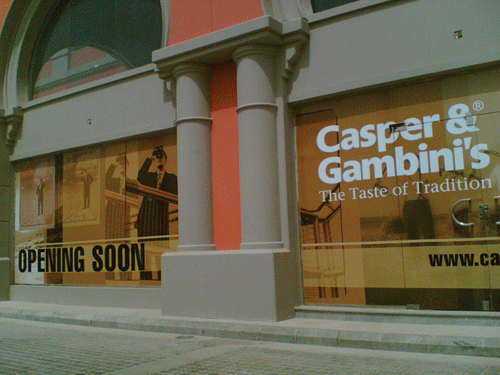
“It’s been the nice ideas of Lebanon: Patchi, Rectangle Jaune and concepts like Casper and Gambini. But we are going to introduce people from abroad, with Dunkin’ Donuts joining lately, and trying to keep Lebanese flair while getting bigger,” he said.
Richa said the LFA was too heavily skewed towards the food and beverage sector, and needs to diversify.
“I’d really like to see it go beyond the food and beverage lead,” he said.
But Arbid says that’s part of the nature of the franchise.
“We are trying to cover all the sectors, but restaurants offer the biggest potential for franchising,” he said.
Whether the LFA is elitist or not, it does have to be less discriminate after gaining membership in the World Franchise Council (WFC), made up of 34 franchise associations globally. One condition of the WFC is that the LFA be opened to non-Lebanese franchises. This will drastically boost the number of LFA players. “We believe we can reach over 100 members soon, especially as we opened the door to franchises,” said Arbid.
The membership of the WFC clearly works both ways, allowing for Lebanese franchises to enter markets elsewhere, even while foreign franchises in Lebanon gain from LFA experience. Seeing this potential, the LFA helped create the Mediterranean Franchise Association with 14 other countries in April. It is an indication of the strategic markets Lebanese brands want to expand into following entry in the Gulf and Levant markets.
“The new markets are the south Mediterranean: Morocco, Tunisia, Algeria and Libya, as it’s maybe too early to go to Europe,” Arbid said. “It’s best to go not to virgin markets but emerging markets.”
While the LFA is actively working on such expansion, individual members are eying franchise prospects even further afield. Kassa’a has expanded eastwards beyond the Gulf to have a branch in Kabul, and is to enter the French market with niche decorative products.
“We’re not far from signing in France, so bucking the trend [of the global downturn]. People are shocked,” Kassa’a said.
Restaurant chain Casper and Gambini had a chance to open in Malaysia at a mall half owned by the Kuwait Financial House that would target the Arab tourism segment.
“We had an opportunity but we didn’t find a local partner,” said Anthony Maalouf, chief executive officer of Casper and Gambini.

Solid partnership
The need for partnerships, typically for 10 years, is one area that the LFA assists in, yet the decision is ultimately up to the franchiser. And getting the right partner is not always straightforward said Maalouf, adding that formal agreements in the Middle East are “only ink on paper.” In Dubai, the local franchisee shifted interest away from involvement with Casper and Gambini after two years.
“We missed the train, but what’s going on there now can get us into the market,” Maalouf said.
Yet Casper and Gambini is a strong brand, and the company is finding offers from local players, such as in Syria.
“Since the region opened as one market, and we have brand value, we don’t need locals to get land or the location,” Maalouf said. “Real estate developers come to us and we can go directly in or as partners.”
Given the current status of the financial markets, expanding abroad in the present climate would seem low on most business’s priority lists. But Lebanese brands have continued to enjoy growth throughout the Middle East, buoyed by strong growth in the local market.
“Last year was a very good year for everyone, and in 2009 [there is] still growth in the first quarter,” Arbid said.
Such results have only boosted brands appetite for expansion. For instance, Casper and Gambini opened three new outlets in Lebanon over the past year, revenues have tripled, and the brand is set to open in the soon to be opened Souks of Beirut. Abroad, outlets are to open in Kuwait and Qatar, while Casper and Gambini has expanded into a falafel franchise, Falafel Nadia, in Kuwait.
But for Lebanese brands to truly succeed internationally, they need to do well at home.
“In no way can the LFA do well abroad if it does not do well locally. There is a direct correlation,” Arbid said. “We need to wait and see what direction the global economy is going in, and in Lebanon over the next six months whether it remains politically stable.”

June 3, 2009 0 comments
0 FacebookTwitterPinterestEmail
Lebanon

Acres Development – Georges Kamal (Q&A)

by Executive Staff June 3, 2009
written by Executive Staff

Georges Kamal is the CEO of Acres Development, a subsidiary of the retail company Azadea. Earlier this year, Acres launched its first property — Le Mall Sin el Fil — and they currently have plans to launch two more: Le Mall Saida (at the end of the year), and Le Mall Dbayeh (at the end of 2010). Executive sat down with Mr. Kamal recently to talk about the branding of Le Mall, and why, despite the economic crisis, he believes this is a good time to launch shopping malls in Lebanon.

E  Tell me about the new Le Mall at Habtoor City.
Don’t say Habtoor, please.

E  Ah, I see. So Le Mall is in the location of the old Habtoor Le Boulevard Mall, at the Habtoor Grand Hotel, in Sin el Fil, but it’s an entirely new mall?
Right. The idea was to re-launch this mall. The original building was achieved in 2005, by Habtoor. It’s part of their hotel. But they didn’t succeed.

E  Why not?
You can attribute it to the circumstances in Lebanon, the political uncertainty which Lebanon was suffering for a couple of years, because of the [former Prime Minister Rafiq] Hariri assassination.

E  And your company, Acres Development, took over this failed mall and re-launched it as Le Mall. Why?
The commercial deal was fantastic. Because when there is a failure somewhere, the owner tells you, “Please take it and make something successful out of it,” and the conditions were extremely pleasant and profitable for us. We leased it from Habtoor for 20 years.
Also we believed a lot in the area, Sin el Fil.

E  That’s pretty brave, launching three malls in the middle of an economic crisis. You must be pretty confident.
This is important, because it’s directly related to our strategy. What we are testing today, are seeing today, is that Lebanon is crossing the crisis without any loss, any harm. Why? We think that in the previous three to four years Lebanon didn’t pick up as much as the other countries abroad picked up, it didn’t profit from the growth in the region because of the political situation here. That’s why today, you don’t feel like you’re going down, because you didn’t go up. The moral of this is that Lebanon is still attractive to the Arabs in the region and to Lebanese living abroad. We’re always trying to monitor, month by month, what’s happening in Lebanon, and we are always surprised in a positive way. So we are extremely confident in this country.
We’re seeing right now an increase in our sales by 20 percent.

E  Why do you think that is, other than the relative stability of Lebanon lately?
What we’ve done to Le Mall is a series of actions. First, the architecture and the design of the old building was extremely heavily, a lot of concrete, not a lot of light, not a lot of style. What we’ve done is to make it lighter, a modern style, catchy. We changed 50-60% of the structure.
Our second action was to build a very strong mix of brands inside. Because what brings people to Le Mall, or any mall, is really the brands there. Azadaya, the mother company of Acres, has in its portfolio a lot of big brands: Zara, Massimo Dutti, Paul and Bear, a lot of these brands. And we completed the Azadaya brands with some from the other big groups, like Retail Group [La Senza, La Cenza Girl, Aldo, Nine West] and Bestseller [Vero Moda, Jace & Jones.]
And in order to complement the shopping area with some food and beverage, we brought with us the leaders in the Lebanese market — Roadster, Lina’s, Dunkin’ Donuts, Burger King, Columbus Café, Julia’s.

E  Finally, there is the communication, the campaign.
The famous IAmMyself.Me campaign. You could hardly leave your house without seeing that.
That was the idea — it was a crazy idea to promote something very solid in Gemmayze, but today it is the talk of the town. What you try to do is build Le Mall as a brand. We went in a very aggressive campaign, very catchy one, and very young very trendy.

E  What about the other branches — the future branches in Saida and Dbayeh?
We’re full in Saida, all the shops, and in Dbayeh I can’t even open the leasing right now, because I have 100 shops, and the waiting list is 500 long!

E  Is there one that you like the best?
Dbayeh. It’s a more interesting one because it will be bigger, it will be on the highway, it’s very well located, and you have cinemas, entertainment, and we have many more anchor tenants than Sin el Fil or Saida, because they are smaller malls. In Sin el Fil and Saida, you have about 12,000 square meters of gross leasable area. In Dbayeh you have double this.

E  Plus, you get to build the Dbayeh and Saida malls from scratch, unlike Sin el Fil. What’s there in those cities now?
In Dbayeh there is nothing. In Saida there will be another mall facing us that they are building now. We will finish at the same time, and both of us will create synergy for the whole area. From there, you have Saida, Tyre, Jezzine, the mountains around there — now there is nothing. We are going there and taking the risk, we’ll be the first, and that’s what you’re doing, trying to be a leader in all markets.

E  How did you get into this business?
I’m a civil engineer, and I worked a lot in France in real estate development. Then I came back to Lebanon… and then I moved to this company.

E  I assume you are a big fan of malls.
No! It’s by accident. I used to build offices, I used to build apartments, it’s all real estate development. Malls are not hard if you have a structured mind and you have the logic for the whole process. Selling malls is like selling glasses, or popcorn. It’s just a product.

E  I noticed that in one of your sketches for the future malls there seems to be a giant Aquarium, which reminds me of a mall in Dubai. Is that what you’re going for? Do you have ‘Gulfie’ aspirations?
The final product — a virtual aquarium, not a real one — won’t be like that. It’s smaller. At the beginning it was like this but it was extremely costly, so we decreased the cost of it. Dubai is Dubai. When you start to do a project in Dubai, it doesn’t matter if it is profitable, it just has to make an impact.

E  So no plans for an indoor ski slope?
In Saida mall? Ha. No. How we will succeed is with the mixed brand in the mall.
Our vision is to be a leader in Lebanon in commercial development, and try to compete on the regional level. So for now, let’s be humble. But in 10 to 15 years? What you want to do is make Acres into something big, a Lebanese company, with a well known trademark in the region.
Right now we’re moving in the right direction.

June 3, 2009 0 comments
0 FacebookTwitterPinterestEmail
Lebanon

Real estate – The house made of brick

by Executive Staff June 3, 2009
written by Executive Staff

The region’s real estate markets have seen better times. Jordan’s property prices continue to plummet. Dubai’s real estate bubble has burst. The rest of the Gulf Cooperation Council hasn’t fared much better. In Lebanon, prospective buyers waited for prices to follow suit; figuring the past year’s decrease in construction cost and the lower demand from Lebanese expatriates would bring prices down. But Lebanon’s real estate has had a very different experience from its regional colleagues since last fall’s crash began.

Real estate prices in Lebanon are not going up — but they’re not going down. Demand from expatriates has slowed, but prices have not taken a plunge mainly due to strong local demand and scarcity of land and properties. Still, some prices have decreased 10 to 20 percent because developers who had the luxury of inflating prices due to high demand are being forced to return to the original, fair market value of properties.

Demand leveling out
Local demand for Lebanese real estate has not decreased, since the Lebanese economy, as a whole, has not been severely affected by the financial crisis. The banking sector is still performing well and making loans available. Companies operating in Lebanon are not shutting down or sacking employees, leaving the local demand for properties intact.
What is triggering a concern is the demand from Lebanese expatriates, who represent the largest portion of the market and dominate the mid-range and high-end segments. There is an ongoing debate about how hard the crisis has hit expatriates, and how that will affect the real estate sector.
“Definitely we are seeing the impact,” adds Hani Haddad, managing director of A&H Construction and Development, of his firm’s performance over the last few months. “The demand was much lower. But it is starting to pick up again,” he says.
A&H specializes in high-end properties, whose clientele is comprised mainly of Lebanese expatriates. Haddad says one of the reasons for the lower demand was that people stopped buying. They assumed prices would go down, as in other countries in the region.
“They waited and prices didn’t go down. So maybe now they are starting to change their mind,” he says.
Some say that demand in Lebanon has not been impacted at all, while others say expatriates have started to return with no money to buy a house, consequently lowering the demand for properties in Lebanon.
Coldwell Banker President Elie Harb says that there is no evidence that demand has gone down.
“It is a normal cycle,” he says. “Every year, we see these months have the lowest activity.”
Harb says expatriates who drive Lebanon’s real estate market are highly educated managers and professionals with high incomes. He says it is doubtful large swaths of these professionals would lose their jobs, and is optimistic the real estate market will recover soon.
Christian Baz of Baz Real Estate disagrees.
“All market segments will be affected,” says Baz. “People are coming back broke. They either bought their house already, or are broke and will live with their parents.”
Those who are still buying are currently enjoying the luxury of making an unhurried choice, at least compared to how the Lebanese market was a year ago. Stable prices mean buyers have more time to compare properties, without having to worry about prices going up the next day, or another buyer aquiring the property.
“Properties are not selling as quickly as they used to,” says Karim Makarem, director at RAMCO. “While not so long ago, if you saw a property, the next day it could be sold. Now it is not sitting, but you might have a few days, a week or two before you make an offer.”
Sandro Saade, co-general manager at Greenstone, says prospective buyers are now “pickier.”
“[The consumer] is asking questions, and making sure that the product that is delivered is of better quality and is reflected in the price being asked,” says Saade.

A fair price?
Many factors play a role in determining Lebanon’s property prices, the most important being the availibility of land, construction materials, profits and demand. When the market was peaking, all these indicators were heading upwards. Land became scarcer and construction material more expensive. People rushed to buy properties for fear of further price increases. Some developers jacked up prices, confident consumers would buy out of necessity.
“People have overpaid… because they were either mislead, or they refused to get advice and they went with their gut feeling,” says Makarem. This created a vicious circle where prices rose and buyers rushed to make purchases, which then caused prices to rise again.
Developers who took advantage of the rush are the ones who are now being forced to rollback inflated prices. The lower cost of construction material and dwindiling demand has left them with no other option.
“Certain developers have reduced their asking prices by up to 20 percent,” Makarem says. “But their asking prices were overpriced to start with.”
He adds that there is a huge risk in doing so, because when the market slows down, buyers will know the price increase was unjustified and it will hurt the developer’s reputation.
Other developers who set their prices according to ‘reasonable’ parameters are not finding it necessary to decrease their prices. They did not use the increase in construction material costs as an excuse to inflate prices. And now they say the decrease in the cost of construction material is not substantial enough to trigger a price decrease.
“The cost of construction has not lowered substantially, as people think,” says Karim Saade, the other co-general manager at Greenstone. Saade says this is one of the reasons why Greenstone and other reputable developers are maintaining their current prices. Haddad from A&H concurs.
“We stick to our prices, we don’t lower them and we don’t increase them,” he says.
Even if conventional wisdom says the cost of construction material has decreased and prices should go down, land remains very expensive. In densely packed Beirut, finding a plot to build on has become more difficult, and developers are now including the high cost of land in their cost structure, making apartments expensive.
“There is no land anymore [in Beirut]. And if there is, they are asking for ridiculous prices,” says Haddad.
Makarem says the city’s spatial limits may drive prices up in the boom times, but generally the limited supply helps contribute to the stability of Beirut’s real estate market.
“As long as that is the case, I don’t see any reason why the prices of end products should collapse,” he says.

Money to give
Most Lebanese buyers rely on financing to purchase property. With a healthy banking sector, Lebanon has not been hit by a lack of liquidity, and buyers can acquire home loans or mortgages provided by banks in partnership with the Public Corporation for Housing.
“Conditions are still the same,” says Antoine Chamoun, general manager of Bank of Beirut Invest. “The flow of people is still the same, and I may say even more than before.”
But the situation has changed for expatriates. The crisis has put a lot of expat’s jobs at risk, and Bank of Beirut, and other banks, are increasing the level of scrutiny on the financial status of applicants, the stability of their jobs and other sources of income.
“We are looking more at the source and the stability of the income. We are also seeing if the employer is affected or not,” says Chamoun.
He says the heightened scrutiny and generally bleak economic conditions outside Lebanon has caused expatriate applications to decrease.
The credit situation for developers is better. Developers in Lebanon, compared to their regional colleagues, are not over-leveraged and they continue to apply for loans. A bank not only provides project financing depending on developer’s financial situation, but also on the specific project. The bank studies market activity in the area, the expected sales and other factors.
“We are receiving a lot of applications from developers for project financing — the number [of applications] has not changed,” says Chamoun.

Developers sitting pretty
Most developers are in a good position in Lebanon due to having sold a majority of their projects. Consequently, they have not been forced to sell at a discount as demand has slowed, which has kept prices stable.
“We started the sales process in September 2008, and have sold so far 35 percent of the project, which is a very good result. So we are quite confident” says Greenstone’s Saade.
Developers have not changed their operating strategies. They did not feel the need to. On the contrary, they are still planning ahead and looking for new projects and future investments. Currently there are 300 new construction projects in Beirut, according to Makarem, totaling some 1.6 million square meters of built up area.
A new trend that is coming to the market is the construction of smaller, cheaper units because the financial crisis might lower the budget of some people looking for more affordable units to rent or buy. Brokers are advising developers to focus on the mid-range market, and several developers are considering the change.
“The true demand is to build a house of 150-160 square meters with three bedrooms, and having the price below $200,000, so that 90 percent of the local market can buy” says Harb from Coldwell Banker.
Haddad says that his firm, A&H, might consider building smaller units, but it is still a dilemma because in the high-end segment the target market is usually families who are used to big spaces. Still, they might consider it for their next project. “Our budget is $1.5 million. Maybe you can go smaller, take it down to $500,000,” adds Haddad.

Awaiting the summer
Real Estate professionals are optimistic about the summer. Most believe that if elections go well, the real estate market in Lebanon will bloom again, since it will represent a safe haven for those who still have money and are willing to invest.
“I think in the summer you might find a lot people looking to buy,” says Makarem. “If ever [people] needed evidence that no matter what happens, the [real estate]sector in Lebanon is extremely secure, they have it.”

June 3, 2009 0 comments
0 FacebookTwitterPinterestEmail
Lebanon

Rest & recreation – Clubs find summer’s groove

by Executive Staff June 3, 2009
written by Executive Staff

With the Mediterranean a few feet away, and a table groaning with plates of grilled prawns, it’s hard to picture Oceana beach club as a scene of any duress. Life here among the bronzed and beautiful is good. But in 2006, as owner Nicolas Sawan says, the first Israeli bombs to hit the Dammour area were just a few hundred meters away.

“They hit the bridge where we had the Oceana sign,” he says.
Beyond the human carnage and destruction wrought by the July war, Lebanon’s tourist heavy economy also took a blow. The initial overall economic cost was estimated at $2.8 billion and the year, which had begun with a record flow of tourists, saw an 85 percent drop from the previous August, according to Tourism Ministry statistics. The owners of Lebanon’s beach clubs, who had been preparing for a bumper season, were hit particularly hard. Sawan, for example, claims he invested $200,000 on an advertising and marketing campaign that year.
Although the conflict lasted almost exactly the length of Lebanon’s high tourist season — from mid-July to mid-August — Oceana reopened after the bombs stopped falling, just to prove a point: Lebanon doesn’t give up that easily. But the experience left Sawan and other beach club owners with a little less spring in their step, even as this year the Tourism Ministry is once again recording significant year-on-year increases of visitors, up 53 percent in the first quarter.
Ziad Abdo, Oceana’s general manager, said the club would not be investing nearly as much — perhaps half the original amount — in its marketing campaign as they had in 2006. While Oceana still runs radio advertisements, they are playing it a bit cooler, hoping instead to bring in new clients through other means.

A pool of one’s own
For example, they have carved out creative new transport strategies, including an exclusive deal with the Intercontinental Phoenicia Hotel, which will provide a free shuttle service to and from Oceana for its guests. They’re also planning to offer arrival via sea; visitors can leave from the Marina at Dbayeh and take a boat directly to Oceana. Thanks to these innovations, they’re expecting a 30 percent increase from last year’s 62,000 entries.
Gilbert Khoury, owner of Bamboo Bay beach club in Jiyeh, also had to make some hard choices in the wake of the war.
“Because of the 2006 war we had a huge amount of losses, around half a million dollars,” he says. Once bitten, he is now twice shy: after the war, and against the background of continuing conflict and instability that has plagued Lebanon, he abandoned plans to develop a resort and hotel complex on an adjacent property.
“Because of the problems from 2005 to 2008, we decided not to develop a hotel-resort complex as we’d initially planned. It was too risky to invest this much money,” says Khoury.
Instead, he reinvested almost $500,000 in an upgrade and expansion of Bamboo Bay, in order to reposition the club as “one of the most Class A and A plus” projects on Lebanon’s coast, as he puts it. To that end, he’s enlarged the total area of the club from 12,000 to

19,000 square meters, adding 14 private “terraces,” or bungalows, along the beach, and six terraces with private dip pools. Each terrace has its own changing area, shower and restroom. There’s also a “mega-terrace,” which has a larger dip pool, solarium and private bar, as well as a butler service.
“It’s like a micro-beach resort that you can rent privately for the day,” Khoury says.
On top of this substantial investment in infrastructure, Khoury has made what he considers an even more important investment, in human resources.

Select clientele
“Last year, we had a big crisis in hiring qualified staff, because a lot of people left to work abroad. This year, it’s the opposite. Because of the work crisis in the Middle East, we’ve been able to hire a lot of qualified staff from the Gulf,” Khoury says.
“People are willing to come back to Lebanon and work, and that’s what we’re most excited about. It’s not only a restructuring of the physical aspect, but also a deep managerial restructuring. Our staff is very motivated, very qualified, and it’s going to make a big difference in the quality of service this year,” he adds.
Despite increasing the size of the club by more than 50 percent, Khoury plans to limit the number of clients he lets in to 800, maintaining a high area-to-client ratio that will set Bamboo Bay apart. In a tiny, nosy country like Lebanon, what greater luxury is there than a little extra room to breathe? 
At Lazy B, they’ve also placed a premium on space, capping admission at 500 visitors and, as Karima Hawa, wife of owner Georges Boustani, points out, leaving around a third of their land untouched and unused.
“We left it just the way it was,” she says.
Daisy Boustani, Georges’ mother and the club’s designer, has re-done the bar and replaced the furniture for this year. But she’s not expecting anything out of the ordinary.
“We’re just working for the people who are used to coming here,” she says.

June 3, 2009 0 comments
0 FacebookTwitterPinterestEmail
  • 1
  • …
  • 465
  • 466
  • 467
  • 468
  • 469
  • …
  • 685

Latest Cover

About us

Since its first edition emerged on the newsstands in 1999, Executive Magazine has been dedicated to providing its readers with the most up-to-date local and regional business news. Executive is a monthly business magazine that offers readers in-depth analyses on the Lebanese world of commerce, covering all the major sectors – from banking, finance, and insurance to technology, tourism, hospitality, media, and retail.

  • Donate
  • Our Purpose
  • Contact Us

Sign up for our newsletter

[contact-form-7 id=”27812″ title=”FooterSubscription”]

  • Facebook
  • Twitter
  • Instagram
  • Linkedin
  • Youtube
Executive Magazine
  • ISSUES
    • Current Issue
    • Past issues
  • BUSINESS
  • ECONOMICS & POLICY
  • OPINION
  • SPECIAL REPORTS
  • EXECUTIVE TALKS
  • MOVEMENTS
    • Change the image
    • Cannes lions
    • Transparency & accountability
    • ECONOMIC ROADMAP
    • Say No to Corruption
    • The Lebanon media development initiative
    • LPSN Policy Asks
    • Advocating the preservation of deposits
  • JOIN US
    • Join our movement
    • Attend our events
    • Receive updates
    • Connect with us
  • DONATE