• Donate
  • Our Purpose
  • Contact Us
Executive Magazine
  • ISSUES
    • Current Issue
    • Past issues
  • BUSINESS
  • ECONOMICS & POLICY
  • OPINION
  • SPECIAL REPORTS
  • EXECUTIVE TALKS
  • MOVEMENTS
    • Change the image
    • Cannes lions
    • Transparency & accountability
    • ECONOMIC ROADMAP
    • Say No to Corruption
    • The Lebanon media development initiative
    • LPSN Policy Asks
    • Advocating the preservation of deposits
  • JOIN US
    • Join our movement
    • Attend our events
    • Receive updates
    • Connect with us
  • DONATE
Executive Insights

Capitalizing in these times of crisis

by Mazen Skaf May 3, 2009
written by Mazen Skaf

The authors of Executive Insights have been invited by this magazine to offer their professional opinions and analysis to you, the reader. Executive magazine does not endorse the analysis of Insight authors, nor should the Insights be interpreted as reflecting the views or opinions of Executive or its editorial staff.

Former Federal Reserve Chairman Alan Greenspan, testifying before the House Committee on Oversight and Government Reform, called the current economic crisis a “once-in-a-century credit tsunami.” For companies across industries, access to credit has certainly been an acute near-term concern. But as governments and central banks act to ease credit markets, corporate leaders must now make larger strategic decisions, under conditions of extreme uncertainty, that will determine how well their companies fare against the strongest economic headwinds in decades.
Astute business leaders realize the current environment will open significant opportunities for their companies to benefit from the dislocations across industries. To identify and capitalize on these opportunities in the face of significant uncertainty about the length and depth of the current crisis, decision-makers should take an integrated approach to strategy and risk management. Specifically they should:
• Reassess the risk-return profile of their corporate portfolio as well as new investments under consideration.
• Develop strategies and contingency plans shifting payoff profiles toward a greater upside and limited downside.
• Build and maintain strategic maneuverability.

Reassessing the risk-return profile
The current financial crisis has triggered a re-pricing of assets and has brought about significant volatility in commodity prices and financial securities. The result is that many asset prices across several classes of assets may decline in a very long process and may overshoot on the way down just as they overshot on the way up.
In addition, several industries are witnessing fundamental shifts in underlying value drivers, ranging from freight rates to energy prices to availability of credit. Companies in these industries should therefore rigorously reassess the risk-return profile of their current corporate portfolio of business units and investments. This should be based on both a sound analysis of the underlying value drivers and the ranges of uncertainty associated with these value drivers, as well as the exposure of the corporation to those uncertainties resulting from the corporate strategy and investments.
In this context, it is critical to distinguish between uncertainty and risk exposure. One may be uncertain about the direction of prices of a certain commodity like natural gas, for example. However, risk exposure is determined as a result of the strategy, asset investments, and contractual obligations of an entity or corporation and how they are driven by an uncertain parameter. As part of evaluating any new investment opportunity, decision-makers should demand rigor at three levels:
(1) Thorough assessment and understanding of the relevant uncertainties; (2) analysis of the risk exposure to specific uncertainties resulting from the contemplated investment, taking into account the corporate portfolio of assets and contractual obligations, and (3) evaluation of the risk-return profile of the contemplated new investment and comparison with the risk-return profiles of other available alternatives.
In the making, timing, and resourcing of strategic decisions, leaders face a deeper and broader set of uncertainties than they have likely ever faced. Consider just a few of those uncertainties:
• The depth and length of the crisis — Predictions of the magnitude of the current economic crisis range from several quarters of recession to doom-and-gloom scenarios of prolonged worldwide depression. While forecasters may differ on the length and depth of the current crisis, the real challenge lies in developing a robust strategy with contingency plans.
• The effect of government intervention — Just as the Great Depression ushered in the New Deal, the current crisis is likely to see a fresh wave of government actions, including regulation, stimulus packages, global trade restrictions, or at least skepticism about free trade. Certainly, few people would have predicted even a few months ago that the US would not only be bailing out financial institutions but also taking an equity stake in them. Increased regulation may slow recovery, and various forms of economic stimulus may favor some industries over others, but the consequences of these interventions — intended and unintended — remain unknown.
• The impact of deleveraging — With some $600 trillion in derivatives contracts outstanding worldwide, perhaps $10 trillion in mortgages in the US, and $60 trillion in credit default swaps in the US, the unprecedented level of leverage in the economy will take a long time to unwind. This deleveraging is leading to the re-pricing of different asset classes and recalculations of risk. Further, as asset prices across several asset classes decline during a very long process, it’s possible that they will overshoot on the way down just as they overshot on the way up.

Developing strategies and contingency plans
Taking an integrated approach to strategy development and risk management enables decision-makers to shift the payoff profile of an investment or the overall distribution of shareholder value towards greater upside, while limiting the downside (see graph on this page).
In a military context, it is often said that “the mission comes before safety;” otherwise, no one would leave the barracks or base. The parallel in a business context is that strategy comes before risk management. Usually, that is the case and strategy sets the structure and provides the context for the best approach to risk management. However, in times of great uncertainty and significant volatility, organizations should take an integrated approach to strategy and risk management to limit the downside exposure and increase the potential upside in the case of favorable market conditions.
The types of bets that organizations should consider or pursue are ones with limited downside yet with significant or unlimited upside. This is similar to buying a call option on a stock, or negotiating an option with a contractor for expanding a factory that would be exercised in the case of a market turnaround.
Unfortunately, many of the financial services companies that ran into trouble were doing just the opposite: aggressively selling instruments that exposed them to unlimited downside risk for a small fee upfront. In addition to the fundamental flaws in the models used by such financial services firms, and their mispricing of risk, the root cause may lie in incentive structures that rewarded short-term performance without weighing the impact on long-term shareholder value.

Seeing opportunity where others see risk
Just as stock volatility presents savvy investors with rich opportunities for gain, the current economic uncertainty offers similar opportunities for enterprises that know how to make strategic decisions. Distressed assets are likely to be available at a bargain as some companies are forced to raise cash to reduce debt. Opportunities for mergers and acquisitions will also be plentiful. In specific industries, uncertainties will create “white space” where companies that comprehensively understand value and risk can prosper. In petrochemicals, with slowdowns in the US and China and decline in feedstock prices globally, attractive opportunities to acquire capacity or companies may appear in late 2009 and 2010.
Opportunities are likely to be even greater for companies in industries that do not require a great deal of leverage or debt finance. There may be opportunities in some industries for smart companies to leapfrog the competition and take the industry lead. Again, the key will lie in knowing how to comprehensively understand risk and value in reaching strategic decisions.

Building and maintaining strategic maneuverability
During periods of steady growth and expansion, it is easier to foresee how conditions will evolve, although it is no less important to comprehensively understand uncertainty, value and risk. In times of great uncertainty, conditions can evolve much more unpredictably, with wide swings, sudden impact and lingering effects. Such times offer great opportunity, but safely seizing those opportunities requires strategic flexibility and maneuverability, not bet-the-company gambles. The current downcycle may take several quarters or several years to play out, but strategic maneuverability can enable a company to outlive the downcycle.
One key source of strategic maneuverability lies in building a cash reserve (see table) and securing access to credit for when it is needed in order to judiciously capitalize on attractive acquisition opportunities. We are seeing deals with attractive fundamentals selling at a fraction of book value or with very attractive earning yields. However, acquirers need to keep three things in mind:
• More attractive deals may materialize. Keep some buying power in reserve to take advantage of those deals.
• The fundamentals themselves may change given the strength of the underlying trends. Several industries are going through seismic shifts and earnings projections may prove too optimistic to attain. Valuation benchmarks and multiples may be further revised.
• Even for very attractive deals that pass due diligence, inching into the full investment position in a specific sector may be advantageous. Use a rigorous analysis of the sequential decisions and the uncertainties related to asset valuation to understand the overall risk-return profiles of various investment alternatives.
Over the course of the current downcycle, entire industries, markets and geographies may be transformed. Banking has already been profoundly changed. In the face of such tectonic shifts, strategy development should encompass a full understanding of the risk-return profile of any strategic alternative. It should also include how best to split the investment into a sequence of smaller investments. Those smaller investments enable learning and contingent responses as conditions evolve — the essence of strategic maneuverability.

The way forward
Given the scope, magnitude and unpredictability of today’s uncertainties, leaders can be forgiven if they find the challenge of making sound strategic decisions extremely daunting. The spread between best-case and worst-case scenarios can be vast and so can the consequences of strategic miscalculation. Further, traditional approaches to strategic decision-making confuse risk with uncertainty, resulting in sub-optimal decisions. But by understanding uncertainty and risk, identifying opportunities and maintaining strategic maneuverability, leaders can do far more than simply steer clear of danger. They make strategic decisions that harness today’s economic headwinds to take their companies forward.

Dr. Mazen Skaf  is partner and managing director of the Europe and Middle East Practice of Strategic Decisions Group

May 3, 2009 0 comments
0 FacebookTwitterPinterestEmail
Finance

IPO Watch – A pent-up market

by Executive Staff May 3, 2009
written by Executive Staff

Capital market desks from Riyadh to Damascus continue to experience a great deal of backlogs for IPOs that are ready and waiting for the ice to break. Experts say that risk capital will eventually open up to new issuers and the IPO market is expected to pick up further momentum in the third and fourth quarter of 2009.

The experts might be right. In late April, and despite the severe downturn in local markets, Gulf investors announced the establishment of a $10 billion Islamic ‘godfather-of-all-banks’ bank to tap interest in sharia-compliant institutions. The new bank will be based in Bahrain and will be called Istikhlaf Bank. Adnan Ahmed Yousif, chairman of the Union of Arab Banks, said plans include a private placement of $6.5 billion and a $3.5 billion IPO in the fourth quarter of 2009. He added that the bank will be listed on the Bahrain Stock Exchange and Nasdaq Dubai. Some of the seed investors include the Islamic Development Bank, Saudi Investment Bank and the Kuwait Real Estate Bank. “The bank has raised $3.5 billion including $1 billion from the management. We are hopeful it will be ready by the fourth quarter,” said Al Baraka chairman Shaikh Saleh Abdulla Kamel, who is promoting the bank.

April showers bring May flowers
So April did not only bring with it spring, it also brought with it the earning season, two other IPO announcements and solid numbers for the four insurance firms who floated their shares during the third week of the month. The concurrent IPOs of the four insurance companies on the Saudi Stock Exchange were all well received in the market, according to announcements.
Al Rajhi Company for Cooperative Insurance or ARCCI saw its $16 million offering subscribed some 151 percent in only the first two days of its IPO. According to a statement by the issue’s lead manager, Al Rajhi Financial Services Co, over 146,000 subscribers signed up on April 18 and 19 for shares worth $24 million.
The combined value of the shares offered for subscription by the four insurers approaches $70 million. Besides ARCCI, the issuers are Weqaya Takaful Insurance and Reinsurance Company ($21.33 million), AXA Cooperative Insurance Company ($21.33 million), and ACE Arabia Cooperative Insurance ($10.6 million).
AXA and ACE also encountered handsome demand; according to statements, offerings were covered about three and six times, respectively, several days ahead of the close of the subscription on April 27.
Vodafone Qatar, which closed subscription to its $952 million IPO on April 26, did not immediately disclose if there was over-subscription. However, the company praised the “overwhelming public support” it received for this IPO.
Qatar National Bank (QNB), the country’s largest bank, said that it plans to float 32.5 percent of Qatar National Bank – Syria in May in an attempt to raise over $35 million. QNB will retain a 49 percent stake in the new bank, the Syrian government 15.5 percent and three percent will be offered to private investors. QNB – Syria has a paid-up capital of $100 million and will offer 3,250,000 shares priced at SYP500 each ($11).
The Abu Dhabi-based Emirates Steel Industries plans to launch an IPO in 2011 provided local markets stabilize, said Chairman Hussein Jassim al-Nuwais. Although no additional details were provided about the IPO, if confirmed the IPO is expected to generate a lot of buzz as observers expect it to be one of the largest IPOs in 2009.

An IPO tower
The Dubai-based Alpha Tours, which had announced its intentions for an IPO in early 2007, said the travel services company will float 50 percent of its shares to the public in the second quarter of 2009. Alpha, who has appointed Ernst & Young as the lead manager for the issue, seeks to raise $150 million, according to statements made by Ghassan Aridi, Alpha Tours chief executive.
The Jeddah-based Knowledge Economic City Co., or KEC, which announced its IPO plans last month, released additional details about the float, saying that it will sell a 30 percent stake in an attempt to raise $301.6 million in May. The Saudi authorities approved KEC’s license with capital of $906 million.
So the IPO pipeline in the region continues to do better than its peers in the United States (US) and European markets. Obviously, it will take much more interest for the IPO market to return to its pre-2008 conditions, but larger private and government companies cannot continue to put off their IPOs indefinitely. As these companies scale up, so does their capital requirements.
Given the substantial opportunities for regional companies in the US and European market, the cost of expanding internationally through buying a major competitor in those markets is beyond what even large venture-capital firms can provide. Unless the larger private and government companies can tap the IPO market, they cannot continue to grow.

May 3, 2009 0 comments
0 FacebookTwitterPinterestEmail
Executive Insights

EM Leadership Center

by Tommy Weir May 3, 2009
written by Tommy Weir

The authors of Executive Insights have been invited by this magazine to offer their professional opinions and analysis to you, the reader. Executive magazine does not endorse the analysis of Insight authors, nor should the Insights be interpreted as reflecting the views or opinions of Executive or its editorial staff.

Almost every day CEOs and business leaders ask me, “What is going to happen now with the global financial crisis?” or “When will it be over?”
Well, it is over! We can confidently rest on the fact that the world of business as we know it is finished. Sure, many will give their all to bring it back; but no matter how much effort is exerted it is not coming back. This is not a doomsday comment, but rather a statement of reality and a challenge to look ahead to the future.
There simply is too much happening simultaneously on the global scene for there not to be a history-making revolution in the private sector.
For example:
• The Gordon Gecko days (from the film “Wall Street”) of prevailing greed are going to have to give way to business leaders acting responsibly. Your investors and consumers will demand it.
• The days of short-term high-risk driven solely by the quarterly results will be replaced by a focus on long-term sustainability. As CEO you will be held culpable for the long-term prosperity of your company and possibly even its impact on others.
While many businesses are longing to get back to the way things were prior to the crisis, CEOs are asking, “when will it be over?” and “how can we return to the way that it was?” The intelligent leaders are asking what the new business environment will be.
As we look to the future, we should all be wondering, “why do organizations overlook the statistic that is going to have the greatest impact on business ever?”
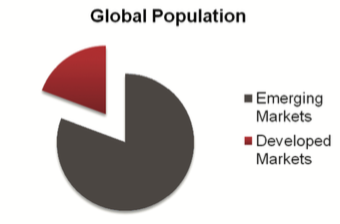
We all know the global financial crisis has had a crippling impact on business as it cut the supply to the hot air balloon of business and let the air out. Of course, this means that you will have to recreate how you do business and lead differently. But the statistic that matters more than any other is that the emerging markets comprise 80 percent of the global population, and the developed world (North America, Western Europe, Japan) are just 19 percent.
Over the past decade we have divided the world according the developed world and the emerging markets, which is a classification based on a nation’s social or business activity in the process of rapid growth and industrialization. But in the future we will segment the world according to where the people are. 
We can say that the era of emerging markets is ending and thanks to the global crisis this is being accelerated. Now, we are moving into a new era, what I call, “peopleization.” This era can be defined as the rise and coming together of populations.
Peopleization is about more than the location of the markets. It is about who the people are. Let’s look at another defining statistic.
The percentages between the markets are almost exact opposites. In the emerging markets 29 percent of the population is under 15 whereas in the developed markets 25 percent is over 55. And the population in 12 percent of the emerging markets is over 55 and 14 percent of the developed markets is under 15.
While the West is suffering from an aging population, the Emerging Markets are wrestling with a “youth bulge.”
Now, let’s figure out what this means for us as business leaders. To do so, you need to answer these questions in your boardroom.
Where is your future market?
Who is your future market?
What defines them?
What are you going to do about it?
As we think about the future, perhaps we should compare Gordon Gecko and Slumdog Millionaire. Both are millionaires. Is that where the comparison stops? The days of Gordon are gone. What is your future?
Whether you agree or accept it, your future is caught up in peopleization!

Tommy Weir, Ph.D., serves as managing director of the EM Leadership Center

May 3, 2009 0 comments
0 FacebookTwitterPinterestEmail
Finance

The financial crisis – Banked with optimism

by Executive Staff May 3, 2009
written by Executive Staff

One year ago, with the global economy fully immersed in its ongoing downslide, Philippe Dauba-Pantanacce, a senior economist for the Middle East region at Standard Chartered Bank, went on a speaking tour. As he listened to economists and audiences from around the region, Dauba-Pantanacce couldn’t help noticing a disconcerting trend — many people thought the economic crisis was ending, and the world was headed for a recovery.

“Of course,” Dauba-Pantanacce said recently, “we can see now, in fact, that’s not what happened.”
Dauba-Pantanacce, who encourages people to call him Philippe (he knows his name is hard to pronounce for non-francophones), prides himself on bringing a dissenting view to economic discussions. In the fall of 2007, for instance, Standard Chartered had been one of the only major banks to predict that interest rates in the United States would drop to one percent. They were right.
Late last month, Philippe brought his contrarian’s instinct to a roundtable discussion on the global economy and its impact on Lebanon, held at the Intercontinental Phoenicia Hotel in Beirut and organized by Executive. At the moment, the outlook for Lebanon, which had thus far weathered the economic crisis with surprising resiliency, did not look good.
Nassib Ghobril, the head of Economic Research at Byblos Bank, had recently been reading a handful of country reports from the International Monetary Fund (IMF) and others — “they were all very gloomy,” he said. Just that week, for instance, the Economist Intelligence Unit had downgraded Lebanon’s expected economic growth in 2009 from 2.7 percent to 2.4 percent. It was the third such downgrade this year.
The focus of this pessimism, as everyone at the table knew, was the expected decline in earnings around the world — especially the Gulf, where some 30 percent of Lebanon’s expatriate workers are based. That fact continues to threaten a dramatic decline in Lebanon’s remittances, which constitute at least 25 percent of gross domestic product.
Philippe was not dissuaded. He believed that things could be worse and, in fact, thought they might be getting better. Philippe is willow-thin and he has an easy-going affability. He was wearing a tailored, dark suit with a bright pink tie. Sitting next to him on one side was Pik Yee Foong, the chief executive officer of Standard Chartered in Lebanon, who had earlier introduced him as “Mr. Philippe.” On the other was Abdel Rahman Mogharbel, a manager at the Banking Control Commission at the Central Bank of Lebanon, which has been credited by many, including Philippe, for insulating Lebanon from the crisis with its conservative policies.
“We are calling this crisis the Great Recession, versus the Great Depression,” Philippe said. “The fourth quarter of 2008 was appalling, but the first quarter of 2009 was better.” Where Lebanon is concerned, Philippe sees remittances declining less precipitously than most due to the stability of the Gulf, adding that low oil prices will drastically reduce the cost of energy, a major burden on the country’s expenditures.

Gulf of hysteria
The focus of Philippe’s analysis was an outlook for the Gulf countries, particularly the United Arab Emirates, that was stronger than that of most other economists. For months, the business press had been filled with articles predicting the demise of Dubai — the downward spiral, they called it — and Philippe thought the whole thing was overblown, a lot of “hysteria.” As he saw it, the downturn in Dubai had been driven by an over-inflated real estate market, but that the market “correction” was, “for the medium to long term, a good thing.”
“Where will the engine of growth come from in Dubai?” Mazen Hanna, an economic advisor to Saad Hariri, asked Philippe. Like several of the Lebanese economists at the roundtable, Hanna found Philippe’s take on the Gulf a little hard to believe. Dubai’s economy, he pointed out, was “one of the most affected today because it was the most exposed internationally.”
Philippe’s answer was, to some extent, non-academic — we don’t know all the details, but the money keeps coming from somewhere. He mentioned some maturing bonds that had recently been paid out by an unknown investor.
He went on, “This crisis has put Dubai to the test, but more than Dubai it has put the UAE as one country to the test.”
Dubai had been bailed out by Abu Dhabi (another thing Philippe says he had predicted with certainty before most other analysts), which may have cost Dubai its independence, but in exchange had actually fortified the UAE’s economy in the long run.
Now instead of two separate economies — one, Dubai’s that was heavily based on real estate speculation (and thus highly unstable), the other, Abu Dhabi’s, that was solely based on oil and gas reserves (and thus ephemeral) — there is now a shared, diversified economy.
Going forward, the UAE — with a distinct geographical advantage, and a “logistical structure” (including major ports and airlines) that Philippe considered 10 years ahead of anyone else — could position itself as a major transportation hub and the “warehouse of the region,” he said.
With regard to Lebanon, Philippe pointed to something more intangible: the strength of domestic confidence.
“Domestic consumption can drive every force of the economy,” he says, pointing to the US, where 70 percent of the GDP comes from it.
Meanwhile, he says the Lebanese people’s great faith in their national banking system has meant that deposits nationwide have, and will continue, to rise. More bank deposits means more money to offer as loans.
Once again, the Lebanese were less bullish than Philippe.
This was something one private banker — who preferred to remain anonymous — knew a thing or two about, and she pointed out that one  of the reason the banks in Lebanon were so well capitalized was because the Lebanese had so little faith in other markets. “Even if you have a political crisis in Lebanon the outflows have nowhere else to go,” she said. “It’s very superficial.”

A bad moon a-rising
Standard Chartered’s Pik Yee Foong said that although the deposit to loan rate in Lebanon was fairly well endowed, there were “mixed signals” on demand for loans.
And Imad Jamil Zbib, an assistant vice president at American University Beirut and a former professor of business, saw a more pressing indicator: graduating seniors were having a hard time finding jobs, especially now that they had to compete with more experienced young professionals returning from layoffs in the Gulf.
Yasser Akkaoui, the editor-in-chief of Executive Magazine, who was moderating the panel, asked the collected experts what they thought were the biggest risks for the Lebanese economy.
The obvious answer was the unstable political situation. “I think the political deadlock in the country had derailed the privatization process,” Mazen Hanna said, referring to efforts to privatize Électricité du Liban, as well as the telecommunications networks.
He went on to address the dangers associated with Lebanon’s dependence on remittances and expatriate investments, which account for a large percentage of the banking sectors’ deposits.
“My greatest fear is a point in time where you would find that this financing is no longer available to the government, and the government in such a world would have no recourse to the rest of the world because of the current situation… That would be the gloom scenario.”
On this, at least, Philippe agreed. Much of the domestic spending he had pointed to was dependent on what he called the domestic dynamic: “a feeling, real or imagined, of security and political stability.” A major security or political crisis in Lebanon could upset the whole balance. He agreed privatizing EDL was also essential.
But if his dissenting predictions were right — as they had been so often in the past — then the stability of the Gulf countries ought to be a sufficient bulwark, at least, against Mazen Hanna’s “gloom scenario.”
For most of the conversation Abdel Rahman Mogharbel had been tight-lipped, not willing to say too much, perhaps worried that, as a representative of the Central Bank, his thoughts could be misconstrued as foresight. Finally, he turned to Philippe, smiled, and said dryly, “You seem optimistic.”

May 3, 2009 0 comments
0 FacebookTwitterPinterestEmail
Levant

Campaign priorities – The Grand Serail’s to-do list

by Executive Staff May 3, 2009
written by Executive Staff

Lebanon has an exasperating array of economic issues which will need to be tackled by the new government that will be formed after the June 7th general elections. Many leaders speak about economic plans and reform, but can their walk match the talk?

“Not one of the current candidates for the upcoming elections has a clear understandable economic vision for Lebanon,” says Oussama Safa, the general director for the Lebanese Center for Policy Studies. “This shows that accountability and checks and balances have no part in the elections. The elections are a battle of slogans not programs.”

As part of this magazine’s election coverage, Executive has asked Lebanese business figures, academics, economists and civil society leaders to provide what they think the economic priorities for the next government should be.
Stability seems to be top priority.

“If there is political stability and security then there will be confidence. Confidence is the key aspect to economic growth,” says Nassib Ghobril, head of economic research for Byblos Bank.

Safa says that to achieve stability, Lebanese politicians must place their first priority on “forming a national unity government and staying away from controversial issues.”

However, March 8 and March 14 have already begun to disagree over the meaning of a national unity government. The March 8 coalition has made clear that, for them, a unity government means that the minority has veto power in the next government. March 8 has already offered March 14 a blocking minority if the opposition wins. But March 14 has made clear that they want direct competition in this election where the winner takes all. Prime Minister Fouad Saniora told Reuters that “a national unity government is not only favorable but it is important… But for us to depend on ‘veto power’ governments means that we will reach… a point where we cannot advance.”

Stability is one priority that does appear to be achievable, despite the current disagreement over the makeup of a unity government. Rapprochement between Syria and Saudi Arabia helps, and increases the prospect of a government with a minority wielding veto power. Antoine el-Khoury, general manager of BREI Real Estate, says “we should be smart enough to find common ground.”
Besides stability, Khoury and other interviewees say the new government should focus on reducing the role of the state, fighting corruption, increasing transparency and containing the economic crisis.

Reducing the role of the state

The cost of doing business in Lebanon is prohibitive for Lebanese businesses and foreign investors. Reducing the role of the state is seen as a key step toward creating a better environment for these business interests. This is seen as particularly urgent given the increased competitiveness of the region and the global financial crisis.

In their report ‘A New Path for Economic and Social Development in Lebanon’, Marc Daou and Jad Chaaban — president of the Lebanese Economic Association and an economics professor at the American University of Beirut (AUB) — articulate how Lebanon is in danger of being overrun by the rest of the region: “Human capital, Lebanon’s main competitive advantage, has deteriorated. Despite spending lots on education, the quality of learning is low compared to other countries, and outcomes are not up to expectations.” One of their recommendations is to “reduce the role of the state to the regulation and provision of public goods.”

Nassib Ghobril of Bank Byblos argues that the new government should go even further than this. Ghobril claims that 2007 was one of the worst years in Lebanon’s recent modern history but the economy still grew by four percent.
“What does this tell us? We only need a minimal government in Lebanon,” he says.

The level of bureaucracy that the state imposes on businesses in Lebanon can be incredibly taxing, says Safa. “It takes 42 days to set up a business in Lebanon which is probably the longest in the world.”

Another reason the private sector wants the state out of its business is because of the negative relationship between the two. Khoury says that when his company goes to the civil service they make him and his company “feel like thieves,” just because they are businessmen. He says that at the same time the government is not doing enough to promote responsible businesses. “We feel alone fighting against irresponsible businessmen draining the resources of the country,” remarks Khoury.

The bloated Lebanese bureaucracy is viewed as needing a complete overhaul, which would include shrinking and reorganizing the government. One interviewee who requested to remain anonymous says that certain parts of the administration are very corrupt. The procedures laid out by the various administrative departments are deliberately unclear and inconsistent; a citizen always needs to hire mediators. He also added that his company must pay bribes to various part of the government administration to get the public documentation.

Corruption and transparency
Lebanon is currently ranked 102nd of 180 countries on the Corruption Perceptions Index (CPI). Other indicators such as the Global Integrity Index, the World Bank Governance Indicators, as well as the Open Budget Index confirm Lebanon’s desperate situation when it comes to corruption and transparency.
The Lebanese Transparency Association (LTA), the Lebanese chapter of Transparency International, has been working hard to bring the government to account. Gaëlle Kibranian, program manager for the Democratization and Public Accountability program at LTA, says Lebanon’s situation is dismal.
“Lebanon remains [a] confessional [system], which shapes the relationship between citizens and state, as well as the lack of separation of powers,” Kibranian says. “This leads to nepotism, clientalism, and patronage.”
Kibranian argues that one of the first measures the government should be taking is to “implement the United Nations Convention against Corruption (UNCAC), which was ratified by Lebanon.”

Khoury confirms the need for more ethics, particularly in regards to the real estate sector, “which is not only important for us but also in attracting investors.”
But it’s not all bad news and there is some hope that politicians will take corruption seriously. The elections and the new election law are a case in point. Kibranian notes that the monitoring and controlling of this year’s campaign spending has made a difference.

“It has meant that politicians are taking the question of corruption very seriously, trying to abide by the law, in order to avoid future challenges,” claims Kibranian.
Apart from outright corruption through bribes, Safa gives another view of the problem in relation to overlapping interests. He says close relationship between the government and the Lebanese banking sector is too close for comfort.
“The bankers and financers are in bed with the government — the prime minister is a former banker and the Lebanese government owes billions to the Lebanese banking system,” Safa says. “The result of this is that different economic sectors are ignored.”

The power of the banks was recently illustrated in their rejection of a proposed interest rate increase and a social security proposal that was stopped by the Bank Association. According to Nassib Ghobril, 54 percent of the public debt is owed to Lebanese banks, illustrating what a stranglehold the banks have on the Lebanese government.

But the banks have recently been held up as Lebanon’s savior, and rightly so, in the face of the global economic crisis. The firm foundations of the Lebanese banking system, demanded by the Lebanese Central Bank, have saved the economy, thus far, from significant harm amidst the turmoil of the global economic crisis. The economic crisis continues however, and the experts say the new government should focus on protecting Lebanon.

The global economic crisis    

The president of the World Union of Arab Banks, Joseph Torbey, recently called for the Lebanese government to create a ‘national strategy’ to strengthen the financial and monetary system against the financial crisis. Torbey says a strategy is urgently needed, given Lebanon’s large public debt.

This was backed by Freddie Baz, general manager of Bank Audi sal-Audi Saradar Group, who wrote in the Daily Star that the financial crisis was worse than anyone could ever imagine. A similarly gloomy view was reflected in a comment by an anonymous J.P. Morgan adviser quoted in the Star. The advisor didn’t see an end to this crisis before 2015.

So, despite the fact Lebanon has so far escaped the consequences of the global economic crisis, and even benefited from the crisis through increased deposits, there may still be a long, rough road ahead.

Although Lebanon may have benefited from increased deposits, Bank Byblos’ Ghobril says many of the resources for financing the public debt are now gone due to the financial crisis and the lack of liquidity.

The chance to privatize the telecommunications sector and Middle East Airlines has now been missed. Ghobril says even if the privatizations continue, it will be a long time before investors are willing to pay the prices they were eyeing just a year ago, in 2007.

“A Credit Suisse report stated that the government could have received $5 billion for the telecom network but in the current financial crisis the valuation has collapsed,” Ghobril stated.

Most significant for Lebanon is the predicted fall in remittances, which account for 27 percent of Lebanon’s current account receipts — the highest such share in the region. Ghobril warned that the future is precarious for Lebanon economically because of the likelyhood of a huge drop in remittances.

“Standard and Poor’s carried out a stress test that showed that if remittances drop by 20-30 percent, as expected, this would lead to a current account deficit of 17 percent of GDP,” Ghobril says.

Not only does Lebanon have to cope with its citizens abroad not sending money back, but Safa says the new government will also have to cope with “waves of Lebanese [who] may return.”

“A main challenge for the government will be finding jobs for all of these returnees,” says Safa.

The wrap-up

The challenges for the Lebanese economy and next government are enormous. It is clear that the main priority for the next Lebanese government should be stability, and once this is achieved then the many challenges to the Lebanese economy can be addressed.

These challenges are intertwined and can be solved through the creation of good governance policies. Good governance in the current sectarian system is yet to be achieved and many doubt the upcoming election results, regardless of who wins, will change this feature of Lebanese government.

However, if the above priorities are addressed in an economic strategy that is then implemented, the economic woes of the budget deficit, the balance of payments, social inequalities and the trade deficit could all start to be ameliorated. Being content with stability, however, may be more realistic.

May 3, 2009 0 comments
0 FacebookTwitterPinterestEmail
Financial Indicators

Regional equity markets

by Executive Staff April 10, 2009
written by Executive Staff

Beirut SE  (one month)

Current Year High: 1,629.74  Current Year Low: 705.56

The BLOM Stock Index tracking share prices on the Beirut Stock Exchange closed the March 27 session at 1047.92 points, 20 points lower than its close on February 27. The BSI is down 11 percent from the start of 2009. In the review period, eight sessions to close with a gain were outnumbered by 12 sessions that saw the market drop. However, all trading sessions ended with index fluctuations of less than one percent, except for March 25 when the index slipped 1.44 percent, pulled down by six percent and 3.2 percent price losses in the two share classes of real estate firm Solidere when a substantial amount of shares were offered for sale at a discount to the previous close. In Beirut, analysts assumed that this sudden drop in the share price of Solidere was triggered by an individual trader’s need for cash. In fiscal news, the Lebanese Republic announced that it successfully swapped $2.1 billion in Eurobonds with maturity in 2009 for longer-term bonds, which will mature in 2012 and 2017. As the elections for the Lebanese parliament are taking more and more hold of public attention, the BSE will likely be under the spell of the elections in the second quarter.

Amman SE  (one month)

Current Year High: 5,043.72  Current Year Low: 2,550.70

The Amman Stock Exchange (ASE) rode the bandwagon of market gains to close the March 29 session four percent higher at 2,721.48 points when compared with the close at the end of February. The positive sessions in March cut the ASE Index’s contraction in the first quarter of 2009 down to 1.3 percent. For the first quarter of 2009, the insurance sector index was the best performer on the ASE with a 16.3 percent gain. Banking took the other end of the share price spectrum, weakening 17 percent from the start of 2009. Banking was also the only sector to underperform the general index in March whereas the services index, up 7.4  percent, accounted for the month’s strongest gain. Real estate sector companies attracted significant action from traders while the undisputed top share price gainer was the specialized mortgage insurance firm Darkom Finance and Investments Co. The share price of the company, which had started operations in mid 2008, rose 68 percent in March.

Abu Dhabi SM  (one month)

Current Year High: 5,148.49  Current Year Low: 2,136.64

The larger of the UAE securities markets closed at 2,545.65 points on March 29 in a second consecutive month of gains, achieving 7.1 percent from the end of February. Gains rolled nicely in almost every session starting March 18 and the momentum flattened at the end of the review period as attention shifted towards first-quarter result expectations, which are mixed. The energy and telecommunications sub-indices led the market up with gains of 19.5 percent and 18 percent, whereas the construction index lagged behind and couldn’t catch the up-train. Construction ended 26 percent lower, however, real estate gained 8.3 percent. The strongest gainer in the period was the new health insurance specialist, Green Crescent Insurance Co; whereas the insurance sector index was flat, debutant Green Crescent added 38 percent in its first two trading sessions when compared with the issue price. Building materials company Arkan was the market’s biggest loser in March. The scrip, which had dropped about 55 percent in the first half of the month, made good some of its losses in the second half but ended the review period 37.8 percent lower.

Dubai FM  (one month)

Current Year High: 5,859.57  Current Year Low: 1,433.14

The Dubai Financial Market (DFM) closed at 1,604.71 points on March 29, representing a gain of just under three percent in the month of March. The trading range fluctuated between an intra-month low of 1,490 and a high of 1,623 points. The utilities sub-index was the strongest performer on the DFM but most sectors moved in positive territory, except for banking which ended the review period 1.6 percent lower and materials which lost five percent. When compared with the end of 2008, however, materials, investments, and real estate are all still quite deep in the hole, with losses ranging from 14 percent to 40 percent. Dubai Islamic Bank and sharia-compliant insurer Salama Group were the best performers of the month, moving up 33 percent and 29.5  percent, respectively. Drake and Skull International, the construction group which started trading last month on the DFM after waiting with its entry as long as possible since its initial public offering in July 2008, was not so lucky. The new stock was the DFM’s biggest loser in March, ending the period 33 percent lower from its issue price of 1 AED per share.  

Kuwait SE  (one month)

Current Year High: 15,654.80            Current Year Low: 6,391.50

The Kuwait Stock Exchange (KSE) Index ended the review period at 6,739.70 points on March 29, representing a climb of more than 5.4 percent from the last session in February. March performance mitigated the unfriendly picture of the first quarter, but the year-to-date loss at 13.4 percent remains one of the steeper slides on Arab bourses in 2009. By respectively adding 20 percent, 13 percent and 12 percent, the food, banking, and investment sub-indices were on the forefront of the bourse’s uptrend in March and most other sector indices moved range bound with the general index, except for insurance, which weakened in early March and stayed at the bottom during the review period. While the KSE still saw 12 companies lose between a fifth and half of their share prices in the month of March, this was more than countered by the number of gainers where 34 companies appreciated in share price by 20 percent or more — as biggest gainer, real estate company Massaleh almost doubled its share price, whereas Gulf Insurance Company had a second month of turmoil and ended 49.4 percent lower. Political worries weighed on the KSE as discussions of an economic stimulus package were juxtaposed with resignation of cabinet and dissolution of parliament.

Saudi Arabia SE  (one month)

Current Year High: 10,291.47            Current Year Low: 4,264.52

The Saudi Stock Exchange (TASI) closed at 4,752.32 points on March 25, up 8.39 percent from the last close in February. It ended the first quarter with a loss of 1.05 percent when comparing the March 25 close with the last close in 2008 and with a loss of 5.87 percent when compared with the close on the first trading day. The difference in TASI performance between the two methods of defining the year-to-date period in 2009 is exceptionally wide which is a reminder of the volatility of the trading, making it more interesting to check other vitality stats. The TASI trading volume in the first quarter represented close to 75 percent of total GCC trading volume, a dominant proportion of regional trading activity and substantially higher than the Saudi bourse’s 44 percent share in total GCC market cap at the end of Q1, according to Zawya financial data. Led by three insurers and debutant Ethihad Atheeb, the share prices of 24 stocks rose by more than 25 percent apiece, whereas nine stocks shed a quarter of their wealth or more. Overall, gainers outnumbered losers by healthy margins in the quarter, but the ratio in March was about equal. 

Muscat SM  (one month)

Current Year High: 12,109.10            Current Year Low: 4,223.63

The only market that suffered a drop in its general index in March 2009 was Oman. Whereas it had held up better than other GCC exchanges in February, the Muscat Securities Market Index closed at 4,722.95 points on March 29, representing drops of 2.69  percent on the month and of 13.2  percent on the year. The industry sub-index made an upward escape in the March review period and closed 9.2 percent higher; banking and services did not manage to cross into positive territory. Losers outnumbered gainers four to three in the review period from February 26, but it is not to be overlooked that the majority of share price drops were contained in the bracket of less than 10 percent. Market cap leader Omantel, whose CEO resigned at the end of March, suffered a 14.4 percent contraction in share price in the review period. While the company had reported positive results for 2008, its Q4 net profit declined by two thirds due to a difficult time at its subsidiary in Pakistan. Banking heavyweight Bank Muscat showed a slight share price gain at 1.4 percent in March. 

Bahrain SE  (one month)

Current Year High: 2,902.68  Current Year Low: 1,572.19

Of the six GCC bourses that showed gains in the month of March, the Bahrain Stock Exchange (BSE) Index added the least, with a 0.85 percent index improvement to 1,590.92 points at its March 29 close when compared with the last session in February. The BSE has a negative performance for the first quarter, with a drop of 11.2  percent since the start of the year. Banking (-18.5  percent) and services (-13.5 percent) were the sectors with significant underperformance in the first three months of 2009. In March, however, the previously oversold banking index made a contrarian move and outperformed the general index by more than five percentage points, with investments (+1.1  percent) a distant second place in up-moving sectors. As the financial world is awaiting the next round of global restructuring talks, this time by the G20, the tiny Bahraini bourse is as good an example as any for the uncertainty of markets under the thumb of global influences. While a pessimistic band of dark augers, the region’s investment houses described recent upswings in developed markets as bear market rallies and not as a swing into recovery. One may be wise not to exclude any possibilities, not even positive surprises later in 2009.

Doha SM  (one month)

Current Year High: 12,627.32            Current Year Low: 4,230.19

Investors on the Doha Stock Market (DSM) apparently exhausted their capacity for pessimism and, at least for the review period from February 26 to March 29, they made the stocks shine on the DSM. The general index added net 660 points over the period to its close at 5,098.51 points on March 29, representing a GCC-leading gain of 14.9 percent even as profit taking occurred in the last session of the review period. Volatility on the DSM was significant, at 48 percent according to Zawya. Industrial and banking outperformed the general index, while the insurance index underperformed. Notably, many large caps were in demand and gainers included all five of the strongest companies by market cap: Industries Qatar (+30.9 percent), Qatar National Bank (+37.7 percent), Qatar Telecom (+16.4 percent), Qatar Islamic Bank (+8.9 percent) and Ezdan Real Estate (+39.7 percent). Other strong gainers were Ahli Bank and Qatar Commercial Bank. The banking sector received positive news at the beginning of March as the government took measures to infuse liquidity into banks through a decision to purchase investment portfolios held by banks on the DSM.

Tunis SE  (one month)

Current Year High: 3,418.13  Current Year Low: 2,685.76

Adding 29.5 points from February 26 to March 27 means that the Tunindex of the Tunisian Stock Exchange benefited only with a one percent gain from the positive developments, which pushed the Nasdaq for the first time this year into the black on March 26 and let most GCC securities markets partly recover from their losses in the first ten or eleven weeks of the year — but then the TSE was already moving up in the first two months of 2009 so that its status at the end of Q1 is 6.6 percent up year-to-date. Battery manufacturer Assad was the market’s top advancer in March with a 16 percent increase in its share price. Market cap heavyweights Poulina Holding and Banque de Tunisie recorded moderate drops in their share prices, weakening by 2.3 percent and 1.1  percent, respectively.

Casablanca SE  (one month)

Current Year High: 14,878.30            Current Year Low: 9,405.86

Buying moods from earlier in 2009 faded on the Casablanca Stock Exchange (CSA) in March and the Index retreated 5.3 percent to close at 10,628.29 points on March 27. The index slipped especially in the period between March 16 and 24 before adding about 200 points to the end of the review period. For the year to date, the weaker performance in March means that the CSE Index neared the end of the first quarter at a 3.25 percent lower reading than at the start of 2009. In news relating to listed companies, the Moroccan government announced the licensing of a new mobile operator. The third GSM license went to a company called Wana, part of the Omnium North Africa conglomerate. Maroc Telecom, the market cap leader on the CSE, saw its share price under pressure after the announcement and ended March 4.8 percent lower. Maroc Telecom formally announced its 2008 results on March 23, reporting an increase in net profits of almost 19 percent.

Egypt CASE (one month)

Current Year High: 11,935.67            Current Year Low: 3,389.31

The Egyptian bourse, long seen as the region’s exchange with the strongest alignment to international markets, in March boomed more than any other Arab securities market. The EGX 30 Index closed the March 29 session at 4,332.56 points, signifying a 20.5 percent increase from the last session in February. However, it is a reminder of how steeply the EGX fell in the first two months of 2009 that the index is still 5.74 percent down from the start of the year. With only seven companies seeing their share prices go deeper in the red in March, the positive mood on the exchange was broad even as its capability of endurance cannot be judged as yet. Two companies in the market’s medium to small size range more than doubled their share prices in March but more significantly, the market cap heavyweights Orascom Telecom Holding and Orascom Construction Industries respectively added 43.4 percent and 27 percent and were way up there in the gainers together with a diverse spectrum of companies from real estate to manufacturing.

April 10, 2009 0 comments
0 FacebookTwitterPinterestEmail
Banking & Finance

Money Matters by BLOMINVEST Bank

by Executive Staff April 10, 2009
written by Executive Staff

Regional stock market indices

Regional currency rates

Cairo to build a $2 billion power plant

Cairo will be constructing a $2 billion power plant in Ain Sokhna on the Gulf of Suez. The plant will provide 1,300 megawatts (MW) of steam power and will be the first in Egypt to use supercritical technology. A similar venture will increase the overall efficiency of the plant allowing a faster response to the change in demand while reducing emissions. The project will be financed by two loans and several funds by Arab contributors. The first loan amounting to $450 million is signed with the African Development Bank and will cover 22 percent of the cost of the project, while the second loan will be given by the World Bank and will amount to $600 million. The remaining funding for the project will come from the Egyptian Electricity Holding Company (EEHC), the Arab Fund for Economic & Social Development (AFESD), and the Kuwaiti Fund for Arab Economic Development (KFAED).

Saudi company to sign $2.5 billion power project

The Saudi Electricity Company (SEC) will sign a deal with both Korea Electric Power corporation and the local Acwa Power International for the $2.5 billion Rabigh independent power project (IPP). The SEC stated that it will announce the pre-qualified bidders for the PP11 IPP power project in Riyadh by the end of March. The SEC changed the shareholding structure of the project, giving a 51 percent stake for the winning bidder, while the remaining 49 percent will be sold in an initial public offering (IPO). The old ratio had been 40:60, giving the bulk to individual shareholders. In another economic highlight, inflation in Saudi Arabia is excepted to continue falling this year. Consumer prices retreated in February to 6.9 percent from 7.9 percent in the previous month.

UAE inflation to drop in 2009

The key drivers of inflation in 2008 — liquidity, cost of housing and cost of food — are not expected to increase this year. Therefore, inflation in the UAE is expected to ease to two to three percent in 2009. Next year is expected to be the year of recovery from the financial crisis for the Gulf, Asia and Africa, which are relatively less affected than the US, UK and the Eurozone, where the recovery is expected to take a longer period. Moreover, the UAE is putting into action the lessons learned from the recession. For example, the other side of the downturn in the UAE’s real estate sector could be positive for the economy as funds and human resources that were primarily geared for the real estate sector could now be used in other productive industries. In addition, the fiscal and monetary measures taken by the UAE authorities, in the form of direct liquidity injections, has boosted the confidence of investors locally and regionally. This confidence is being confirmed by the current satisfactory levels of credit growth that range between 10 percent to 15 percent, after reaching 49 percent last June.

April 10, 2009 0 comments
0 FacebookTwitterPinterestEmail
North Africa

Clashing cells

by Executive Staff April 10, 2009
written by Executive Staff

Maroc Telecom (MT) has long held a dominant share of Morocco’s mobile market, but a new entrant will increase competition for the kingdom’s subscribers. On February 4, the National Agency for the Regulation of Telecommunications (Agence Nationale de Réglementation des Télécommunications, ANRT) announced that the third second-generation (2G) mobile license had been awarded to Wana, a subsidiary of domestic conglomerate Omnium Nord Afrique (ONA).

Wana’s new 2G GSM license, which pits it against current incumbents MT and Méditel, is only the latest addition to the company’s telecoms portfolio that also includes a third generation (3G) license awarded in 2006. Details on the exact amount of Wana’s bid have not yet been released, but both the ANRT and Wana have described it as a “significant investment.” The new 15-year nationwide license gives Wana access to a market that includes 22.82 million mobile subscribers, according to figures published by the ANRT.

Despite its late start, Wana will hope to take advantage of an under-saturated market, which has a penetration rate of 74 percent, and to entice subscribers with competitive technology and pricing.

ANRT announced the tender on October 30, 2008 as a measure to boost competition and bring down prices in the sector. Since its creation in 1998, after the amendment of the Post Office and Telecommunications Act, the ANRT has been charged with modernizing, regulating and supervising the telecoms sector, while implementing the law, which calls for increased competition to provide consumers with more choice and better products and services. MT, the formerly state-owned company, had a monopoly over the sector until liberalization began in 1999.

MT is a formidable competitor with Vivendi, Europe’s largest entertainment group, now holding a controlling 54 percent share in the company. According to the most recent figures released by the ANRT, Wana controls 1.2 percent of the market, while MT and Meditel have market shares of 65.6 percent and 33.2 percent, respectively.

Despite increased competition from the new entrant, MT has stated that it expects to build on its 2008 growth, predicting a revenue increase of more than three percent this year. On February 23, MT announced that its 2008 net profits rose 18.5 percent year-on-year to $1.16 billion, and that its consolidated earnings from operations were up 13.5 percent to $1.62 billion, with revenue growing 7.2 percent to $3.53 billion, mostly on the back of mobile customers.

As the telecommunications arm of ONA, Wana already has a strong foundation to build on. ONA is Morocco’s biggest conglomerate, with broad interests such as banking, insurance, retailing and mining. Although Wana has been active in other segments of the telecoms market, such as Internet and fixed-line telephony, the new license gives it access to one of the sector’s most lucrative areas. The first mobile phone network, introduced in Rabat in 1989, had 700 subscribers, a figure that jumped to three million by 2000. Mobile phone use has continued to rise and the current national penetration rate of 74 percent far exceeds ANRT’s growth prediction. A 2004 study forecast that it would take until 2014 to reach this level.

Mobile subscribers jumped from 700 in 1989 to three million by the year 2000

Spinning the web

Despite the impressive subscriber growth to date, the government is doing even more to expand the reach of the kingdom’s mobile phone network. In November 2006, the ANRT adopted the Program for Universal Access to Telecommunications (PACT), which aims to connect some two million people and 9,200 remote villages by 2011. The program extends to telephony and Internet services. MT recently signed a $342 million contract to connect more than 7,000 towns and villages nationwide, which represents some 80 percent of the PACT program.

Morocco’s mobile expansion is part of a larger regional trend. Cell phone sales have proved resilient in the Middle East and Africa and purchases are projected to increase 14.77 percent from 176 million units in 2008 to 202 million units in 2009, as prices for handsets fall and more 3G networks are established.

For the kingdom, mobile telephony contributes significantly to the value of the telecoms sector as a whole. Its continued liberalization is expected to increase the industry’s proportion of GDP from seven percent in 2008 to 10 percent in 2009. At a time when other sectors are facing declining demand, telecom is a bright spot in Morocco’s economy.

April 10, 2009 0 comments
0 FacebookTwitterPinterestEmail
North Africa

Private accounts on hold

by Executive Staff April 10, 2009
written by Executive Staff

Algeria’s banking reform has been slow but could pick up later this year as the general election approaches. The sector appears to have avoided the worst of the global economic crisis, having had little exposure to toxic loans and low levels of overseas activity. Prime Minister Ahmed Ouyahia remarked last October that the Algerian economic and financial system was protected from the worst of the crisis as it was not as “evolved and our stock market is not fully integrated into the world financial markets.”

The downturn in the international markets has slowed the reform process. A key component of the reform platform was the privatization of some of the six state banks, with the first of these — Crédit Populaire d’Algérie (CPA) — initially slated for sale in early 2008.

Having planned to sell a 51 percent stake and received expressions of interest from a number of foreign banks, the government announced it was suspending the privatization of CPA indefinitely due to concerns over the impact of the global financial crisis. Officials said that conditions were not right for the sale, which the state hoped would raise some $1.5 billion.

It was also suggested that the overall privatization process had been put on hold due to concerns within Algeria over foreign dominance of the banking sector, as well as perceptions that overseas investors across the economy were repatriating profits without contributing to the country.

The Banque d’Algérie serves as both the country’s central bank and as the regulator for the sector. Though the Banque d’Algérie lists 16 private banks as operating in Algeria, it is the six state-owned institutions that dominate the market. According to a report issued by the Gulf Investment House in December 2008, state banks account for 95 percent of the sector’s total assets. To a large extent, this is due to a 2004 government decree that requires public sector entities to work exclusively with state banks, restricting deposit flows to the private segment.

However, Minister of Industry and Investment Promotion, Hamid Temmar, told parliament in mid-January that the government remained committed to privatization and said that the only state enterprises that would not be sold off were those in the energy sector — Sonatrach and Sonelgaz — and the national railway.

Public banks too have problems of their own. Though they do not have any difficulty in attracting deposits, they are proving less successful in keeping staff. According to a report by the Professional Assembly of Banks and Financial Institutions, more than 2,500 officers of state banks have transferred to the private sector since 2001, lured by higher wages. To try to stem the outward flow of staff, the government offered the state’s 23,000 bank employees up to 30 percent pay rises in June 2008.

With a presidential election scheduled for April 9, there is a chance that the stalled privatization process may be reignited, along with the program of banking reform.

The need for reform in the banking sector was highlighted in the latest study by the US-based Heritage Foundation on the openness of the global economy. In its 2009 Index of Economic Freedom, Algeria’s overall economy was ranked 107 out of the 183 countries assessed and 14 out of 17 countries in the Middle East and North African region, with a score of 56.6 out of 100. However, while scoring highly in some categories, such as 72.5 for business freedom, Algeria’s worst result was in financial freedom, rating just 30 points, almost 20 points below the global average.

The report said that the pace of overhauling the banking sector in Algeria had been slow and uneven and that “reform is critical if resource allocation and private sector development are to improve.”

The government wants to see greater diversity in the economy, to move away from a dependency on the energy industry and to broaden the private sector. To achieve this, it will need to push ahead with its reforms of the banking industry, especially the privatization of state lenders, a step that would result in the return of public funds into the private sector.

April 10, 2009 0 comments
0 FacebookTwitterPinterestEmail
Levant

Tanking up with tax

by Executive Staff April 10, 2009
written by Executive Staff

At a time when oil prices are half of what they were a year ago, the retail price of gasoline in Lebanon has been stagnant or climbing. For example, in July 2007 when the price of Brent crude was around $78 per barrel, the government raised taxes on gasoline which pushed the price from $14.90 per 20 liters — the standard measurement for gasoline in Lebanon — to $15.64 per 20 liters. This is roughly the same price of gasoline in today’s retail market, at a time when crude sells at around $50 per barrel. Needless to say, this illogical development is confusing for the consumer.

In 1985, then Minister of Finance Camille Chamoun issued a governmental decree abolishing state subsidies on gasoline; so legally the subsidy was removed. However, the government has levied a tax on gasoline, which it increases or decreases at will. When the government decreases the tax, gasoline prices drop giving the feel of a subsidy.

Further exacerbating the situation is that most people in Lebanon rely on private transport. Lebanon’s approximately 1.4 million registered vehicles consume around five million liters of gasoline per day, according to Bahij Abou Hamzeh, president of the Association of Petroleum Importing Companies (APIC) in Lebanon.

Another factor experts in Lebanon point to is unfair competition. “There is an oligopoly controlling gasoline imports to Lebanon and this is the heart of the problem,” says Jad Chaaban, professor of economics at the American University of Beirut and acting president of the Lebanese Economic Association. “The prices are set by the Ministry of Energy in consultation with the APIC. When you have an oligopoly controlling an import sector you cannot pass on decreasing or rising prices with the same efficiency as when you have a competitive market.”

Collusion in a free market

For his part, Abou Hamzeh admits that the association does collude with the Lebanese Ministry of Energy, but insists that the market is open to anyone who has the means to set up the infrastructure.

“We regulate the market in cooperation with the ministry but we have to do it because it’s the only product in Lebanon that has a ceiling for the price,” claims Abou Hamzeh. “The government is setting the ceiling of the price on a weekly basis. This doesn’t mean we cooperate in order to monopolize the market; it’s not what we are after.”

Abou Hamzeh blames the government who earlier this year raised the level of taxes on gasoline to $6.35 per 20 liters of imported gasoline when the price of oil was at around $35 per barrel. Abou Hamzeh adds that the gasoline price ceiling, set weekly, is too low. “The government imposes a ceiling according to the international prices and a small margin to cover additional costs,” says Abou Hamzeh. “This margin does not cover our costs. We cannot continue like this; we are making a loss not a profit.”

Whether or not competition is fair, one thing does remains clear: that the government is making a lot of money. Most estimates are that government revenues from gas tax will increase this year to around $466 million as opposed to $199 million in 2008. On March 19, the Lebanese General Confederation of Labor Unions gathered in front of the Lebanese parliament to protest the high prices and taxes on gasoline and around 150 cars blocked one of Beirut’s main commercial districts.

Tax of necessity

The government, however, seems to have little choice when it comes to removing the tax, since it is already drowning in a sea of debt and in need of more revenue. Furthermore, according to a high ranking member at the Ministry of Finance who spoke on condition of anonymity, the government must keep the higher gasoline tax in place because it has already reneged on two of its other promises made to donors at Paris III: the five to seven percent taxation on bank deposits and the increase of Value Added Tax (VAT). The cherry on top may be that many in the government are reluctant to enact policy due to the upcoming elections in early June.

“When we protest the government tells you, ‘you are right but now we have to have the election’,” says Abou Hamzeh.

Whatever the reasons may be, for the immediate future it seems that the high gasoline prices and price fixing will continue. Once again it seems it will be Lebanon’s people and industries that pay the final price.

April 10, 2009 0 comments
0 FacebookTwitterPinterestEmail
  • 1
  • …
  • 472
  • 473
  • 474
  • 475
  • 476
  • …
  • 688

Latest Cover

About us

Since its first edition emerged on the newsstands in 1999, Executive Magazine has been dedicated to providing its readers with the most up-to-date local and regional business news. Executive is a monthly business magazine that offers readers in-depth analyses on the Lebanese world of commerce, covering all the major sectors – from banking, finance, and insurance to technology, tourism, hospitality, media, and retail.

  • Donate
  • Our Purpose
  • Contact Us

Sign up for our newsletter

    • Facebook
    • Twitter
    • Instagram
    • Linkedin
    • Youtube
    Executive Magazine
    • ISSUES
      • Current Issue
      • Past issues
    • BUSINESS
    • ECONOMICS & POLICY
    • OPINION
    • SPECIAL REPORTS
    • EXECUTIVE TALKS
    • MOVEMENTS
      • Change the image
      • Cannes lions
      • Transparency & accountability
      • ECONOMIC ROADMAP
      • Say No to Corruption
      • The Lebanon media development initiative
      • LPSN Policy Asks
      • Advocating the preservation of deposits
    • JOIN US
      • Join our movement
      • Attend our events
      • Receive updates
      • Connect with us
    • DONATE